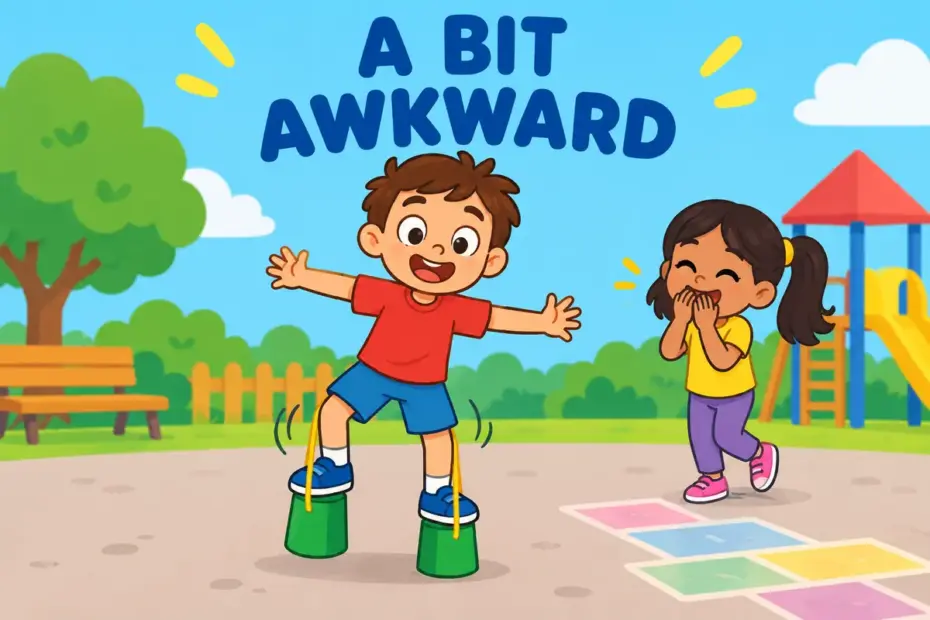
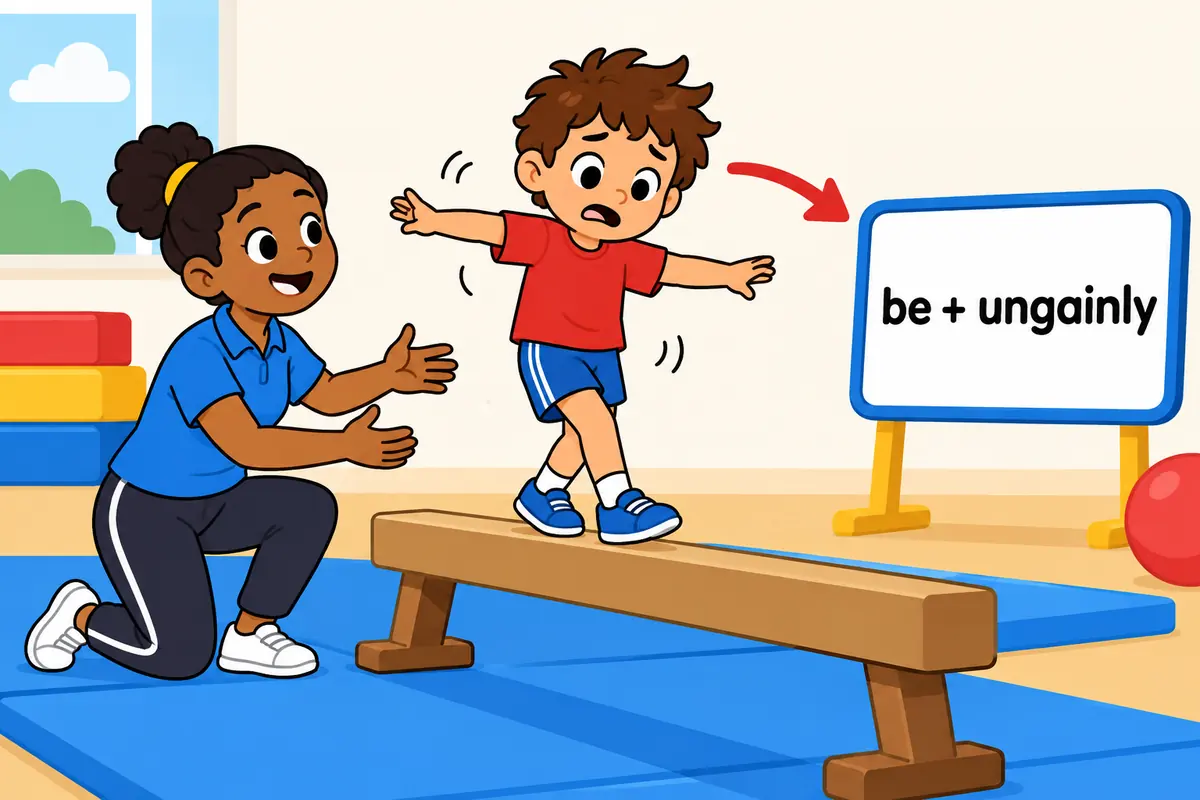
Ungainly means awkward and lacking grace in the way something moves, stands or is shaped. To use ungainly in a sentence, describe what a reader can see: “The long table looked ungainly in the small room.” The adjective points at visible awkwardness, not at carelessness or incompetence.
Ungainly at a glance
- Ungainly is an adjective; its noun is ungainliness, and it has no standard adverb of its own.
- The dominant pattern is be or look ungainly, or an ungainly + noun.
- It describes visible awkwardness of movement, build or shape rather than behaviour.
- Common collocations are an ungainly walk, an ungainly machine and ungainly proportions.
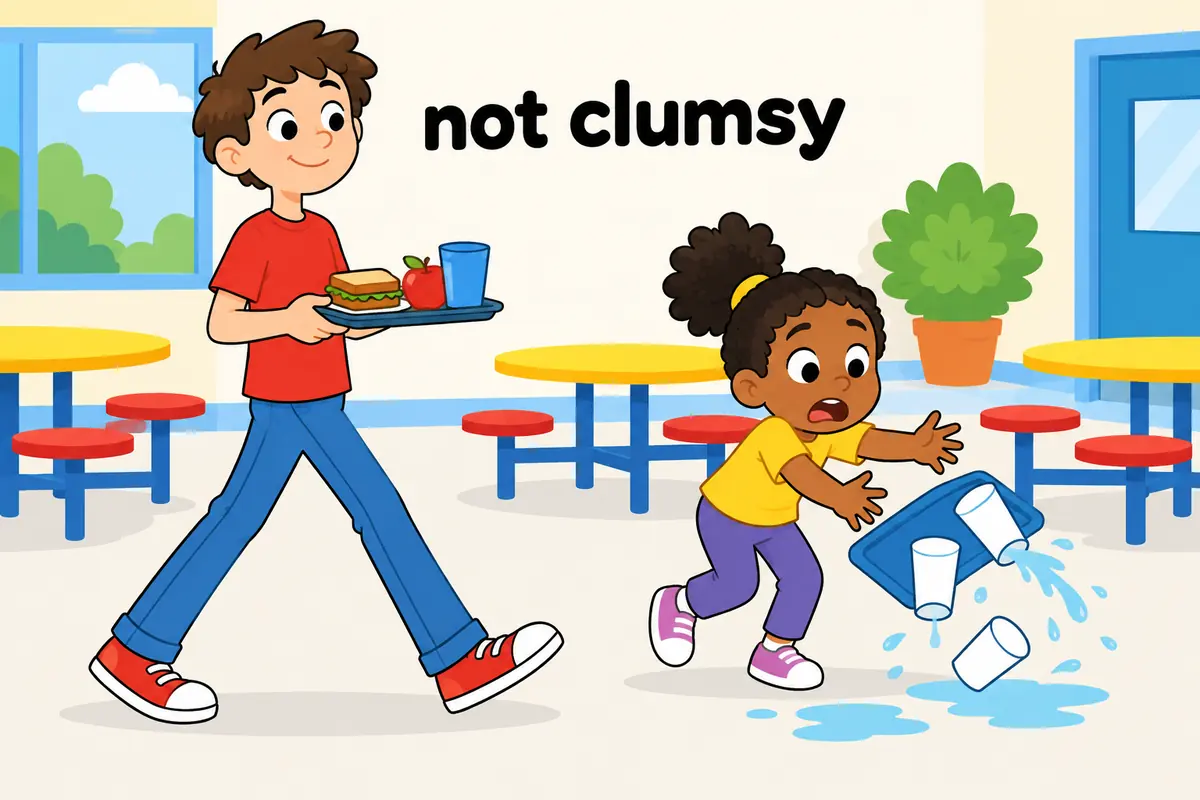
- The commonest error is using ungainly for a person who drops things, where clumsy is the right word.
What does ungainly mean?
Ungainly is an adjective meaning awkward and without grace in movement, shape or appearance. The Cambridge entry for ungainly joins the ideas of awkwardness and lack of elegance, and both senses follow the same grammar. The table separates the sense used of living things from the one used of objects.
| Sense | Plain meaning | Example sentence |
|---|---|---|
| Awkward in movement | Moves without ease or balance | The young colt was ungainly for a few weeks. |
| Cumbersome in shape | Looks heavy, clumsy or badly proportioned | An ungainly crane blocked the whole lane. |
One limitation is worth stating plainly. Ungainly describes what can be seen, not what a person is like. A dancer can be ungainly out of practice and graceful on stage, and a machine can be ungainly and still work perfectly. Where the awkwardness is a matter of bumping into things, awkward and clumsy are the closer words.
How do you use ungainly in a sentence?
Ungainly follows be, look or become, or sits before a noun, and it never needs a preposition unless you name what is awkward about the subject. Five patterns cover almost every real sentence.
| Pattern | Example | What it signals |
|---|---|---|
| be + ungainly | The old bus was slow and ungainly. | A general judgement of awkwardness. |
| an + ungainly + noun | An ungainly staircase twisted up the tower. | The adjective before the thing itself. |
| be + ungainly + in + noun | He was ungainly in his new uniform. | Names the setting that exposes the awkwardness. |
| grow or become + ungainly | The puppy grew ungainly almost overnight. | Awkwardness that arrives with size. |
| look + ungainly | The design looks ungainly from behind. | An impression rather than a fact. |
Writers describing a heavy, slow sort of awkwardness often reach for lumbering, which adds weight and noise to the picture, while ungainly stays with shape and balance.
Ungainly in a sentence: examples across contexts
Ungainly changes company more than it changes meaning. The nine sentences below keep the same adjective while moving from a farmyard to a design review, and each names what the reader is meant to picture.
| Context | Example sentence | Why this works |
|---|---|---|
| Classroom | The new desks were too tall and looked ungainly in rows. | Names the feature that makes them awkward. |
| Farm and nature | The foal was ungainly until its legs caught up with its body. | Explains the awkwardness as temporary. |
| Sports writing | His ungainly stride still carried him past the whole field. | Contrasts awkward looks with real speed. |
| Engineering | An ungainly gantry had to be dismantled after the bridge opened. | Applies the word to a structure, not a person. |
| Design review | The prototype works but looks ungainly from the side. | Separates function from appearance. |
| Dance class | Beginners feel ungainly before the steps become automatic. | Uses the word for a feeling in the body. |
| Nature writing | The heron took off with an ungainly flap. | The movement is awkward yet effective. |
| Conversation | I felt ungainly in borrowed skates. | The first person and the everyday register. |
| Architecture | Critics called the extension ungainly beside the old stone front. | Reports a judgement about proportion. |
Ungainly vs clumsy
Ungainly and clumsy are often used as twins, but one is about how something looks or moves and the other is about getting things wrong. The table separates the attributes that change the choice.
| Attribute | ungainly | clumsy | gawky |
|---|---|---|---|
| Core idea | Lacks grace of form or movement | Prone to mishaps and mistakes | Tall and awkward, especially young |
| Describes | Movement, build, objects | Actions and handling | A growing person |
| Implies incompetence | No | Often | No |
| Tone | Neutral, sometimes fond | Critical | Fond or mildly teasing |
| Typical subject | A crane, a walk, proportions | A waiter, a pass, a apology | A teenager, a foal |
Verdict: choose clumsy when something is dropped, fumbled or done badly, ungainly when the problem is the look or balance of the thing itself, and gawky for a tall young person who has not grown into their frame. Where a word is needed for a person who is both tall and awkward, gangly covers the same ground informally.
Word forms and grammar of ungainly
Ungainly is settled as an adjective, and the forms built from it are limited. The table lists what exists and marks what learners invent.
| Form | Part of speech | Example |
|---|---|---|
| ungainly | adjective | An ungainly ladder leaned against the wall. |
| ungainliness | noun | Critics noted the ungainliness of the new wing. |
| ungainlily | non-standard adverb | Use awkwardly or ungracefully; ungainlily is not English. |
| ungainlyness | non-standard noun | Use ungainliness, formed with -ness from -ly, with no extra n. |
Because ungainly already ends in -ly, writers sometimes mistake it for an adverb and produce forms such as she danced ungainly. The adjective is correct after a linking verb and awkwardly or ungracefully does the adverb work.
Common mistakes with ungainly
- Incorrect:
He is very ungainly with a hammer.Correct: He is very clumsy with a hammer. Rule: Clumsy covers mishaps; ungainly describes visible awkwardness of movement or shape. - Incorrect:
She walked ungainly down the aisle.Correct: She walked ungracefully down the aisle. Rule: Ungainly is an adjective, so it cannot modify a verb. Use ungracefully or awkwardly. - Incorrect:
His ungainlyness was obvious to everyone.Correct: His ungainliness was obvious to everyone. Rule: The noun is ungainliness, and the double n is wrong. - Incorrect:
The ungainly of the tower surprised us.Correct: The ungainliness of the tower surprised us. Rule: Ungainly is an adjective and never a noun. - Incorrect:
An ungainly chef dropped every plate.Correct: A clumsy chef dropped every plate. Rule: Dropping things is clumsiness; ungainly is about how something looks or moves.
Practice using ungainly
Work through the six items, then read the reason beside each answer rather than only the key.
- Fill the gap: The young giraffe looked ______ beside the neat fence.
- Choose the better word: He is a careful worker but rather (ungainly / clumsy) with a full tray.
- Correct the error: The robot moved ungainly across the floor.
- Build a sentence: use an ungainly about a piece of classroom furniture.
- Spot the register: which belongs in a formal design report — the wing looks ungainly against the old stone, or the wing looks well awkward next to the old stone?
- Rewrite with the noun: The staircase was ungainly. Use ungainliness instead.
Answers
- ungainly — the adjective follows look and describes the animal’s awkward shape.
- clumsy — a full tray points to mishaps, which is clumsiness rather than lack of grace.
- The robot moved ungracefully across the floor — the adverb is ungracefully, since ungainly is an adjective.
- Model answer: An ungainly bookcase stood in the corner of the classroom.
- The wing looks ungainly against the old stone — a formal report avoids well awkward.
- The ungainliness of the staircase was obvious — the noun names the quality.
The bottom line
Use ungainly in a sentence when you want to describe visible awkwardness of movement, build or shape, and keep clumsy for the person who drops and fumbles things. The two nuances that decide most sentences are these: ungainly is an adjective with no adverb of its own, and it passes no judgement on competence. Where a tall young person is the subject and the tone is fond, gawky is the friendlier choice.
Frequently asked questions about ungainly
Is ungainly formal or literary?
It sits in neutral to formal written English and appears often in nature writing, sports reports and design criticism. It is not archaic and not especially literary. In casual speech most people say awkward or clumsy instead, so ungainly can sound a little careful or deliberate when spoken aloud.
Does ungainly describe people or things?
Both. It can describe a person’s walk or build, an animal learning to move, or an object such as a crane, a staircase or a machine. The sense stays the same in each case: a lack of grace in how the thing looks, stands or moves rather than in what it does.
Can ungainly mean the same as clumsy?
Only loosely. Clumsy suggests a tendency to drop, bump or fumble, and it usually criticises. Ungainly simply says the movement or shape lacks grace and can even sound affectionate about a growing animal. A graceful dancer can still be clumsy with a hammer, and a clumsy person can have a graceful walk.
What is the noun for ungainly?
The noun is ungainliness, as in critics noted the ungainliness of the new wing. There is no standard adverb, so sentences that need one use awkwardly or ungracefully. Because ungainly already ends in -ly, learners sometimes mistake it for an adverb and write walked ungainly, which is wrong.
Do you ever find yourself using awkward or clumsy phrases that just don’t flow well in your writing? These sentences may come off as unpolished or unrefined, lacking the grace and fluidity needed to effectively convey your ideas. This is where the use of “ungainly” sentences comes into play.
When a sentence is described as “ungainly,” it means that it is awkwardly or clumsily constructed, hindering the overall readability and impact of your writing. These sentences can disrupt the flow of your ideas and make it challenging for readers to fully comprehend your message.
7 Examples Of Ungainly Used In a Sentence For Kids
- The ungainly elephant tried to balance on one leg.
- The ungainly ostrich waddled awkwardly on the sand.
- The ungainly giraffe tried to reach the tree’s leaves.
- The ungainly penguin slipped and slid on the ice.
- The ungainly bear stumbled over its own feet.
- The ungainly octopus struggled to move gracefully.
- The ungainly frog leaped with a big splash.
14 Sentences with Ungainly Examples
- Ungainly heaving around a heavy backpack can strain your back muscles, so it’s important to pack light.
- It can be quite ungainly trying to balance a plate of food while standing in a crowded hostel cafeteria.
- Ungainly handwriting in your notes can make it difficult to study and revise effectively.
- Walking in ungainly flip-flops during the monsoon season can lead to slipping and falling on slippery floors.
- Juggling multiple textbooks and notebooks can result in an ungainly pile of belongings at the library desk.
- Wearing oversized hoodies and baggy pants can sometimes make you look ungainly and unkempt in college.
- Trying to fit into a cramped lecture hall desk can sometimes lead to an ungainly seating position.
- Tangled earphone wires can be quite ungainly and frustrating to deal with during a crowded bus ride.
- An ungainly attempt to participate in a dance performance without prior practice can result in a lackluster performance.
- Fumbling with keys while searching for the right one can be ungainly and time-consuming, especially when running late for a class.
- Carrying a cumbersome umbrella in strong winds can lead to an ungainly battle to keep it from flipping inside out.
- Wearing ill-fitting or oversized shoes can make you walk ungainly and increase the risk of tripping or stumbling.
- Aiming for a basketball shot with an ungainly shooting form can lead to missed opportunities on the court.
- Holding a stack of heavy textbooks in an ungainly armful can be tiring and strain your muscles over time.
How To Use Ungainly in Sentences?
To properly use the word Ungainly in a sentence, you must understand its meaning. Ungainly is an adjective used to describe something or someone as awkward, clumsy, or lacking in grace. When incorporating this word into your sentences, it is important to consider the context in which it is used.
Here is an example sentence that illustrates the use of Ungainly:
– “Despite her best efforts, Sarah felt ungainly as she attempted to navigate the crowded dance floor in her high heels.”
As you can see in the sentence above, Ungainly is used to describe how Sarah felt while trying to move gracefully on the dance floor. You can use it to describe a person’s physical movements, their behavior, or even the appearance of an object that seems awkward or lacks finesse.
When using Ungainly in a sentence, it is essential to ensure that it fits the context and enhances the description of what you are trying to convey. By incorporating this word thoughtfully into your writing or speech, you can help paint a clearer picture for your audience.
Practice using Ungainly in various sentences to become more comfortable with its usage and to improve your overall vocabulary skills.
Conclusion
In conclusion, sentences with ‘ungainly’ depict awkward and clumsy expressions that lack grace or fluidity in their structure. The use of ‘ungainly’ in sentences underscores elements that are inelegant or cumbersome, often emphasizing a lack of finesse or agility in language. These sentences serve as a reminder of the importance of clarity and precision in communication, highlighting the impact of awkward phrasing on effective expression.
Overall, sentences with ‘ungainly’ draw attention to the need for thoughtful construction and careful consideration in writing to avoid cumbersome or awkward language. By recognizing and correcting instances of ‘ungainly’ sentences, writers can refine their communication skills, enhancing the readability and impact of their writing.


