Unify means to join separate parts into one or to make them consistent with each other. To use unify in a sentence, name the parts and the whole they form: “The coach unified the squad.” The verb is transitive, so it always needs a person, group or system to act on.
Unify at a glance
- Unify is a transitive verb; its forms are unify, unifies, unified and unifying.
- Its noun is unification and its adjective is unified.
- The two senses are joining parts into one and making things consistent.
- Typical subjects are a leader, a treaty, a standard or a shared goal.
- Unify is neutral to formal and common in politics, sport and technology.
- The commonest error is confusing unify with unite, which stresses coming together.
What does unify mean?
Unify is a transitive verb meaning to bring separate parts together into a single whole, or to make them consistent. The Cambridge entry for unify keeps both senses. In everyday writing, combine the two lists is the plainer choice for the first sense, and merge suits two things that become one.
| Sense | Plain meaning | Example sentence |
|---|---|---|
| Bring together | Join separate groups into one | The new leader unified the rival factions. |
| Make consistent | Bring different systems into line | The company unified its payment rules. |
| Create one whole | Combine parts into a single unit | One anthem unified the crowd. |
| Rally behind a cause | Give a group a single purpose | The emergency unified the whole neighbourhood. |
One limitation is worth stating plainly. Unify does not mean to win people over or to erase differences; it means parts are made to work as one, and a sentence that hides who is doing the joining loses its subject. It also says nothing about how willing the parts were, which is why a forced merger can be described as a unification.
How do you use unify in a sentence?
Unify takes a direct object, so the parts being joined appear after the verb. The passive is common when the agent is unknown or unimportant, as in the provinces were unified in 1861. The pattern matters because unite and merge stress the opposite direction.
| Pattern | Example | What it signals |
|---|---|---|
| subject + unify + group | A shared threat unified the towns. | Names the force and the group it joins. |
| subject + unify + system | The board unified the two databases. | The consistency sense applied to things. |
| be unified | The states were unified after the war. | Passive; the agent is left unstated. |
| unify + plural noun | The teacher unified the two classes. | A plural object shows what was joined. |
| unify + around/behind + noun | The party unified around a new plan. | Prepositional pattern for shared support. |
| unify + under + a leader | The provinces were unified under one crown. | An under-phrase names the single head. |
Unify in a sentence: examples across contexts
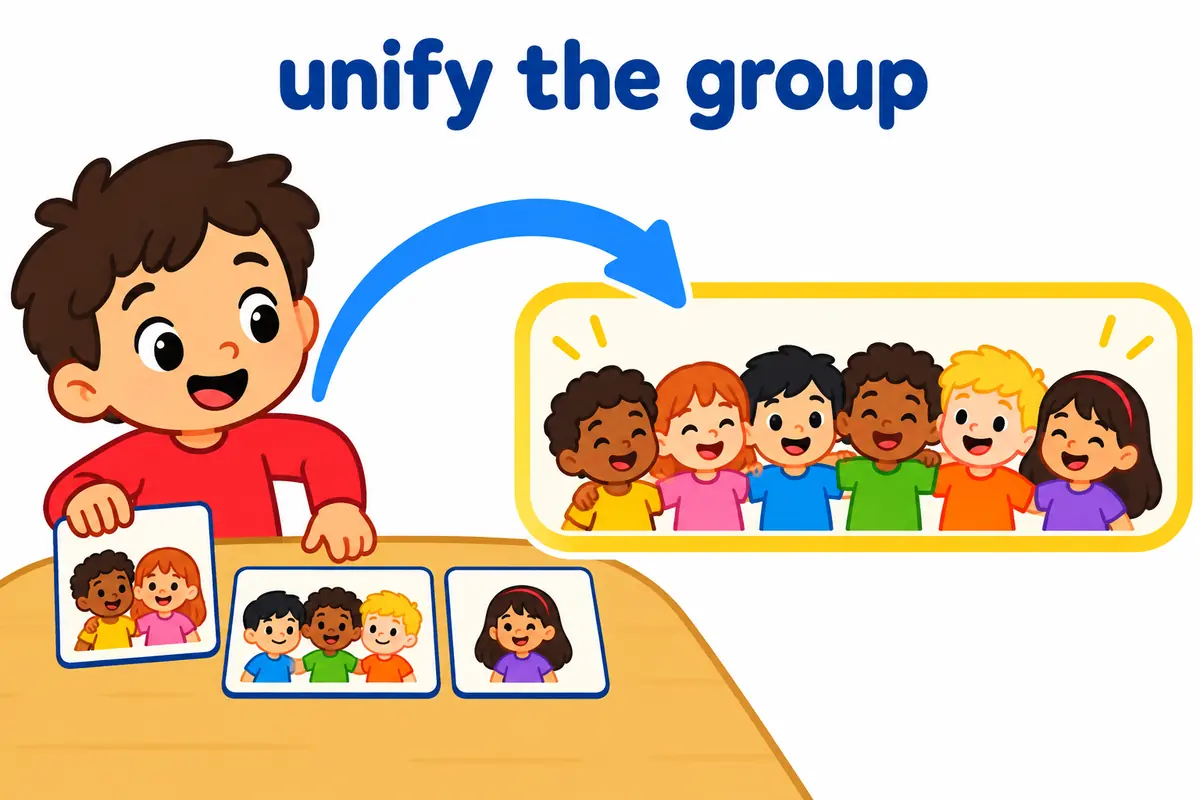
Unify appears wherever separate things are made to work as one, from a football club to a database. The twelve sentences below keep the verb while moving between registers. To make a position stronger by joining, writers often choose consolidate their position, and to fit parts into an existing whole they choose integrate new staff. Each sentence names both the force and the parts it brings together, because the verb is transitive and needs an object.
| Context | Example sentence | Why this works |
|---|---|---|
| Politics | The treaty unified the two rival states. | The agent is the agreement, which keeps the sentence formal. |
| Sport | A new captain unified a divided dressing room. | The subject is a person who brings others together. |
| Technology | The company unified its three login systems. | The consistency sense applied to technical things. |
| Education | The head teacher unified the two year groups for the project. | A plural object shows what was joined. |
| Business | One brand design unified every regional office. | A standard as subject is the classic consistency pattern. |
| Science | A single theory unified the scattered observations. | An abstract subject suits academic writing. |
| Religion | The council unified the two congregations under one roof. | A body as agent keeps the register formal. |
| Music | The chorus unified the singers and the crowd. | Shows joining people through a shared moment. |
| History essay | The provinces were unified in 1861. | Passive voice when the agent matters less than the result. |
| Community | The flood unified neighbours who had barely spoken. | A shared event as the unifying force. |
| Conversation | A common goal unified the whole team. | Everyday speech keeps the object simple. |
| Grammar | The editor unified the spellings across the book. | Consistency applied to small written details. |
| Manufacturing | The group unified its safety rules across every plant. | Consistency applied to shared standards. |
| Local news | A new footbridge unified the two halves of the village. | A physical object as the unifying agent. |
| Finance | The bank unified its two currencies into one account. | Joining concrete things into a single unit. |
| Sport reporting | A late equaliser unified players and supporters alike. | An event that brings separate groups together. |
Unify vs unite
Unify and unite overlap, and the choice depends on whether a single person or event does the joining. Unify tends to be top-down and focused on the resulting whole; unite tends to describe people coming together by mutual feeling.
| Attribute | unify | unite |
|---|---|---|
| Core idea | Make separate parts one consistent whole | Come or bring together in agreement |
| Emphasis | The whole that results | The act of joining |
| Typical subject | Leader, standard, policy | Cause, feeling, threat |
| Object | Systems, groups, rules | People, parties, efforts |
| Direction | Often top-down | Often mutual |
| Register | Formal and technical | Neutral and emotional |
Verdict: choose unify when something is made into one consistent whole, and unite when people or groups come together, especially for a shared cause. A government unifies a school system; its citizens unite in support of it.
Word forms and grammar of unify
Unify is regular, and its family fills political and technical writing. The table lists the forms and one look-alike to avoid.
| Form | Part of speech | Example |
|---|---|---|
| unify | verb, base | A single exam board will unify the rules. |
| unifies | present, third person | The anthem unifies the crowd. |
| unified | past and past participle | The treaty unified the two regions. |
| unifying | present participle | A unifying idea held the coalition together. |
| unification | noun | Unification took a decade of talks. |
| unifier | noun, rare | The railway was the great unifier of the region. |
| deify | verb, different meaning | Say unify the provinces, not deify the provinces. |
Keep deify separate: it means to treat someone as a god, so it could never replace unify in a sentence about joining parts.
Common mistakes with unify
- Incorrect:
The treaty unified between the two regions.Correct: The treaty unified the two regions. Rule: Unify is transitive and takes the parts as its object. - Incorrect:
The two regions unified themselves.Correct: The two regions were unified by the treaty. Rule: Unify usually needs an outside agent, so the reflexive sounds odd. - Incorrect:
The city unified its rules to make them different.Correct: The city unified its rules to make them consistent. Rule: Unify means making things the same or compatible, not different. - Incorrect:
The manager unified around her team.Correct: The team unified around its manager. Rule: Unify takes the people being joined as the object, not the person they support. - Incorrect:
The reforms deified the provinces.Correct: The reforms unified the provinces. Rule: Deify means make a god of; the look-alike differs by one letter. - Incorrect:
The two systems unified together into one.Correct: The two systems were unified into one. Rule: Unify already contains the idea of one, so together is redundant. - Incorrect:
The new law unifies people to follow it.Correct: The new law unifies the regions. Rule: After unify comes the thing joined, not an infinitive clause.
Practice using unify
Work through the eight items, then read the answers for the reasoning rather than only the key.
- Fill the gap: The mayor promised to ______ the feuding districts.
- Choose the better word: Angry at the new tax, the farmers (unified / united) in protest.
- Correct the error: The new standard unifies to the formats.
- Build a sentence: use the passive be unified about two rival clubs.
- Spot the register: which belongs in a policy paper — the agency will unify the two systems, or the agency will smoosh the two systems together?
- Rewrite as a noun: The country was unified in 1861.
- Fill the gap: A common language ______ the many communities.
- Choose the better word: Historians (deified / unified) the two rival kingdoms under one crown.
Answers
- unify — a leader joins the districts into one, so the object is what gets joined.
- united — the farmers come together by their own feeling; unify would need someone doing the joining.
- The new standard unifies the formats — unify takes a direct object, not a to-phrase.
- Model answer: The two youth clubs were unified under a single coach.
- The agency will unify the two systems — the other option uses slang.
- The country’s unification came in 1861 — the noun needs an article or possessive.
- unifies — the language is the force that makes the communities one.
- unified — the crowns join the kingdoms; deified would mean worshipped as gods.
The bottom line
Use unify in a sentence when separate parts are made into one whole or made consistent, and name the parts as the object. Two details decide most sentences: the verb is transitive, so it needs something to act on, and unite is the better choice when people come together by mutual feeling. The noun is unification, and the adjective is unified.
Frequently asked questions about unify
Is unify the same as unite?
They overlap but differ in emphasis. Unify stresses making parts into one consistent whole, often from above, as when a board unifies rules. Unite stresses people or groups coming together, often by shared feeling. A single leader can unify; a crowd usually unites.
What is the noun of unify?
The noun is unification, and the adjective is unified. Unification names the process, as in the unification of the two systems, while unified describes the result, as in a unified standard. Both are regular forms built from the same root.
Does unify always need an object?
Unify is transitive, so it always takes an object except in the passive, where the object becomes the subject. Write the leader unified the party or the party was unified, never simply the party unified. A missing object is the commonest learner error with this verb.
What is the difference between unify and deify?
Unify means to join parts into one; deify means to treat someone as a god. The two words differ by a single letter, so they are easily confused in writing. If the sentence is about joining groups or systems, unify is the correct verb.