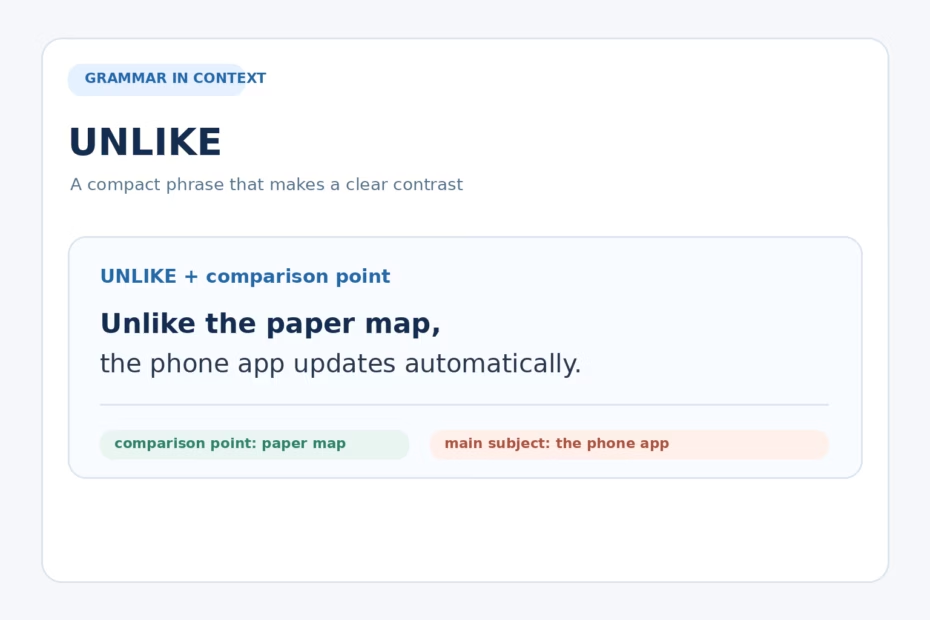
Unlike means “different from” and introduces the person, thing, or activity being contrasted. In a sentence, it is usually followed by a noun phrase, an object pronoun, or an -ing phrase: Unlike her brother, Maya prefers tea; Unlike driving, cycling keeps you outdoors. If you want to put a complete clause after the contrast marker, use whereas or while: Whereas Maya prefers tea, her brother orders coffee.

What does unlike mean?
Unlike has two closely related uses. It can describe a difference (The new model is unlike the old one) or introduce a contrast (Unlike the old model, the new one has a longer battery life). Oxford Learner’s Dictionaries lists both meanings under the preposition and also notes the pattern It is unlike him to be late, meaning that being late is not typical of him.
In the common sentence pattern, unlike is a preposition. The phrase after it is the comparison point; it does not by itself make a second clause. This is why Unlike her, I work from home is standard, while Unlike she works from home, I commute is not the usual construction. Write Whereas she works from home, I commute to compare two complete clauses.
Three useful patterns with unlike
| Pattern | Example | What it contrasts |
|---|---|---|
| Unlike + noun phrase | Unlike the first draft, the revision states its main point clearly. | Two things |
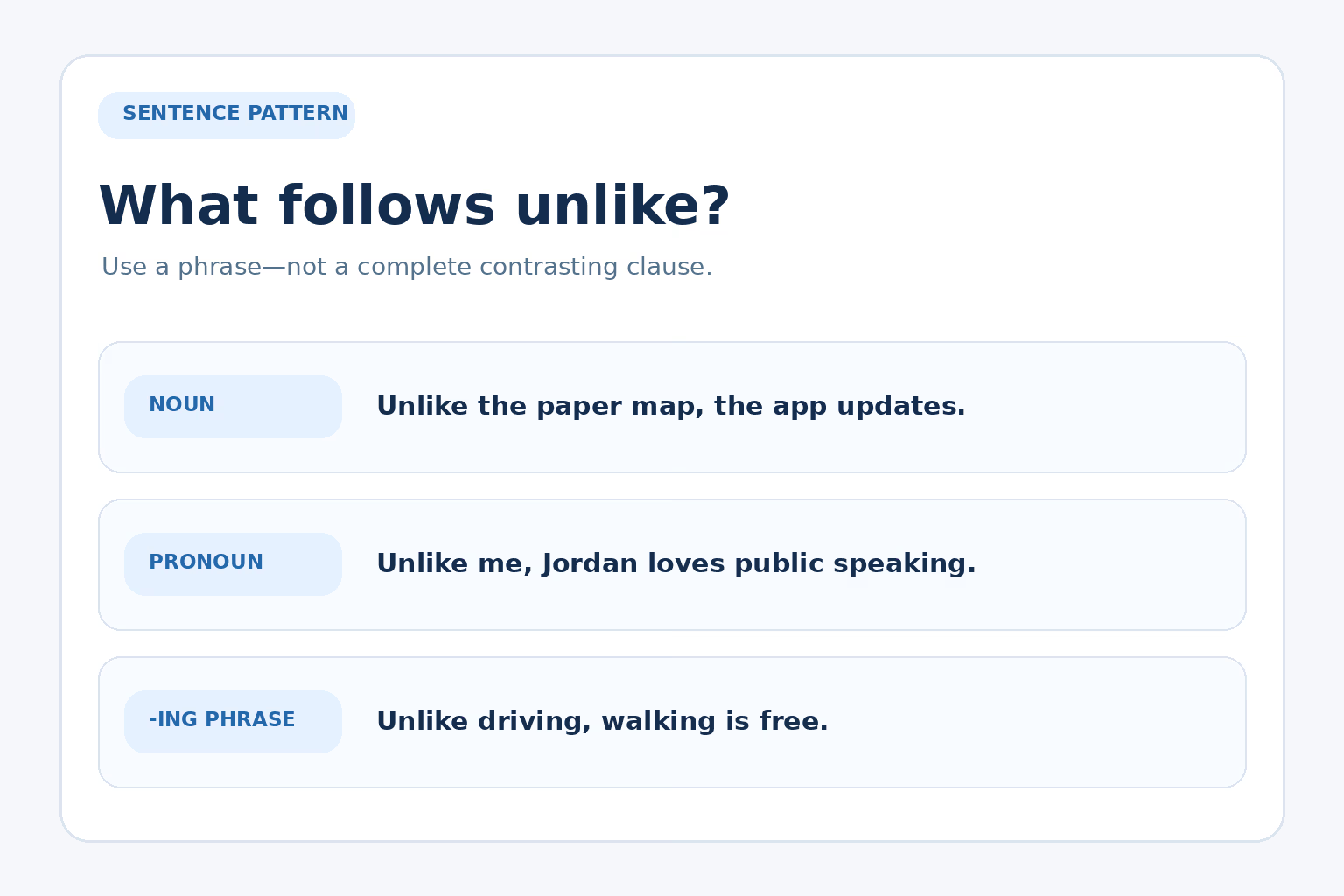
| Unlike + object pronoun | Unlike me, Jordan enjoys speaking in front of a crowd. | Two people |
| Unlike + -ing phrase | Unlike taking a taxi, walking costs nothing. | Two activities |
| Noun or pronoun + be + unlike + noun phrase | This winter is unlike the mild one we had last year. | A quality or situation |
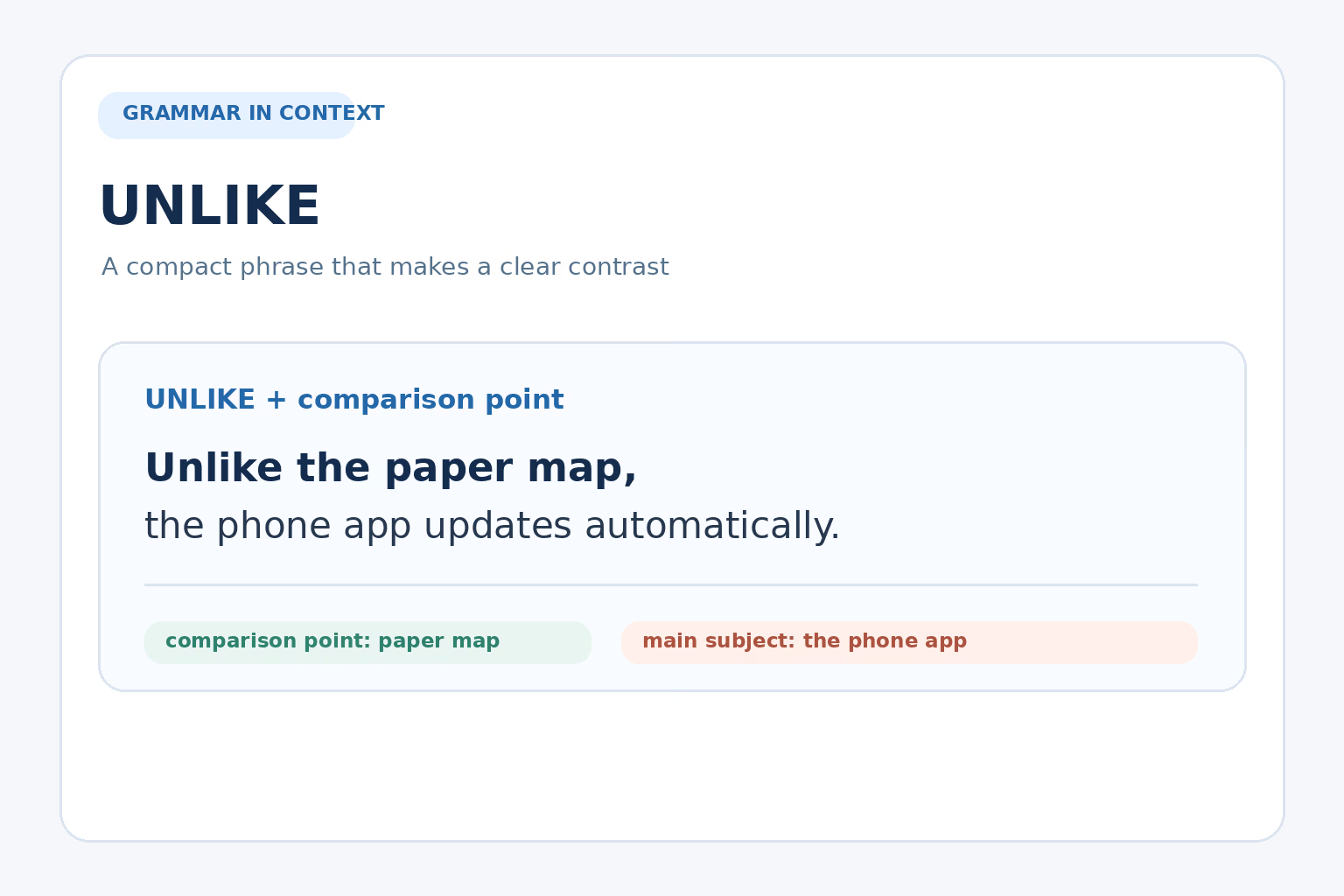
For the first three patterns, put the contrasting phrase before a comma and then state the main subject: Unlike the printed map, the phone app updates automatically. You can also place the phrase later: The phone app, unlike the printed map, updates automatically. The commas set off the interruption in that version.
Unlike me or unlike I?
When unlike is followed directly by a personal pronoun, use the object form: me, him, her, us, or them. The pronoun is the object of the preposition:
- Unlike me, Alina likes spicy food.
- Unlike him, his teammates arrived early.
- Unlike us, the neighbors have a garden.
Use a subject pronoun when it is the subject of its own clause after whereas or while: Whereas I like spicy food, Alina prefers mild dishes. The difference is about the pronoun’s job, not about formality.
Unlike vs. whereas and while
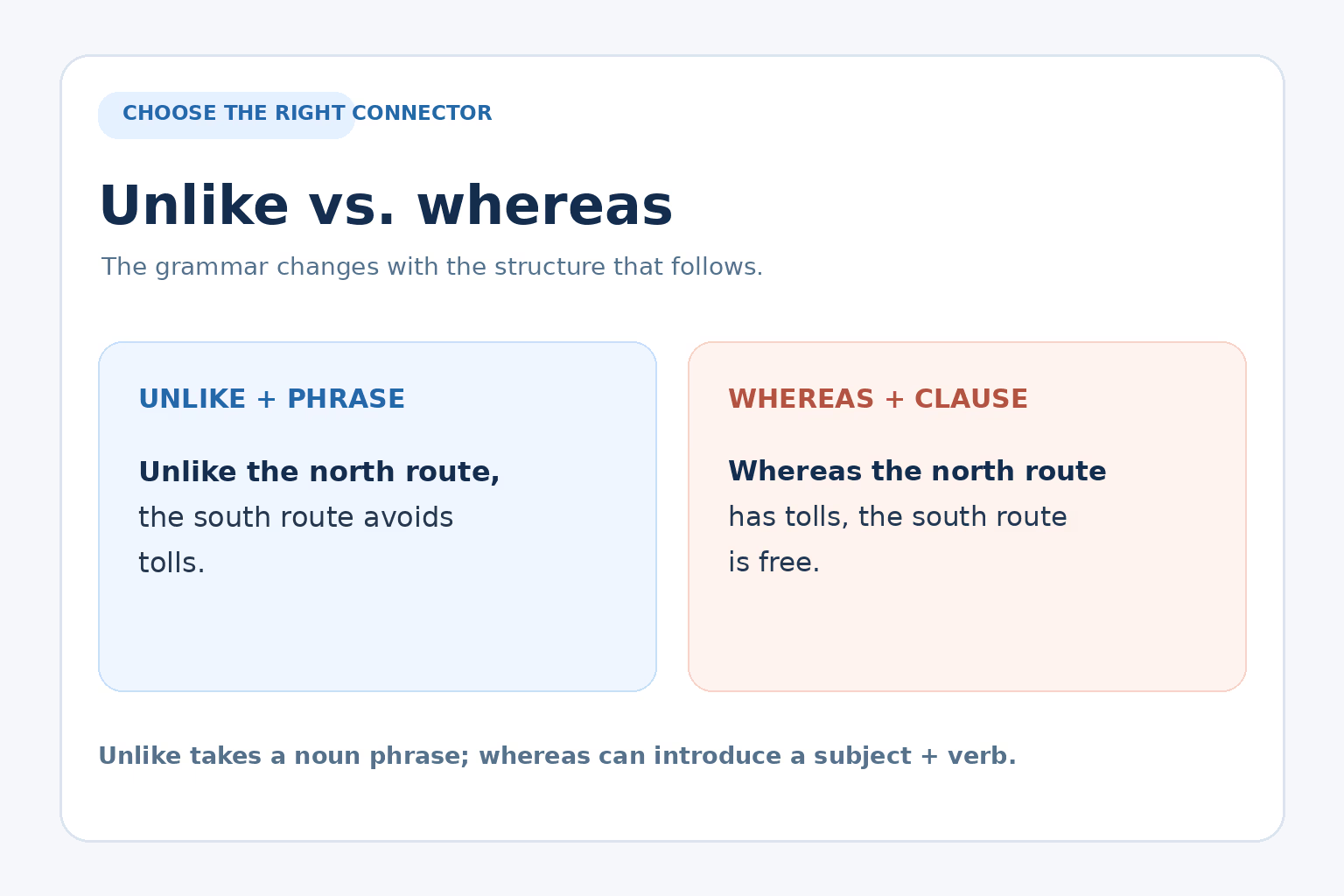
Choose unlike when a compact phrase is enough. Choose whereas or while when you want to give each side its own subject and verb.
| Use | Example |
|---|---|
| Unlike + phrase | Unlike the north route, the south route avoids tolls. |
| Whereas + clause | Whereas the north route has tolls, the south route is free. |
| While + clause | While my sister likes crowded beaches, I prefer quiet coves. |
While can also mean “during the time that,” so make the contrast clear from context. In formal comparisons, whereas is often the more precise choice.
Punctuation and clear comparisons
When an opening unlike phrase leads into the main clause, a comma normally marks the end of that introductory phrase: Unlike the first plan, the revised schedule leaves time for lunch. If the phrase comes at the end, a comma is usually unnecessary: The revised schedule is unlike the first plan. A comma is not required immediately after the word unlike; place it after the whole introductory phrase.
Make sure the phrase after unlike can logically be compared with the subject of the main clause. In Unlike the old camera, Priya took better photos, the grammar seems to compare a camera with Priya. Revise it to Unlike the old camera, Priya’s new model takes sharper photos or Unlike the old camera, the new one takes sharper photos. This keeps the comparison parallel.
The adjective unlike can also follow a linking verb: The twins are unlike in temperament. Do not confuse it with alike, which means similar: The twins are alike in appearance but unlike in temperament.
Common mistakes with unlike
- Using a subject pronoun after the preposition: Prefer Unlike her, I prefer email, not Unlike she, I prefer email.
- Putting a full clause directly after unlike: Use Whereas the shop closes at six, the café stays open later, not Unlike the shop closes at six…
- Leaving the comparison unclear: Compare like with like: Unlike the older laptop, the new laptop runs quietly.
- Adding a comma after unlike by default: Keep the contrasting phrase together—Unlike the other option, this one is refundable.
- Confusing unlike and dislike: Unlike means different from; dislike means not to like. Unlike my brother, I dislike olives uses both words correctly.
Frequently asked questions
Can unlike start a sentence?
Yes. An opening phrase such as Unlike the paper version, the digital copy is searchable is a common way to foreground a contrast. Use a comma after the full introductory phrase.
Can unlike be followed by a verb?
It can be followed by an -ing form used as a noun phrase, as in Unlike swimming, running is easy to do anywhere. To contrast a full clause with its own subject and verb, use whereas or while.
Is “not unlike” the same as “unlike”?
No. Not unlike usually means “similar to” or “resembling,” often with a cautious tone: The pattern is not unlike a leaf’s branching veins. Plain unlike marks a difference.
What is a simple synonym for unlike?
Depending on the sentence, you can use different from, in contrast to, or as opposed to. Check the grammar around the replacement: Unlike her brother becomes In contrast to her brother, while whereas her brother prefers tea still needs a clause connector.
For dictionary definitions and additional usage examples, see Oxford Learner’s Dictionaries’ entry for unlike and the Cambridge Dictionary entry for unlike.
Do you know how to properly use the word “unlike” in a sentence? “Unlike” is a versatile term that is often utilized to highlight distinctions between various subjects or ideas.
It is commonly used to showcase differences in characteristics, actions, or qualities between two or more entities. The word “unlike” can be a powerful tool in expressing contrasting points or nuances in a clear and concise manner.
7 Examples Of Unlike Used In a Sentence For Kids
- Unlike apples, oranges are round in shape.
- I like the color blue, unlike my friend who prefers red.
- Unlike cats, dogs enjoy playing in water.
- Sam enjoys drawing, unlike Alex who likes to read books.
- Unlike winter, summer is hot and sunny.
- Unlike cars, bicycles do not have engines.
- Sarah is good at singing, unlike Tom who is good at dancing.
14 Sentences with Unlike Examples
- Unlike other countries, in India, college students often have to deal with intense competition for limited resources.
- Unlike some universities, the college campus provides a safe and inclusive environment for all students.
- Unlike high school, college students have more freedom to choose their courses and schedules.
- Unlike traditional classrooms, online lectures offer more flexibility for students to study at their own pace.
- Unlike in the past, college students now have access to a variety of digital tools and resources to aid in their studies.
- Unlike some colleges, ours offers a wide range of extracurricular activities to cater to varied interests.
- Unlike other professions, the field of academia requires continuous learning and research to stay updated.
- Unlike in some countries, students in India often face societal pressure to pursue a certain career path.
- Unlike some colleges, ours has a strong emphasis on practical, hands-on learning experiences.
- Unlike in other academic systems, the grading system in India is often based on a percentage scale.
- Unlike in high school, college students are expected to take more responsibility for their own learning and success.
- Unlike in some courses, ours encourages active participation and discussion in the classroom.
- Unlike in some colleges, our campus offers a range of affordable food options for students to choose from.
- Unlike in some educational institutions, our college has a dedicated career counseling center to guide students in their professional endeavors.
How To Use Unlike in Sentences?
Unlike is used to show the contrast or difference between two or more things in a sentence. Here is a guide on how to use unlike effectively in a sentence:
-
Positioning: Unlike is commonly used at the beginning of a sentence to set up the contrast between two subjects. For example: “Unlike her sister, Lily prefers tea over coffee.”
-
Followed by subjects: After using unlike, it is essential to follow it with the subjects that are being compared. For example: “Unlike cats, dogs are known to be more loyal.”
-
Use of comma: It is common to use a comma after unlike when setting up a comparison between two elements. For example: “Unlike in the past, technology has made communication easier.”
-
Use in questions: Unlike can also be used in questions to inquire about a difference. For example: “Unlike last year, will you be attending the company picnic this time?”
-
Variety in use: Don’t hesitate to use unlike in various situations to highlight differences between people, objects, ideas, or actions.
By following these guidelines, you can effectively incorporate unlike into your sentences to emphasize differences and create more dynamic and engaging writing.
Conclusion
In writing, sentences with “unlike” are used to highlight differences between two or more subjects. These sentences draw attention to distinctions, aiding readers in understanding comparisons more effectively. By using “unlike” in sentences, writers can provide clarity and depth to their writing, emphasizing contrasts and showcasing unique characteristics of various subjects.
Overall, sentences with “unlike” play a crucial role in conveying comparisons in a clear and concise manner. They serve as valuable tools for writers seeking to elucidate differences between subjects, allowing for a more structured and coherent presentation of contrasting ideas or characteristics.


