Unprecedented means never having happened or existed before, so it describes something with no earlier example. To use unprecedented in a sentence, place it before the noun it describes: “The town recorded unprecedented rainfall in March.” The adjective asserts that no precedent exists, which is a strong claim to earn.
Unprecedented at a glance
- Unprecedented is an adjective; unprecedentedly is its adverb and unprecedentedness a rare noun.
- It almost always sits immediately before the noun it describes, as in unprecedented demand.
- The usual nouns are event, level, scale, demand, growth and rainfall.
- It belongs to news, reports and formal analysis rather than casual talk.
- The commonest error is treating a merely rare event as unprecedented when a precedent exists.
What does unprecedented mean?
Unprecedented is an adjective meaning never having happened or existed before. The Cambridge entry for unprecedented ties it to things with no earlier example. Three shades sit under that single idea: an event nobody has seen, a level nobody has reached, and something so new it is unique in kind. A merely unheard-of event is surprising, but unprecedented is the stronger claim.
| Sense | Plain meaning | Example sentence |
|---|---|---|
| Novel event | Something that has never happened | The summit ended with an unprecedented power cut. |
| Novel level | A scale or amount never reached | Demand hit unprecedented levels in December. |
| Novel method | A course of action never tried | The team ran an unprecedented joint rehearsal. |
One limitation matters more than any other. Unprecedented does not mean surprising, rare or unpredictable; it means that no earlier example exists, so a single precedent disproves it. When something is only unusual, rare or striking is the honest word, because unprecedented overstates the evidence.
How do you use unprecedented in a sentence?
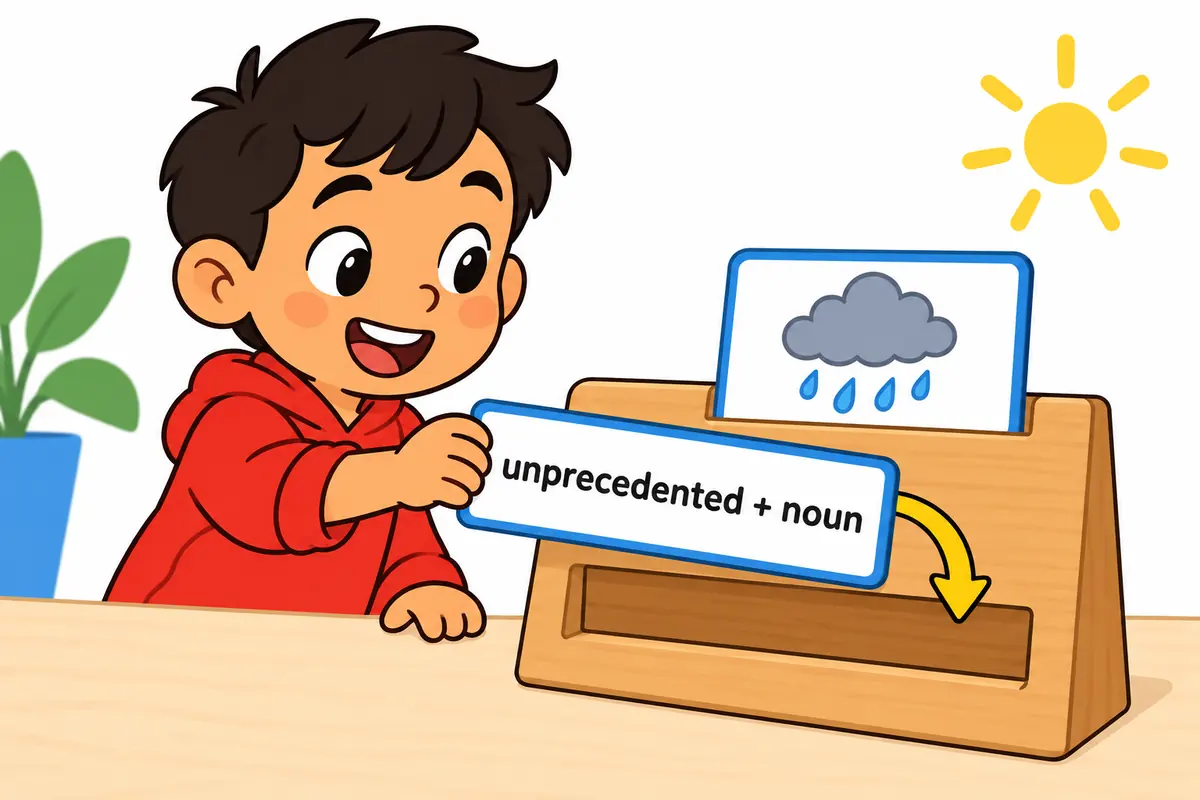
Attributive position carries almost every real use: unprecedented sits directly before the noun it describes. The adjective can also follow a linking verb as a subject complement, and it never takes a comparative form.
| Pattern | Example | What it signals |
|---|---|---|
| unprecedented + noun | The bridge closed after unprecedented snowfall. | The default form; the noun names what is new. |
| be + unprecedented | The silence in the chamber was unprecedented. | Predicate position; the subject is the topic. |
| unprecedented + in + noun | The move was unprecedented in scope. | Limits where the novelty lies. |
| unprecedented + since + time | Costs are unprecedented since records began. | Anchors the claim to a baseline. |
| unprecedentedly + adjective | The river rose unprecedentedly fast. | The adverb modifies another adjective. |
The adverb is the form learners miss. Writers say the river rose unprecedentedly fast, not the river rose unprecedented fast, because the adverb modifies the adjective that follows it rather than the noun.
Unprecedented in a sentence: examples across contexts
Unprecedented shifts topic more than register, because the claim must survive in every setting. The ten sentences below move from a weather bulletin to a conversation, and each names the thing that is new.
| Context | Example sentence | Why this works |
|---|---|---|
| Weather news | Storms dumped unprecedented rain on the coast this week. | Names the measurement the novelty applies to. |
| Business report | The plant reported unprecedented demand for spare parts. | The noun demand keeps the claim concrete. |
| Politics | The committee met during an unprecedented recess. | Anchors formal register to a specific noun. |
| Science writing | The telescope logged unprecedented data rates. | New records make no-precedent defensible. |
| Sports | The club won by an unprecedented margin. | Margin gives the scale readers can check. |
| Classroom | Our class saw unprecedented snow in April. | A concrete event a young reader can picture. |
| Legal writing | The statute created an unprecedented duty of care. | Formal register suits the making of new law. |
| History essay | The treaty set an unprecedented precedent for peace. | The noun pair stresses enduring newness. |
| Workplace email | We are seeing unprecedented wait times today. | Common in service updates that explain delays. |
| Conversation | Rain like this is unprecedented for June. | Informal, yet keeps the strong claim intact. |
Only the last sentence drops the noun-first pattern and lets the adjective stand after the verb. That is the form to reach for in speech, while reports keep the word tight against its noun.
Unprecedented vs extraordinary and unique
Extraordinary means remarkable or out of the ordinary, while unprecedented means there is no earlier example at all. Unparalleled means nothing matches it, and groundbreaking means it changes what comes next. The three overlap, but only unprecedented makes the never-before claim.
| Attribute | unprecedented | extraordinary | unique |
|---|---|---|---|
| Core claim | No earlier example exists | Remarkable, out of the ordinary | The only one of its kind |
| Strength | Strong; a precedent cancels it | Moderate; a matter of degree | Strong; a matter of category |
| Register | News and formal analysis | Neutral and everyday | Neutral |
| Works with ordinary nouns | Only when genuinely new | Freely | Often |
| Fails when | A precedent is found | Nothing fails; it is graded | Something identical appears |
Verdict: use unprecedented when you can defend never before, extraordinary for something merely remarkable, and unique when the point is one of a kind rather than first.
Word forms and grammar of unprecedented
Unprecedented builds on the noun precedent, and each form has a narrow job. The adjective is absolute, so it does not accept most or more.
| Form | Part of speech | Example |
|---|---|---|
| unprecedented | adjective | The delay was unprecedented. |
| unprecedentedly | adverb | Prices rose unprecedentedly fast. |
| unprecedentedness | noun, rare | Critics questioned the unprecedentedness of the claim. |
| precedent | noun, root | The ruling set a precedent. |
| unpresidented | non-standard spelling | No sentence: spell it unprecedented. |
Unprecedent is not a word, and the spelling unpresidented smuggles in president; both are errors. Because the adjective already means never before, adding most, more or very changes nothing and weakens the sentence.
Common mistakes with unprecedented
- Incorrect:
The heat was unprecedented hot.Correct: The heat was unprecedentedly hot. Rule: Before an adjective, the adverb unprecedentedly is required. - Incorrect:
This is the most unprecedented result yet.Correct: This is an unprecedented result. Rule: Unprecedented is absolute and has no comparative or superlative. - Incorrect:
It was unprecedented that no such thing had ever happened.Correct: It was unprecedented. Rule: The definition already means never before, so the clause repeats it. - Incorrect:
Sales were unprecedented last year and identical the year before.Correct: Sales were unprecedented last year. Rule: A matching earlier period is a precedent and cancels the claim. - Incorrect:
An unpresidented crowd arrived.Correct: An unprecedented crowd arrived. Rule: The word contains precedent, not president.
Practice using unprecedented
Work through the six items, then read the reason beside each answer rather than only the key.
- Fill the gap: The city opened extra shelters after ______ snowfall.
- Choose the better word: The team’s win was impressive, though a bigger one happened in 1999, so the result was (extraordinary / unprecedented).
- Correct the error: The crowd was unprecedented large.
- Build a sentence: use unprecedented levels about a river rising.
- Spot the register: which belongs in a news report — Officials reported unprecedented rainfall, or It was, like, so unprecedented?
- Rewrite with the adverb: The prices rose and the speed was unprecedented. Use unprecedentedly.
Answers
- unprecedented — snowfall is the noun that names what is new, and the word sits right before it.
- extraordinary — a bigger earlier win is a precedent, so the never-before claim of unprecedented is false.
- The crowd was unprecedentedly large — the adverb is needed before the adjective large.
- Model answer: The river reached unprecedented levels after three days of rain.
- Officials reported unprecedented rainfall — a news report keeps formal register and names the noun.
- The prices rose unprecedentedly fast — the adverb modifies fast, not the noun prices.
The bottom line
Use unprecedented in a sentence only when no earlier example exists, and place it directly before the noun that names what is new. The two nuances that decide most sentences are these: a single precedent cancels the claim, and the absolute adjective rejects comparatives such as most. Where a thing is merely remarkable, novel or extraordinary is the more precise word.
Frequently asked questions about unprecedented
Is unprecedented a formal word?
Unprecedented is standard rather than stiff, so it fits news writing, reports and essays, and it also appears in careful conversation. It is too weighty for a quick text about an ordinary surprise, where rare or unusual sounds more natural. The word carries no moral tone, because good, bad and neutral events can all be unprecedented.
What part of speech is unprecedented?
Unprecedented is an adjective, and it usually appears before the noun it describes. Its adverb is unprecedentedly, as in prices rose unprecedentedly fast, and its noun unprecedentedness is rare and mostly used in commentary. The root is the noun precedent, which names an earlier case that guides a later one.
Can you say most unprecedented?
No, most unprecedented is not standard. The adjective is absolute, meaning there is no earlier example at all, so it cannot be graded as more or most. A writer who wants emphasis should strengthen the noun instead, as in an unprecedented collapse, or choose a graded adjective such as extraordinary or remarkable.
Does unprecedented mean the same as unforeseen?
No. Unprecedented means no earlier example exists, while unforeseen means simply not predicted. An event can be foreseen and still unprecedented if it has never happened before, and it can be unforeseen yet familiar when something similar happened earlier. Keep the two claims apart when a sentence depends on proof.
Have you ever encountered a situation so unique, so unparalleled, that it could only be described as unprecedented? The word “unprecedented” is used to depict something that has never been witnessed or experienced before, setting it apart from all past occurrences.
In English language, “unprecedented” is used to emphasize the extraordinary nature of an event, situation, or phenomenon. It conveys the sense of incomparable novelty, making it a powerful term to describe groundbreaking developments or unforeseen circumstances.
7 Examples Of Unprecedented Used In a Sentence For Kids
- The unprecedented rain caused a big flood in the village.
- The unprecedented number of butterflies made the garden look beautiful.
- The unprecedented amount of snow made it difficult to walk outside.
- The unprecedented heat made everyone feel thirsty.
- The unprecedented number of stars in the sky looked magical.
- The unprecedented number of colors in the rainbow amazed us.
- The unprecedented number of birds chirping in the morning woke us up early.
14 Sentences with Unprecedented Examples
- This semester, the college is facing unprecedented challenges due to the sudden shift to online classes.
- The impact of the pandemic on campus life has been truly unprecedented.
- The number of students applying for internships this year is unprecedented.
- The college is implementing unprecedented safety measures to ensure students’ well-being.
- The opportunities for virtual networking events are unprecedented.
- This year’s graduation ceremony will be an unprecedented virtual event.
- The student council is organizing an unprecedented online talent show.
- The amount of study material available online is unprecedented.
- The college library is experiencing an unprecedented surge in e-book downloads.
- The level of collaboration among students during remote group projects is unprecedented.
- The technology available for virtual labs is unprecedented.
- The faculty is adapting to unprecedented teaching methods.
- The increase in online workshops and webinars is unprecedented.
- The college’s response to the crisis has been unprecedented.
How To Use Unprecedented in Sentences?
To use the word Unprecedented in a sentence, you can follow these simple steps:
-
Understand the meaning: Unprecedented is an adjective that is used to describe something that has never been done, seen, or experienced before. It signifies that the event or situation is unique and groundbreaking.
-
Context: Identify a situation that is truly extraordinary and has never occurred in the past. This could be a historical event, a technological advancement, or a significant change in society.
-
Sentence construction: Craft a sentence that conveys the exceptional nature of the event or situation. For example, “The global pandemic had an unprecedented impact on the economy, leading to widespread job losses.”
-
Review: Make sure that the sentence accurately captures the meaning of Unprecedented and highlights the novelty or rarity of the event being described.
-
Practice: Try using Unprecedented in different sentences to become more comfortable incorporating it into your vocabulary.
Remember, using Unprecedented can add depth and emphasis to your writing, making your descriptions more vivid and impactful. Enjoy experimenting with this powerful word in your sentences!
Conclusion
In conclusion, the examples of sentences with the keyword “unprecedented” highlight unique and unparalleled situations or events that have never been seen before. These sentences underscore the novelty and extraordinary nature of circumstances that break away from the usual or expected patterns. Whether describing a global pandemic, economic downturn, or technological breakthrough, the term “unprecedented” emphasizes the exceptional nature of these occurrences that challenge the norms and conventional wisdom.
By using “unprecedented” in sentences, we are able to convey the magnitude and significance of events that go beyond the norm, prompting us to rethink our understanding of the world we live in. These sentences serve as a reminder of the ever-evolving and unpredictable nature of our world, urging us to adapt, learn, and grow in the face of unprecedented challenges and opportunities.