Vapor vs vapour is not a choice of meaning but of spelling: American English writes vapor, while British and most Commonwealth English writes vapour. To use the word in a sentence, match the spelling to your readers and keep one form throughout a document. Both spellings name the same gaseous form of a substance.
Vapor and vapour at a glance
- Vapor and vapour are the same noun in two regional spellings, with no difference in meaning.
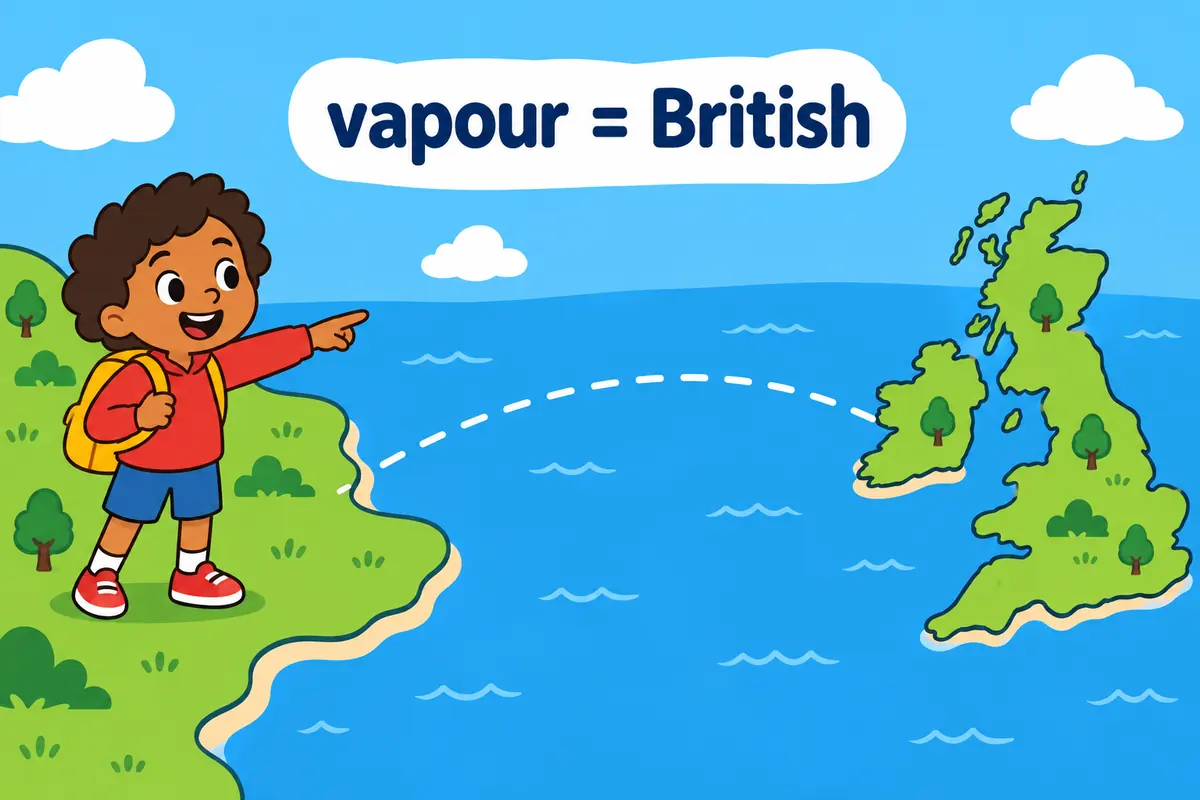
- American English uses vapor; British and most Commonwealth English uses vapour.
- The plural follows each spelling: vapors in the United States, vapours in Britain.
- Related forms split the same way, though British writing also accepts the -ize forms.
- The commonest error is mixing vapor and vapour inside one document.
What do vapor and vapour mean?
Vapor and vapour are nouns meaning a substance in a gaseous state, especially one formed from a liquid that has warmed. The Cambridge entry for vapor and the Cambridge entry for vapour give the same definition, which is the point: the two spellings differ only by region. A wisp above a hot drink is vapour, and the gas given off by petrol is vapor, yet the noun behind both is identical.
| Word | Region | Example sentence |
|---|---|---|
| vapor | American English | Water vapor filled the warm kitchen. |
| vapour | British and Commonwealth English | Water vapour filled the warm kitchen. |
| vapor / vapour | Both, in science writing | The vapour above the beaker condensed on the glass. |
One honest limitation belongs here. Vapor and vapour are not synonyms for steam or mist. Steam is hot water vapour, and mist is tiny liquid droplets, so a weather report says mist, while a science text says water vapour. The plural vapours also carries an old-fashioned sense of low spirits, which a modern sentence rarely wants.
Vapor vs vapour: spelling by region
Once you know the region, the choice is automatic. The table sets the two spellings side by side across the features that actually vary, so nothing is left to guesswork.
| Criterion | vapor | vapour |
|---|---|---|
| Main region | American English | British and most Commonwealth English |
| Meaning | A gaseous form of a substance | Exactly the same |
| Plural | vapors | vapours |
| Verb form | vaporize, vaporized | vaporise or vaporize; both accepted |
| Compounds | water vapor, vapor trail | water vapour, vapour trail |
| Register | Standard in US publishing | Standard in UK publishing |
| Style guides | Favoured by US manuals | Favoured by UK manuals |
| Example | The vapor rose from the cup. | The vapour rose from the cup. |
One careful point: British writing accepts both -ize and -ise endings, so vaporize is not wrong in Britain, but the -our spelling of the noun has no American rival. The split is firmest on the noun and looser on the derived verb.
Which should you use?
The audience decides, and the answer is never to mix them. The table maps the situations readers meet most often to a firm recommendation.
| Situation | Use | Reason |
|---|---|---|
| A school essay in Britain | vapour | The local convention is -our, and a teacher marking the work expects it. |
| A report for a US company | vapor | US house style drops the u, and internal documents follow it. |
| An international science journal | Follow the journal | Many journals set one spelling; check the style page before submitting. |
| A news site with mixed readers | vapor | US spelling dominates most online publishing and avoids stray marks. |
| A UK press release | vapour | British outlets and readers expect the -our form throughout. |
The verdict is simple: vapor for American readers, vapour for British and Commonwealth readers, and whichever the publication mandates when a house style overrides the region. Never place vapor and vapour in the same paragraph, because that reads as an error rather than a choice.
How do you use vapor and vapour in a sentence?
The grammar is the same for both spellings, so the only real decisions are the sense and the surrounding words. Five patterns cover the sentences you will meet, and the collocations show where each spelling belongs.
| Pattern | Example | What it signals |
|---|---|---|
| water + vapor / vapour | Water vapour forms when warm air cools. | The commonest collocation in science and weather writing. |
| vapor / vapour + rises, forms, condenses | The vapour condensed on the cold glass. | The noun acts as a subject with a physical process. |
| a cloud, plume or trail of vapor / vapour | A plume of vapor hung over the pool. | Describes a visible amount rather than a whole gas. |
| vapor / vapour pressure, phase, barrier | The vapour barrier keeps the wall dry. | Attributive use in technical compounds. |
| the vapors / vapours (archaic) | She was said to have the vapours. | An old sense of low spirits; rare and best avoided today. |
The word pairs naturally with the water cycle, so a sentence about evaporation will usually reach for vapor or vapour, while one about droplets on a window is describing condensation instead.
Vapor and vapour in a sentence: examples across contexts
The ten sentences below move from a science bench to a weather desk, and each one keeps a single spelling so the regional choice stays visible.
| Context | Example sentence | Why this works |
|---|---|---|
| Science lesson | Water vapour in the air cooled into tiny droplets. | UK spelling in a British classroom. |
| US lab report | Water vapor escaped through the loose seal. | US spelling in an American report. |
| Weather report | A band of vapour drifted in from the coast. | Describes a visible plume, not a whole gas. |
| Engineering note | Fit a vapour barrier behind the plaster. | Technical compound with the British spelling. |
| Chemistry text | The vapour pressure rose as the flask warmed. | Attributive use in a measured quantity. |
| Everyday scene | Vapour curled from the kettle spout. | A small, visible amount in plain description. |
| Energy writing | Captured vapor can drive a small turbine. | The US spelling in an industrial context. |
| Health advice | Warm vapour can ease a blocked nose. | A practical, non-technical use. |
| Travel writing | A thin vapour hung over the hot springs. | Sets a scene with the British spelling. |
| Historical prose | Doctors once blamed the vapours for low moods. | Shows the old sense, kept for period flavour. |
Notice that none of these sentences needs water or clouds nearby to be clear, but the words steam and mist would change the meaning, since both name something more specific than a gas.
Word forms and grammar of vapor and vapour
The two spellings differ across the whole family of derived forms, though the verb ending is more flexible than the noun. The table pairs each form in American and British style.
| Form | Part of speech | American / British example |
|---|---|---|
| vapor / vapour | noun, singular | The vapor rose. / The vapour rose. |
| vapors / vapours | noun, plural | Harmful vapors escaped. / Harmful vapours escaped. |
| vaporize / vaporise | verb | It will vaporize fast. / It will vaporise fast. |
| vaporized / vaporised | verb, past | The spray vaporized. / The spray vaporised. |
| vaporization / vaporisation | noun | Rapid vaporization. / Rapid vaporisation. |
| vaporous | adjective | A vaporous haze, spelled the same in both. |
| vaporized | non-standard noun | Not a noun; write vaporization / vaporisation instead. |
The adjective vaporous keeps one spelling everywhere, so the -our split touches the noun and its verb but not every relative. British writing also accepts the -ize verb, which means a UK text may use vapour with vaporize and still be consistent in style.
Common mistakes with vapor and vapour
- Incorrect:
The vapour rose, and the vapor thinned.Correct: The vapour rose, and the vapour thinned. Rule: Keep one spelling throughout a single document. - Incorrect:
The water vapored in the sun.Correct: The water vaporized in the sun. Rule: Vapor / vapour is a noun; the verb is vaporize or vaporise. - Incorrect:
US report: the water vapour condensed.Correct: US report: the water vapor condensed. Rule: American English drops the u. - Incorrect:
UK letter: the water vapor condensed.Correct: UK letter: the water vapour condensed. Rule: British English keeps the u in the noun. - Incorrect:
Steam and vapor mean the same in science.Correct: Steam is hot water vapour specifically. Rule: Vapour is the general gas; steam and mist are narrower. - Incorrect:
She had a vapour and went home.Correct: She felt unwell and went home. Rule: The plural vapours meaning low spirits is archaic and unclear today.
Practice using vapor and vapour
Work through the seven items, then read the reasons rather than only the answers.
- Fill the gap: US style: the kettle released clouds of water ______.
- Fill the gap: UK style: the kettle released clouds of water ______.
- Choose the better word: The warm air made the puddle (vaporize / vaporous) within an hour.
- Correct the error: The vapour rose and the vapor thinned in the same sentence.
- Build a sentence: use vapour pressure in a British lab report.
- Spot the register: which suits a US news site — water vapor over the lake, or water vapour over the lake?
- Repair the form: The spray vaporized into a fine mist. Rewrite it in British style.
Answers
- vapor — US style drops the u in the noun.
- vapour — UK style keeps the u in the noun.
- vaporize — the sentence needs a verb, while vaporous is the adjective.
- The vapour rose and thinned in the same sentence — never mix the two spellings.
- Model answer: The vapour pressure rose as the flask warmed.
- Water vapor over the lake — US publishing prefers the -or spelling.
- The spray vaporised into a fine mist — British style keeps the noun -our and may use -ise.

The bottom line
Use vapor for American readers and vapour for British and Commonwealth readers, and never mix them in one document. The two facts that settle most sentences are these: the split is a matter of region, not meaning, and the noun carries the -our/-or difference while the verb may take either -ize or -ise in British style. Where the meaning shifts to a specific form of water, gas, steam or mist is the more precise word.
Frequently asked questions about vapor and vapour
Is vapour a word in American English?
Vapour appears in American English only as a British import, so a US editor would mark it as a misspelling. American style uses vapor everywhere, including the plural vapors and the verb vaporize. If you write for an American audience, drop the u in every form of the noun.
Why does British English add a u?
British spelling keeps the u in a whole family of words that came through French, such as colour, favour, honour and vapour. American spelling dropped the u in this group as part of a wider simplification. The pattern, not the history, is the useful guide: where American writes -or, British usually writes -our.
Does vapor always mean steam?
No. Vapor and vapour are the general term for a substance in a gaseous state, while steam is hot water vapour specifically. A cool wisp above a cup is vapour, not steam, and mist is a cloud of tiny liquid droplets rather than a gas at all. The words are related but not interchangeable.
What is the plural of vapor?
The plural is vapors in American English and vapours in British English. It follows the singular spelling, so the two forms never meet in careful writing. Note that the plural once meant low spirits or a fainting fit, an old sense that survives only in historical prose and should be avoided in ordinary sentences.