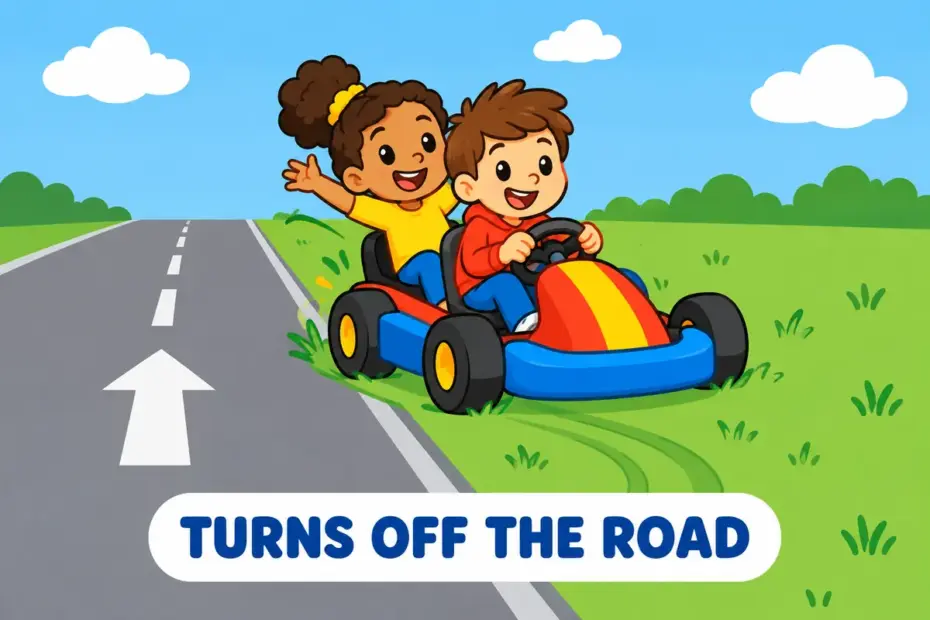
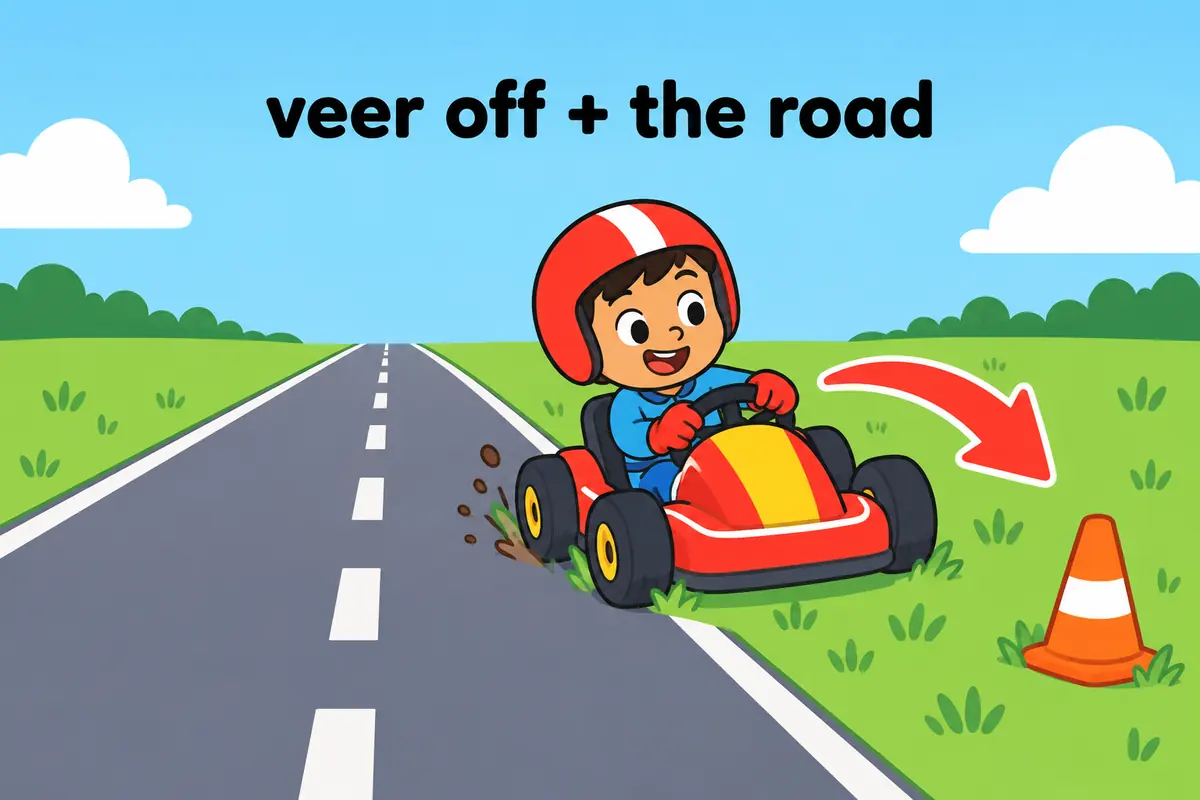
Veer off means to turn or drift suddenly away from a set course, path or subject. To use veer off in a sentence, name the route or topic being left: “The car veered off the road.” The phrase is intransitive, so nothing is turned by an outside force; the subject changes direction on its own.
Veer off at a glance
- Veer off is an intransitive phrasal verb; its forms are veers off, veered off and veering off.
- It usually names a route, a course or a topic that the subject leaves.
- The particle off must stay with the verb: veer off the road, never veer the road off.
- The preposition into marks a new subject or direction, as in veer off into a tangent.
- The commonest error is treating it as transitive, as in the driver veered the car off.
What does veer off mean?
Veer off is a phrasal verb meaning to change direction suddenly and leave a course, whether a physical path, a plan or a line of conversation. The Cambridge entry for veer off records the physical sense. In writing, the topic sense is now more common than the literal one: a meeting veers off the agenda, and a story veers off course.
| Sense | Plain meaning | Example sentence |
|---|---|---|
| Leave a road or path | Turn sharply away from a route | The bike veered off the track. |
| Leave a topic | Move away from the subject | The discussion veered off the main point. |
| Leave a plan or course | Depart from an intended path | The project veered off schedule. |
| Storm sense | A storm or wind changes direction | The hurricane veered off to the north. |
One limitation is worth stating plainly. Veer off suggests an unintended or unwelcome turn, so it fits a meeting that loses its thread better than a speaker who deliberately changes subject. For a planned change of direction, use turn aside or switch to.
How do you use veer off in a sentence?
The subject does the turning, and off introduces what is left behind. Five shapes cover almost every real sentence.
| Pattern | Example | What it signals |
|---|---|---|
| subject + veer off + noun | The van veered off the highway. | Names the route the subject leaves. |
| subject + veer off + course | The talks veered off course. | Off course is a fixed pairing. |
| subject + veer off + into + noun | He veered off into a long story. | Marks the new subject or direction entered. |
| subject + veer off + topic | The panel veered off topic. | Off topic is the topic equivalent of off course. |
| veer + adverb + off | The ball veered sharply off the post. | An adverb can sit between veer and off. |
Veer off in a sentence: examples across contexts
Veer off covers steering, storms and speeches with the same shape, and the context alone tells a reader which is meant. The nine sentences below move from a driving lesson to political commentary.
| Context | Example sentence | Why this works |
|---|---|---|
| Driving lesson | The learner veered off the lane when a cat ran out. | A literal steering example with a cause. |
| News report | The train veered off the rails shortly after the junction. | Reporting a sudden physical departure. |
| Meeting notes | The call veered off the agenda twice before lunch. | The topic sense in workplace writing. |
| Classroom | The essay veered off the question in the final paragraph. | Off the question is a common school phrase. |
| Weather report | The storm veered off its predicted path overnight. | A natural subject changing direction. |
| Conversation | We veered off into a chat about holidays. | The into pattern marks a new topic. |
| Sports report | The winger veered off the wing and cut inside. | Directional movement in sport. |
| Travel writing | The trail veered off toward the coast. | Off toward adds a new heading. |
| Political commentary | The debate veered off script when the heckling began. | Off script is a set phrase. |
| Air traffic | The plane veered off its assigned heading for a few seconds. | A technical use of the course sense. |
| Navigation app | The route veered off the motorway near the tunnel. | The course sense in an everyday tool. |
| Budget meeting | Spending veered off the forecast in the final quarter. | An abstract course sense in finance. |
The adverb slot is the flexible part. Sharp, slightly and suddenly all fit between veer and off, but the noun after off is usually fixed by the idiom: a road, a course, a topic or a script.
Notice how often the subject is not a person. Cars, storms, trails, talks and spending all veer off, because the verb pictures a system losing its intended line rather than a driver choosing a turn. Sentences with a human subject usually add a figurative topic, as in the speaker veered off the point.
Veer off vs swerve
Veer off and swerve both describe a sudden change of direction, and writers reach for the wrong one when a hazard is involved.
| Attribute | veer off | swerve |
|---|---|---|
| Core meaning | Leave a course suddenly | Change direction to avoid something |
| Direction | Away from a path or topic | Sideways, often one sharp move |
| Usual subject | A vehicle, a storm, a conversation | A vehicle, a cyclist, a goalkeeper |
| Object | Names what is left: the road, the topic | Usually takes no noun after it |
| Register | Neutral, common in news and meetings | Neutral, chiefly physical |
| What it implies | Departure from an intended line | A quick reaction to a hazard |
Verdict: use veer off when something leaves its path or subject, and swerve when a driver or player turns sharply to avoid an obstacle.
Word forms and grammar of veer off
The particle off is fixed, and veer also works without it, which is where learners get confused between the base verb and the phrasal verb.
| Form | Part of speech | Example |
|---|---|---|
| veer off | base phrasal verb | The car may veer off the road. |
| veers off | third-person singular | The talk veers off topic quickly. |
| veered off | past and past participle | The plane veered off the runway. |
| veering off | present participle | Wayward comments kept veering off the point. |
| veer | base verb without a particle | The road veers left after the bridge. |
| veering | noun formed from the gerund | Veering off course cost them the race. |
The base verb turn describes any change of direction, while the phrasal form veer off adds the idea of leaving a line. Where the departure is measured rather than sudden, deviate from the plan is the more formal choice; a speaker who gradually loses the thread may stray from the point instead, and a talk pushed aside on purpose uses deflect the question. A drift in the same family is gradual, which is the contrast the next table draws out.
Common mistakes with veer off
- Incorrect:
The driver veered the car off the road.Correct: The car veered off the road. Rule: Veer off is intransitive, so the thing that changes direction is the subject. - Incorrect:
The meeting veered the topic.Correct: The meeting veered off the topic. Rule: The particle off cannot be dropped before the noun. - Incorrect:
The cyclist veered off from the path.Correct: The cyclist veered off the path. Rule: Drop from, because off already carries the sense of leaving. - Incorrect:
The conversation veered off to a new topic.Correct: The conversation veered off into a new topic. Rule: Use into before the new subject, not to. - Incorrect:
The bus was veered off the road by the wind.Correct: The bus veered off the road. Rule: Veer off is intransitive and is not used in the passive.
Practice using veer off
Work through the six items, then check the reasoning rather than only the answer.
- Fill the gap: The taxi ______ the roundabout when the lights changed.
- Choose the better word: The budget talks (veered off / veered) course after lunch.
- Correct the error: He veered the bike off from the lane.
- Build a sentence: use veer off into about a lesson that turns into a story.
- Spot the register: which fits a meeting summary — the call veered off the agenda, or the call went totally off?
- Rewrite with the base verb: The skier veered off the piste. Remove off and change the meaning to a simple turn.
Answers
- veered off — the taxi is the subject that leaves the road, and off names what it leaves.
- veered off — off course is the fixed pairing in the topic and plan sense.
- He veered off the lane — the verb is intransitive and off needs no from.
- Model answer: The quiet lesson veered off into a long story about the teacher’s travels.
- The call veered off the agenda — a summary keeps the phrase and avoids totally.
- The skier veered left at the piste edge — the base verb veer means a change of direction without the idea of leaving a set course.
The bottom line
Use veer off in a sentence when something leaves a path, a course or a topic without being forced, and let the subject do the turning. The two nuances that decide most sentences are these: veer off is intransitive, so the car veers rather than the driver veering the car, and the noun after off is usually a fixed idiom such as off course, off topic or off script. Where the change is gradual rather than sudden, drift is the quieter choice.
Frequently asked questions about veer off
Is veer off one word or two?
Veer off is written as two words. It is a phrasal verb made of the verb veer and the particle off, so the two are never joined and never hyphenated. Only the verb inflects, giving veers off, veered off and veering off, while off stays unchanged in every form.
Is veer off transitive or intransitive?
Veer off is intransitive, which means it does not take a direct object. The thing that turns is the subject, as in the van veered off the highway. The noun after off is not an object but part of the phrase naming what is left, so it cannot be moved in front of the verb.
Can veer off be used about a conversation?
Yes. The topic sense is common in meetings, classrooms and writing, as in the discussion veered off the agenda. It carries the same idea as a vehicle leaving a road: the conversation leaves its intended line, usually without anyone planning to change the subject. Into marks the new topic.
What is the difference between veer off and go off?
Go off is broader and more colloquial, covering alarms, food and explosions as well as departures. Veer off is narrower and always means a sudden change of direction away from a course, path or topic. When you want the image of a sharp turn, veer off is more precise.