
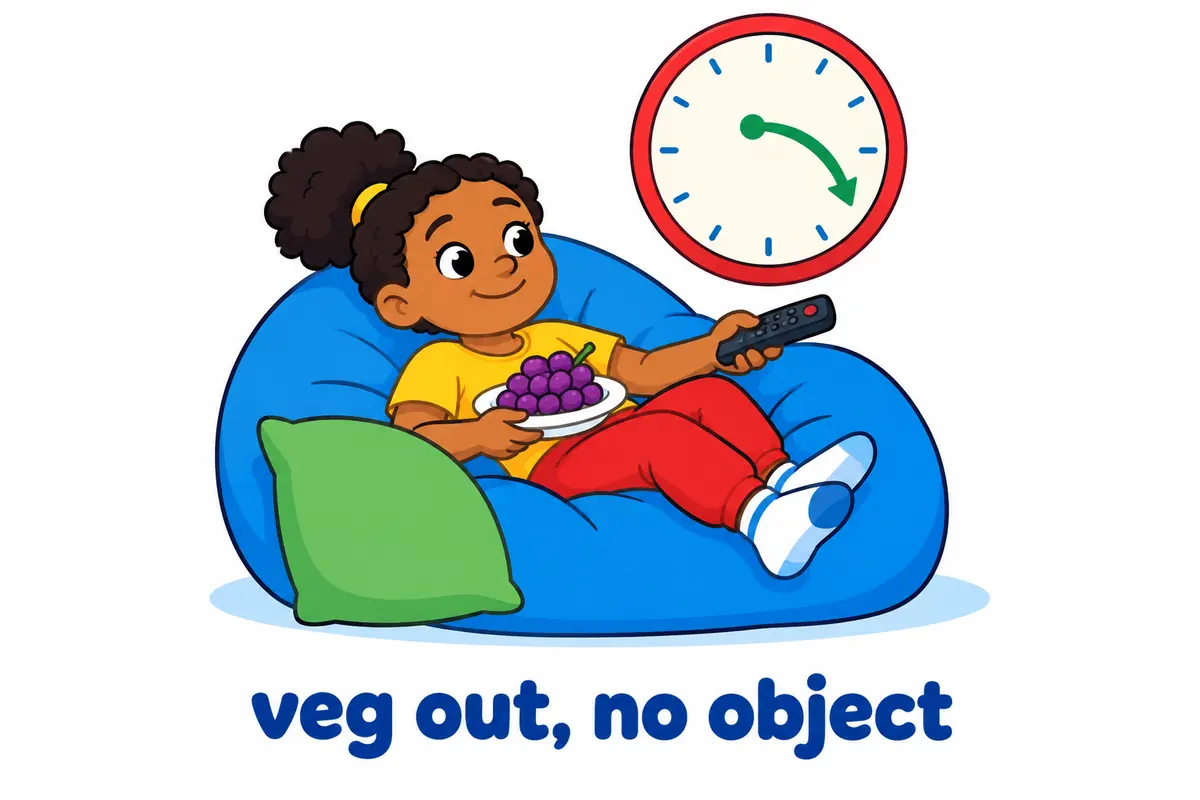
Veg out means to relax completely and do very little, usually while watching something or scrolling. To use veg out in a sentence, give it a place or a stretch of time rather than an object: “We vegged out on the sofa all afternoon.” The verb is intransitive, so nothing is ever vegged out.
Veg out at a glance
- Veg out is an intransitive phrasal verb: weed out splits, but veg out never takes a direct object.
- Its forms are veg out, vegs out, vegged out and vegging out.
- The tone is informal and friendly, so it suits conversation and blogs more than reports.
- It usually appears with a place, as in veg out on the couch, or a time, as in veg out all weekend.
- The commonest error is adding an object, as in veg out the TV, which no standard use permits.
What does veg out mean?
Veg out is a phrasal verb meaning to relax in a passive, low-effort way, with no particular goal. The Cambridge entry for veg out marks it as informal, and that label explains its habits: it needs company and a place, and it avoids serious writing. The image is close to a vegetable, useful only for sitting still.
| Sense | Plain meaning | Example sentence |
|---|---|---|
| Rest idly | Relax with almost no effort | After the exams we vegged out for two days. |
| Watch pass without engaging | Let time slip by in front of a screen | He vegged out to old films all evening. |
Two limits are worth stating. Veg out does not mean laziness, because it describes a choice rather than a failure, and it does not fit a formal report, where rest and recover do the same job without the slang. A learner who writes the committee vegged out after lunch has chosen the wrong register, not the wrong meaning. The phrase also implies a soft seat or a screen, so it sounds faintly odd about energetic rest such as a long hike.
How do you use veg out in a sentence?
Veg out is intransitive, so it cannot take an object, and its fixed particle never moves. Add information with a prepositional phrase instead: veg out on the sofa, in front of the television, with a friend, or all weekend. The intransitive shape is the single rule that keeps the sentence grammatical.
| Pattern | Example | What it signals |
|---|---|---|
| veg out + place | We vegged out on the sofa. | Names where the rest happens. |
| veg out + time | They veg out every Sunday morning. | A routine or duration, the commonest add-on. |
| veg out + in front of + noun | She vegged out in front of a crime drama. | Links the rest to a screen. |
| veg out + with + person | We vegged out with the neighbours. | Rest shared rather than solitary. |
| stop / start + vegging out | Stop vegging out and help with dinner. | The gerund carries the verb after another verb. |
Keep the verb object-free even when the sentence grows long: the sofa, the weekend and the series all belong to prepositions, never to the verb itself. That single rule prevents the most common error with this phrase.
Veg out in a sentence: examples across contexts
The verb changes tone more than meaning from one scene to the next. The twelve sentences below keep the same casual sense while moving from a bedroom to a sports column, and each row shows what the surrounding words are doing.
| Context | Example sentence | Why this works |
|---|---|---|
| Weekend chat | We vegged out on the sofa and watched three films in a row. | A time and a place replace the object. |
| Blog post | Here is how I veg out after a long week of classes. | The informal register matches the topic. |
| Text message | Not doing anything tonight, just vegging out. | The gerund keeps the message short. |
| Family scene | The whole family vegged out in front of the old quiz show. | Collective rest suits the plural subject. |
| Study advice | Give yourself one evening to veg out before revision starts. | An instruction keeps the verb object-free. |
| Sports column | The squad vegged out in the hotel before the final. | Light tone inside a semi-formal piece. |
| Workplace break room | We veg out for ten minutes, then get back to the queue. | Contrasts passive rest with active work. |
| Travel diary | Rain kept us indoors, so we vegged out with a deck of cards. | The with phrase adds company. |
| Health writing | An evening spent vegging out can lower stress if it is deliberate. | Keeps the slang while making a careful point. |
| Conversation | I veg out for an hour and then sleep much better. | The first person is natural for a hobby. |
| Podcast notes | I vegged out to three episodes while the rain poured down. | The to phrase names the activity without an object. |
| Grandparent chat | We just veg out and watch the birds from the porch. | A simple present shows a happy routine. |
Across every row the verb keeps one shape; the detail always arrives through a preposition rather than an object. That is why a learner who adds a direct object, as in veg out the film, builds a sentence no native speaker would use.
Veg out vs chill out and zone out
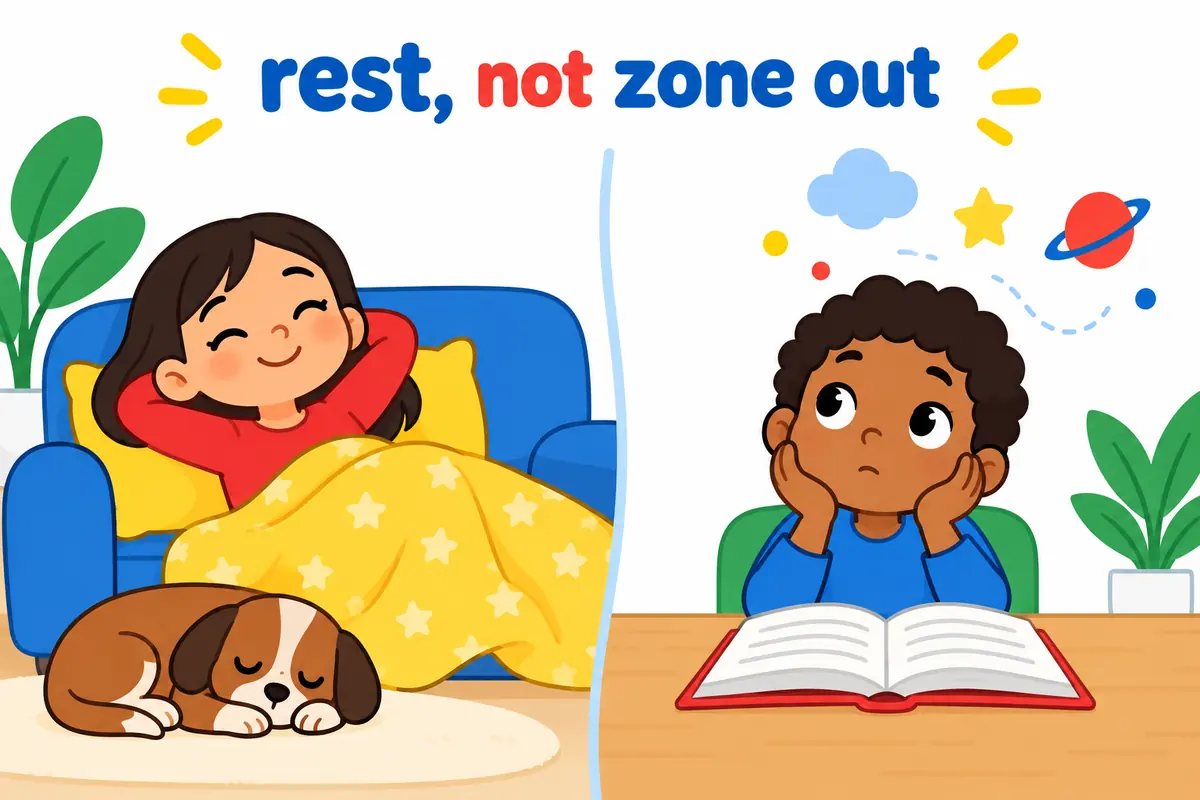
Veg out overlaps with two nearby verbs and matches neither of them exactly. chill out covers relaxing and calming down, while zone out means losing attention rather than choosing rest.
| Attribute | veg out | chill out | zone out |
|---|---|---|---|
| Core meaning | Rest with almost no effort | Relax or calm down | Lose focus and drift |
| Is it chosen? | Yes, deliberately idle | Yes, often after stress | Often involuntary |
| Typical add-on | A place or a stretch of time | An instruction to a tense friend | Mid-sentence, during a lesson |
| Register | Informal and friendly | Informal and reassuring | Informal, mildly critical |
| Object allowed | No | No | No |
Verdict: choose veg out for chosen, screen-heavy rest, relax after work when a neutral verb is wanted, and zone out when the point is losing attention rather than choosing to rest. When the mind drifts without consent, that is zoning out rather than vegging out.
Word forms and grammar of veg out
Veg out inflects like any regular verb, and its spelling doubles the consonant before ing, giving vegging rather than veging. The table also sets it beside two neighbours so the particle is never mistaken. When the rest is brief and active, rest for a few minutes and lounge in the garden keep a similar tone without the slang. A short nap after lunch is rest, but a whole afternoon of it is vegging out.
| Form | Part of speech | Example |
|---|---|---|
| veg out | phrasal verb, base form | They veg out every Friday night. |
| vegged out | phrasal verb, past and past participle | We vegged out after the match. |
| vegging out | phrasal verb, present participle | She is vegging out in the living room. |
| veg out on | fixed phrase plus preposition | He vegged out on the couch for hours. |
| veg | noun, unrelated, British | Add the veg to the pan and simmer. |
| laze around | different phrasal verb | They lazed around the pool all day. |
Common mistakes with veg out
- Incorrect:
We vegged out the film last night.Correct: We vegged out to a film last night. Rule: Veg out is intransitive and cannot take a direct object. - Incorrect:
She vegged the sofa for an hour.Correct: She vegged out on the sofa for an hour. Rule: The particle out is fixed and cannot be dropped. - Incorrect:
The committee vegged out during the review.Correct: The committee rested during the review. Rule: The verb is informal, so formal writing needs a neutral substitute. - Incorrect:
Veg out it before dinner.Correct: Veg out before dinner. Rule: There is no object and therefore no pronoun to place.
Practice using veg out
Work through the seven items, then read the answer notes for the reason rather than the key alone.
- Fill the gap: After the exams, we ______ in front of a comedy all evening.
- Choose the better word: Turn off the news and (veg out / zone out) for an hour.
- Correct the error: He vegged out the whole series on Sunday.
- Build a sentence: use veg out on about a rainy Saturday.
- Spot the register: which belongs in a school report – the pupils vegged out at break, or the pupils relaxed at break?
- Rewrite in the past continuous: They veg out all afternoon.
- Rewrite with a time phrase: We veg out. Add “every Saturday”.
Answers
- vegged out – the verb is intransitive, so the evening is described by a phrase, not an object.
- veg out – the sentence describes chosen rest, while zone out would mean losing attention.
- He vegged out to the whole series on Sunday – no direct object is allowed, so to marks the activity.
- Model answer: We vegged out on the sofa while the rain hammered the windows.
- The pupils relaxed at break – a formal report avoids the informal phrasal verb.
- They were vegging out all afternoon – the continuous doubles the g before ing.
- We veg out every Saturday – a time phrase is the natural add-on because the verb takes no object.
The bottom line
Use veg out in a sentence for deliberate, low-effort rest, and give it a place or a stretch of time because it cannot take an object. The two details that decide most sentences are its intransitive shape and its informal register, which suits a message to a friend but not a report. Where a neutral tone is needed, laze about on a Sunday or rest reads more widely.
Frequently asked questions about veg out
Is veg out one word or two?
It is always two words, veg out, with the particle separate. The form vegged and the gerund vegging are single words, but the base phrase keeps its space. Writing vegout as one word is non-standard and would read as a spelling mistake in any dictionary entry.
Can veg out take an object?
No. Veg out is intransitive, so it never takes a direct object. A learner who writes veg out a film should change the phrasing to veg out to a film or veg out in front of a film. The object-free shape is the rule that keeps the sentence grammatical.
Is veg out rude or lazy?
Neither. Veg out names a choice to rest, not a failure to act, and it is friendly rather than critical. It can still be too casual for formal writing, so a report would use rest or recover. In conversation it usually signals comfort and relaxation, not laziness.
What is the difference between veg out and goof off?
Veg out means resting with no goal, while goof off means avoiding work you should be doing. A person who veg out on a day off is relaxing; a person who goofs off at work is shirking. The two phrases share a casual tone but carry opposite ideas about effort.