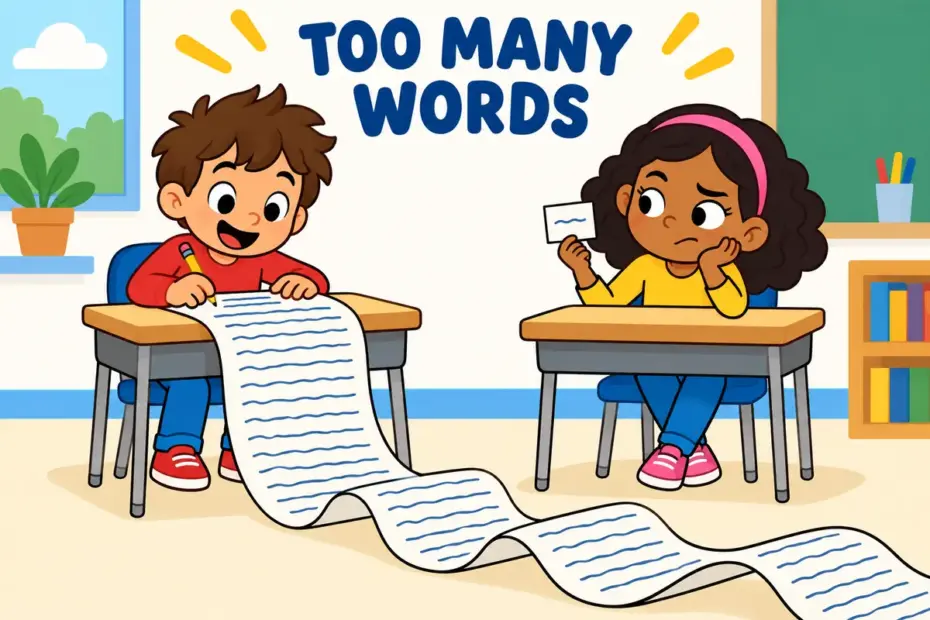
Verbose means using more words than are needed to make a point, and in a sentence it describes the speech or writing rather than the person’s character. You would write a verbose report, a verbose email or a verbose explanation. “The manual is so verbose that a single step fills three pages.”
Verbose at a glance
- Verbose is an adjective meaning using more words than necessary.
- It usually precedes the noun: a verbose report, a verbose email.
- It describes language, not sociability; a quiet person can still write a verbose memo.
- The noun is verbosity and the adverb is verbosely.
- The commonest error is using it for someone merely talkative, where garrulous fits better.
What does verbose mean?
Verbose is an adjective meaning using more words than are needed. The Cambridge entry for verbose records that sense, and the kind of language decides which shade is meant. Where the criticism is simply about padding in prose, wordy is the closer adjective.
| Sense | Plain meaning | Example sentence |
|---|---|---|
| Of writing | Padded with unnecessary words | The verbose report buried the main finding. |
| Of speech | Long and roundabout | His verbose answer filled ten minutes. |
| In computing | Producing detailed output about each step | Run the command in verbose mode to see every file it writes. |
One limitation is worth stating plainly. Verbose is a criticism of length, not of difficulty, so it does not mean complex or advanced. A simple idea can be verbose, and a hard one can be concise. For a person who simply enjoys talking, say talkative or garrulous instead.
How do you use verbose in a sentence?
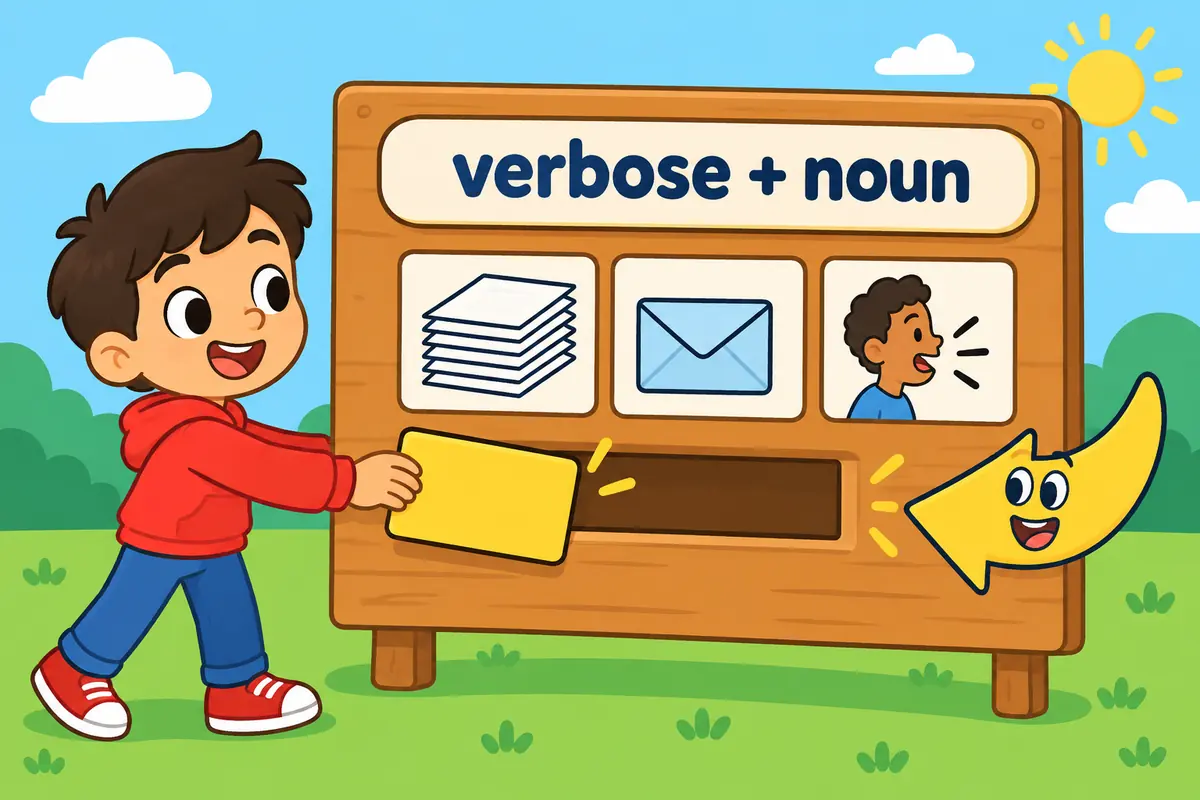
Put verbose directly before the noun that names the language: a verbose email, a verbose speech, a verbose log. Five patterns cover almost every real sentence, and the predicative use usually adds too or so.
| Pattern | Example | What it signals |
|---|---|---|
| verbose + noun | The verbose draft hid the main point. | The default, attributive pattern for writing. |
| verbose + speech noun | His verbose reply annoyed the panel. | Applied to spoken answers. |
| be + verbose | The instructions are too verbose to follow. | Predicative use, often with too or so. |
| verbosely + verb | She explained the rule verbosely. | The adverb, for the manner of an act. |
| verbosity (noun) | The editor cut the verbosity in half. | The noun form, for the quality itself. |
A long document is not automatically verbose: redundant is the better word when the problem is repeated content rather than sheer length.
Verbose in a sentence: examples across contexts
Verbose keeps its meaning while the setting changes the noun it attaches to. The nine sentences below move from a classroom to a computer terminal, and each one names the language being criticised.
| Context | Example sentence | Why this works |
|---|---|---|
| Classroom | The teacher asked for a shorter essay after a verbose first draft. | Shows the word applied to a student’s writing. |
| Workplace email | Keep the update brief; the last one was too verbose to skim. | A predicative use that fits a busy office. |
| News report | The minister’s verbose statement avoided the question for ten minutes. | Links length to evasion in public life. |
| Technical writing | The verbose manual repeats the same warning four times. | Pairs the adjective with a practical document. |
| Conversation | His voicemail was so verbose that I stopped listening. | Shows the word used critically in speech. |
| Academic writing | Reviewers asked the author to cut a verbose methods section. | Names the exact part of a paper that needs trimming. |
| Computing | Run the installer in verbose mode to log every file it writes. | Uses the technical sense of detailed output. |
| Business writing | A verbose proposal can lose a reader before the price. | Connects wordiness to a real cost. |
| Public speaking | The chair warned against verbose answers in the debate. | Applies the adjective to a spoken format. |
The related adjective long-winded stresses how long an explanation takes, while verbose stresses the surplus of words.
Verbose vs garrulous
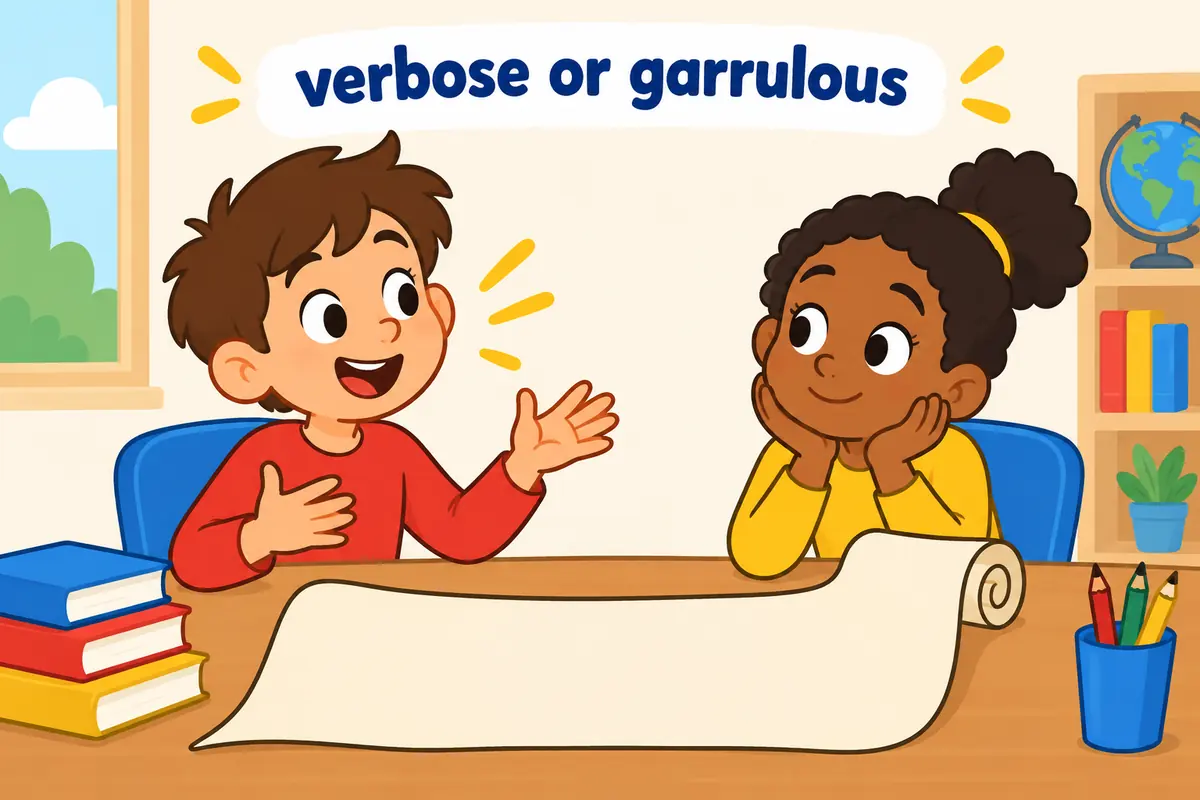
These two adjectives both suggest too much language, but one judges the words and the other the person. garrulous describes somebody fond of talking, while verbose describes the wordy language itself.
| Attribute | verbose | garrulous |
|---|---|---|
| Meaning | Using more words than needed | Fond of talking, chatty |
| Describes | Language: speech, writing, output | A person’s habit |
| Can a quiet person be it | Yes; a silent writer can be verbose | No; a garrulous person talks a lot |
| Typical collocation | A verbose report | A garrulous neighbour |
| What it criticises | Length and padding | Nonstop talk |
| Sample sentence | His verbose memo filled two pages. | Our garrulous neighbour talked for an hour. |
Verdict: choose verbose for wordy language and garrulous for a talkative person. The noun verbosity names the quality of being verbose, and it is more formal than the adjective.
Word forms and grammar of verbose
Verbose inflects like a normal adjective, and its derived forms are mostly formal. The table also lists the technical phrase that uses the word as a fixed label.
| Form | Part of speech | Example |
|---|---|---|
| verbose | adjective, base | They sent a verbose summary. |
| verbosely | adverb | He described the route verbosely. |
| verbosity | noun | Her verbosity cost her the interview. |
| verboseness | noun, rare | Editors dislike verboseness in headlines. |
| verbose mode | noun phrase, computing | Start the tool in verbose mode. |
The noun verbosity is the form to watch, because it often appears without any article: the report was a masterpiece of verbosity.
Common mistakes with verbose
- Incorrect:
My uncle is very verbose; he talks to everyone.Correct: My uncle is very talkative; he talks to everyone. Rule: verbose describes wordy language, not a sociable person. - Incorrect:
The equation was verbose.Correct: The explanation of the equation was verbose. Rule: verbose describes the words used, not the subject itself. - Incorrect:
He spoke verbose.Correct: He spoke verbosely, or he gave a verbose speech. Rule: use the adverb verbosely, or the adjective before a noun. - Incorrect:
The email was verbosity.Correct: The email was verbose. Rule: verbose is the adjective; verbosity is the noun. - Incorrect:
She wrote a verbose of words.Correct: She wrote a verbose passage. Rule: the adjective goes directly before a noun, with no of between them.
Practice using verbose
Work through the six items, then check the reasoning rather than only the key.
- Fill the gap: The first draft was so ______ that the editor cut it in half.
- Choose the better word: Our (verbose / garrulous) neighbour chatted for an hour.
- Correct the error: He explained the rule verbose.
- Build a sentence: use a verbose email about a delayed reply.
- Spot the register: which belongs in a technical guide — run the tool in verbose mode, or the tool talks a lot?
- Rewrite with the noun: Her writing was far too wordy. Use verbosity.
Answers
- verbose — the adjective describes the padded draft before the noun.
- garrulous — the neighbour is a talkative person, so the person adjective fits.
- He explained the rule verbosely — the adverb modifies the verb explained.
- Model answer: A verbose email about the delay took ten minutes to read.
- Run the tool in verbose mode — the technical phrase is a fixed label for detailed output.
- Her verbosity made the report hard to finish — the noun names the quality itself.
The bottom line
Use verbose in a sentence when language carries more words than the message needs, and let it sit directly before the noun. The two details that decide most sentences are these: verbose judges the words, not the speaker’s sociability, and it is about surplus length rather than difficulty. For a talkative person, talkative or garrulous is the better choice.
Frequently asked questions about verbose
Is verbose always an insult?
Verbose is usually a mild criticism of length, but it is not a harsh word. In technical writing, verbose mode is a neutral label for detailed output. When it describes a person’s email or report, it simply says the message could have been shorter, not that the writer is foolish.
Does verbose mean complicated?
No. Verbose means using more words than needed, which is a comment on length rather than difficulty. A simple instruction can be verbose, and a difficult idea can be stated concisely. If a passage is hard to follow because of jargon, technical or dense is the better description.
What is the noun form of verbose?
The noun is verbosity, meaning the quality of using too many words, as in the report was a masterpiece of verbosity. It is more formal than the adjective and often appears without an article. The adverb is verbosely, used to describe how something was said or written.
Is verbose used in computing?
Yes. In computing, verbose mode makes a program print detailed information about each step it takes. The sense comes from the same idea of saying more than usual. It is neutral there rather than critical, because a developer often wants the full detail on purpose.
Do you ever find yourself struggling to express your thoughts concisely, but end up being overly wordy instead? If so, you might be guilty of being verbose.
Verbose is an adjective used to describe writing or speech that uses more words than necessary, often in a way that is long-winded or overly complicated.
7 Examples Of Verbose Used In a Sentence For Kids
- Verbose means using more words than needed.
- When you are verbose, you talk a lot.
- Sometimes it’s fun to be verbose and tell long stories.
- It’s important to be clear in our communication and not be verbose.
- Try to express your thoughts in a simple way and avoid being verbose.
- Being verbose can make it hard for others to understand you.
- Let’s practice being concise and not verbose in our conversations.
14 Sentences with Verbose Examples
- Verbose explanation of complex mathematical concepts can help students better understand and apply them in problem-solving.
- It is important to provide a verbose summary of key points before examinations to enhance retention and recall during revision sessions.
- Creating verbose study guides can be an effective way to organize and review course material for upcoming tests.
- When writing research papers, using a verbose writing style can help convey ideas clearly and support arguments with detailed explanations.
- Verbose note-taking during lectures can aid in capturing important information and insights shared by professors.
- Collaborating with classmates on group projects may require verbose communication to ensure everyone is on the same page.
- In group study sessions, asking verbose questions can stimulate discussion and lead to deeper understanding of course material.
- Peer feedback that is verbose and constructive can assist students in improving their assignments and academic performance.
- Before delivering presentations, practicing with a verbose script can help students become more confident and articulate speakers.
- Professors often encourage students to be verbose in their answers to essay questions to demonstrate a thorough understanding of the subject matter.
- When preparing for exams, creating verbose flashcards with detailed information can aid in memorization and retention of key concepts.
- Developing a verbose understanding of programming languages is essential for computer science students to excel in coding assignments.
- Engaging in verbose discussions during seminar classes can enrich learning experiences by exploring diverse perspectives and viewpoints.
- Writing reflective essays that are verbose in exploring personal growth and challenges can help students gain deeper insights into their academic journey.
How To Use Verbose in Sentences?
To use the word Verbose in a sentence, remember that it refers to something that uses more words than necessary. Here is a simple guide for beginners:
-
Identify the context: Before using the word Verbose, make sure you understand the situation where excessive words are being used. It is often used to describe long-winded or overly detailed speech or writing.
-
Choose the appropriate moment: Look for a situation where you can clearly observe unnecessary verbosity. This can be in a conversation, a written piece, or any other form of communication.
-
Formulate your sentence: Once you have identified a suitable context, construct your sentence using the word Verbose in the appropriate place. For example, “His explanation was so verbose that it was hard to follow.”
-
Practice using the word: To become more comfortable with incorporating Verbose into your vocabulary, try using it in different sentences. This will help you grasp its meaning and usage more effectively.
-
Seek feedback: If you are unsure about your usage of the word Verbose, don’t hesitate to ask for feedback from friends, family, or teachers. Constructive criticism can help you improve your language skills.
Remember, using Verbose in a sentence can enhance your communication skills by adding depth and precision to your expression. By following these simple steps, you can confidently incorporate this word into your daily conversations and writing.
Conclusion
In conclusion, verbose sentences are characterized by being overly long, wordy, and often containing unnecessary or redundant information. These sentences tend to obscure the intended message, making communication less clear and effective. By simplifying and condensing verbose sentences, we can improve clarity and ensure that our message is easily understood by the intended audience.
Avoiding verbose sentences is crucial in effective communication, as it helps to convey thoughts and ideas in a concise and straightforward manner. By being mindful of verbosity and choosing clarity over unnecessary complexity, we can enhance the impact of our writing and speaking, making our communication more accessible and engaging for others.


