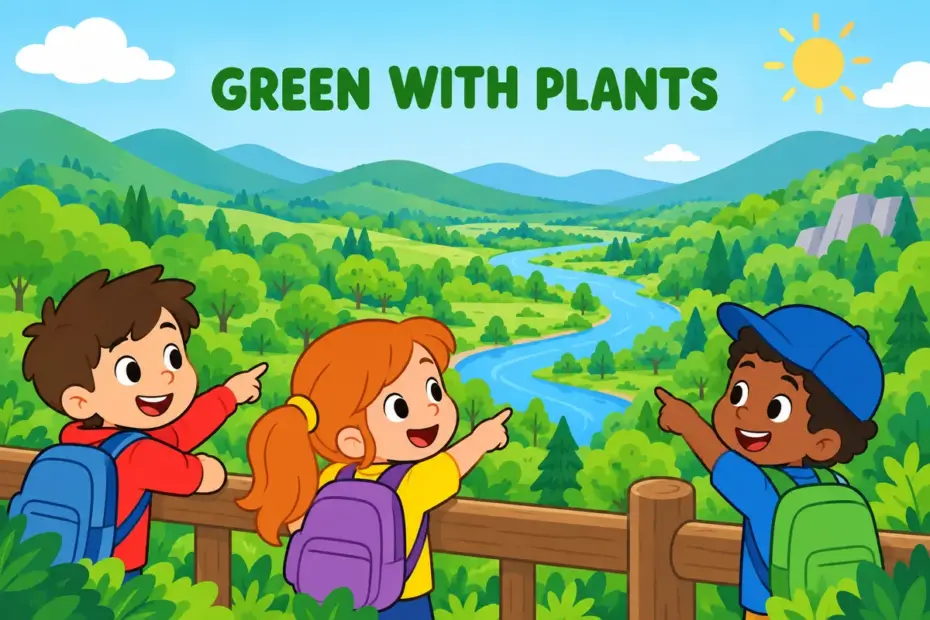
Verdant describes land that is thickly covered in healthy green plants. To use verdant in a sentence, pair it with a concrete landscape: “the verdant valley fed three villages.” The adjective describes growing ground and its foliage, not the colour of an object.
Verdant at a glance
- Verdant is an adjective meaning green with abundant plant growth.
- It normally describes land, valleys, fields, gardens and forests.
- The comparative is more verdant, never verdanter.
- Its noun is verdancy and its adverb is verdantly; verdure is a close noun for greenery.
- The commonest error is using verdant for any green object, such as a verdant shirt.
What does verdant mean?
Verdant is an adjective meaning green with abundant, healthy plant growth, and it can also suggest a rich or flourishing quality. The Cambridge entry for verdant records the green-with-foliage sense, which is the one that appears in almost every real sentence.
| Sense | Plain meaning | Example sentence |
|---|---|---|
| Green with plants | Covered in dense, healthy foliage | The verdant slopes above the lake stay green all year. |
| Rich and flourishing | Suggesting growth and abundance, often figuratively | The town enjoyed a verdant spell of new business. |
| Fresh and moist | Describing ground well supplied with water | After the rains the marsh turned verdant almost overnight. |
One limitation is worth stating plainly. Verdant describes a place and its growing plants, so a green-painted door is not verdant and neither is a green shirt. The word also assumes the green comes from growth, which is why a chemically bright lawn can look green without ever being verdant.
How do you use verdant in a sentence?
Verdant attaches to a landscape noun, and the surrounding words usually name either the rain or the water that keeps it green. Five patterns cover almost every real sentence, and the comparative is always built with more.
| Pattern | Example | What it signals |
|---|---|---|
| verdant + landscape noun | The verdant valley lay below the pass. | Names the ground itself, the core use. |
| be + verdant | After the rains the hillside was verdant again. | Describes a changed state after water arrives. |
| verdant + with + noun | The marsh was verdant with reeds. | Names the plant that supplies the green. |
| more verdant than | The lower field is more verdant than the ridge. | Comparative needs more, never the -er ending. |
| verdant + figurative noun | a verdant imagination | Stretches the word beyond landscape, best used sparingly. |
The eye should also meet the cause of the green. A fertile river plain stays verdant because silt and water renew it, so naming the rain, the river or the soil makes the description do more work than the adjective alone.
Verdant in a sentence: examples across contexts
Verdant belongs to description, so it appears wherever a writer wants a picture of abundant green. The nine sentences below move from a classroom to a conservation report, and each one keeps the word tied to real ground.
| Context | Example sentence | Why this works |
|---|---|---|
| Classroom | Our map showed a verdant jungle beside a dry desert. | Contrasts a plant-rich region with a barren one. |
| Travel writing | Beyond the ridge the verdant terraces stepped down to the river. | Paints a specific managed landscape. |
| News report | Farmers returned to the verdant delta after the floods. | Uses the word factually about recovered farmland. |
| Estate listing | The cottage looks onto verdant meadows in every direction. | Sells a view through a longing adjective. |
| Academic writing | The study compared verdant wetlands with drained marshland. | Keeps the word technical and neutral. |
| Poetry | A verdant hush settled over the orchard at dusk. | Applies the word to a mood, a deliberate stretch. |
| Conversation | The garden is verdant now that the sprinklers work. | Names the cause of the greenery in plain speech. |
| Conservation | Grazing kept the verdant heath open for ground-nesting birds. | Links the adjective to a management practice. |
| Gardening | Climbing ferns make a shady wall look verdant. | Shows plants as the source of the effect. |
Every row keeps the green attached to plants or ground. Where the writing is about health rather than scenery, a word such as flourishing often fits the sentence better than verdant.
Verdant vs lush and green
Verdant is close to two everyday words and shares their greenness without matching their range. Lush stresses thickness and richness of growth, while green names the colour itself and applies to almost anything.
| Attribute | verdant | lush | green |
|---|---|---|---|
| Core image | Ground covered in healthy foliage | Thick, rich, plentiful growth | The colour itself |
| Usual subject | Valleys, fields, hills, gardens | Plants, grass, jungles | Any object, surface or plant |
| Implies water and health | Yes | Yes, strongly | No |
| Register | Literary and descriptive | Everyday to literary | Neutral |
| Sounds odd about a shirt | Yes | Yes | No |
Verdict: choose green for a plain colour, lush for dense and rich growth, and verdant when the point is a whole landscape made green by healthy plants. A luxuriant growth can tip into untidiness, whereas verdant stays favourable and orderly.
Word forms and grammar of verdant
Verdant inflects with more and most rather than with endings, and its family includes two nouns that learners often mix. The table also marks the invented comparative that should be avoided.
| Form | Part of speech | Example |
|---|---|---|
| verdant | adjective | The verdant meadow filled with poppies. |
| more verdant | comparative adjective | This pasture is more verdant than the last. |
| most verdant | superlative adjective | It is the most verdant corner of the estate. |
| verdantly | adverb | The slope grew verdantly after the rains. |
| verdancy | noun | The verdancy of the valley surprised us. |
| verdure | noun, literary | The walls were hung with summer verdure. |
| verdanter | non-standard – do not use | write more verdant instead |
Keep verdancy and verdure apart in use: verdancy names the quality of being green, while verdure names the greenery itself. A page on grassy ground shows how a plainer adjective handles the same scene.
Common mistakes with verdant
- Incorrect:
She wore a verdant scarf.Correct: She wore a green scarf. Rule: Verdant describes plant-covered land, so it cannot label a garment. - Incorrect:
The garden grew verdanter each spring.Correct: The garden grew more verdant each spring. Rule: The comparative uses more, not the -er ending. - Incorrect:
The verdancy of the fields were lovely.Correct: The verdancy of the fields was lovely. Rule: Verdancy is a singular noun and takes a singular verb. - Incorrect:
The painted wall is verdant.Correct: The painted wall is green. Rule: Verdant implies living growth, not paint or dye. - Incorrect:
The whole city is verdant.Correct: The city parks are verdant. Rule: Verdant suits planted ground, not streets and buildings.
Practice using verdant
Work through the six items, then check the reasoning rather than only the answer.
- Fill the gap: After a wet spring the hillsides turned ______ within weeks.
- Choose the better word: The (verdant / green) jumper matched her shoes.
- Correct the error: The marshes are more verdant than the dry ridge.
- Build a sentence: use verdant valley about farmland beside a river.
- Spot the register: which belongs in a travel brochure – the verdant terraces slope to the water, or the green field is down there by the water?
- Rewrite with the noun: The valley was full of green growth. Use verdure instead.
Answers
- verdant – the rain has made the ground green with new growth.
- green – a jumper cannot be verdant, because the word describes land, not cloth.
- The marshes are more verdant than the dry ridge – the sentence is already correct; check the comparative uses more.
- Model answer: The verdant valley beside the river supports three farms.
- The verdant terraces slope to the water – a brochure keeps the descriptive adjective and drops the plain field.
- The valley was hung with summer verdure – verdure names the greenery itself.
The bottom line
Use verdant in a sentence about land that is green with healthy, growing plants, and keep the subject a valley, field, garden or hillside. The two points that decide most sentences are these: verdant names living growth rather than the colour green, and its comparative is more verdant. Where only a colour is meant, the plainer word green is always the safer choice.
Frequently asked questions about verdant
Does verdant just mean green?
It means something narrower: land covered in healthy, growing plants. Green can label any colour, from paint to fabric, but verdant assumes living growth and usually water. That is why a verdant meadow sounds natural while a verdant car sounds wrong to most readers.
What kind of landscape can be verdant?
Verdant suits valleys, fields, hillsides, gardens, marshes and forests, especially after rain. It fits ground that a reader can picture as green. It does not fit streets, buildings or indoor spaces, because those surfaces are not made green by growing plants.
Is verdant a formal word?
Verdant sits in descriptive, literary and journalistic writing rather than casual speech. Travel brochures and feature articles use it freely, and academic writing accepts it in a neutral sense. In everyday conversation most people simply say green or lush instead.
What is the noun form of verdant?
The noun is verdancy, which names the quality of being green, and a literary noun verdure names the greenery itself. Both are less common than the adjective. Use verdancy for the state and verdure for the plants, so the valley has verdancy while its slopes wear verdure.
Have you ever come across the word “verdant” and wondered what it means? Verdant is an adjective that describes something lush with green vegetation, typically used to paint a vivid picture of vibrant plants and grass.
This term is commonly employed to evoke images of flourishing landscapes, portraying a scene rich in greenery and life. Keep reading to discover how “verdant” can add a touch of vivid description to your writing.
7 Examples Of Verdant Used In a Sentence For Kids
- The verdant trees are bright green and full of leaves.
- I love to play in the verdant grass at the park.
- The verdant garden is filled with colorful flowers.
- The verdant meadow is home to many butterflies and bees.
- I can see the verdant hills from my window.
- The verdant forest is a great place to spot birds and animals.
- Let’s have a picnic in the verdant field today!
14 Sentences with Verdant Examples
- Verdant fields on campus provide a peaceful spot for students to relax and study.
- The library’s courtyard is surrounded by verdant shrubs and flowers, creating a serene ambiance for studying.
- Verdant trees line the paths leading to the lecture halls, offering shade to students walking in the sun.
- The university’s botanical garden is a haven of verdant beauty, perfect for biology students to explore.
- The campus cafeteria overlooks a verdant courtyard where students can enjoy a meal in nature.
- A verdant campus lawn is the ideal setting for students to gather for outdoor events and activities.
- Studying under the shade of a verdant tree in the campus quad is a popular choice for students on a sunny day.
- The university’s sports fields are surrounded by verdant grass, perfect for students to participate in outdoor games.
- The rooftop garden provides a verdant oasis in the midst of the bustling city, where students can escape for a moment of tranquility.
- The campus arboretum boasts a wide variety of verdant trees and plants, offering students a chance to learn about different species.
- The outdoor classroom, surrounded by verdant foliage, is a unique space for students to attend lectures in a natural setting.
- The campus pond is surrounded by verdant vegetation, creating a peaceful spot for students to reflect and relax between classes.
- The rooftop terrace offers a stunning view of the city skyline, framed by the verdant leaves of potted plants around the perimeter.
- The student housing complex is nestled in a verdant valley, providing a quiet retreat from the hustle and bustle of campus life.
How To Use Verdant in Sentences?
Verdant means lush, green, and full of vegetation. When using this word in a sentence, it is important to keep in mind its specific meaning to ensure clarity in your communication.
To correctly use verdant in a sentence, follow these steps:
-
Identify the context: Determine the situation you are describing or the setting you are discussing. Verdant is typically used to describe landscapes, gardens, forests, or any place that is abundantly green and vibrant.
-
Position the word: Place verdant in a position within the sentence where it accurately conveys the lushness or greenery of the scene you are describing. For example, you can say, “The verdant meadows stretched as far as the eye could see.”
-
Use descriptive language: Enhance your sentence by adding other adjectives or descriptive words that further emphasize the rich greenery or vitality of the surroundings. For instance, “The verdant forest was teeming with life, from colorful birds to blooming wildflowers.”
-
Check for clarity: Before finalizing your sentence, make sure that the use of verdant aligns with the image or idea you want to convey. Ensure that the sentence flows smoothly and effectively communicates your message.
By following these steps, you can confidently incorporate verdant into your sentences to vividly describe lush, green landscapes or environments.
Conclusion
In summary, the use of “verdant” in sentences paints vivid images of lush green landscapes and vibrant foliage. It is a versatile term that can be applied to various settings, from peaceful countryside scenes to bustling city parks. These sentences evoke a sense of freshness, abundance, and natural beauty, allowing readers to easily visualize the verdant surroundings described. The word “verdant” adds depth and color to descriptions, making them more vibrant and engaging for the reader.
Overall, the word “verdant” serves as a powerful descriptor, enhancing the imagery and atmosphere in sentences related to nature or landscapes. Its connotations of growth and vitality make it a valuable addition to any writer’s vocabulary, providing a vivid and lively portrayal of verdant settings.


