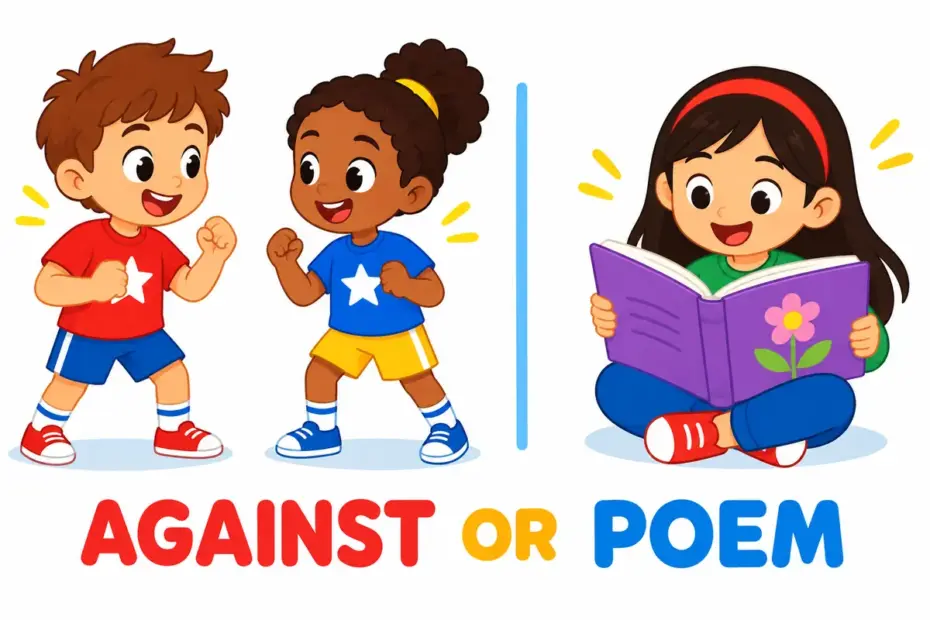
The versus vs verse choice comes down to meaning: versus sets two things against each other, while verse names a line or stanza of poetry or song. To use them in a sentence, write the final as north versus south and the lyrics as the second verse. The two words sound alike but never swap.
Versus vs verse at a glance
- Versus is a preposition or conjunction meaning against, as in the debate was town versus gown.
- Verse is a noun meaning a line, stanza or group of lines in poetry or song.
- The two are near-homophones, which is the single reason writers mix them.
- Versus is often shortened to vs. or v., but verse has no such abbreviation.
- The commonest error is writing north verse south when the meaning is against.
Versus vs verse: the master comparison
One table settles the decision. The criteria below are weighted toward the questions a writer actually faces: what the word means, where it appears, and what errors follow when the two are confused.
| Criterion | versus | verse |
|---|---|---|
| Core meaning | Against, or in contrast with | A line or stanza of poetry or song |
| Part of speech | Preposition and conjunction | Noun, very occasionally a verb |
| Sound | Two syllables, VER-sus | One syllable, rhyming with worse |
| Typical context | Sport, law, debate, comparison | Poetry, hymns, lyrics, scripture |
| Abbreviation | vs. or v. | None |
| Plural | Not used in the plural | verses |
| Signed by a wrong choice | Writing verse for against | Writing versus for a poem line |
The weight of the decision falls on meaning, not on sound. When the sentence describes opposition, no line of poetry is involved, and versus is the only correct word. When the sentence describes writing arranged in lines, terminology from poetry applies and verse is correct. Register is a minor tiebreaker at best, because both words appear in formal and casual writing alike.
Which should you use?
Five reader situations cover almost every real question, and each has a firm answer rather than a hedge.
| Situation | Use | Reason |
|---|---|---|
| Comparing two teams or options | versus | The sentence sets one thing against another. |
| Quoting a line of a hymn or poem | verse | The unit of writing is what you are naming. |
| Writing a legal case name | versus | Court style spells the word out in full. |
| Texting a quick score | vs. | The abbreviation belongs to versus, not verse. |
| Referring to song structure | verse | The section between choruses is a verse. |
When in doubt, ask what the sentence is about. Versus appears whenever the sentence is a direct comparison of two sides; if it is about words arranged in lines, use verse. The difference is that clean, so there is no situation that needs both at once.
What do versus and verse mean?
Versus is a preposition and conjunction meaning against, and verse is a noun meaning a line or a group of lines in poetry, song or scripture. The Cambridge entry for versus and verse distinguishes the two headwords, and the parallel structure below shows how completely the meanings separate. Verse is the word that belongs to poetry, song and scripture, while versus belongs to contests and comparisons.
| Word | Plain meaning | Example sentence |
|---|---|---|
| versus | Against, or compared with | The case was heard as Reed versus the council. |
| versus | In contrast to | The plan pits cost versus safety. |
| verse | A line or stanza of a poem | She recited the opening verse from memory. |
| verse | A section of a song | The second verse is quieter than the chorus. |
Two related words cause extra trouble. Against is the ordinary English equivalent of versus and the safer choice outside headlines and case names. Stanza is the technical term for a group of verses, so a poet may write several stanzas, each holding four verses, while versus never touches poetry at all.
How do you use versus and verse in a sentence?
Each word has a small set of patterns, and neither crosses into the other’s territory. The table below pairs the two so the grammar stays parallel.
| Pattern | Example | What it signals |
|---|---|---|
| noun + versus + noun | The final is north versus south. | Two sides placed in direct opposition. |
| clause + versus + clause | They weighed paying now versus waiting a year. | A comparison between two options. |
| case name + versus + name | Roe versus Wade is often shortened to Roe v. Wade. | The formal legal pattern of opposition. |
| the + ordinal + verse | The third verse repeats the chorus line. | A specific unit inside a poem or song. |
| verse + of + work | A verse of the hymn came back to her. | Part of a named longer text. |
Versus behaves like a preposition, so it links two nouns or two clauses and takes no object of its own beyond the pair. Verse behaves like any countable noun, so it takes articles and plurals: the first verse, several verses, a verse of scripture. The one shared risk is that both begin with vers, which is why a spell check will not catch a wrong choice.
Versus and verse in a sentence: examples across contexts
The two words keep to their own registers almost perfectly. The ten sentences below range from a courtroom to a hymn book, and each one uses a pattern from the table above.
| Context | Example sentence | Why this works |
|---|---|---|
| Sports report | Tonight’s cup tie is City versus United. | Two named sides in direct opposition. |
| Legal writing | The appeal was filed as Barnes versus the ministry. | The full form suits formal case names. |
| Everyday comparison | We compared renting versus buying before we moved. | Two options weighed against each other. |
| Debate | The motion was reform versus inertia. | Abstract nouns can stand in opposition too. |
| Headline | Nature vs. nurture, revisited. | The abbreviation works in a tight headline. |
| Poetry | The closing verse returns to the first image. | A named unit inside a poem. |
| Song lyric | She sang the verse a little lower than usual. | The section between choruses is a verse. |
| Religious text | He read a single verse before the service. | A numbered sentence of scripture. |
| Classroom | Each group wrote one verse about the sea. | A countable unit the pupils can produce. |
| Conversation | It was me versus the whole committee, honestly. | Informal, but the opposition sense is intact. |
Only the final sentence is casual, yet it still obeys the rule that versus means opposition. A reader who knows the meanings can predict every one of these choices without seeing the context label.
Word forms and grammar of versus and verse
The two words build separate small families, shown side by side below. The table also marks the forms that do not exist, because invented ones are the commonest error in student writing.
| Form | Part of speech | Example |
|---|---|---|
| versus | preposition, full form | The match is Riverside versus Oakfield. |
| vs. | abbreviation | The result was 2 vs. 1. |
| v. | abbreviation, legal | Brown v. the board is a landmark case. |
| verse | noun, singular | He learned one verse by heart. |
| verses | noun, plural | The final verses are the hardest to sing. |
| versed | adjective | She is well versed in local history. |
| verses | non-standard for versus | Do not write north verses south; the word is versus. |
The adjective versed is worth separating from both. It means experienced or practised, as in well versed in the rules, and it has nothing to do with either opposition or poetry. A related poetry verb, versify, means to compose verse, and it never appears in the comparison sense. The full versus page gathers the sport, legal and comparison uses in one place.
Common mistakes with versus and verse
- Incorrect:
Tonight’s match is Rangers verse Celtic.Correct: Tonight’s match is Rangers versus Celtic. Rule: Opposition needs versus; verse names poetry. - Incorrect:
She read the first versus of the poem.Correct: She read the first verse of the poem. Rule: A line of poetry is a verse; versus never counts units. - Incorrect:
The teams were verses each other.Correct: The teams were set against each other. Rule: Versus is not a verb, so it cannot take were. - Incorrect:
He is versus in three languages.Correct: He is versed in three languages. Rule: The practised adjective is versed, not versus. - Incorrect:
The chorus comes after the second versus.Correct: The chorus comes after the second verse. Rule: Song sections are verses; versus cannot take a plural.
Practice using versus and verse
Work through the seven items, then read the reason beside each answer.
- Fill the gap: The semi-final is Eastfield ______ Westfield.
- Choose the better word: She hummed the opening (versus / verse) of the song.
- Correct the error: The case was listed as Khan verses the hospital trust.
- Build a sentence: use versus about a choice between two holiday plans.
- Spot the register: which belongs in a hymn sheet — verse three, or versus three?
- Rewrite with the abbreviation: The legal case Smith versus Jones. Use v.
- Explain the difference: give one sentence with versus and one with verse.
Answers
- versus — the two teams are in opposition, so versus is required.
- verse — the opening section of a song is a verse.
- The case was listed as Khan versus the hospital trust — verses is never correct for opposition.
- Model answer: We could not decide between the coast versus the mountains.
- Verse three — a hymn is poetry, so versus cannot label its units.
- Smith v. Jones — the legal abbreviation for versus is v.
- Versus: It was experience versus youth. Verse: The last verse made everyone smile.
The bottom line
The versus vs verse distinction rests on meaning: use versus for opposition or comparison, and verse for a line or stanza of poetry, song or scripture. Two nuances settle most writing problems, and both are grammar rather than style: versus is a preposition that links two nouns, while verse is a countable noun that takes articles and a plural. Where a plain English word will do, against can often replace versus, but nothing replaces verse when the subject is poetry.
Frequently asked questions about versus and verse
Is versus formal or informal?
Versus works at every level. It appears in formal legal writing, where case names spell it out in full, and in casual sport talk, often shortened to vs. The full form suits edited prose, while the abbreviation fits headlines, scores and text messages. Neither form is wrong, and only the setting decides which reads better.
Can verse be used as a verb?
Verse has a rare verb use meaning to compose poetry, as in he versed the tale in rhyming couplets, but most readers never meet it. The common adjective is versed, meaning practised or experienced, as in well versed in the rules. For ordinary writing, keep verse as a noun and let the context carry the meaning.
How do you abbreviate versus?
Versus shortens to vs. with a full stop in American style, or to vs without one in British style, and to v. in legal case names. The abbreviation never stands for verse, so a poem never has a vs. The full word is safer in formal prose, where an unexplained abbreviation can look careless.
What is the plural of verse?
The plural is verses, as in the final verses are the hardest to sing. Verse is a countable noun, so it takes numbers and articles: one verse, three verses, the second verse. Versus has no plural at all, because it is a preposition, so verses can never mean against under any circumstances.