
Vicarious means experienced through another person rather than directly, as when a parent enjoys a vicarious thrill from a child’s success. To use vicarious in a sentence, put it before the noun it describes: a vicarious pleasure, a vicarious liability. The adjective always signals that the experience or the duty belongs to someone else.
Vicarious at a glance
- Vicarious is an adjective; its adverb is vicariously and its noun is vicariousness.
- The dominant pattern is vicarious + noun, as in a vicarious thrill.
- The adverb lives in the phrase live vicariously through someone.
- Common collocations are vicarious pleasure, vicarious pride and vicarious liability.
- The commonest error is confusing vicarious with vivacious, which means lively.
What does vicarious mean?
Vicarious is an adjective meaning felt or done through another person instead of by yourself. The Cambridge entry for vicarious records both the emotional sense and the legal sense of a duty carried by a substitute. Where the borrowing is neutral and structural, proxy names the stand-in rather than the feeling.
| Sense | Plain meaning | Example sentence |
|---|---|---|
| Secondhand feeling | Experienced by watching or hearing about another person | The crowd felt a vicarious thrill at the young skater’s win. |
| Delegated role | Performed by one person in place of another | The manager bore vicarious responsibility for the team’s error. |
| Legal substitution | Liability transferred from the wrongdoer to a superior | The company accepted vicarious liability for its driver. |
One limitation is worth stating plainly. Vicarious does not mean imaginary or false. A vicarious pleasure is a real feeling, genuinely experienced, and a vicarious duty is a real obligation. The adjective describes the route of the experience, not its strength, so it never means faint or pretend.
How do you use vicarious in a sentence?
Vicarious almost always sits before a noun, and the noun names either the feeling or the duty that has moved from one person to another. The adverb vicariously is the form that follows verbs, and it nearly always appears with through.
| Pattern | Example | What it signals |
|---|---|---|
| vicarious + feeling noun | They shared a vicarious pride in her medal. | The emotion is felt on another person’s behalf. |
| vicarious + experience noun | The diary offers a vicarious journey. | The reader travels in imagination, not in person. |
| vicarious + duty noun | He carried a vicarious burden for his brother. | An obligation is shouldered for somebody else. |
| live vicariously through + person | She lives vicariously through her students. | The adverb particles the experience to the other person. |
| vicarious + liability | Vicarious liability rests with the employer. | A fixed legal term of delegated responsibility. |
In emotional writing, sympathetic describes sharing another person’s feeling, but vicarious adds the idea that you never take part yourself. Where the experience is entirely channelled through a substitute, indirect and borrowed both describe the route.
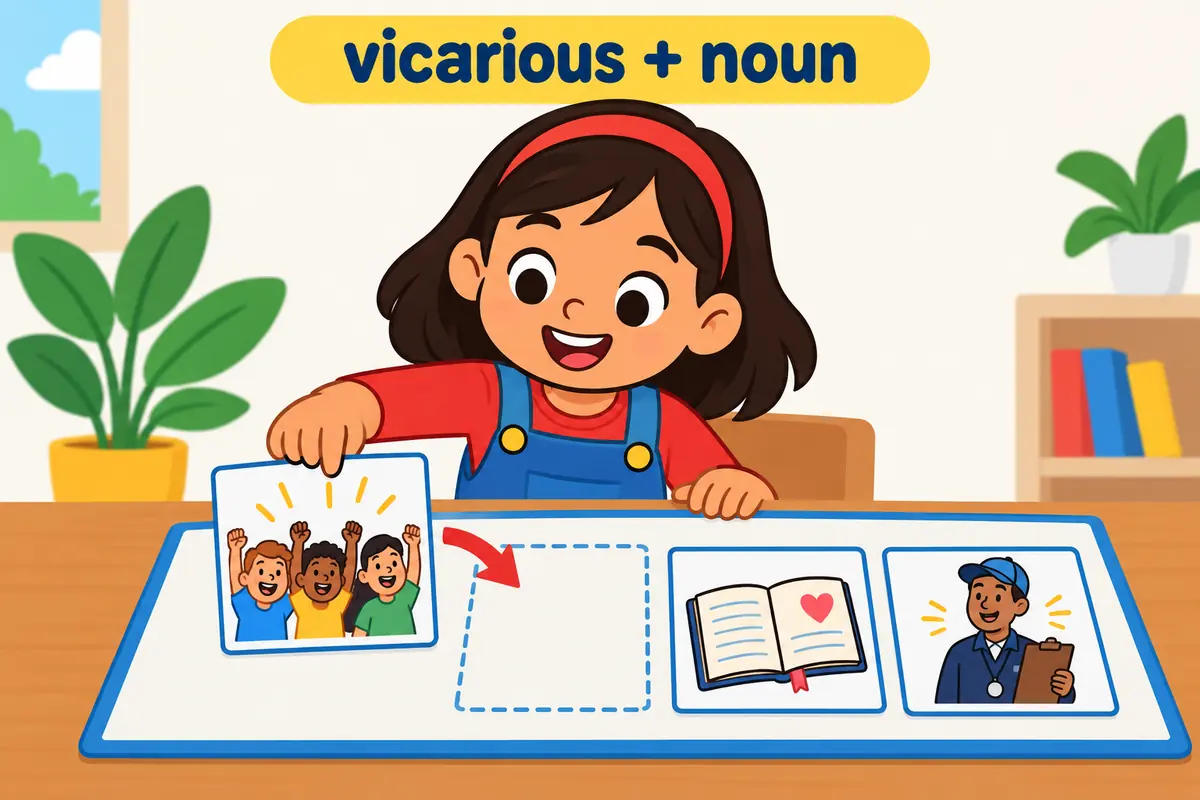
Vicarious in a sentence: examples across contexts
Vicarious keeps its borrowed-experience sense across settings, but the noun beside it decides the register. The eight sentences below move from a playground to a law report, and each names who actually had the experience.
| Context | Example sentence | Why this works |
|---|---|---|
| Classroom | The class felt vicarious pride when their classmate won the cup. | Names the group that shared the feeling indirectly. |
| Workplace email | We take vicarious credit for the intern’s clean report. | Signals genuine but indirect involvement. |
| News report | Fans enjoyed a vicarious triumph as their old club won. | The distance between fan and team is explicit. |
| Parenting column | Many parents live vicariously through their children. | The fixed adverb phrase states the habit plainly. |
| Legal writing | Vicarious liability can rest on an employer for a worker. | A technical term used with its exact sense. |
| Book review | The memoir gives a vicarious taste of desert travel. | The reader experiences the journey secondhand. |
| Sports commentary | The bench shared a vicarious joy in the winning goal. | Links a group emotion to another person’s action. |
| Conversation | I get a vicarious kick from her cooking videos. | The informal noun kick keeps the tone light. |
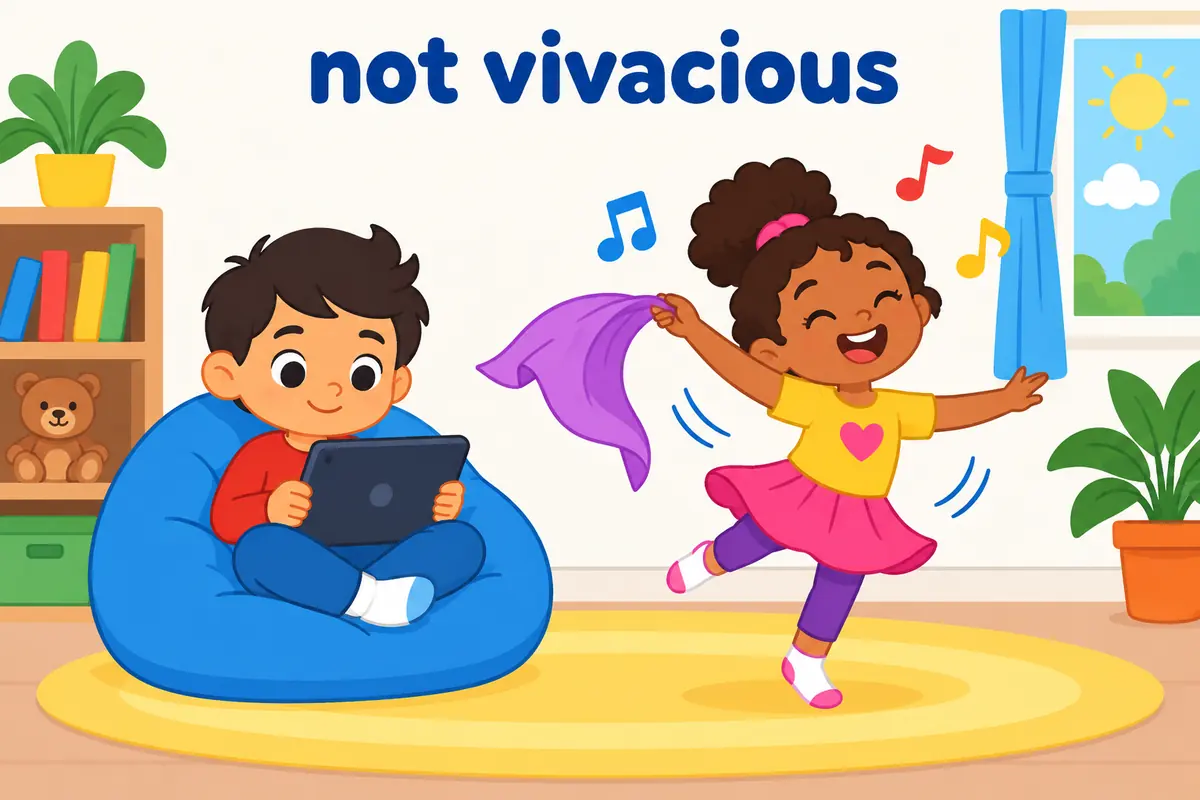
Vicarious vs vivacious
Vicarious and vivacious look and sound alike, and they describe completely different things. Vicarious is about experience borrowed from another person; vivacious is about a lively, energetic personality. A single letter separates them.
| Attribute | vicarious | vivacious |
|---|---|---|
| Core meaning | Experienced through somebody else | Lively, spirited and full of energy |
| Describes | A feeling, a role or a duty | A person or a manner |
| Typical noun | Thrill, pleasure, liability | Host, personality, performer |
| Register | Formal, also legal | Literary or complimenting |
| What it implies | Distance from the experience | Warmth and social energy |
Verdict: choose vicarious when the point is secondhand experience, and vivacious only when the point is a sparkling personality.
Word forms and grammar of vicarious
Vicarious has a small, regular family. The adverb does most of the work in speech, and the noun is rare but correct. The table lists each form with its typical setting.
| Form | Part of speech | Example |
|---|---|---|
| vicarious | adjective | She felt a vicarious delight. |
| vicariously | adverb | He lived vicariously through the team. |
| vicariousness | noun, rare | The novel’s vicariousness is its charm. |
| vicar | noun, unrelated | The vicar led the service. |
| vicious | adjective, unrelated | A vicious rumour spread quickly. |
The adverb vicariously is far commoner than the adjective in everyday speech, because the phrase live vicariously through has become fixed.
Common mistakes with vicarious
- Incorrect:
She was vicarious when she heard the news.Correct: She felt a vicarious joy when she heard the news. Rule: Vicarious describes the feeling, not the person, so it needs a noun such as joy before it can follow felt. - Incorrect:
The show was vicarious and full of energy.Correct: The show was vivacious and full of energy. Rule: Vivacious means lively; vicarious means experienced through another person. - Incorrect:
I vicariously the concert through my sister.Correct: I lived vicariously through my sister at the concert. Rule: Vicariously is an adverb, so it must modify a verb such as lived, not stand alone. - Incorrect:
He felt vicariously proud of himself.Correct: He felt vicariously proud of his daughter. Rule: The pride belongs to another person, so the phrase needs that person after it. - Incorrect:
The vicarious was strong.Correct: The vicarious pleasure was strong. Rule: The adjective cannot be used as a noun; supply the noun it describes.
Practice using vicarious
Work through the six items, then read the reasons rather than only the answers.
- Fill the gap: Grandfather took ______ pride in his granddaughter’s medal.
- Choose the better word: The host was warm and (vicarious / vivacious).
- Correct the error: I vicarious her travels through her letters.
- Build a sentence: use live vicariously through about a football fan.
- Spot the register: which belongs in a law essay, vicarious liability, or I got a vicarious buzz?
- Rewrite with the adverb: He enjoyed his son’s success secondhand. Use vicariously instead.
Answers
- vicarious — the pride is felt on another person’s behalf, so the adjective precedes pride.
- vivacious — the host is lively; vicarious describes borrowed experience.
- I live vicariously through her travels — the adverb must modify a verb such as live.
- Model answer: The fan lives vicariously through the club he supports.
- vicarious liability — the fixed legal term suits a formal essay.
- He enjoyed his son’s success vicariously — the adverb explains how he enjoyed it.
The bottom line
Use vicarious in a sentence when a feeling, an experience or a duty passes from one person to another, and let the following noun say which. Two nuances decide most uses. The adjective is attributive, so it normally needs a noun such as thrill or liability, while the adverb vicariously follows a verb in the phrase live vicariously through. Keep vicarious apart from vivacious, and the meaning stays clear.
Frequently asked questions about vicarious
Is vicarious a formal word?
Vicarious sits in formal and written registers, and it is a fixed term in law. In conversation the adjective sounds stiff, so most speakers reach for the adverb instead: I lived vicariously through my sister. The legal phrase vicarious liability is entirely standard and belongs in any professional document.
What is the difference between vicarious and vivacious?
Vicarious means experienced through another person, as in a vicarious thrill, while vivacious means lively and full of energy, as in a vivacious host. The words differ by one letter and by everything else: vicarious describes distance from an experience, vivacious describes a sparkling personality.
Can vicarious describe a person?
Vicarious describes a feeling, a role or a duty rather than a person, so a person is never simply vicarious. A person can feel vicarious pride or carry vicarious responsibility, and both need the noun that names what is borrowed. The adverb is the form that attaches to what a person does.
What does living vicariously mean?
Living vicariously means enjoying experiences through somebody else instead of having them yourself, as when a fan celebrates a team’s victory. The feeling is genuine even though the achievement is not your own. The phrase live vicariously through has become fixed, and through names the person whose life supplies the experience.
Have you ever experienced something through another person’s perspective? This is what we call a “vicarious” experience.
The term “vicarious” refers to experiencing something indirectly or secondhand through someone else.
7 Examples Of Vicarious Used In a Sentence For Kids
- The girls read about vicarious adventures in their storybook.
- The boys played with toy cars pretending to have a vicarious race.
- The children watched a movie about vicarious experiences in outer space.
- The friends shared vicarious thrills while playing make-believe superheroes.
- The siblings enjoyed vicarious travels through a virtual reality game.
- The classmates felt vicarious joy as they watched a puppet show together.
- The students felt vicarious excitement as they listened to a thrilling tale.
14 Sentences with Vicarious Examples
- While watching a live cricket match, I experienced vicarious excitement as my friends cheered for every boundary and wicket.
- As I listened to my classmates recount their adventurous trekking trip, I couldn’t help but feel a vicarious thrill imagining the stunning views they must have seen.
- Through my friend’s detailed description of his internship at a prestigious company, I experienced a vicarious sense of accomplishment and success.
- Watching a documentary on wildlife conservation efforts, I felt a vicarious sense of pride in knowing that some college students were actively involved in such impactful projects.
- Attending a literature seminar, I gained a vicarious understanding of complex literary theories from the insightful discussions led by professors and scholars.
- After hearing about a colleague’s fascinating research project, I experienced a vicarious sense of intellectual curiosity and excitement about delving into new academic pursuits.
- Reading a travel blog written by a college student exploring offbeat destinations, I felt a vicarious sense of wanderlust and adventure.
- Watching a dance performance showcasing various traditional Indian styles, I was filled with a vicarious appreciation for the dedication and skill of the young performers.
- Hearing about a peer’s successful participation in a Model United Nations conference, I felt a vicarious sense of pride in their diplomatic accomplishments.
- Engaging in a lively debate club session, I experienced a vicarious thrill as my peers passionately argued their viewpoints on current social issues.
- Attending a music concert featuring a talented college band, I felt a vicarious sense of joy and energy from the electrifying performance.
- Listening to a guest lecture by a renowned professor, I gained a vicarious understanding of cutting-edge research and innovative ideas shaping academia.
- Watching a college football match, I cheered enthusiastically for my team, feeling a vicarious rush of adrenaline with every play and goal.
- Discussing a classmate’s internship experience in a foreign country, I experienced a vicarious sense of cultural immersion and learning through their vivid stories.
How To Use Vicarious in Sentences?
Vicarious is used to describe experiencing something through someone else’s actions or feelings. When using vicarious in a sentence, you can convey that you are imagining yourself in someone else’s place. For example, “I had a vicarious thrill watching my friend bungee jump because I felt the excitement as if I were the one jumping.”
To use vicarious effectively, ensure that you understand the context in which you are using the word. This will help you accurately convey the idea of experiencing something indirectly. For instance, “Through her detailed storytelling, she allowed the audience to have a vicarious experience of traveling to exotic lands.”
Remember that vicarious is often used to express a sense of living through someone else’s experiences, emotions, or actions. By using this word in your writing or conversation, you can add depth and complexity to your expression. For instance, “As a sports fan, I get a vicarious sense of achievement when my favorite team wins a championship.”
Practice using vicarious in various contexts to become more comfortable with its usage. Experiment with incorporating this word into your everyday language to enhance your communication skills and vocabulary.
Conclusion
In conclusion, vicarious experiences are powerful tools that allow individuals to learn and grow through observing the experiences of others. By immersing oneself in another person’s feelings, actions, or experiences, individuals can gain insights and perspectives that they may not have had otherwise. Through vicarious learning, individuals can expand their knowledge, empathy, and understanding of the world around them.
From reading books to watching movies or even learning from someone else’s mistakes, vicarious experiences offer a unique way to gain knowledge and wisdom without directly experiencing something firsthand. By cultivating a sense of empathy and understanding through vicarious experiences, individuals can develop a greater appreciation for the diverse array of human experiences and emotions, ultimately enriching their own lives.


