To vie for something is to compete eagerly with others to win it. The phrasal verb vie for keeps for before the prize, and its subject is almost always plural because rivals are implied. Consider “Three cities are vying for the games.”
Vie for at a glance
- Vie for is a phrasal verb; its forms are vie, vies, vied and vying.
- For is a preposition, so vie for is inseparable and the prize always follows for.
- The subject is usually plural or collective: cities, teams, firms, candidates, rivals.
- The pattern vie with X for Y names both the rival and the prize in one sentence.
- The register is journalistic and formal; compete is the neutral everyday verb.
- The commonest spelling error is writing vieing instead of the correct vying.
What does vie for mean?
Vie for is a phrasal verb meaning to compete eagerly with others in order to win or obtain something. The Cambridge entry for vie for records the verb vie and its for pattern, and it is the shape almost every sentence uses. The first sense is a contest for a limited prize: a contract, a title, a place. The second sense is a contest against a named opponent, introduced by with. A third sense describes competing to be the one who does something, expressed with to plus a verb.
| Sense | Plain meaning | Example sentence |
|---|---|---|
| Compete for a prize | Two or more parties want the same thing | Five firms are vying for the contract. |
| Compete against a rival | The opponent is named with with | She vied with her sister for the lead role. |
| Compete to act | Parties want to be the one who does something | Two towns vie to host the final. |
The word carries a strong suggestion of eagerness, so it suits contests where several hopefuls genuinely want the same prize. It is not a word for a lone contestant and not a word for a quarrel, because vie assumes rivals and a sought-after goal. When only one person is taking part, compete is the accurate choice; when the effort is sustained and serious, strive or battle may fit better.
How do you use vie for in a sentence?
Vie is an intransitive verb, which means it never takes a direct object. The thing being sought is always introduced by a preposition, most often for, and the rival is introduced by with. Because for is a preposition rather than a movable particle, vie for cannot be separated: you cannot write vie the contract for, and for cannot strand at the end of the clause. The table sets out the shapes that cover almost every sentence.
| Pattern | Example | What it signals |
|---|---|---|
| vie for + noun | Five firms are vying for the contract. | The prize is named; the rivals stay general |
| vie with + rival + for + noun | She vied with her sister for the lead role. | Both the opponent and the prize are named |
| vie to + verb | Two towns vie to host the final. | The prize is an action, not a thing |
| be vying for + noun | The startups are vying for attention. | An ongoing, current contest |
| vie against + rival | They vie against each other every season. | Less common, but shows a standing rivalry |
| vying + noun | The vying candidates gave short speeches. | A participle used as an adjective |
Two rules keep the verb safe. First, keep the subject plural or collective, because a single subject with no rivals reads oddly: the city is vying for the games only works if other cities are understood. Second, never insert the prize between vie and for. The preposition locks the two words together.

Vie for in a sentence: examples across contexts
Vie for moves comfortably between sport, business, politics and culture, and each setting changes what counts as the prize. The table gives ten registers with the reason each sentence works.
| Context | Example sentence | Why this works |
|---|---|---|
| Sports report | Four clubs are vying for the title. | A plural subject and a single prize suit the verb exactly. |
| Business news | Three builders vied for the stadium contract. | Past tense reports a completed contest for a fixed job. |
| Politics | Six candidates are vying for the party leadership. | The continuous form shows a race still in progress. |
| Travel writing | Two coastal towns vie for the summer visitors. | Present tense states an ongoing seasonal rivalry. |
| Technology press | Startups are vying for a share of the market. | for plus a noun names the goal, not a rival. |
| Academic writing | Rival theories vied for acceptance throughout the decade. | Abstract rivals can vie for an idea, not just a prize. |
| Culture pages | The two actresses vied for the same role. | for marks the single contested role. |
| Broadcast news | Several networks are vying to host the debate. | vie to plus a verb frames the prize as an action. |
| Local paper | Village teams vie with one another for the cup. | with names the rivals and for names the trophy. |
| Feature article | Young chefs vie for a place in the final. | A collective subject keeps the focus on the contest. |
Vie for vs compete for
The word readers most often weigh against vie for is compete for, because the two overlap almost completely in meaning. They differ in intensity, in how many rivals are implied, and in register.
| Attribute | Vie for | Compete for |
|---|---|---|
| Core meaning | Contend eagerly for a prized goal | Take part in a contest for a goal |
| Intensity | Strong, eager rivalry | Neutral, factual participation |
| Rivals implied | Usually several, always at least two | One or more |
| Typical subject | Cities, teams, firms, candidates | Any person, team or company |
| Register | Journalistic and formal | Neutral, used everywhere |
| Other patterns | vie with X for Y, vie to do Y | compete with X, compete to do Y |
Choose vie for when the eagerness of the contest is the point, and compete for when you simply need to state who is taking part. When the effort is a long, determined struggle rather than a race, contend, strive or rival may carry the meaning more precisely. In a quick contest for a single goal, race is a plainer alternative to vie.
Word forms and grammar of vie for
Vie is a regular verb with one spelling trap in the -ing form, where the ie changes to y. The table lists the forms learners need and marks the shapes that are not standard.
| Form | Part of speech | Example |
|---|---|---|
| vie for | Base phrasal verb | They vie for the prize. |
| vies for | Third-person singular | She vies for the top spot. |
| vied for | Past tense and past participle | They vied for the cup last year. |
| vying for | Present participle | They are vying for the lead. |
| vying | Attributive participle | The vying teams trained hard. |
| vieing for | Non-standard spelling | Avoid; the correct form is vying for. |
| vie for to win | Non-standard | Avoid; write vie to win or vie for the win. |
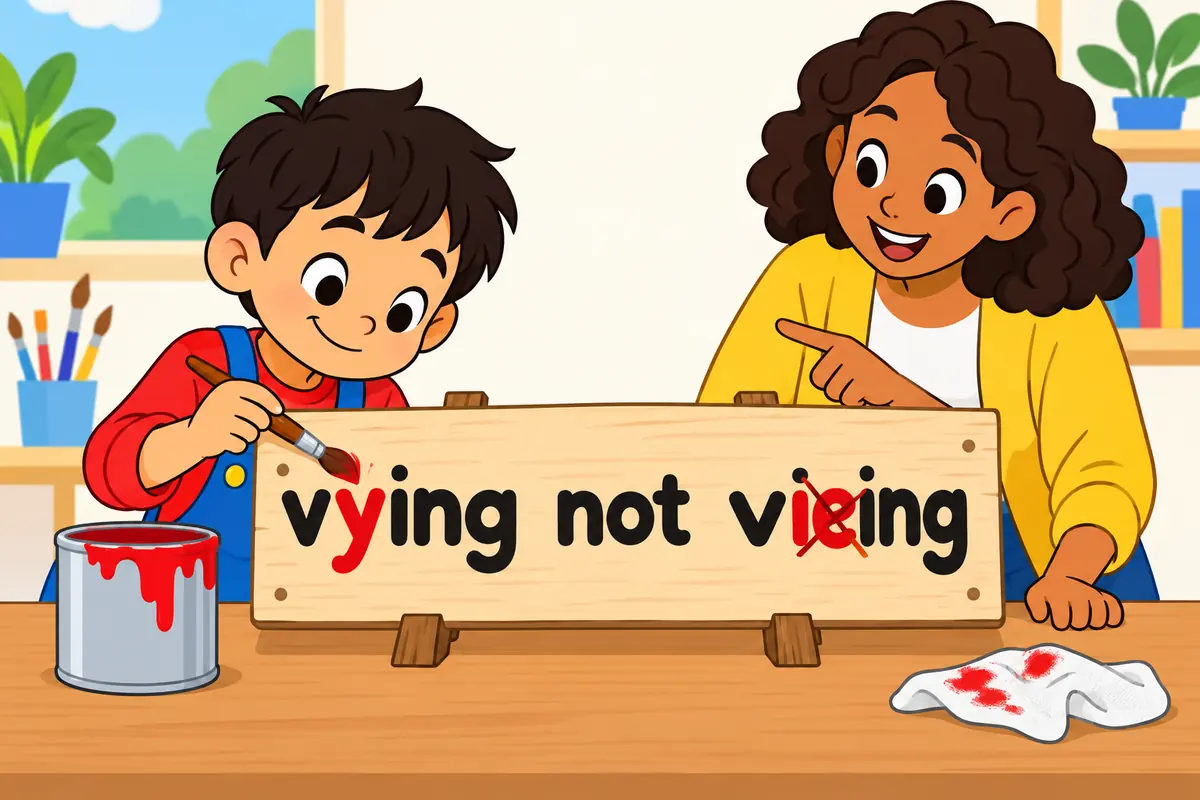
The spelling rule is simple: when a verb ends in ie, the -ing form changes the ie to y. That gives vying, not vieing, the same way die becomes dying. It is the single most common error with this verb.
Common mistakes with vie for
- Incorrect: The two teams are vieing for the cup. Correct: The two teams are vying for the cup. Rule: a verb ending in ie changes to y before -ing.
- Incorrect: She vied the scholarship. Correct: She vied for the scholarship. Rule: vie is intransitive, so the prize needs the preposition for.
- Incorrect: He vied for to lead the project. Correct: He vied to lead the project. Rule: use vie to plus a verb, never for to.
- Incorrect: They vied the contract for. Correct: They vied for the contract. Rule: for is a preposition and cannot strand at the end.
- Incorrect: He vied with the other players. (meaning he fought them) Correct: He argued with the other players. Rule: vie means compete for a goal, not quarrel.
- Incorrect: Only one runner vied for the medal. Correct: Only one runner competed for the medal. Rule: vie implies rivals, so a lone contestant competes.
Practice using vie for
- Fill in the blank: Six startups are ______ for the same investors.
- Choose the better word: With no other entrant, she simply ______ for the place. (vied / competed)
- Correct the error: Two cities are vieing for the games.
- Build a sentence: use vie with + a rival + for + a prize.
- Spot the register: which sentence belongs in a news report? (a) We all want the prize. (b) Three firms are vying for the contract.
- Fill in the blank: The young chefs ______ to impress the judges last night.
- Correct the error: They vied the trophy.
- Fill in the blank: Rival theories have ______ for support for decades.
Answers
- vying — the continuous form needs the participle, spelled vying.
- competed — a lone contestant competes; vie needs rivals.
- Two cities are vying for the games. — the -ing form changes ie to y.
- Model: The champion vied with her rival for the title. — with names the rival and for names the prize.
- (b) Three firms are vying for the contract. — the eager verb and plural subject suit a news report.
- vied — the past time phrase needs the past tense.
- They vied for the trophy. — the prize must follow the preposition for.
- vied — the present perfect takes the past participle vied.
The bottom line
Vie for is the eager verb of competition, and it keeps for locked before the prize while its subject stays plural or collective. Use it when several rivals genuinely want the same thing, and use compete for when you only need to state who is taking part. The one spelling to memorise is vying, because vie for in a sentence so often appears in its continuous form.
Frequently asked questions about vie for
How do you spell the -ing form of vie?
The -ing form is vying, spelled v-y-i-n-g. When a verb ends in ie, the ie changes to y before the -ing ending, just as die becomes dying and lie becomes lying. The misspelling vieing is common, but it is never correct in standard English, so check the spelling whenever the continuous form appears.
Is vie for transitive or intransitive?
Vie is intransitive, so it never takes a direct object. The prize is introduced by the preposition for, as in vie for a place, and a rival is introduced by with, as in vie with a rival for a place. Because for is a preposition, it stays fixed and can never be separated from the verb.
Can a single person vie for something?
Vie normally implies rivals, so it needs at least an understood competition. A sentence such as the only entrant vied for the prize sounds odd because nobody else is competing. When only one party takes part, compete is the accurate verb; reserve vie for contests where two or more rivals want the same goal.
What is the difference between vie for and vie with?
Vie for names the prize: teams vie for the cup. Vie with names the rival: she vied with her sister. The two often appear together, as in vie with a rival for a prize, which names both the opponent and the goal. Choose the pattern that matches the information your sentence needs to give.