
Vie means to compete eagerly with others for something, and to use vie in a sentence you pair it with for, with or to: “Three firms vie for the contract.” The verb is intransitive, so it never takes a direct object, and its -ing form drops the ie to become vying.
Vie at a glance
- Vie is an intransitive verb; its forms are vie, vies, vied and vying.
- The dominant patterns are vie for a prize, vie with a rival and vie to do something.
- Vie belongs to fairly formal writing, common in journalism and sports reporting.
- Typical subjects are firms, teams, candidates, cities and nations.
- The commonest error is misspelling the -ing form as vieing instead of vying.
What does vie mean?
Vie is an intransitive verb meaning to compete eagerly with someone for the same thing. The Cambridge entry for vie records the sense of struggling or competing for superiority. One sense stresses the prize, as when candidates vie for a single seat; a second stresses the rivalry itself, as when two athletes vie throughout a final. The competition is usually keen but not hostile, which is why vie suits sport, markets and awards. Where the struggle is long and serious, strive is often the better verb, because vie implies a contest with rivals rather than effort against difficulty. The word is also too grand for a friendly disagreement: two friends arguing over a bill are not vying, because no prize is at stake.
| Sense | Plain meaning | Example sentence |
|---|---|---|
| Compete for a prize | Rival others to win something | Six singers vie for one place. |
| Contend with a rival | Struggle against an opponent | The two clubs vied all season. |
| Stake a claim | Press a claim in a contest | Several ports vied to host the race. |
How do you use vie in a sentence?
The verb cannot take a direct object, so the thing contested arrives through a preposition or an infinitive. The table sets out the patterns that sound natural.
| Pattern | Example | What it signals |
|---|---|---|
| vie for + prize | Three firms vie for the contract. | For names what is being won. |
| vie with + rival | She vied with her sister for the lead. | With names the opponent. |
| vie to + verb | Cities vie to host the final. | To plus an infinitive names the goal. |
| vying (participle) | The teams are vying for a place. | The -ing form drops the ie. |
| vied (past) | They vied for the same seat last year. | Past tense is regular. |
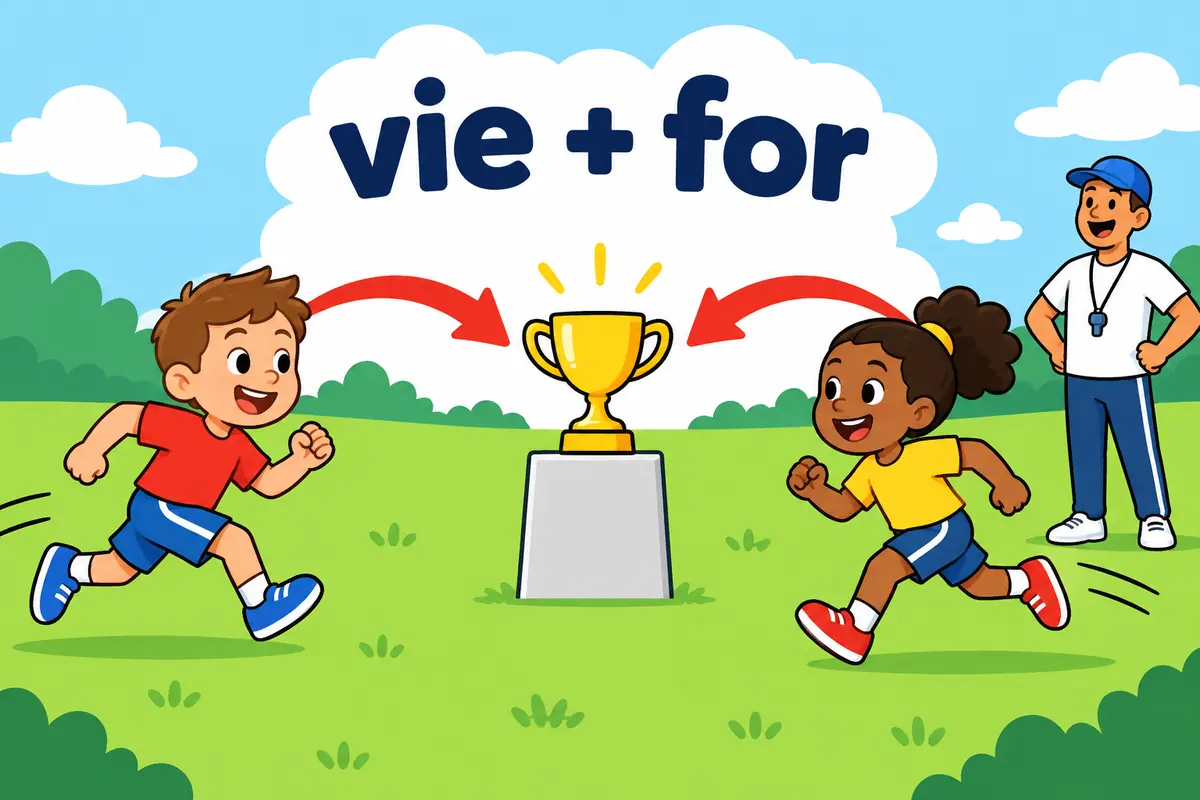
Vie in a sentence: examples across contexts
| Context | Example sentence | Why this works |
|---|---|---|
| Sports writing | Two sprinters vie for the season title. | Names rivals and prize in one line. |
| Business news | Several airlines vie for the busy route. | Formal register suits the verb. |
| Politics | Candidates vie to lead the party. | To plus infinitive names the goal. |
| Academic writing | Competing theories vie for acceptance. | Abstract subject reads naturally. |
| Conversation | The cousins always vie for grandma’s attention. | Shows an informal, light rivalry. |
| Event bidding | Three cities vied to stage the games. | Past tense with a shared aim. |
| Technology | Small apps vie with giants for users. | With names the stronger rival. |
| School report | The pupils vied for a place in the choir. | Everyday contest, clear prize. |
Vie vs via and compete
Learners confuse vie with two very different words, one a lookalike and one a synonym.
| Attribute | Vie | Via | Compete |
|---|---|---|---|
| Part of speech | Verb | Preposition | Verb |
| Core meaning | Rival others for a prize | By way of a place or method | Take part in a contest |
| Typical pattern | vie for, vie with, vie to | travel via Paris | compete for, compete in |
| Register | Fairly formal | Neutral | Neutral and common |
| Strength | Keen, ongoing rivalry | No rivalry at all | General and broad |
Keep compete for everyday contests and vie when the rivalry is keen and the prize is named; via is a preposition and never means competing. A rival who vies for a place may have to answer a formal challenge, and when the contest becomes a long struggle, a plainer verb reads better.
Word forms and grammar of vie
| Form | Part of speech | Example |
|---|---|---|
| vie | Verb (base) | They vie for the top prize each spring. |
| vies | Verb (third person) | She vies with the best in the county. |
| vied | Verb (past) | The two sides vied for control. |
| vying | Verb (present participle) | The teams are vying for a place. |
| have vied | Verb (past participle) | Rivals have vied for the cup for years. |
| vieing | Non-standard | Incorrect: They are vieing for the cup. |
The related noun rivalry and the verb rival cover the same idea from the opponent’s side.
Common mistakes with vie
- Incorrect:
They are vieing for the cup.Correct: They are vying for the cup. Verbs ending in -ie change to y before -ing. - Incorrect:
The teams vied the trophy.Correct: The teams vied for the trophy. Vie is intransitive, so it needs for before the prize. - Incorrect:
They vied to the contract.Correct: They vied for the contract. To introduces a verb, not the prize itself. - Incorrect:
She vied with winning the race.Correct: She vied to win the race. With takes a rival, while to takes an infinitive. - Incorrect:
He vyes for the lead.Correct: He vies for the lead. The third person drops the e and adds s.
Practice using vie
Work through the six items, then check the reasoning rather than only the answer.
- Fill the gap: Four chefs ______ for the single prize.
- Choose the better word: The two nations (vied / vied with) each other for the trade deal.
- Correct the error: The startups are vieing for the same customers.
- Build a sentence: use vie to about towns seeking a music festival.
- Spot the register: which belongs in a news report, the ports vied to host the fleet, or the ports totally fought over the fleet?
- Rewrite in the past: The clubs are vying for promotion. Use the past tense.
Answers
- vie. Four chefs is plural, so the base form follows the plural subject.
- vied with. With names the rival, so the second option fits the sentence.
- The startups are vying for the same customers. The -ing form of vie is vying.
- Model answer: Several towns vie to host the summer music festival.
- The ports vied to host the fleet. A news report avoids totally and keeps the verb precise.
- The clubs vied for promotion. Vied is the regular past tense of vie.
The bottom line
Use vie in a sentence when rivals compete keenly for a named prize, and attach the prize with for, the opponent with with, or the goal with to. Two details decide most sentences: the verb is intransitive, so it never takes a direct object, and the -ing form is vying, not vieing. For ordinary contests, contend or compete is the plainer choice.
Frequently asked questions about vie
How do you spell the -ing form of vie?
The -ing form is vying, spelled v-y-i-n-g. Verbs that end in -ie drop the e and change the i to a y before adding -ing, so vie becomes vying, die becomes dying and lie becomes lying. The spelling vieing is a common slip but it is never correct in standard English.
Is vie transitive or intransitive?
Vie is intransitive, so it cannot take a direct object. You cannot say they vied the trophy. Instead, the prize follows for, as in they vied for the trophy, or the rival follows with, as in they vied with their neighbours. The verb always links to its target through a preposition or an infinitive.
What is the difference between vie and compete?
Both mean to take part in a contest, but vie is keener and more formal. Compete is neutral and fits any contest, from a race to a job interview. Vie suggests an ongoing, eager rivalry, often for one desirable prize, and it appears mostly in journalism and formal prose rather than everyday speech.
Can vie be used in everyday conversation?
Vie can appear in speech, but it sounds more formal than compete or fight over. A person might say the cousins vie for grandma’s attention, which is natural and light. In casual talk, though, most speakers reach for compete or fight over, and save vie for writing that needs a precise, slightly elevated verb.
Have you ever come across the word “vie” in a sentence and wondered about its meaning? In simple terms, “vie” refers to the act of competing eagerly with someone in order to achieve or obtain something.
In everyday language, when we say someone is vying for a promotion, they are competing with others for that position. Similarly, when multiple cities vie for the opportunity to host a major event, they are all competing against each other. Let’s explore further how “vie” is used in different contexts and sentences to better understand its significance.
7 Examples Of Vie Used In a Sentence For Kids
- Vie for the top spot in the race.
- Let’s vie to see who can jump the highest.
- We can vie to see who can run the fastest.
- Vie for the juiciest mango in the basket.
- Let’s vie to be the first one to finish the puzzle.
- Vie to see who can color the most pictures.
- We can vie to be the best at playing tag.
14 Sentences with Vie Examples
- Students vie for top positions in college competitions to showcase their talents.
- Many college students vie for internships at reputed companies to gain valuable work experience.
- In the competitive world of academics, students often vie for scholarships to ease the financial burden of college fees.
- College sports teams constantly vie for victory in matches and tournaments to bring glory to their institution.
- Aspiring writers vie for a chance to have their work published in the college magazine.
- Students vie for the attention of recruiters during campus placement drives to secure job offers.
- During college festivals, various teams vie for the title of best decorated stall or most entertaining performance.
- For coveted spots in study groups, students often vie to impress their peers with their knowledge and skills.
- In order to represent the college at prestigious events, students must vie for selection in the student council.
- As the deadline for submitting research papers approaches, students vie to access relevant resources in the library.
- Students vie for leadership positions in college organizations to enhance their leadership skills.
- In heated debates, students vie to present their arguments persuasively and convincingly.
- College students often vie for spots in popular elective courses with limited availability.
- During job fairs and recruitment events, students vie to make a lasting impression on potential employers.
How To Use Vie in Sentences?
To use “Vie” in a sentence, start by understanding that this word means the quality of life or the way of living. Here is a simple guide for beginners to effectively incorporate this word into a sentence:
-
Choose the right context: Consider what you want to convey – whether it’s discussing the quality of life, a lifestyle choice, or the way someone is living.
-
Place “Vie” correctly: In your sentence, “Vie” should typically come after the subject and any descriptive words to make it clear how it relates to the rest of the sentence.
-
Use connecting words: To make the sentence flow smoothly, consider using connecting words like “in,” “of,” or “for” before and after “Vie.” For example, “She has a passion for the vie of a minimalist.”
-
Consider the overall message: Before finalizing your sentence, make sure that the use of “Vie” accurately conveys the intended meaning.
-
Practice makes perfect: Finally, practice using “Vie” in different sentences to become more comfortable incorporating it into your everyday language.
By following these steps, beginners can effectively incorporate the word “Vie” into their sentences and improve their overall communication skills.
Conclusion
In conclusion, the examples of sentences with the keyword “vie” demonstrate its use in contexts where individuals compete or strive for something, such as power, success, or admiration. These sentences illustrate the competitive nature inherent in human interactions, highlighting the drive to surpass others and achieve personal goals. From businesses vying for market dominance to athletes competing for championship titles, the word “vie” captures the essence of rivalry and ambition in various endeavors.
Overall, the versatility of “vie” in expressing the concept of competition adds depth and nuance to sentences, emphasizing the relentless pursuit of excellence and recognition. By observing how “vie” is employed in different scenarios, we gain insight into the dynamics of ambition and the enduring human desire to excel and outperform others.


