Vitiate means to spoil, weaken or make ineffective, and in law it means to make an agreement or process invalid. To use vitiate in a sentence, name what is damaged and what damages it: “The fraud vitiated the entire contract.” The verb is transitive and formal, so it appears mostly in legal, academic and technical writing.
Vitiate at a glance
- Vitiate is a transitive verb meaning to spoil, weaken or invalidate; its forms are vitiates, vitiated, vitiating and vitiation.
- The two main senses are spoiling quality or effectiveness and, in law, making something legally invalid.
- Its usual subject is a fault, defect, fraud, error or impurity, and its object is a process, contract, argument or result.
- The phrase vitiated by introduces the cause, as in consent vitiated by fraud.
- It belongs to legal, academic and technical writing and sounds overblown in ordinary speech.
- The commonest error is confusing vitiate with mitigate, which means almost the opposite.
What does vitiate mean?
Vitiate is a transitive verb meaning to spoil or weaken the quality, force or effectiveness of something, and in legal use to make it invalid. The Cambridge entry for vitiate records the general sense of spoiling or reducing effectiveness and the legal sense of destroying validity. A flaw does not have to destroy a thing outright to vitiate it; it is enough to impair the hearing of a case or to undermine the case that rests on it.
| Sense | Plain meaning | Example sentence |
|---|---|---|
| Spoil quality | Lower the worth or purity of something | Impurities vitiate the taste of the water. |
| Weaken effectiveness | Reduce the force or validity of an argument | One false premise vitiates the whole proof. |
| Make legally invalid | Deprive a contract or process of legal force | The conflict of interest vitiated the tender. |
| Corrupt morally, literary | Damage the character of something | Old writers feared that wealth vitiated the mind. |
One limitation is worth stating plainly. Vitiate is a formal word, and in plain writing spoil, weaken or invalidate usually serve better. The legal sense is also narrower than cancel: vitiate names the defect that removes validity rather than the act of declaring something void. A contract may be vitiated by fraud and still exist on paper until a court acts.
How do you use vitiate in a sentence?
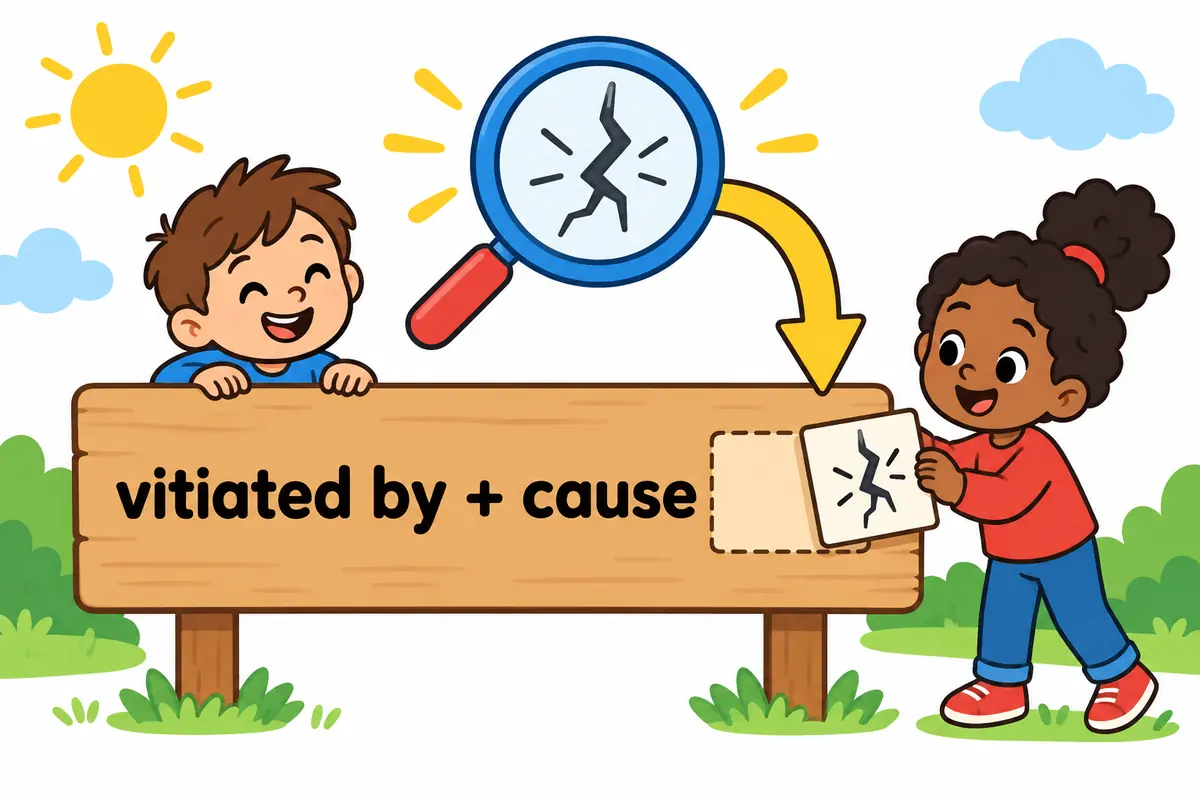
Put the damaged thing directly after the verb, and if you name the cause, put it after by. Six patterns cover the real uses, and the passive with by is the one formal writing relies on most.
| Pattern | Example | What it signals |
|---|---|---|
| vitiate + object | The error vitiates the conclusion. | The object is the thing damaged. |
| be vitiated by + cause | The consent was vitiated by fraud. | Passive use that names the cause after by. |
| vitiate + a contract or process | Bias vitiated the whole tendering process. | The legal sense of removing validity. |
| vitiate + quality or effect | Noise vitiated the quality of the recording. | The technical sense of impairment. |
| vitiate + the force of | Delay vitiated the force of the objection. | Formal phrasing for weakened authority. |
| vitiated (participle) | A vitiated atmosphere hung over the talks. | Participial adjective, rare and literary. |
Vitiate in a sentence: examples across contexts
The twelve sentences below keep the same verb while the setting changes, and each one names the flaw and the thing it damages. A cause can contaminate a sample in science or spoil the result in a kitchen, and vitiate covers both.
| Context | Example sentence | Why this works |
|---|---|---|
| Legal writing | The undisclosed payment vitiated the settlement. | Names the flaw and the legal instrument it destroyed. |
| Contract law | Consent vitiated by duress can undo a contract. | Uses the passive with by to name the cause. |
| Science writing | Trace impurities vitiate the results of the assay. | Applies the spoiling sense to measurement. |
| Academic prose | A single unsupported premise vitiates the argument. | Weakens an argument rather than a physical thing. |
| Business email | A late disclosure vitiated the due diligence report. | Ties a defect to a professional document. |
| News report | Irregularities vitiated the election result, the court ruled. | Legal and institutional framing. |
| Health writing | Poor storage vitiates the potency of the vaccine. | Technical sense of reduced effectiveness. |
| Environment | Runoff vitiated the water quality in the bay. | Spoiling sense with a concrete cause. |
| Conversation | One rushed decision could vitiate months of work. | Keeps the formal verb in a plain sentence. |
| History essay | Court intrigue vitiated the treaty before it was signed. | Blends a political and a legal setting. |
| Sports regulation | An ineligible player vitiated the club’s cup run. | Uses the rules context to weaken a result. |
| Philosophy | A hidden assumption vitiates the syllogism. | Formal logic, where validity is at stake. |
Vitiate vs mitigate
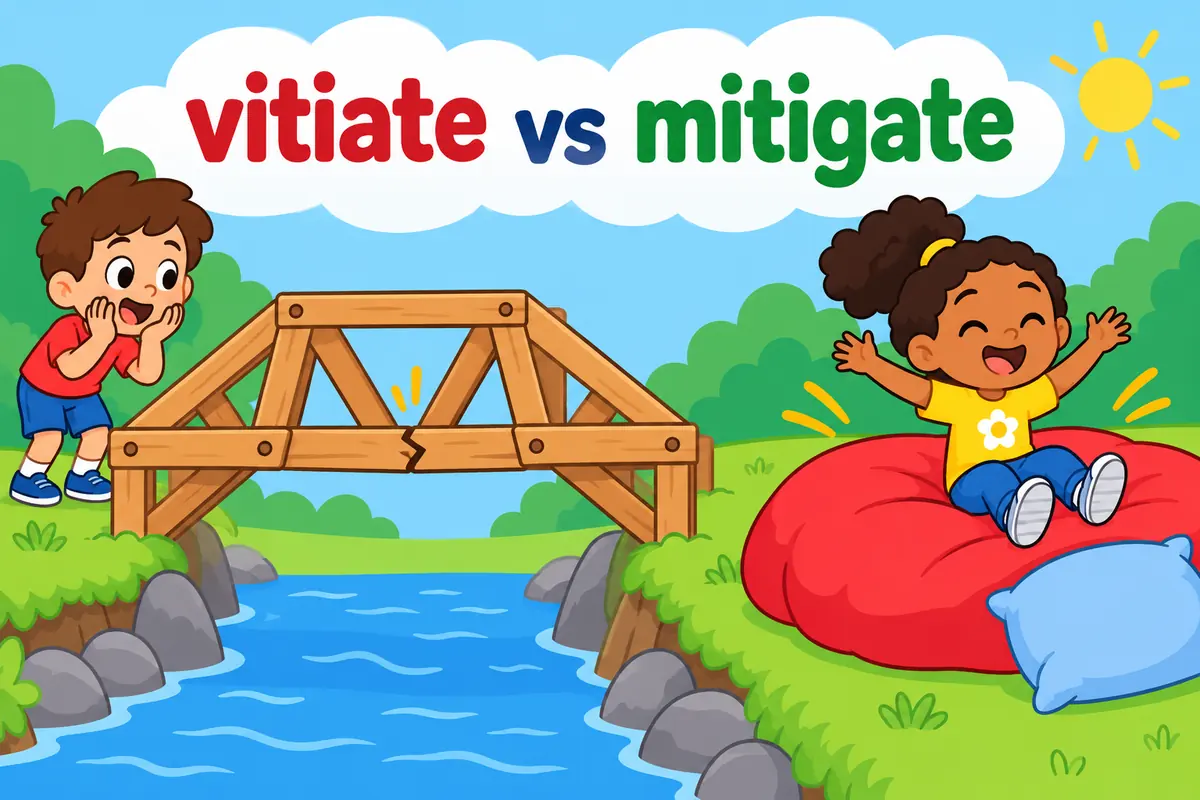
Vitiate and mitigate sound alike and pull in opposite directions. Vitiate makes something worse or removes its validity; mitigate makes a harm less severe. The similarity of the two words is the single commonest trap for learners.
| Attribute | vitiate | mitigate |
|---|---|---|
| Direction | Makes worse or invalid | Makes less severe |
| Typical object | A contract, argument, quality or process | Pain, loss, risk or punishment |
| Effect | Destroys force or value | Reduces intensity or harm |
| Legal use | Yes, invalidating | No |
| Register | Formal, legal and technical | Formal and neutral |
Verdict: choose vitiate to spoil or invalidate and mitigate to soften, and never let the shared rhythm trade their meanings.
Vitiate, invalidate and impair compared
Three verbs sit close to vitiate, and each answers a different question. invalidate states the result, impair describes reduced function, and vitiate names the flaw that damages force or value.
| Attribute | vitiate | invalidate | impair |
|---|---|---|---|
| Core job | Spoil or remove the force of something | Declare or make legally void | Reduce strength or function |
| Who acts | A flaw, fault or impurity | A court, rule or clause | Illness, age or damage |
| Typical object | Contract, argument, quality | Contract, marriage, election | Hearing, vision, function |
| Result | Force or value is lost | Legal status ends | Ability is reduced |
| Register | Formal and legal | Legal and everyday | Medical and formal |
Verdict: use invalidate for the legal outcome, impair for reduced ability, and vitiate when you want to point at the defect doing the damage.
Word forms and grammar of vitiate
Vitiate inflects regularly, and the table also catches a noun form that learners invent and a participial use that is genuinely established.
| Form | Part of speech | Example |
|---|---|---|
| vitiate | verb, base form | Bias can vitiate a whole inquiry. |
| vitiates | verb, third person singular | A single lie vitiates the statement. |
| vitiated | verb, past and past participle | The storm vitiated the harvest. |
| vitiating | verb, present participle | A vitiating error forced a retrial. |
| vitiation | noun | The vitiation of consent was the core issue. |
| vitiated | participial adjective | A vitiated agreement is unenforceable. |
| vitiate | noun — non-standard | Non-standard: The vitiate of the deal caused alarm. |
The related adjective appears in fixed legal phrases such as a vitiated consent, and the noun vitiation names the harm itself.
Common mistakes with vitiate
- Incorrect:
The medicine vitiated the pain.Correct: The medicine mitigated the pain. Rule: Vitiate means make worse or invalid, not relieve. - Incorrect:
The court vitiated the contract was unfair.Correct: The court vitiated the contract. Rule: Vitiate takes a noun object, never a that-clause. - Incorrect:
The fraud vitiated.Correct: The fraud vitiated the agreement. Rule: Vitiate is transitive, so the damaged thing must be named. - Incorrect:
Honestly, the traffic vitiated my whole morning.Correct: Honestly, the traffic ruined my whole morning. Rule: Keep vitiate for formal contexts; ruined is the plain word for a spoiled morning. - Incorrect:
The deal was vitiated.Correct: The deal was vitiated by the undisclosed loan. Rule: The passive usually names the cause with by, so the reader knows what removed validity.
Practice using vitiate
Work through the seven items, then read the reasoning rather than only the key.
- Fill the gap: The hidden payment ______ the fairness of the competition.
- Choose the better word: A warm drink (vitiated / mitigated) the cold.
- Correct the error: The error vitiated.
- Build a sentence: use be vitiated by about a decision undone by a conflict of interest.
- Spot the register: which belongs in a legal memo — the consent was vitiated by duress, or the deal got wrecked?
- Change the form: The judge vitiated the will. Use vitiation instead.
- Rewrite as passive: A clerical error vitiated the results. Use was vitiated by.
Answers
- vitiated — the payment is the flaw that removed the fairness of the competition.
- mitigated — the drink reduced the cold; vitiated would mean it made the cold worse.
- The error vitiated the findings — the verb is transitive and needs an object.
- Model answer: The decision was vitiated by an undisclosed conflict of interest.
- The consent was vitiated by duress — a legal memo keeps the precise passive form.
- The vitiation of the will was challenged in court — the noun names the act of removing validity.
- The results were vitiated by a clerical error — the passive puts the flaw after by.
The bottom line
Use vitiate in a sentence when a flaw, fault or impurity spoils the quality of something or removes its legal force, and name that damaged thing directly after the verb. The two points that settle most sentences are these: vitiate is transitive and formal, so it needs an object and suits legal or academic prose, and its passive almost always names the cause with by. Where you mean to make a harm less severe, debase the standard is a different idea again; the word you want there is mitigate.
Frequently asked questions about vitiate
What is the difference between vitiate and mitigate?
Vitiate means to spoil, weaken or make invalid, so it makes a thing worse or removes its force. Mitigate means to make a harm less severe, so it reduces damage. They sound similar and are often confused, but they point in opposite directions: fraud vitiates a contract, while an apology mitigates a loss.
What does vitiated by mean in law?
Vitiated by names the defect that removes the legal force of something. Consent vitiated by fraud means the agreement was given because of a deception, so it may be unenforceable. The phrase points at the cause after by, and it describes the flaw rather than a court order declaring the document void.
Is vitiate a common word?
Vitiate is uncommon outside legal, academic and technical writing, where it names spoiling or invalidating with precision. In everyday speech people say ruined, weakened or cancelled instead. Using vitiate in a casual sentence sounds deliberately formal, so reserve it for contexts that need the exact legal or scientific sense.
How do you pronounce vitiate?
Vitiate has three syllables with the stress on the first: VISH-ee-ayt. The t before i sounds like sh, so the opening is not vit as in vitamin. The middle syllable is a quick ee, and the last syllable rhymes with late. The past tense vitiated adds an extra syllable at the end.