
Volatile describes something that changes quickly and unpredictably, from a liquid that evaporates to a market, mood or match that will not stay settled. To use volatile in a sentence, put the adjective before the noun it describes: “a volatile market.” The word rarely stands alone at the end of a clause.
Volatile at a glance
- Volatile is an adjective; its noun is volatility, and it has no common adverb in everyday use.
- The dominant pattern is adjective plus noun, as in a volatile market or a volatile compound.
- Its two main senses are chemically unstable, and likely to change fast and unpredictably.
- Volatile belongs to finance, science and news writing more than to casual conversation.
- The commonest error is treating volatile as a plain synonym for bad or angry.
What does volatile mean?
Volatile is an adjective meaning either easily evaporated and chemically unstable, or liable to change rapidly and unpredictably. The Cambridge entry for volatile records both senses, and the difference is the difference between a laboratory and a trading desk. A jar of volatile solvent is a physical danger, while a volatile share price is an economic one, and in both cases the word warns that the thing will not hold its current state. When a writer means only that a number fell, unpredictable describes the pattern without the extra sense of risk.
| Sense | Plain meaning | Example sentence |
|---|---|---|
| Chemically unstable | Evaporates or reacts easily, often dangerously | The volatile solvent must be kept away from the flame. |
| Quick to change | Rises, falls or shifts without warning | The volatile exchange rate unsettled importers. |
| Easily stirred | Changes mood or temper rapidly | His volatile temper cleared as fast as it came. |
One limitation is worth stating plainly. Volatile does not mean simply bad, and it does not mean broken. A volatile asset can be profitable and a volatile reaction can be useful in a process. The word measures how fast something moves, not whether that movement helps or harms.
How do you use volatile in a sentence?
Put volatile immediately before the noun it describes, or after a linking verb such as be, become or seem. Five patterns cover almost every real sentence, and the predicative one carries the strongest warning because it leaves the subject to speak for itself.
| Pattern | Example | What it signals |
|---|---|---|
| volatile + noun | The volatile compound was stored in a steel cabinet. | The adjective narrows a noun, its commonest job. |
| be / become + volatile | Oil prices became volatile after the pipeline closed. | A change of state, introduced by a linking verb. |
| more / most volatile | Small-cap shares are more volatile than blue chips. | A comparison along a scale of movement. |
| too volatile to + verb | The mixture was too volatile to move safely. | A limit reached, followed by the blocked action. |
| volatile + in + setting | Sugar is volatile in a frost year. | Restricts the unpredictability to one setting or period. |
Two patterns are worth memorising. Finance writing prefers a plural subject with the singular adjective, as in markets are volatile, while science writing keeps volatile in front of a noun, as in a volatile liquid. Writers who mean merely likely to change often choose erratic when the changes are irregular and hard to predict.
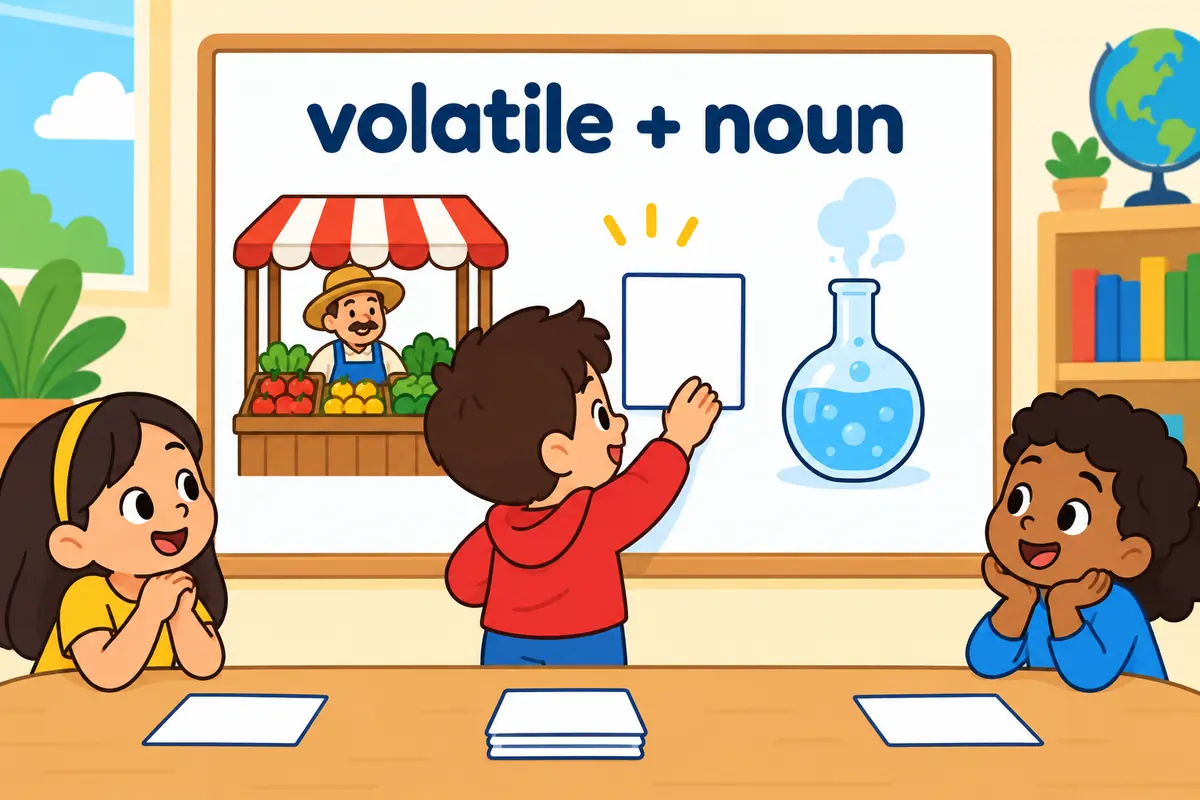
Volatile in a sentence: examples across contexts
Volatile keeps its meaning and changes its company. The nine sentences below move from a classroom to a trading desk, and each one names the thing that is moving.
| Context | Example sentence | Why this works |
|---|---|---|
| Classroom | The volatile glue gave off fumes, so the class opened the windows. | A sensory detail shows the chemical sense. |
| Lab report | The sample remained volatile below five degrees. | The predicative pattern reports a measured property. |
| Workplace email | The supplier warned that shipping costs stay volatile this quarter. | A hedged present tense fits an uncertain forecast. |
| Finance column | The volatile index swung eight percent in a single session. | A number makes the movement verifiable. |
| News report | A volatile crowd of protesters gathered outside the town hall. | The word describes mood rather than money. |
| Weather writing | Autumn weather is volatile along the coast. | A familiar subject keeps the term readable. |
| Sports commentary | The volatile final minutes produced three goals. | The time frame carries the unpredictability. |
| Conversation | He has a volatile temper in the mornings. | The mood sense is the one people use in speech. |
| Technical manual | Do not heat the volatile reagent in an open tray. | An instruction uses the word as a warning. |
The first and last rows show the same adjective doing two jobs: in the laboratory it names a physical property, while in the finance column it names a behaviour.
Volatile vs unstable
Volatile and unstable overlap, and choosing between them changes the message. unstable means liable to fall, fail or break, while volatile means liable to move or change quickly. A chair is unstable but never volatile, and a share price is volatile even when the company behind it is perfectly sound.
| Attribute | volatile | unstable |
|---|---|---|
| Core meaning | Changes fast and unpredictably | Likely to collapse, fail or fall |
| Typical subjects | Prices, liquids, moods, weather | Structures, governments, patients, systems |
| Suggests danger | Sometimes, through speed | Usually, through weakness |
| Neutral use | Common in finance and science | Common in engineering and medicine |
| Opposite | Stable, settled, steady | Sound, secure, solid |
Verdict: use volatile when the movement is the point, and unstable when the risk is that the thing gives way. A volatile market may be healthy, while an unstable one is already cracking.
Word forms and grammar of volatile
Volatile inflects like any adjective and builds a noun in -ity. The table also shows the related verb, and the invented noun that learners sometimes reach for by mistake.
| Form | Part of speech | Example |
|---|---|---|
| volatile | adjective, base form | A volatile market rewards patience. |
| more volatile | adjective, comparative | Gas is more volatile than diesel. |
| most volatile | adjective, superlative | It was the most volatile week of the year. |
| volatility | noun | Volatility rose before the vote. |
| volatilize | verb, related form | Heat will volatilize the compound. |
| volatileness | noun, non-standard | Avoid volatileness; use volatility instead. |
The related verb is covered on the page for volatilized, and it describes the act of turning into vapour rather than the tendency to change. Keep the noun volatility for the abstract quality and the adjective volatile for the thing itself.
Common mistakes with volatile
- Incorrect:
The weather was volatile and I felt unstable.Correct: He blamed the volatile weather for the delay. Rule: volatile describes the thing that changes, not the person reacting to it. - Incorrect:
The volatile was dangerous.Correct: The volatile chemical was dangerous. Rule: used before a noun, this adjective cannot stand alone as the subject. - Incorrect:
His mood is very volatility.Correct: His mood is highly volatile. Rule: volatility is the noun, so it cannot follow is when you mean the adjective. - Incorrect:
The bridge is volatile.Correct: The bridge is unstable. Rule: volatile implies rapid change, not structural weakness. - Incorrect:
Prices volatile every day.Correct: Prices are volatile every day. Rule: the predicative adjective needs a linking verb before it.
Practice using volatile
Work through the six items, then read the reasoning rather than only the answer.
- Fill the gap: The ______ solvent must be stored away from any flame.
- Choose the better word: After the scandal, the government grew (volatile / unstable) and lost a confidence vote.
- Correct the error: The volatile crossed the city in an hour.
- Build a sentence: use volatile before a noun to describe a market.
- Spot the register: which fits a science report — the compound is volatile at room temperature, or things got pretty volatile today?
- Rewrite with the noun: Prices are volatile after the harvest. Use volatility instead.
Answers
- volatile — the solvent changes state easily, which is the chemical sense.
- unstable — a government liable to collapse is unstable, not volatile.
- The volatile storm crossed the city in an hour — the adjective needs a noun to describe.
- Model answer: The volatile market frightened new investors.
- The compound is volatile at room temperature — a report avoids the idiom get volatile.
- Volatility rises after the harvest — the noun becomes the subject.
The bottom line
Use volatile in a sentence when something changes fast and will not hold still, and choose it for prices, liquids, moods and weather rather than for things that are merely weak. Two nuances decide most sentences: the adjective normally sits before its noun, and it measures speed of change rather than harm. Where a writer wants the instability of character behind the change, fickle is the sharper word, because the shift comes from inside the person.
Frequently asked questions about volatile
Is volatile a negative word?
Not necessarily. Volatile describes speed of change, and fast change can create profit as easily as loss. A volatile share may reward a patient investor, while a steady share can still fall. The word warns that the value will move, not that it will move downward.
What is the difference between volatile and unstable?
Volatile means liable to change quickly and unpredictably, and it usually describes prices, liquids, moods and weather. Unstable means liable to collapse, fail or fall. A volatile market can be healthy, while an unstable bridge is a danger, so the two words answer different questions.
Can volatile describe a person?
It can describe someone whose mood or temper shifts quickly, as in a volatile colleague. It does not mean violent or unreliable in general. When the point is a steady character flaw rather than rapid change, a word such as mercurial is the more accurate adjective.
Does volatile have an adverb?
Volatile has no common everyday adverb. Writers who need one use the phrase in a volatile way or reach for the related noun volatility, as in volatility rose sharply. Treat volatilely as rare and best avoided, because it sounds forced in ordinary writing.
Have you ever struggled with understanding the meaning of the term “volatile”? In essence, when something is described as volatile, it means that it is highly unstable and likely to change rapidly or unpredictably.
This term is frequently used to characterize situations, substances, or financial markets that can experience sudden and drastic shifts. Understanding the concept of volatility is crucial in various fields such as economics, chemistry, and meteorology.
7 Examples Of Volatile Used In a Sentence For Kids
- The volatile liquid in the bottle can evaporate quickly.
- Be careful with the volatile chemicals in the lab.
- Flowers release a volatile fragrance when you sniff them.
- The weather can be volatile and change quickly.
- A volatile situation can be dangerous, so stay calm.
- The volcano erupted with a volatile explosion of ash and lava.
- Fireworks are made with volatile substances for a colorful display.
14 Sentences with Volatile Examples
- Volatile relationships among college friends can make group projects challenging.
- Managing a volatile budget can be tough for college students living away from home.
- Balancing a part-time job with academics can lead to a volatile schedule.
- The stock market can be volatile, so it’s important to do thorough research before investing.
- Volatile emotions during exam time can affect a student’s performance.
- Chemistry experiments often involve handling volatile chemicals with caution.
- Volatile weather patterns can disrupt college events and outdoor activities.
- It’s crucial to find a way to cope with volatile stress levels during the exam season.
- Roommate conflicts can sometimes lead to volatile living situations in college dormitories.
- The political climate on campus can be volatile, especially during student elections.
- Volatile internet connectivity can hinder online classes and research efforts.
- Choosing a career path can be challenging in a volatile job market.
- The price of textbooks tends to be volatile at the beginning of each semester.
- It’s important to have strategies in place to handle volatile academic deadlines.
How To Use Volatile in Sentences?
Volatile means something that is likely to change suddenly and unexpectedly.
To use Volatile in a sentence, start by identifying a noun, pronoun, or word that you want to describe as changing quickly. For example, “He has a volatile temper that can flare up in an instant.” In this sentence, “temper” is the noun that is described as changing suddenly, making it a good candidate for using the word volatile.
It’s important to remember that Volatile can be used to describe not only emotions but also situations, prices, chemicals, and even weather conditions. For instance, “The stock market can be volatile, so it’s important to be cautious when investing.” Here, “stock market” is the noun being described as unpredictable.
When using Volatile in a sentence, think about the context and make sure it fits the meaning of something that is likely to change abruptly. It adds depth and vividness to your writing, helping to convey the idea of sudden change.
Practice using Volatile in different sentences to become more comfortable with incorporating it into your vocabulary. With time and experience, you’ll be able to use Volatile effectively in a variety of situations.
Conclusion
In conclusion, the examples of sentences featuring the keyword “volatile” highlight its diverse applications in describing situations that are unpredictable, unstable, or likely to change rapidly. From financial markets to emotion-driven interactions, the term “volatile” encapsulates the essence of uncertainty and fluctuation. Whether referring to volatile prices in the stock market or a volatile argument between individuals, the word conveys a sense of instability and potential for sudden shifts in behavior or outcomes.
Overall, the varied usage of “volatile” in different contexts emphasizes its versatility in capturing the unpredictable nature of events, emotions, and conditions. This term serves as a powerful descriptor for scenarios characterized by rapid changes, making it a valuable addition to our vocabulary when seeking to convey the transitory and changeable aspects of a situation.


