Volunteer vs voluntarily comes down to what the sentence needs: volunteer is a noun or verb for the person who offers help or the act of offering it, while voluntarily is an adverb describing how something is done without being forced. Choose the noun when you name the helper, the adverb when you modify the action.
Volunteer and voluntarily at a glance
- Volunteer is both a noun and a verb; voluntarily is only an adverb.
- The noun volunteer names an unpaid helper; the verb volunteer names the offer.
- Voluntarily reports that an action was a free choice rather than an order.
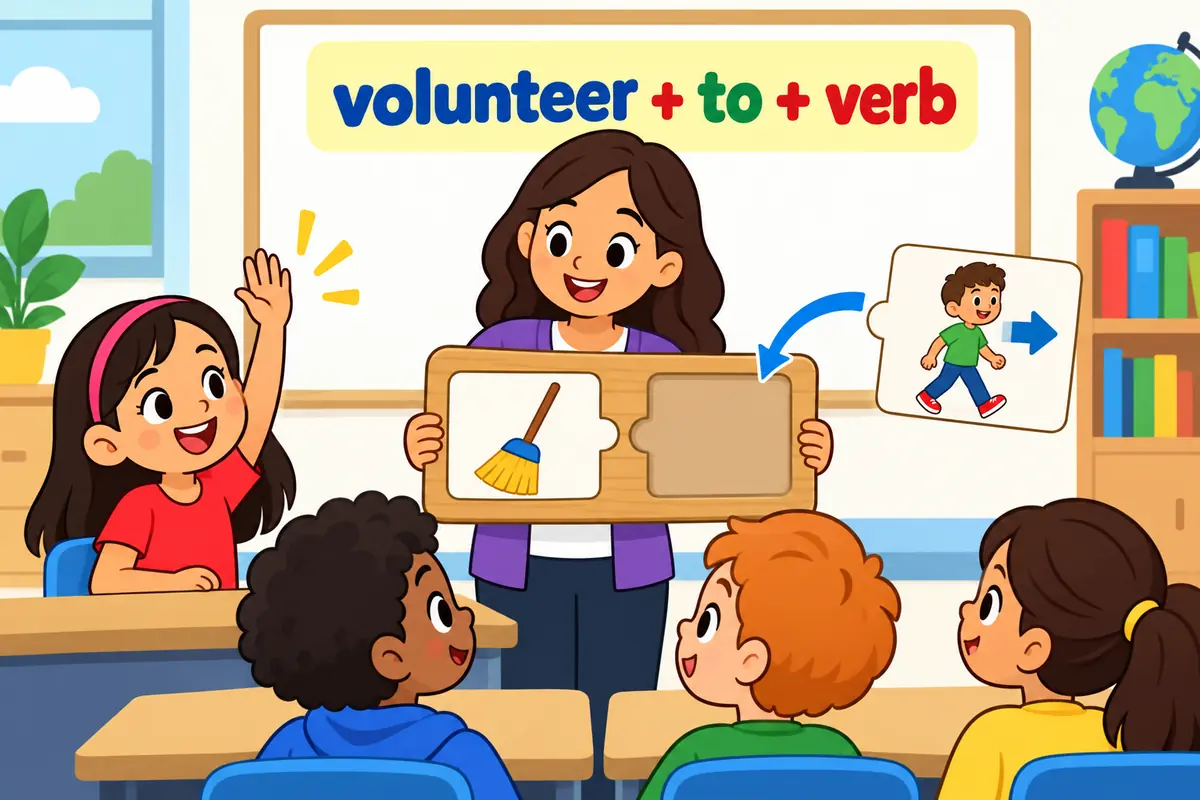
- The verb volunteer is followed by a to-infinitive: volunteer to help.
- Voluntarily usually sits next to the verb it describes, before or after it.
- The commonest error is reaching for the noun where the adverb is required.
What do volunteer and voluntarily mean?
Volunteer is a noun and a verb: the noun names a person who offers to do something without being asked or paid, and the verb names the act of making that offer. Voluntarily is an adverb meaning done by a person’s own choice rather than under pressure. The Cambridge entry for volunteer covers both noun and verb, and the entry for voluntarily confirms the adverb’s sense of acting of one’s own accord.
| Word | Part of speech | Plain meaning | Example sentence |
|---|---|---|---|
| volunteer | noun | A person who offers help without pay | Three volunteers ran the stall. |
| volunteer | verb | To offer to do something | She volunteered to lead the tour. |
| voluntarily | adverb | By free choice, not by force | He voluntarily returned the extra change. |
One limitation matters for accuracy. Voluntarily marks the absence of force, not the presence of enthusiasm, so somebody can act voluntarily, which is a free choice, and still dislike the task. The noun volunteer normally carries the idea of unpaid work, but the verb can describe helping that is later rewarded, so the unpaid reading belongs to the noun rather than to the verb.
A substitution test settles most doubtful sentences. If the word can be replaced by on purpose or of their own accord, the sentence needs voluntarily; if it can be replaced by helper or offered, it needs volunteer. The two tests almost never succeed at the same time, which is why the words so rarely trade places without changing the meaning.
Volunteer vs voluntarily
The two words answer different questions: volunteer answers who or what, and voluntarily answers how. The table sets the decision side by side.
| Criterion | volunteer | voluntarily |
|---|---|---|
| What it names | A person, or the act of offering | The manner of an action |
| Part of speech | Noun and verb | Adverb |
| Question it answers | Who helps, or what they do | How something is done |
| Sentence position | Subject or object | Beside the verb it modifies |
| Paid or unpaid | The noun implies unpaid work | Silent on payment |
| Force or freedom | Can describe a rota or a duty | Always free of force |
| Example | The volunteer signed the roster. | She signed the roster voluntarily. |
Verdict: keep volunteer for the person or the act, and keep voluntarily for the manner of the act. A sentence rarely needs both, and swapping them changes the meaning rather than the tone.
How do you use volunteer and voluntarily in a sentence?
The patterns below cover almost every real sentence. The verb volunteer points forward to the action it offers, while the adverb voluntarily attaches itself to a verb that is already there.
| Pattern | Example | What it signals |
|---|---|---|
| volunteer to + verb | Mia volunteered to run the book stall. | Names the action that was offered. |
| volunteer for + noun | Two parents volunteered for traffic duty. | Names the duty rather than the action. |
| volunteer at + place | He volunteers at the animal shelter. | Names where the unpaid work happens. |
| article + volunteer | The volunteers packed forty food boxes. | The noun takes articles and a plural. |
| subject + voluntarily + verb | The club voluntarily shared its accounts. | Reports free choice; the adverb can also precede the verb. |
| verb + object + voluntarily | She returned the trophy voluntarily. | Closes the clause and stresses that nobody asked. |
The choice between for and to matters more than learners expect. Volunteer to names an action the speaker will carry out, as in she volunteered to count the takings, while volunteer for names a role or duty that already exists, as in he volunteered for the late shift. Mixing the two produces sentences such as she volunteered for counting the takings, which sound as if the counting were a permanent post rather than a task.
Two pages extend these patterns: one shows how a person acts voluntarily across registers, and another gathers the countable noun under the volunteer as a noun.
Volunteer and voluntarily in a sentence: examples across contexts
Both words keep their meaning while the setting changes. The nine sentences below move from a classroom to a legal notice, and each one names who acted or how.
| Context | Example sentence | Why this works |
|---|---|---|
| Classroom | Ravi volunteered to water the plants over the holiday. | A school task shows the to-infinitive pattern. |
| School newsletter | The choir sang voluntarily at the winter fair. | The adverb reports free choice with no payment. |
| Workplace email | Two engineers volunteered for the weekend support rota. | The for-pattern names the duty being filled. |
| Charity appeal | Parents donate time and drive the minibus each week. | Unpaid service is the frame the nouns share. |
| News report | The witness came forward voluntarily. | The adverb follows a movement verb in reporting. |
| Legal writing | The firm voluntarily recalled the batch. | The adverb signals compliance without a court order. |
| Conversation | I did not apply; I just volunteered. | The bare verb is the common spoken form. |
| Sports report | The coach volunteered to umpire the final. | The action offered is named after to. |
| Academic writing | Participants joined voluntarily and could leave at any time. | The adverb states consent without pressure. |
| Community notice | The hall will close early, as the caretaker has volunteered to reset the chairs. | The verb explains why the schedule changed. |
| Travel diary | We met a volunteer who had given two summers to the trail. | The noun carries the story of long unpaid commitment. |
Only the newsletter and legal rows remove the person entirely, which is why the adverb suits official and impersonal statements. Where the actor matters, the noun or verb takes over. Register follows the same split: a spoken sentence reaches for the bare verb, while a policy document reaches for the adverb because it hides who decided.
Word forms and grammar of volunteer and voluntarily
The family turns around one root, and the ending decides the job. The adjective voluntary work describes the task, the adverb describes the doing, and the noun names the doer.
| Form | Part of speech | Example |
|---|---|---|
| volunteer | noun, singular | A volunteer opened the gate. |
| volunteers | noun plural; verb, third person | The volunteers arrive at eight; she volunteers every Sunday. |
| volunteered | verb, past and past participle | He volunteered before anyone asked. |
| volunteering | verb participle; noun gerund | She is volunteering this term; volunteering builds confidence. |
| voluntarily | adverb | They closed the stall voluntarily. |
| voluntary | adjective | Voluntary work fills the gap between paid shifts. |
Common mistakes with volunteer and voluntarily
- Incorrect:
She did the work volunteer.Correct: She did the work voluntarily. Rule: The adverb, not the noun, tells how the work was done. - Incorrect:
He voluntarily the food bank.Correct: He volunteered at the food bank. Rule: Voluntarily is an adverb and cannot serve as the main verb. - Incorrect:
They volunteer to helping the fair.Correct: They volunteer to help the fair. Rule: Volunteer takes a to-infinitive, never to plus an -ing form. - Incorrect:
I am a voluntarily worker.Correct: I am a voluntary worker. Rule: The adjective voluntary modifies a noun; the adverb modifies a verb. - Incorrect:
The volunteer she signed the list.Correct: The volunteer signed the list. Rule: The noun is already the subject, so no extra pronoun is needed.
Which should you use?
Match the word to the job the sentence is doing. When permission is the point, voluntarily says the action happened without consent being the issue; when attitude is the point, describe a willing helper, because the adverb says nothing about eagerness.
| Your situation | Use this word | Example |
|---|---|---|
| You name the person who helps | volunteer (noun) | The volunteer greeted every guest. |
| You name the act of offering | volunteer (verb) | He volunteered to open the hall. |
| You describe how something was done | voluntarily | She left the scheme voluntarily. |
| You contrast paid and unpaid work | volunteer | Volunteer cover is unpaid, so the rota needs care. |
Practice using volunteer and voluntarily
Work through the six items, then read the reasons rather than only the answers.
- Fill the gap: The students ______ to tidy the hall after the concert.
- Choose the better word: Nobody forced the club to publish the figures; it did so (volunteer / voluntarily).
- Correct the error: She is a very voluntarily helper at the shelter.
- Build a sentence: use volunteer to + verb about a pupil offering to read aloud.
- Spot the register: which belongs in a formal report, The staff gave up their break voluntarily, or The staff gave up their break volunteer?
- Rewrite with the noun: Several people offered to coach the team. Use volunteer as a noun.
Answers
- volunteered — the students offered the action, so the verb with a to-infinitive fits.
- voluntarily — the adverb reports free choice, and volunteer cannot modify did.
- She is a very willing helper at the shelter — the adjective modifies the noun.
- Model answer: Priya volunteered to read the poem aloud to the class.
- The staff gave up their break voluntarily — the adverb suits a formal report.
- Several volunteers offered to coach the team — the noun names the people.
The bottom line
Use volunteer vs voluntarily as a test of the sentence’s job: choose volunteer when you name the person or the act, and voluntarily when you describe how the act was done. The two decision points are that the verb volunteer points to a to-infinitive, and that the adverb says nothing about whether the work was paid. Where the sentence only reports a choice, voluntarily is the narrower and more accurate word.
Frequently asked questions about volunteer and voluntarily
Is volunteer always unpaid?
No. The noun usually describes unpaid work, but the verb only says that somebody offered. A pupil who volunteers to read aloud is unpaid, while a contractor who volunteers a revised quote is simply offering it. Let the surrounding words carry the question of payment.
Can voluntarily start a sentence?
Yes, for emphasis or contrast. The adverb can open a sentence when it is followed by the subject, as in Voluntarily, the club returned the grant. The more common position is next to the verb, and the fronted version reads as formal or emphatic.
What is the adjective form related to voluntarily?
The adjective is voluntary, as in a voluntary scheme. Voluntarily is the adverb that describes how the scheme was joined. The noun volunteer names the person, so the family runs voluntary, voluntarily, volunteer, each filling a different slot in the sentence.
Should one sentence use both words?
Rarely. A single clause needs either the person or the manner, not both at once. You might write that volunteers stayed voluntarily, pairing the noun subject with the adverb, but that is two ideas, an actor and a choice, rather than one.