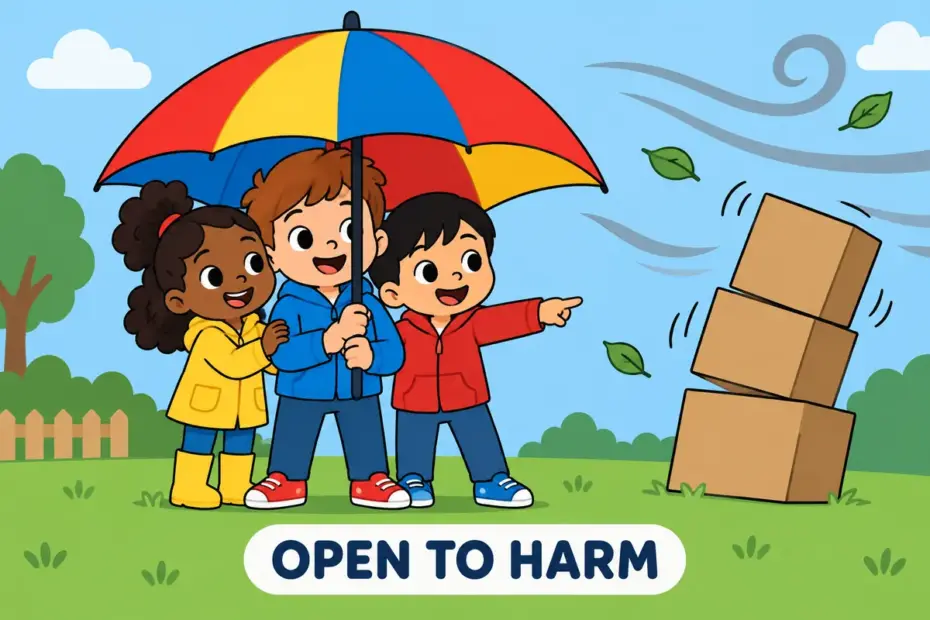
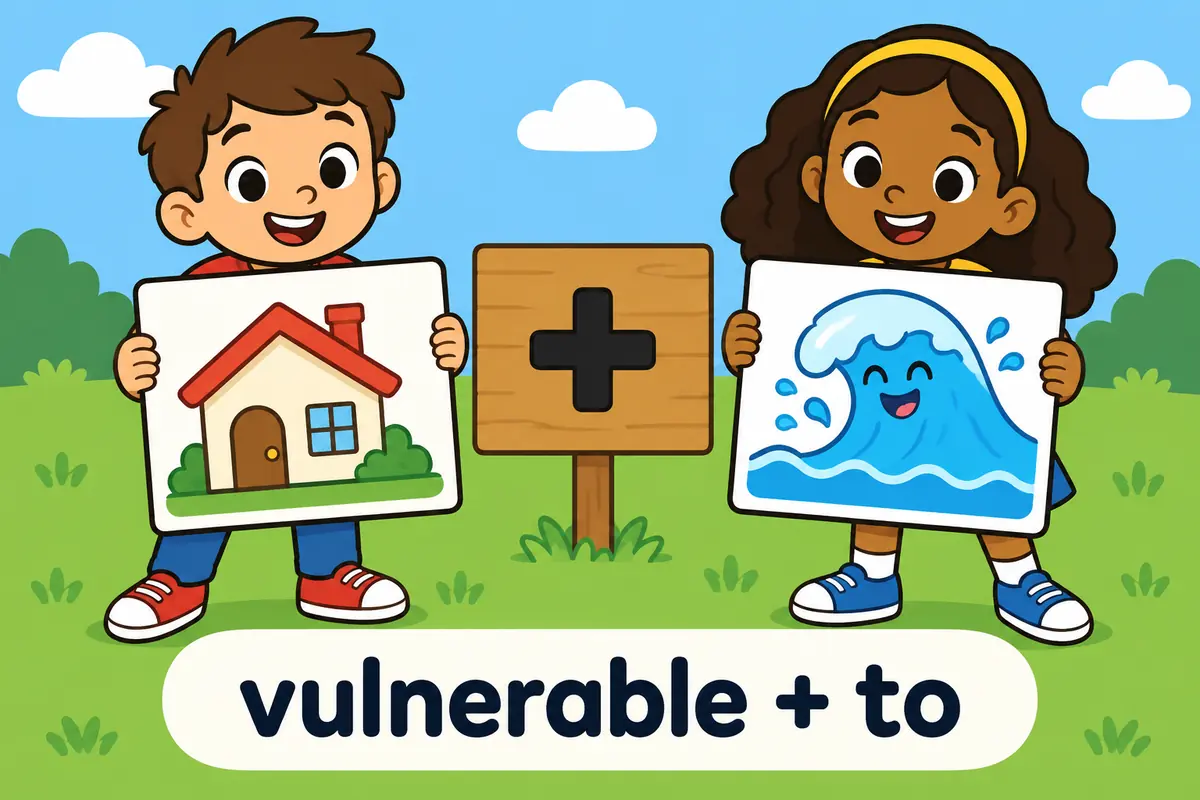
Vulnerable means exposed to harm, attack or damage, describing who or what can be hurt rather than what causes the harm. To use vulnerable in a sentence, name the person or thing first and add the threat after to: “Young seedlings are vulnerable to frost.” The adjective signals risk, not weakness of character.
Vulnerable at a glance
- Vulnerable is an adjective; its noun is vulnerability and its rare adverb is vulnerably.
- The dominant pattern is vulnerable + to + a noun or -ing verb, as in vulnerable to flooding.
- Typical subjects are people, systems, species and positions, never the threat itself.
- The word appears across neutral and formal writing, from public-health advice to security reports.
- The commonest error is treating vulnerable and susceptible as exact synonyms, because susceptible usually means likely to be affected.
What does vulnerable mean?
Vulnerable is an adjective meaning exposed to the possibility of harm, whether physical, emotional, digital or financial. The Cambridge entry for vulnerable records that range, and the grammar hardly changes: something is vulnerable to something else. The subject is whatever might be hurt, and the threat arrives after to.
| Sense | Plain meaning | Example sentence |
|---|---|---|
| Physical safety | Open to injury or attack | The cliff path is vulnerable to erosion. |
| Emotional | Easily hurt by criticism or loss | New teachers often feel vulnerable to complaint. |
| Digital | Open to attack or misuse | The old server was vulnerable to a known flaw. |
| Ecological | At risk of decline or loss | Reef fish are vulnerable to warming water. |
One limitation matters. Vulnerable describes exposure, not frailty or fault: a well-built house on a flood plain is vulnerable without being weak, and calling a person vulnerable says nothing about their courage. When the sense is purely physical and undefended, defenseless against attack is the more literal adjective.
How do you use vulnerable in a sentence?
Put the thing at risk first and the threat second, joined by to. Five patterns cover nearly every real sentence, and the choice between them depends on whether the threat is a noun, an action or a position.
| Pattern | Example | What it signals |
|---|---|---|
| vulnerable + to + noun | Coastal towns are vulnerable to storms. | Names a specific threat. |
| vulnerable + to + -ing verb | The archive is vulnerable to being copied. | Names a threat as an action. |
| vulnerable + noun | Vulnerable passengers board first. | Uses the adjective before a noun as a label. |
| be or feel vulnerable | She felt vulnerable after the move. | Reports a state rather than an event. |
| leave + object + vulnerable | The delay left the camp vulnerable. | Shows an action that creates the exposure. |
A related pattern, prone to mistakes, looks similar but names a repeated tendency rather than exposure to a single threat. If the sentence implies likely repetition, prone is the more exact word.
Vulnerable in a sentence: examples across contexts
Vulnerable moves from immune systems to insurance files without changing shape. The nine sentences below keep the same adjective and vary only the context and the named threat.
| Context | Example sentence | Why this works |
|---|---|---|
| Classroom | The new pupil felt vulnerable on the first morning. | Names a social threat with a clear subject. |
| Public health | Older residents are vulnerable to summer heat. | Uses the standard public-health collocation. |
| Workplace email | The draft budget is vulnerable to a late objection. | Keeps the tone formal and the threat specific. |
| News report | The report found the bridge vulnerable to flooding. | Bases the adjective on a formal finding. |
| Security writing | A shared password leaves the account vulnerable. | Shows an action creating the exposure. |
| Ecology | endangered species are especially vulnerable to habitat loss. | Names the threat with a standard collocation. |
| Conversation | I felt vulnerable telling the group my plan. | The feel pattern survives in speech. |
| Academic prose | Small samples are vulnerable to chance variation. | Names the statistical threat precisely. |
| Sports | The defence looked vulnerable to the long ball. | Names the tactic that exploits the gap. |
Vulnerable vs susceptible
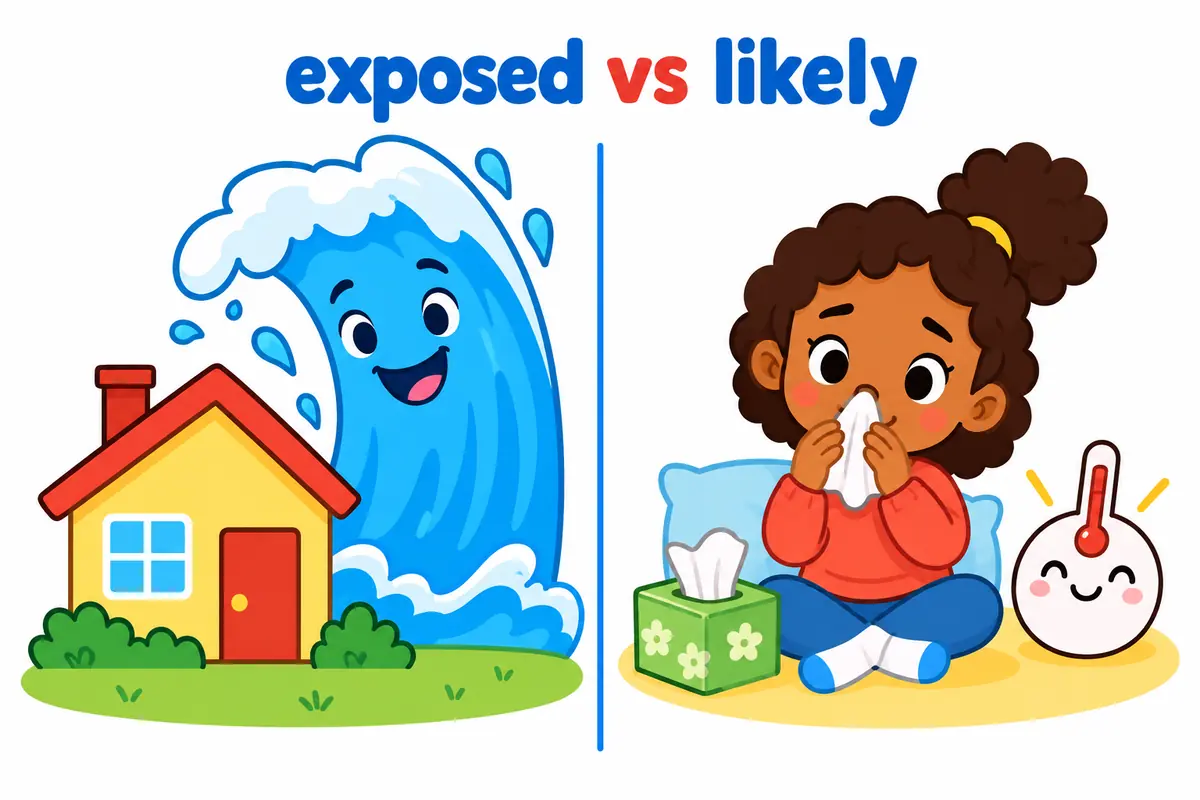
Vulnerable and susceptible overlap when the meaning is open to harm, but they are not interchangeable. Susceptible leans toward likelihood and often toward illness or influence, as in susceptible to infection, while vulnerable carries more at stake and can stand alone without naming a threat at all.
| Attribute | vulnerable | susceptible |
|---|---|---|
| Core meaning | Exposed to harm or attack | Likely to be affected by something |
| Typical threat | Injury, attack, loss or heat | Illness, pressure or persuasion |
| Grammar | vulnerable to + noun, or used alone | Almost always susceptible to + noun |
| Common subjects | People, systems, coasts, species | Patients, children, metal, claims |
| What it implies | Something valuable is at risk | A higher than usual chance |
A wall exposed to salt air is vulnerable by position rather than by choice, and a claim is susceptible to doubt. Verdict: choose susceptible when you mean more likely to be affected, and vulnerable when you mean exposed to real harm.
Word forms and grammar of vulnerable
The adjective changes only for comparison, and the noun does most of the work in formal writing, from audit reports to security logs.
| Form | Part of speech | Example |
|---|---|---|
| vulnerable | adjective | The shelter is vulnerable to wind. |
| more vulnerable | adjective, comparative | The east wing is more vulnerable than the west. |
| vulnerability | noun | The audit listed one serious vulnerability. |
| vulnerably | adverb, rare | The character is shown vulnerably. |
| invulnerable | adjective, opposite | The bunker was not invulnerable. |
Most writers reach for vulnerability when they need a subject for a sentence, because the noun fits a formal report better than the adjective does.
Common mistakes with vulnerable
- Incorrect:
The storm was vulnerable to the village.Correct: The village was vulnerable to the storm. Rule: The subject is what might be hurt, not the threat; the threat follows to. - Incorrect:
She is vulnerable about criticism.Correct: She is vulnerable to criticism. Rule: Use to for the source of harm and about only for a topic. - Incorrect:
The plan is vulnerable of failing.Correct: The plan is vulnerable to failing. Rule: The adjective pairs with to, never with of. - Incorrect:
Vulnerable people should be avoided.Correct: Vulnerable people need extra support. Rule: The adjective describes exposure, not inferiority or contagion. - Incorrect:
The data is very vulnerable.Correct: The data is vulnerable to tampering. Rule: Vulnerable normally wants its threat named, or it sounds vague.
Practice using vulnerable
Work through the six items, then read the reasons rather than only the answers.
- Fill the gap: Seedlings are ______ to a late frost.
- Choose the better word: After the operation he was more (vulnerable / susceptible) to infection.
- Correct the error: The bridge is vulnerable of high winds.
- Build a sentence: use vulnerable to about a paper record left near an open window.
- Spot the register: which belongs in a council report – residents are vulnerable to flooding, or locals could get hit hard by floods?
- Rewrite with the noun: The survey found the coast vulnerable. Use vulnerability instead.
Answers
- vulnerable – the frost is the threat and the seedlings are the subject.
- susceptible – the meaning is a higher chance of infection, which is exactly what susceptible adds.
- The bridge is vulnerable to high winds – the adjective pairs with to, never of.
- Model answer: The paper record was vulnerable to damp air near the open window.
- Residents are vulnerable to flooding – a council report avoids the loose phrase get hit hard.
- The survey found a serious vulnerability along the coast – the noun takes an article.
The bottom line
Use vulnerable in a sentence when you mean exposed to real harm, and name the threat after to. Two details decide most sentences: the subject is the thing at risk, and the adjective pairs with to rather than of. Where the risk is slight, weak and easily hurt or plain at risk may say it more plainly. Reserve vulnerable for situations where something valuable really could be lost.
Frequently asked questions about vulnerable
Is vulnerable always a negative word?
Vulnerable usually signals risk, but it also appears in positive writing about honesty and openness. A reporter who calls a leader vulnerable to criticism means exposure, while a therapist who praises a client for being vulnerable means willing to show real feeling without hiding behind defences.
What preposition follows vulnerable?
The adjective takes to before the threat: vulnerable to heat, vulnerable to hacking, vulnerable to being misread. It never takes of or about in this sense. About appears only when you describe a topic somebody feels uneasy discussing, as in anxious about, which is a different word.
Can vulnerable describe a system rather than a person?
Yes. Systems, buildings, networks and economies are all called vulnerable when a specific threat could damage them. In security writing the pattern is fixed: the subject is the asset and the threat follows to, as in the old server was vulnerable to a known flaw.
How is vulnerable different from weak?
Weak says that something lacks strength, while vulnerable says only that something could be harmed. A strong building can be vulnerable to a flood, and a brave person can be vulnerable to betrayal. Because vulnerable makes no claim about strength, use weak only for a real lack of power.
Have you ever heard the term “vulnerable” and wondered what it means? In essence, vulnerable refers to being open to emotional or physical harm, susceptible to being hurt or wounded.
When someone is in a vulnerable state, they may be more easily influenced, taken advantage of, or affected by negative outside forces. Being vulnerable can stem from a variety of factors, such as a lack of protection, feelings of insecurity, or exposure to risky situations.
7 Examples Of Vulnerable Used In a Sentence For Kids
- Vulnerable animals need our help and protection.
- It is important to be kind to vulnerable friends who need support.
- Sometimes, plants can be vulnerable to too much sun or rain.
- We should always be gentle with vulnerable creatures like butterflies.
- It is our job to care for the vulnerable members of our community.
- When someone is feeling vulnerable, we should be understanding and kind.
- We should always look out for vulnerable classmates and help them when needed.
14 Sentences with Vulnerable Examples
- During exams, students may feel *vulnerable due to the pressure of performing well.*
- Leaving personal belongings unattended in the library can make them *vulnerable to theft.*
- Being new to a college can make students feel socially *vulnerable in unfamiliar surroundings.*
- Using public Wi-Fi networks without proper security measures can leave your personal information *vulnerable to hackers.*
- Over-relying on caffeine for energy can leave students *vulnerable to burnout and exhaustion.*
- Ignoring mental health issues can make students more *vulnerable to anxiety and depression.*
- Walking alone on campus late at night can make students feel *vulnerable to potential dangers.*
- Sharing personal identification details online can leave students *vulnerable to identity theft.*
- Skipping meals to save time or money can make students *vulnerable to health issues.*
- Not practicing safe sex can make students *vulnerable to sexually transmitted infections.*
- Not backing up important assignments can leave students *vulnerable to losing their work if their devices crash.*
- Accepting drink invitations from strangers can make students *vulnerable to being drugged.*
- Falling behind on coursework can leave students feeling *vulnerable to academic failure.*
- Ignoring cybersecurity best practices can make students *vulnerable to data breaches and hacks.*
How To Use Vulnerable in Sentences?
To use the word “Vulnerable” in a sentence, you will need to understand its meaning and how it can be applied in different contexts. Vulnerable is an adjective that describes someone or something that is easily hurt, harmed, or attacked.
Here are some examples of how you can use “Vulnerable” in a sentence:
- “The orphaned children were vulnerable to exploitation without a guardian to protect them.”
- “During a pandemic, the elderly and immunocompromised individuals are considered vulnerable populations.”
- “Leaving your personal information unsecured online can make you vulnerable to identity theft.”
- “After the earthquake, the damaged buildings were vulnerable to collapse in the aftershocks.”
When constructing a sentence with the word “Vulnerable,” it is important to consider the context in which you are using it. Think about who or what is being described as vulnerable and how they are at risk of harm or damage.
By incorporating Vulnerable into your vocabulary and practice, you will become more proficient in expressing ideas and communicating effectively in various situations. Remember to use the word accurately to convey the intended meaning and impact in your sentences.
Conclusion
In sum, the sentences with “vulnerable” painted a vivid picture of individuals or groups facing risks, harm, or challenges that require support and protection to thrive. These sentences highlighted the importance of acknowledging and addressing vulnerability in different contexts, whether it be vulnerable ecosystems, marginalized communities, or personal struggles. It is essential to recognize and empathize with those who are vulnerable, and work towards creating inclusive and supportive environments that promote resilience and empowerment.
By exploring various examples of sentences with “vulnerable,” we gain insights into the complex dynamics of vulnerability and the need for compassionate and proactive responses. These sentences underscore the significance of fostering empathy, understanding, and solidarity to uplift and safeguard those who are vulnerable, ultimately contributing to a more equitable and compassionate society.


