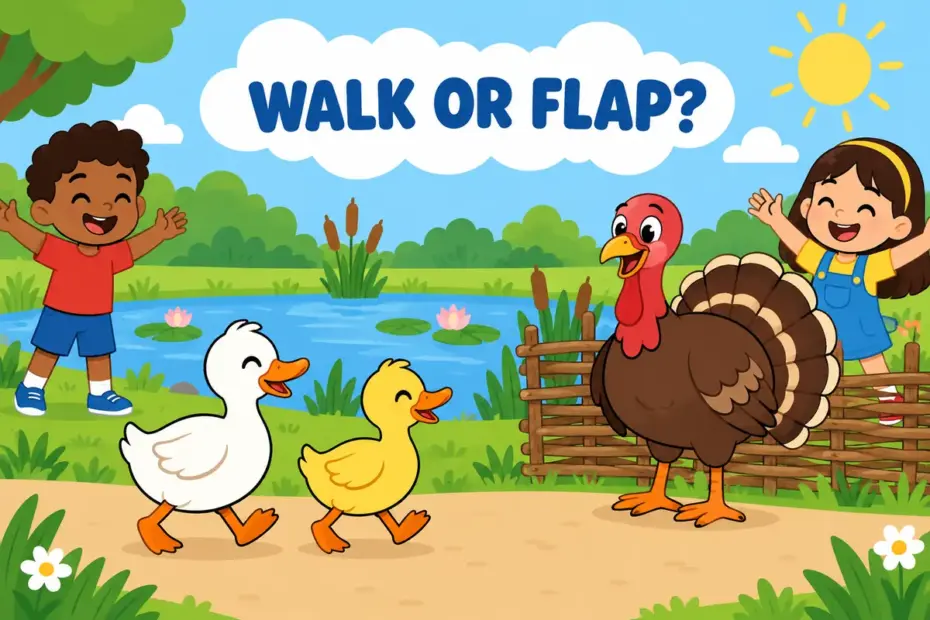
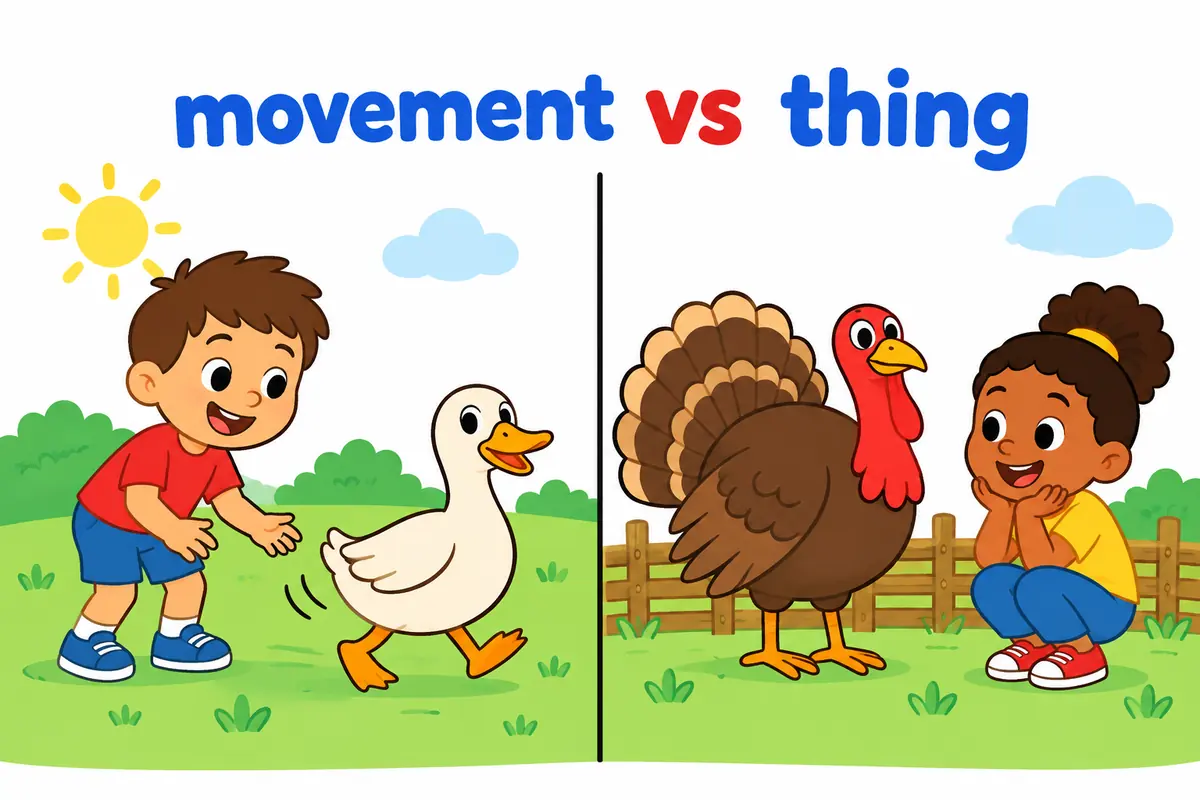
Waddle vs wattle is a spelling pair that trips up many readers: waddle is the swaying, side-to-side walk of a duck or a toddler, while wattle is the fleshy flap hanging from a bird’s throat, or the woven fence made of sticks. Use waddle for movement and wattle for a body part, a material or a tree.
Waddle and wattle at a glance
- Waddle is mainly a verb for a swaying walk, and also a noun for that gait.
- Wattle is mainly a noun for a bird’s throat flap, a woven stick fence or an acacia tree.
- The two words differ by one letter in the middle: waddle has dd, wattle has tt.
- Waddle describes movement; wattle names a thing you can see or build with.
- The commonest error is swapping them, as in a duck that wattle across the pond.
Waddle vs wattle: the master comparison
The decision is easier than the spelling suggests. Waddle always concerns how something moves, while wattle always names an object: a fleshy part, a building material or a tree. The table sets the two words against each other on the points that decide most sentences.
| Criterion | waddle | wattle |
|---|---|---|
| Part of speech | Verb, and a noun for the gait | Noun, and a rare verb for weaving sticks |
| Core meaning | Walk with short steps, swaying side to side | A fleshy throat flap, a woven fence or an acacia |
| What it describes | Movement and the way a body travels | A body part, a material or a plant |
| Typical companion | A duck, a penguin, a toddler | A turkey, a rooster, a cottage wall, a hillside |
| Spelling signal | Double d, rhyming with paddle | Double t, rhyming with battle |
| Common phrase | Waddle like a duck | Wattle and daub |
| Register | Everyday and descriptive | Everyday for birds, technical for building and botany |
| Usual mistake | Used for the bird part | Used for the walk |
What does waddle mean?
Waddle is a verb meaning to walk with short steps while swaying from side to side, the way a duck, a penguin or a very young child moves. The Cambridge entry for waddle records this waddling gait, and the word also works as a noun for the walk itself. The phrase waddle like a duck captures the rocking rhythm exactly. A penguin does not duck its head as it crosses the ice; it waddles, keeping its balance with each short step.
One limitation is worth stating plainly. Waddle is not a neutral word for any slow walk, and it is not the same as limp or stagger. It describes a specific rocking motion with short steps, so an adult who walks this way in a sentence usually invites a gentle joke rather than a description of injury.
What does wattle mean?
Wattle is a noun with three everyday senses. The first is the fleshy flap of skin that hangs from the throat or neck of birds such as turkeys and roosters. The second is a framework of sticks woven with twigs, used for wattle fence panels and for the walls of old buildings, a method still called wattle and daub. The third is an Australian acacia tree, many of which carry golden flowers. The Cambridge entry for wattle covers the bird and building senses.
A small warning belongs here. The three senses are far apart, so a reader needs context to know which one you mean. A sentence about a rooster points to the throat flap, a sentence about a cottage points to the woven sticks, and a sentence about a hillside in spring points to the tree.
How do you use waddle and wattle in a sentence?
Waddle follows the subject as a verb, or becomes a noun after words like with and a. Wattle is a countable noun for the bird part and a mass noun for the building material. The table shows the five patterns that cover almost every real sentence.
| Pattern | Example | What it signals |
|---|---|---|
| waddle as a verb | The duck waddled across the path. | Describes a swaying walk in motion. |
| waddle as a noun | He crossed the room with a waddle. | Names the gait itself after with. |
| wattle for a bird | The turkey’s wattle turned bright red. | The fleshy throat flap, usually with a possessive. |
| wattle for a fence | The barn was built of wattle and daub. | Woven sticks as a building material. |
| wattle for a tree | Golden wattle lines the road in spring. | The Australian acacia, often with a colour word. |
Waddle and wattle in a sentence: examples across contexts
Waddle and wattle rarely share a sentence, because one is about motion and the other about things. The ten examples below place each word in a setting where its meaning is unmistakable.
| Context | Example sentence | Why this works |
|---|---|---|
| Nature writing | The penguin waddled to the water’s edge and slipped in. | A single subject and a clear action show the walk. |
| Parenting | The toddler waddled toward the toy box on unsteady legs. | The short, swaying steps fit a small child. |
| Humour | He waddled down the aisle in boots two sizes too big. | The word gently mocks an awkward walk. |
| Birdwatching | The rooster’s red wattle swung as it crowed at dawn. | Names the throat flap with a possessive. |
| Farming | A turkey’s wattle helps the bird release heat in summer. | Explains the flap’s function, not just its look. |
| History | The cottage walls were made of wattle and daub. | The fixed phrase names the woven building method. |
| Gardening | They wove a low wattle fence around the vegetable plot. | Shows the material used for a real fence. |
| Botany | Golden wattle blooms across the hills in late winter. | Names the acacia tree with its colour. |
| Physical education | The player waddled off the pitch with a twisted ankle. | Uses the walk to suggest an awkward, careful step. |
| Conversation | The ducklings waddle after their mother in a neat line. | The everyday present tense keeps the motion sense. |
Notice that every wattle sentence contains something you could point to, while every waddle sentence contains someone or something moving. That is the quickest way to choose between the two words under pressure.
Word forms and grammar of waddle and wattle
Waddle inflects like a regular verb and doubles the d before -ed and -ing. Wattle is a noun, and the adjective wattled describes a bird that has a wattle. The table also lists the swaps that learners make by mistake.
| Form | Part of speech | Example |
|---|---|---|
| waddle | verb, base form | Ducks waddle on land but swim with ease. |
| waddles | verb, third person singular | The penguin waddles to the edge. |
| waddled | verb, past and past participle | The toddler waddled to the door. |
| waddling | verb, present participle | A waddling duck crossed the road. |
| waddle | noun | She walked with a cheerful waddle. |
| wattle | noun — bird part | The rooster’s wattle is bright red. |
| wattle | noun — fence material | The hut was built of wattle. |
| wattle | noun — tree | Wattle grows across Australia. |
| wattled | adjective | The wattled crane has a pale throat. |
Common mistakes with waddle and wattle
- Incorrect:
The duck wattle across the pond.Correct: The duck waddled across the pond. Rule: Movement uses waddle, with the double d. - Incorrect:
The rooster’s waddle turned bright red.Correct: The rooster’s wattle turned bright red. Rule: The throat flap is the wattle, with the double t. - Incorrect:
They built a waddle fence around the garden.Correct: They built a wattle fence around the garden. Rule: The woven fence takes the double t. - Incorrect:
He waddled the sticks together.Correct: He wove the sticks into wattle. Rule: Waddle is a way of walking, not a way of joining sticks. - Incorrect:
The penguin showed its bright wattle.Correct: The penguin waddled across the ice. Rule: Wattles belong to birds such as turkeys and roosters, not to penguins.
Which should you use?
Match the word to the thing you are describing. The table turns the comparison into a firm choice for the five situations readers meet most.
| Situation | Use | Why |
|---|---|---|
| A duck crossing a path | waddle | It names the swaying way the duck moves. |
| A rooster’s red throat flap | wattle | It names the fleshy part on the bird. |
| A fence of woven sticks | wattle | It names the building material. |
| A toddler’s first steps | waddle | It describes the short, rocking steps. |
| Golden flowering trees in Australia | wattle | It names the acacia tree. |
If the sentence is about how something moves, choose waddle; if it is about something you could photograph or build, choose wattle.
Practice using waddle and wattle
Work through the six items, then read the reason beside each answer rather than only the key.
- Fill the gap: The ducklings ______ behind their mother in a line.
- Choose the better word: The turkey’s (waddle / wattle) flushed red as it puffed out its chest.
- Correct the error: The old barn was built of waddle and daub.
- Build a sentence: use waddle like a duck about a child in flippers.
- Spot the register: which belongs in a nature guide — the penguin waddles to the edge, or the penguin does a funny walk?
- Rewrite with the noun: The duck waddled slowly. Use waddle as a noun.
Answers
- waddled — the ducklings are moving, so the verb is waddle, with the double d.
- wattle — the red throat part is the wattle, with the double t.
- The old barn was built of wattle and daub — the building material takes the double t.
- Model answer: The child waddled like a duck in the oversized flippers.
- The penguin waddles to the edge — a nature guide keeps the precise verb and avoids the vague phrase.
- The duck crossed the path with a slow waddle — the noun follows with and an article.
The bottom line
Choose waddle for a swaying, short-stepped walk and wattle for a bird’s throat flap, a woven fence or an Australian acacia. The spelling is the reliable clue: double d belongs to the movement word and double t to the thing word. Keep waddle vs wattle in mind as a meaning pair rather than a near-synonym pair, because one word describes how something moves and the other names something you can point to.
Frequently asked questions about waddle vs wattle
Is waddle a verb or a noun?
Waddle is mainly a verb, as in the duck waddled across the path. It is also a noun for the walk itself, as in she crossed the room with a waddle. The verb is far more common, and both forms keep the same idea of short steps and a side-to-side sway.
Do all birds have wattles?
No. A wattle is a fleshy flap found on some birds, such as turkeys, roosters and some cranes. Ducks, penguins and most songbirds do not have one. If you are describing a bird that lacks a wattle, the word you want is almost certainly waddle, which describes how the bird moves.
What does wattle and daub mean?
Wattle and daub is an old building method. Wattle is a framework of sticks woven together, and daub is the mixture of mud, clay and straw pressed onto it to make a wall. The phrase is common in history writing about cottages and barns, where the woven panels are still visible.
Can wattle mean a tree?
Yes. Wattle is also the name for many Australian acacias, which carry fluffy golden or cream flowers. Golden wattle is the best known, and it blooms across hillsides in late winter. The tree sense sits beside the bird and building senses, so context is what tells a reader which one you mean.