
Wag in a Sentence: Meaning and Examples
To wag means to move something quickly and repeatedly from side to side or up and down. In “The dog wagged its tail,” the verb describes repeated movement; in “She wagged a finger,” it names a gesture. The past tense is wagged, and the -ing form is wagging.
Key facts at a glance
- Wag is a verb for repeated side-to-side or up-and-down movement.
- Common objects include a tail, finger, or head.
- The forms are wags, wagged, and wagging.
- As a noun, a wag can mean one wagging movement or, informally and old-fashioned, a joker.
- In some regional English varieties, wag school means to miss school without permission.
What does “wag” mean?
Wag most often means to move a body part or object repeatedly from side to side or up and down. Cambridge Dictionary gives the examples of a tail and a finger. A dog can wag its tail; a person can wag a finger to signal warning or disapproval; a branch can wag in a gust.
The verb can be transitive (“She wagged the ribbon”) or intransitive (“The dog’s tail wagged”). It usually suggests several short motions, so it differs from a single wave or a slow sway. The exact direction depends on the object: a tail often moves side to side, while a finger can move side to side or up and down.
How do you use “wag” in a sentence?
Use the pattern wag + object for the person or animal causing movement: “The puppy wagged its tail.” Use object + wag when the moving part is the subject: “Her finger wagged as she counted.” The verb forms are regular: wag, wags, wagged, and wagging.
| Form | Example | What moves |
|---|---|---|
| base verb | The terrier may wag its tail. | dog moves tail |
| third-person singular | Her finger wags when she gives a warning. | finger moves |
| past tense | The puppy wagged its tail at the gate. | movement happened earlier |
| -ing form | The flag was wagging in the wind. | movement in progress |

Wag, wave, wiggle, and sway
Wag usually describes repeated movement of a tail, finger, head, or similar part. Wave more often means moving a hand or object as a greeting or signal. Wiggle describes small, quick movements, often in different directions; sway suggests a slower, smoother movement from side to side.
Choose the verb that matches the action. “The dog wagged its tail” emphasizes repeated tail movement; “the child waved goodbye” describes a greeting; and “the grass swayed in the breeze” suggests a gentle back-and-forth motion. These verbs overlap, but their typical objects and purposes differ.
Other meanings of “wag”
Wag can also be a noun. “A wag of her finger” means one wagging movement; the older informal noun a wag can mean a witty person who enjoys jokes. Cambridge also records the regional informal phrase wag school, meaning to stay away from school without permission in Australian and Northern English usage.
Examples of “wag” in a sentence
- The dog wagged its tail when its family returned home.
- The warning sign hung from a branch that wagged in the wind.
- She wagged her finger gently as a reminder to wait.
- The puppy’s tail kept wagging during the training session.
- One wag of the conductor’s hand started the orchestra.
- He shook his head, then wagged it toward the open door.
- The child watched the flag wag above the garden fence.
- In the story, the village wag made the guests laugh.
Frequently asked questions about “wag”
What does it mean when a dog wags its tail?
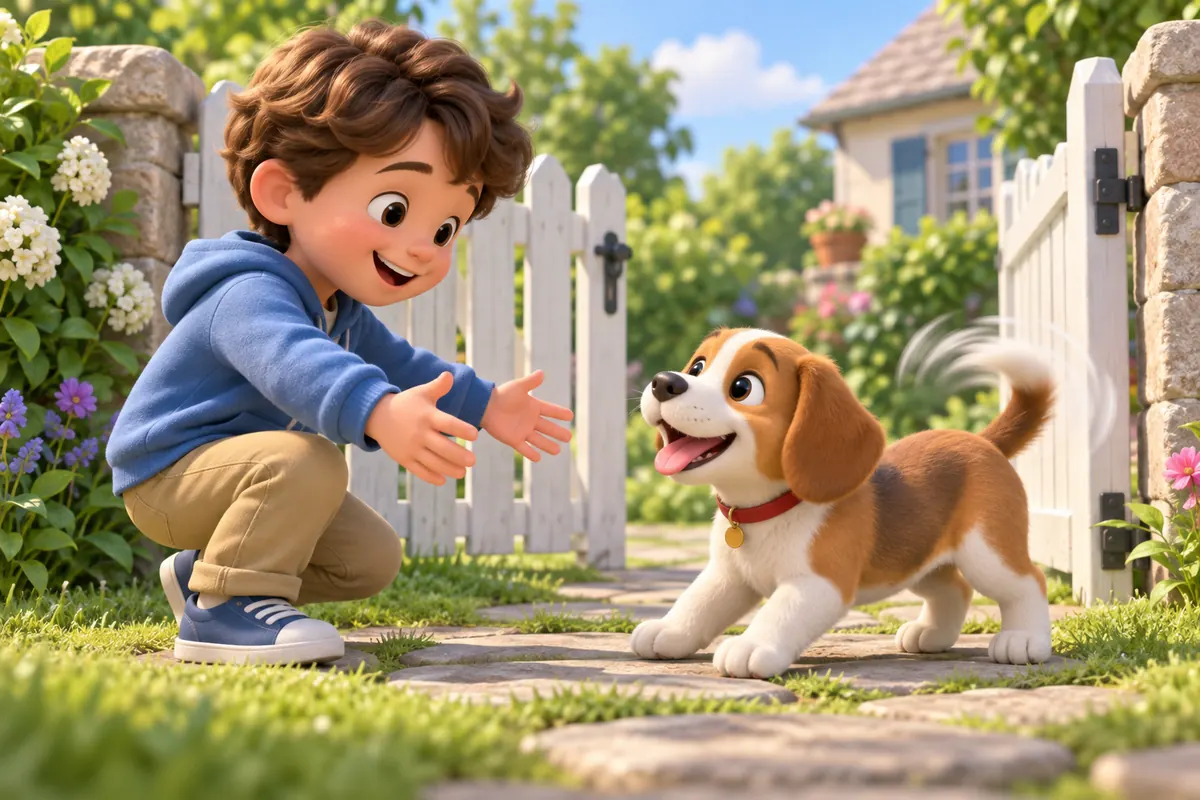
In a sentence, a dog wags its tail means the tail moves repeatedly, usually from side to side. The verb describes motion; it does not by itself prove exactly how the dog feels. Add context, such as a loose posture or a greeting, if you want to describe the situation rather than only the movement.
Can “wag” describe a finger or head?
Yes. A person may wag a finger from side to side or up and down, often to signal warning or disapproval. A head can also wag, although shake is more common for disagreement. Name the body part so the reader can picture the direction and purpose of the motion.
Is “wag” a noun or a verb?
Wag is most common as a verb, as in “the dog wagged its tail.” It can be a noun for a wagging movement, as in “a wag of the tail,” or an old-fashioned informal word for a humorous person. The sentence’s article and position help identify the noun use.
What is the past tense of “wag”?
The past tense and past participle are wagged, with a double g. The present participle is wagging, also with a double g. Write “The dog wagged its tail” and “The dog is wagging its tail”; the base form appears after to or a modal verb.
Using “wag” accurately
Use wag for repeated movement and identify the body part or object that moves. Choose wave, wiggle, or sway when those verbs describe the action more closely; use regional or noun senses only when the context makes them clear.
Correcting a few common examples
The source examples above include phrases such as “a wag of flavors” and “a wag of ideas.” Those are not standard ways to use the movement noun. Use wag as a verb for motion, or use the noun for one movement (“a wag of the tail”); choose words such as variety or range for flavors and ideas. In “wag the plane’s wings,” the sentence should identify the pilot or aircraft as the cause and make the unusual movement context clear.
Have you ever heard of the term “wag” in the English language? Let me break it down for you. In linguistic terms, a wag is a verb that refers to the swift movement from side to side, typically associated with the movement of an animal’s tail.
Using “wag” in a sentence can depict various scenarios, from a dog wagging its tail in excitement to a person playfully wagging a finger as a gesture of warning or amusement. This versatile word adds an element of liveliness and action to any sentence it is used in, making it a fun and dynamic addition to your vocabulary.
7 Examples Of Wag Used In a Sentence For Kids
- Are you ready to wag your tail like a happy puppy?
- The cute puppy loves to wag its tail when it is happy.
- Let’s all wag our tails and be happy like playful puppies!
- When a dog is excited, it will wag its tail very fast.
- I can’t wait to see the dog wag its tail when it sees us.
- Can you wag your imaginary tail like a cheerful dog?
- The dog will wag its tail when it gets a yummy treat.
14 Sentences with Wag Examples
- Have you ever seen a dog wag its tail with excitement?
- The trainee asked the experienced pilot about the various ways to wag the plane’s wings.
- When the professor cracked a joke during the lecture, some students couldn’t help but wag their fingers in the air.
- The college canteen is popular for its delicious wag of flavors, offering a variety of dishes for the students.
- Despite the heavy workload, the students managed to wag through their assignments before the deadline.
- The campus dog’s tail would always wag enthusiastically whenever a student offered it some food.
- The college football team’s victory led to a celebratory wag of excitement among the students.
- As the music started playing at the college festival, the crowd began to wag their heads to the beat.
- Students in the library often found themselves distracted by the wag of conversations happening around them.
- During the monsoon season, students would encounter the occasional wag of umbrella sellers outside the campus gates.
- The college’s annual cultural fest featured a wag of performances, showcasing the diverse talents of the students.
- The student council’s campaign posters were designed to catch the eye with a bold wag of colors and slogans.
- The group project required each student to contribute their own wag of ideas to come up with a comprehensive presentation.
- Some students would try to discreetly wag out of attending certain lectures they found boring.
How To Use Wag in Sentences?
Simply using Wag in a sentence is quite straightforward.
To use Wag correctly in a sentence, you first need to determine the context or situation in which you want to employ the word. Once you have identified the appropriate moment, you can integrate Wag into your sentence.
For example, you can say, “I gave my dog a treat, and he started to wag his tail happily.” In this sentence, the word Wag is used to describe the action of the dog moving its tail from side to side.
Another example could be, “The puppy’s tail began to wag excitedly when it saw its owner coming home.” Here, Wag is used to convey the enthusiastic movement of the puppy’s tail upon seeing its owner.
Remember that Wag is commonly associated with the movement of an animal’s tail, indicating happiness, excitement, or friendliness. So, when incorporating Wag into a sentence, make sure the context aligns with this meaning.
By following these simple steps and examples, you can effectively use Wag in a sentence to communicate a specific action or behavior.
Conclusion
In summary, we explored sentences featuring the word “wag” in various contexts. This term, often associated with the movement of a tail, can be used in different ways to describe actions, emotions, or objects. From describing a dog’s happy wag to a playful wag of a finger, the word “wag” offers versatility in expressing motion, mischief, or physical traits. These sentences vividly illustrate the different scenarios in which “wag” can be effectively incorporated, adding depth and imagery to the language used.
By examining these examples, we gain insight into the diverse applications of the word “wag” in everyday communication. Whether used to convey a wagging tail’s joy or a wagging finger’s warning, this simple term enhances our ability to describe movement, emotions, and behaviors with clarity and vividness.


