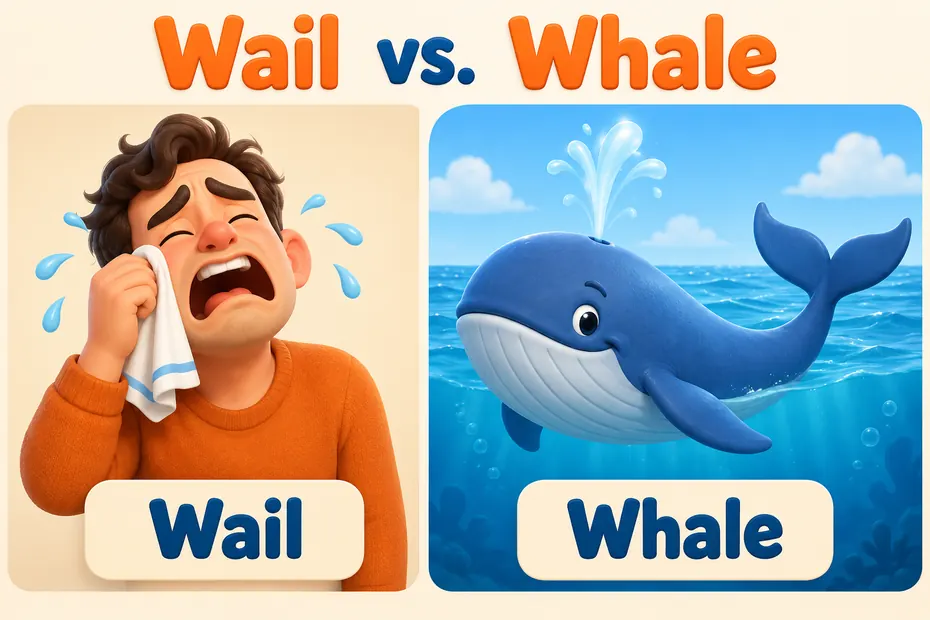
Wail vs. whale: Use wail for a loud, mournful cry or the act of making that sound: “The baby began to wail.” Use whale for the marine mammal: “A whale surfaced beside the distant rocks.” The words sound alike for many speakers, but their spellings identify different meanings.
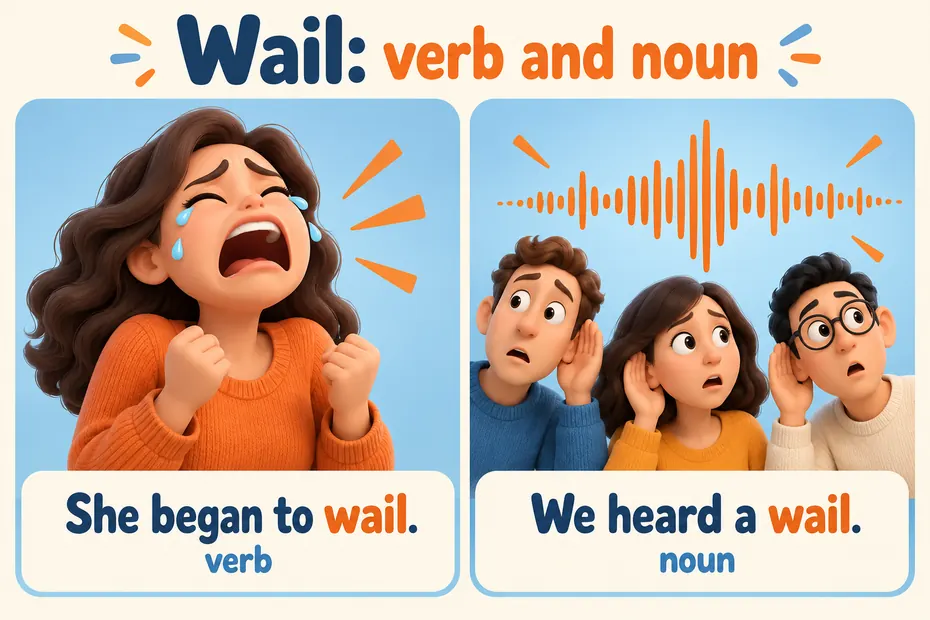
Correction to the older explanation below: Wail is both a verb and a noun, so “She heard a wail” is correct. Whale also has dictionary-listed verb and figurative uses; it is not exclusively an animal noun. Choosing between the words requires meaning, rather than a rigid verb-versus-noun rule.
Wail vs. whale: key facts at a glance
- Wail names a prolonged crying sound or describes making it.
- Whale most commonly names a marine mammal.
- The verb forms are wail, wails, wailed, wailing.
- The ordinary animal plural is whales.
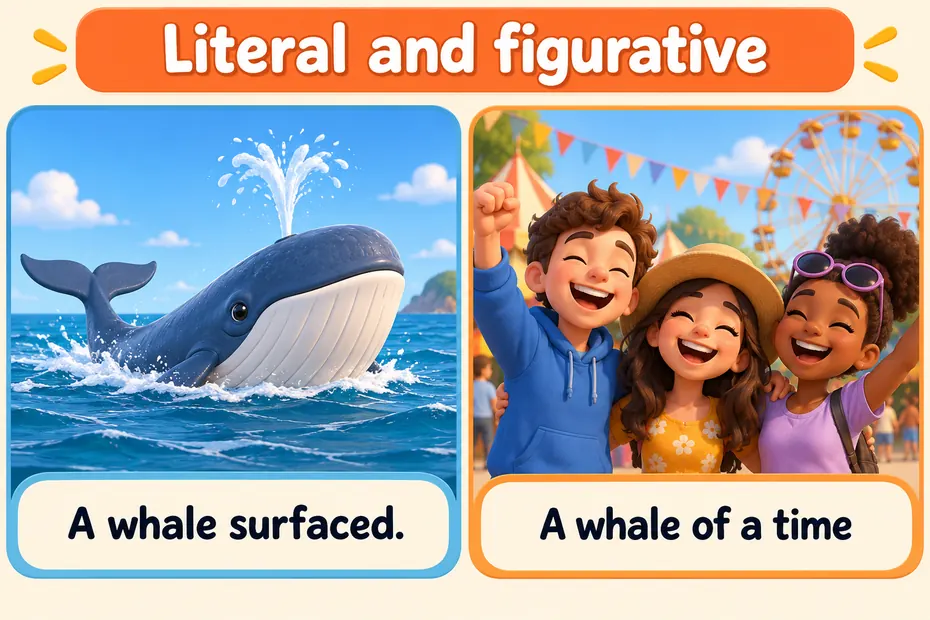
- “A whale of a time” is a figurative expression using whale.
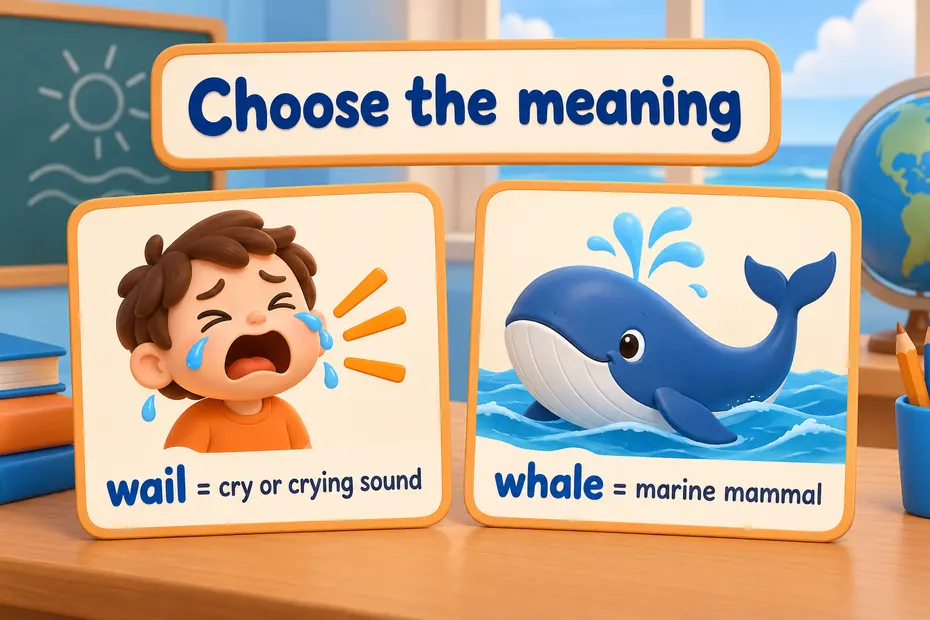
When should you use wail?
Use wail when the sentence concerns crying, lamenting, or a sound resembling a mournful cry. Merriam-Webster’s wail entry includes both noun and verb forms. The noun names the sound; the verb describes producing it.
Compare “The child began to wail” with “A wail came from the next room.” The first sentence uses an action verb after to. The second uses a countable noun after a. Both refer to a sound, so both require the spelling wail.
The sound need not come from a person. “A siren wailed in the distance” uses the verb figuratively, while “the wail of the siren” uses the noun. A writer can also describe a musical instrument as wailing when the sound resembles an intense cry. Such examples broaden the meaning without turning it into the animal word.
When should you use whale?
Use whale for the marine mammal: “The whale surfaced,” “We watched two whales,” or “The whale’s tail disappeared.” Merriam-Webster’s whale entry also records figurative and verb meanings. The common animal sense is the best starting point for beginners, but it is not the whole dictionary entry.
The earlier article includes dolphins under an unusually broad explanation of whale. For practical vocabulary teaching, do not replace every occurrence of dolphin with whale. Cetacean relationships and everyday common names are different levels of description. NOAA Fisheries’ whale resource provides species information, while its navigation also distinguishes dolphins and porpoises for readers.
A language example does not need biological superlatives to work. “A whale surfaced offshore” is sufficient. If you add a species name, measurement, or behavior, verify that detail for the particular species rather than treating every cetacean as identical.
Comparison table: spelling, function, and examples
| Expression | Function | Original example | Meaning test |
|---|---|---|---|
| wail | Verb | The child started to wail. | Make a crying sound. |
| a wail | Noun | A wail broke the silence. | A crying sound. |
| whale | Animal noun | The whale surfaced offshore. | A marine mammal. |
| whales | Plural animal noun | We saw two whales. | More than one animal. |
| a whale of a time | Figurative phrase | They had a whale of a time. | A very enjoyable experience. |
The table shows why part of speech alone fails. “A wail” and “a whale” are both noun phrases. The noun after a could name a sound or an animal. Ask what the sentence describes, then choose the corresponding spelling.
How can you check a confusing sentence?
Replace the uncertain word with a plain explanation. If cry or crying sound preserves the intended meaning, choose wail. If marine mammal fits, choose whale. For an established figurative expression, check the whole phrase rather than substituting one word mechanically.
- “We heard a ___ outside.” If the meaning is a cry, write wail.
- “We photographed a ___ offshore.” If the subject is the animal, write whale.
- “The siren began to ___.” The verb describing its sound is wail.
- “The children had a ___ of a time.” The established expression uses whale.
Spell-check may accept either spelling because both are real words. Read the sentence for sense. “The baby began to whale” does not express the intended crying meaning, even though a dictionary contains separate verb uses of whale.
Frequently asked questions
Are wail and whale homophones?
They are homophones for many English speakers: different words pronounced alike. Some accents retain a distinction between initial w and wh, so avoid claiming they sound identical in every variety of English. In writing, the meaning determines the spelling regardless of a speaker’s particular pronunciation.
Is “a wail of despair” correct?
Yes. In “a wail of despair,” wail is a noun naming a crying sound. The older correction of “a whale of despair” points toward the right spelling, but its repeated claim that wail is only a verb misses the grammatical structure of the corrected phrase itself.
Can a whale wail?
A writer could describe a whale’s vocalization as a wail if that is an intentional sound comparison: “The whale’s call sounded like a wail.” The sentence uses both spellings for different meanings. For a factual account, prefer the appropriate term for the particular vocalization and species rather than assuming all calls are wails.
What is the easiest memory aid?
Connect wail with a crying sound and whale with an ocean animal. Then practice a paired sentence: “We heard a wail before we saw the whale.” This wail vs. whale contrast teaches the meaning of each spelling without relying on the inaccurate rule that only one can be a noun.
Key Takeaways
- “Wail” is a verb that means to cry loudly and mournfully, while “whale” is a noun that refers to a large marine mammal.
- The only similarity between these two words is their phonetic resemblance, but their meanings and usage are different.
- It is crucial to use the correct word in the right context to effectively communicate your message.
- Paying attention to surrounding words and sentence structure can help ensure correct usage.
- Examples: “He heard a wail in the distance and immediately knew that something tragic had happened.” / “We were lucky enough to spot a majestic whale breaching off the coast of Hawaii.”
- Understanding the definitions and distinctions between “wail” and “whale” is important to avoid confusion in writing.
What is the difference between “wail” and “whale”?
When it comes to the words “wail” and “whale,” it’s easy to see why they might cause some confusion. Though they may sound similar, they have completely different meanings. Let’s take a closer look at the difference between these two words.
Definition of “wail”:
“Wail” is a verb that means to cry loudly and mournfully. It is often associated with expressing grief, sorrow, or pain. For example, when someone is overcome with sadness, they might wail in anguish or despair. It’s important to note that “wail” is an action, describing a specific emotional response.
Definition of “whale”:
On the other hand, “whale” is a noun that refers to a large marine mammal. Whales are known for their immense size, magnificent presence, and unique adaptations. They are often found in oceans and seas, and there are several different species of whales, including the humpback whale, blue whale, and killer whale.
As you can see, the only similarity between these two words is their phonetic resemblance. Their meanings and usage are vastly different from each other. This highlights the importance of using the right word in the right context to effectively communicate your message.
To summarize:
| Word | Definition |
|---|---|
| Wail | To cry loudly and mournfully |
| Whale | A large marine mammal |
It’s crucial to remember, context is key when distinguishing between these words. Paying attention to the surrounding words and sentence structure can help you ensure that you are using the correct word.
Here are a few examples to illustrate the difference:
- He heard a wail in the distance and immediately knew that something tragic had happened.
- We were lucky enough to spot a majestic whale breaching off the coast of Hawaii.
Remember, using the correct word not only helps to convey your intended meaning clearly but also demonstrates your command over the English language.
Next, let’s explore some other commonly confused words to further enhance your language skills.
Understanding the meanings of “wail” and “whale”
When it comes to the English language, there’s no shortage of words that can be easily confused or misused. One such pair is “wail” and “whale.” Though they may sound similar, their meanings couldn’t be more different. Let’s take a closer look at each word to understand their definitions and usage.
Definition of “Wail”
“Wail” is a verb that means to cry loudly and mournfully. It is often associated with expressing grief, despair, or intense emotion. When someone wails, they emit a high-pitched, sorrowful sound that can be heard from a distance. This is a word that carries a sense of deep sadness and anguish.
Definition of “Whale”
On the other hand, “whale” is a noun that refers to a large marine mammal of the order Cetacea. These magnificent creatures are known for their size and grace. From the enormous blue whale to the playful dolphins, the term “whale” encompasses a wide range of species that inhabit the world’s oceans.
The Difference Between “Wail” and “Whale”
The difference between “wail” and “whale” is quite distinct. While “wail” is a verb associated with crying and expressing grief, “whale” is a noun that refers to a type of marine mammal. Understanding this difference is crucial for effective communication, as using the wrong word can lead to confusion or convey a completely different meaning.
When encountering these words, it’s important to pay attention to the surrounding words and sentence structure. Context matters when it comes to word usage, and it can prevent unintended misunderstandings.
Examples of “Wail” and “Whale” in Sentences
To further illustrate the difference between these two words, let’s investigate into some examples:
- “She couldn’t help but wail when she received the devastating news.”
- “We were fortunate enough to spot a majestic whale during our oceanic voyage.”
As you can see, the usage of “wail” appropriately conveys the sense of crying loudly and mournfully, while “whale” accurately represents the magnificent marine mammal.
Common misuses of “wail” and “whale”
Let’s take a closer look at some of the common misuses of the words “wail” and “whale” to avoid any confusion in your writing. It’s essential to understand the correct definitions of these words and their proper usage to effectively communicate your message.
The Difference Between “Wail” and “Whale”
To begin, let’s clarify the distinction between these two words. “Wail” is a verb that means to cry loudly and mournfully. On the other hand, “whale” refers to a large marine mammal, often associated with the ocean.
Misuse of “Wail”
One of the common mistakes is using “wail” instead of “whale” when referring to the marine creature. For example, someone might say, “I saw a wail jumping out of the water.” This usage is incorrect because “wail” should be replaced with “whale” to accurately describe the animal.
Misuse of “Whale”
Conversely, sometimes people mistakenly use “whale” instead of “wail” when describing a loud cry or lamentation. For instance, one might say, “He let out a whale of despair.” But, the correct word to use in this context is “wail,” as it properly conveys the meaning of a mournful cry.
Importance of Context and Sentence Structure
Understanding the correct usage of “wail” and “whale” requires paying careful attention to the surrounding words and sentence structure. To avoid confusion, it’s important to select the right word based on the intended meaning and context.
Remember, using the wrong word can lead to misunderstandings and inaccuracies in your writing. So, take the time to choose the appropriate word to accurately convey your intended message.
By becoming more familiar with the definitions and distinctions between “wail” and “whale,” you’ll be able to confidently use these words in your writing. Stay tuned as we explore more tips and examples to further illustrate the differences between these frequently confused words. Let’s continue our journey of enhancing our language skills together!
Stay tuned for more insights on “wail” and “whale” and their correct usage.
Tips for using “wail” and “whale” correctly in your writing
As a writer, it’s important to understand the difference between similar-sounding words like “wail” and “whale” to convey your intended meaning accurately. Here are some tips to help you use these words correctly in your writing:
- Know the Definitions: Familiarize yourself with the definitions of “wail” and “whale” to establish a solid foundation. Understanding the meaning of these words will enable you to use them appropriately in different contexts.
- Pay Attention to Word Function: Consider the part of speech of each word. “Wail” is a verb that means to cry out loudly or mournfully, while “whale” is a noun that refers to a large marine mammal. By identifying the word function, you can ensure proper usage in your sentences.
- Context is Key: Pay close attention to the surrounding words and sentences when choosing between “wail” and “whale.” Think about the overall message you want to convey and select the word that fits the context most accurately. This will prevent confusion and enhance the clarity of your writing.
- Use Examples: To fully grasp the nuances and differences between “wail” and “whale,” it’s helpful to examine examples. Let’s look at a couple:
- “The baby started to wail in the middle of the night.” (verb)
- “We went on a boat tour and saw a whale breach the surface.” (noun)
Notice how the verb form of “wail” describes a sound, while the noun form of “whale” refers to a specific creature. Examples like these can guide you in using the correct word in the appropriate situation.
- Proofread and Revise: After finishing your writing, take the time to proofread and revise your work. Check for any instances where you may have mistakenly used “wail” when you intended to use “whale” or vice versa. This extra step of reviewing your writing will help you catch and correct any errors.
By following these tips and staying mindful of the differences between “wail” and “whale,” you can effectively use these words in your writing and avoid common mistakes that can confuse the reader. Remember, precision in language is crucial for clear communication.
Conclusion
By understanding the definitions and word functions of “wail” and “whale,” as well as paying attention to context, we can use these words correctly in our writing. Through the examples provided, we have seen the clear differences between the verb “wail” and the noun “whale.”
To avoid confusion, it is crucial to proofread and revise our work. Precision in language is essential for effective communication.
Remember, the word “wail” refers to a loud, mournful cry, while “whale” is a large marine mammal. By using these words appropriately, we can ensure that our writing is clear and accurate.
So, next time you encounter these words, take a moment to consider their meanings and the context in which they are used. Your readers will appreciate your attention to detail and your commitment to precise language.
Frequently Asked Questions
Q: What is the main focus of the article?
A: The article focuses on providing tips for correctly using the words “wail” and “whale” in writing.
Q: Why is it important to understand the definitions and word functions of these words?
A: Understanding the definitions and word functions of “wail” and “whale” helps prevent confusion and ensure accurate usage.
Q: How can I differentiate between the verb “wail” and the noun “whale”?
A: Examples are given in the article to highlight the differences between “wail” as a verb (meaning to cry out) and “whale” as a noun (meaning a large marine mammal).
Q: What is the advice given in the article for clear communication?
A: The article advises readers to proofread and revise their work to avoid any ambiguity or confusion caused by incorrect usage of “wail” and “whale”.
Q: What is the overall message of the article?
A: The article emphasizes the importance of precision in language for clear communication when using the words “wail” and “whale” in writing.


