
To use weigh in in a sentence, name the discussion and a preposition, because the phrasal verb is intransitive: “The mayor weighed in on the new timetable.” A topic follows on, and a suggestion follows with, but the verb itself never takes a direct object.
Weigh in at a glance
- Weigh in is an intransitive phrasal verb, so it takes no direct object.
- A topic follows on, and a contribution follows with.
- Its forms are weighs in, weighed in and weighing in; the noun is weigh-in.
- It often suggests a late but welcome contribution to a debate already under way.
- The commonest error is adding a direct object, as in weigh in the argument.
What does weigh in mean?
Weigh in is a phrasal verb meaning to add your opinion to a discussion, especially one that is already in progress. The Cambridge entry for weigh in records this opinion sense alongside the literal sense of being weighed before a contest. Where a writer simply wants to name the act of commenting, comment is the plainer verb, but weigh in adds the idea of entering a debate that others have already started.
| Sense | Plain meaning | Example sentence |
|---|---|---|
| Give an opinion | Join a debate with a view | Three parents weighed in on the uniform rule. |
| Offer a contribution | Supply a remark or a document | She weighed in with a written objection. |
| Be officially weighed | Step on the scales before a contest | The boxer weighed in at seventy kilos. |
One limitation is worth stating plainly. Weigh in is informal to neutral, so a formal report would write commented or ask readers to contribute a view instead, and it cannot be used for a silent opinion nobody hears. It also names the moment of entry, which is why it suits a speaker who arrives late to an argument rather than one who opens it.
How weigh in works with on and with
The preposition after the verb decides whether the sentence names a subject or an offering. Weigh in is intransitive and inseparable, so no object may follow it directly and none may sit between weigh and in. The five patterns below cover the opinion sense and the literal sense, and only the literal one needs a number.
| Pattern | Example | What it signals |
|---|---|---|
| weigh in on + topic | Two teachers weighed in on the change. | The subject under discussion. |
| weigh in with + contribution | He weighed in with a short report. | The form the contribution takes. |
| weigh in + adverb | The mayor weighed in strongly against the plan. | How forcefully the opinion was given. |
| weigh in at + weight | The champion weighed in at sixty-eight kilos. | The literal measurement on the scales. |
| the weigh-in | The weigh-in starts before the final bout. | The noun, naming the official weighing. |
Because the verb is intransitive, it cannot be made passive: a sentence such as the issue was weighed in by the mayor does not work. If you need a passive, switch to the plain verb and write the issue was commented on by the mayor.
Weigh in across registers: examples
Weigh in keeps the same grammar in every setting, but the formality changes with the subject. The nine sentences below move from a classroom to a boxing ring, and each one names the discussion or the scales that the verb attaches to.
| Context | Example sentence | Why this works |
|---|---|---|
| Classroom | Two pupils weighed in on where to hold the party. | A familiar debate keeps the tone light. |
| Workplace email | The finance team weighed in with a revised forecast. | With names the contribution precisely. |
| News report | The minister weighed in on the transport dispute. | On names the public subject. |
| Editorial | Readers weighed in to speak up about the closure. | Shows the verb driving a public response. |
| Sports writing | The champion weighed in at the required limit. | At introduces the measured weight. |
| Meeting notes | The chair invited the treasurer to weigh in. | Uses the verb without a preposition after invite. |
| Academic writing | Two reviewers weighed in with detailed corrections. | A formal register keeps the with-phrase. |
| Conversation | My uncle weighed in with his usual long story. | Informal but grammatically identical. |
| Business news | Analysts weighed in on the takeover before the vote. | A time phrase fixes the moment of entry. |
Only one sentence describes a set of scales. The other eight treat weigh in as an act of speaking, which is the sense that dominates modern use.
Weigh in vs weigh up and weigh down
The same base verb carries three different particles and three unrelated meanings. weigh up means to consider carefully, and weigh down means to burden, so only weigh in adds a view to a discussion.
| Attribute | weigh in | weigh up | weigh down |
|---|---|---|---|
| Core meaning | Add an opinion or step on scales | Consider the pros and cons | Burden or oppress |
| Object or preposition | on a topic, with a comment | Takes a direct object | Takes a direct object |
| Transitive | No | Yes | Yes |
| Usual subject | A person joining a debate | A person deciding | A worry, a load or guilt |
| Register | Informal to neutral | Neutral | Neutral to literary |
Verdict: choose weigh in for joining a discussion or stepping on the scales, weigh up for weighing a decision, and weigh down for a burden, and use opine only when you deliberately want a bookish tone.
Word forms and grammar of weigh in
Weigh in follows the regular verb pattern for weigh, and the hyphen appears only in the noun. The table sets out the verb tenses, the noun and the extra preposition that the literal sense needs.
| Form | Part of speech | Example |
|---|---|---|
| weigh in | phrasal verb, base form | Please weigh in before the vote. |
| weighs in | third person singular | The editor weighs in every Friday. |
| weighed in | past and past participle | She weighed in with a firm objection. |
| weighing in | present participle | The experts are still weighing in. |
| weigh-in | noun, hyphenated | The weigh-in lasted twenty minutes. |
In the opinion sense the verb is never hyphenated and never takes an object, while the noun is always hyphenated: you weigh in, and then the weigh-in is recorded.
Common mistakes with weigh in
- Incorrect:
She weighed in the argument.Correct: She weighed in on the argument. Rule: The opinion sense is intransitive, so the topic follows on. - Incorrect:
He weighed in a suggestion.Correct: He weighed in with a suggestion. Rule: A contribution follows with, not the bare verb. - Incorrect:
We need to weigh in the options.Correct: We need to weigh up the options. Rule: Weigh up means to consider; weigh in means to comment. - Incorrect:
The boxer weighed in seventy kilos.Correct: The boxer weighed in at seventy kilos. Rule: The literal sense needs at before the measurement. - Incorrect:
Please weigh it in.Correct: Please weigh in on it. Rule: The verb is inseparable, so no object may sit between weigh and in.
Practice using weigh in
Work through the six items, then read the reason beside each answer rather than only checking the key.
- Fill the gap: The committee chair asked the treasurer to ______ in on the budget.
- Choose the better word: Before deciding, we should (weigh in / weigh up) the risks.
- Correct the error: The coach weighed in a short statement.
- Build a sentence: use weigh in at about a jockey before a race.
- Spot the register: which belongs in a formal minutes entry — the treasurer weighed in with a correction, or the treasurer totally jumped in with a correction?
- Change to the noun: The boxers will weigh in before the fight.
Answers
- weigh — the bare verb follows the infinitive marker to and takes on before the topic.
- weigh up — considering options is weigh up, not weigh in.
- The coach weighed in with a short statement — a contribution needs with.
- Model answer: The jockey weighed in at fifty-two kilos before the race.
- The treasurer weighed in with a correction — it keeps the neutral register of minutes.
- The weigh-in takes place before the fight — the noun adds the hyphen.
The bottom line
Use weigh in in a sentence when someone adds a view to a debate already under way, and let on name the topic or with name the contribution, because the verb is intransitive and needs one of them. The two nuances that decide most sentences are these: the particle is inseparable, so no object can sit inside, and the literal sense needs at before a weight. When the task is judging options rather than voicing a view, weigh up is the verb you want.
Frequently asked questions about weigh in
Is weigh in formal or informal?
Weigh in sits between informal and neutral, which is why it appears in news, meetings and podcasts but rarely in legal or academic prose. Those registers prefer comment, submit a view or contribute. The verb itself is never wrong, but it carries a conversational energy that a formal document may not want.
What is the past tense of weigh in?
The past tense is weighed in, and the past participle is identical, so the sentence the chair had already weighed in is correct. The third person singular is weighs in and the present participle is weighing in. A form such as weigh ined does not exist, because the verb simply adds the regular ending to weigh.
What does weigh in on mean?
Weigh in on introduces the subject being discussed: to weigh in on a dispute is to offer an opinion about it. The preposition on points to the topic, not to an object being weighed. Without on, the sentence either needs with before a contribution or at before a measured weight.
Can weigh in be separated?
No. The particle stays attached, so English allows weigh in on the plan but never weigh the plan in. The verb is also intransitive, which means no direct object follows it at all. If you need an object, switch to a plain verb such as consider, comment on or oppose.
How to use “weigh in” in a sentence
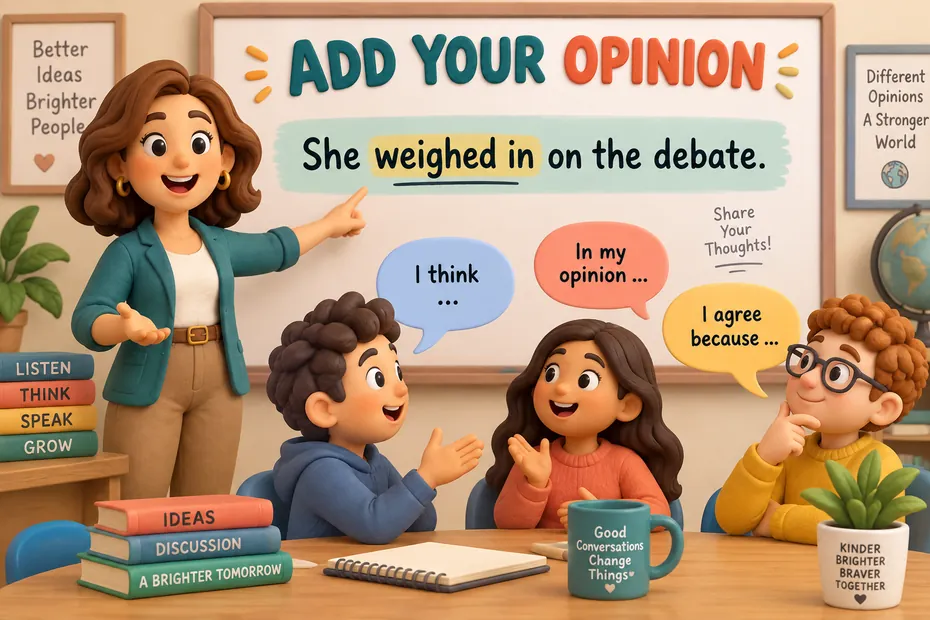
Weigh in commonly means to join a discussion by offering an opinion: “The coach weighed in on the proposed rule change.” It also means to have your weight checked, especially before a sporting event: “The boxer weighed in before the match.” The surrounding words tell readers which meaning you intend.
The Merriam-Webster entry for weigh in recognizes both being weighed and contributing influence or an opinion. For most everyday writing, the discussion meaning is the useful starting point. Someone does more than silently listen: they contribute something to the exchange.
Choose the meaning that fits your situation
| Meaning | Example | What happens? |
|---|---|---|
| Offer an opinion | The librarian weighed in on the reading list. | The librarian contributed a view. |
| Add a contribution | Several parents weighed in with practical suggestions. | They joined the conversation with ideas. |
| Have weight measured | The wrestler weighed in before the tournament. | The wrestler’s weight was checked. |
| Report a measured weight | The package weighed in at two kilograms. | Its recorded weight was two kilograms. |
The sports example does not imply that the athlete offered an opinion. Equally, “She weighed in on the debate” does not mean anyone measured her body weight. Adding a discussion topic, a suggestion, a competition, or a number makes the intended sense easy to recognize.
Weigh in versus weigh: an important distinction
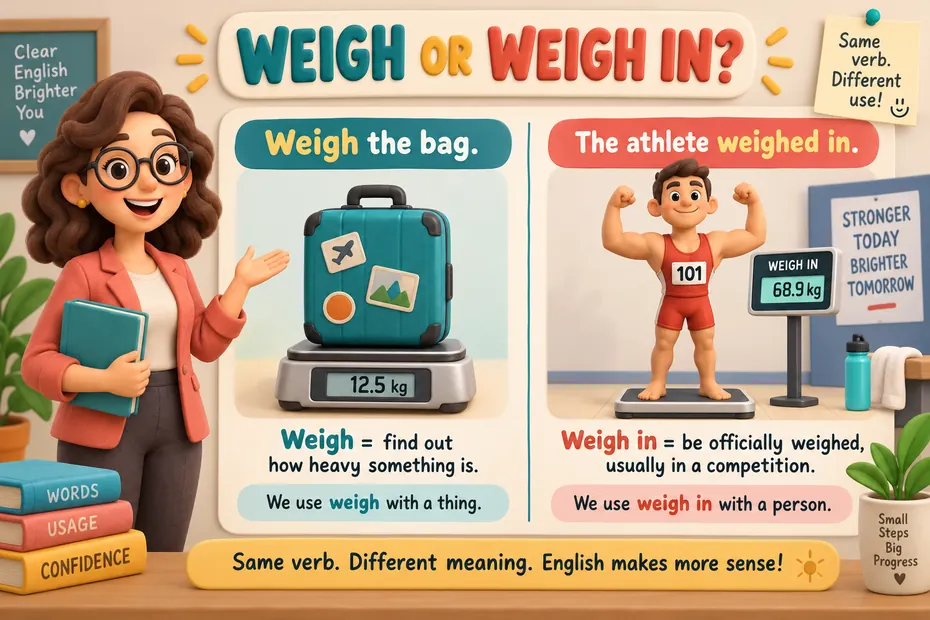
Use weigh when someone measures an object’s weight: “Weigh the flour before mixing it” or “The clerk weighed the parcel.” The dictionary entry for weigh covers this ordinary measuring action. You do not normally need in in a simple instruction about a bag, fruit, or school supplies.
This distinction helps with the older children’s examples below. “Weigh the bag” is the ordinary instruction if you want to check its weight. “The athlete weighed in” belongs to a weighing procedure, often organized before a contest. For a classroom discussion, “The children weighed in on which book to read” naturally uses the opinion meaning.
Useful sentence patterns
- Weigh in on + topic: “The designer weighed in on the proposed layout.” This names the subject of the contribution.
- Weigh in with + contribution: “The engineer weighed in with a simpler solution.” This names what the person offered.
- Weigh in at + weight: “The luggage weighed in at eighteen kilograms.” This gives the measured result.
- Weigh in before + event: “The competitors weighed in before the final.” The event supplies the sporting context.
You can combine topic and contribution when both matter: “The editor weighed in on the headline with two alternatives.” Keep the sentence readable, however. A long chain of details can hide the actual suggestion. If the reader mainly needs the suggestion itself, quote or summarize it in a second sentence.
Verb forms and the hyphenated noun
The verb takes the normal forms weighs in, weighed in, and weighing in. Write “He weighs in when asked,” “He weighed in yesterday,” and “He is weighing in now.” The particle in stays unchanged. Do not write “he weigh in” when the subject is a singular person in the present tense.
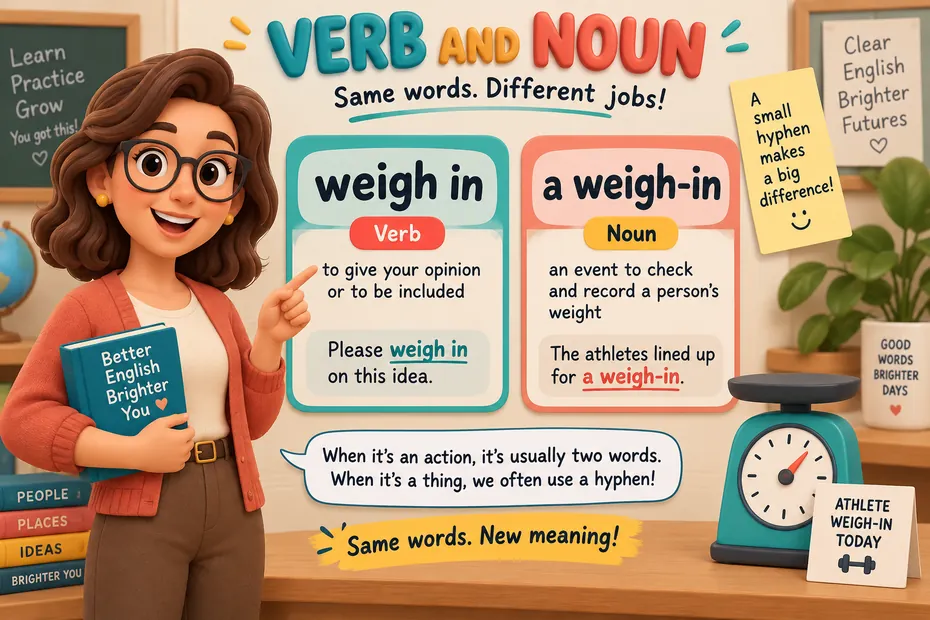
As a verb, keep the two words separate: “They will weigh in tomorrow.” As a noun referring to a weighing event or procedure, use weigh-in: “The official weigh-in starts at nine.” A scheduled weigh-in and someone’s decision to weigh in on a debate are different kinds of activity.
Examples for everyday writing
- Before we chose a date, every team member had a chance to weigh in.
- My sister weighed in on the paint colors and suggested pale green.
- The students weighed in with questions about the new timetable.
- Would you like to weigh in on the proposed menu?
- The committee chair waited until the quieter members had weighed in.
- The competitors must weigh in before their first bout.
- The delivery weighed in at just under five kilograms.
- Weigh the apples separately so we can compare the two bags.
The last example deliberately uses weigh instead of weigh in. Comparing related constructions helps you choose the right one. You can also use “comment on” or “offer a view on” when you want a more explicit discussion phrase, especially for readers who may not know the idiom.
A quick editing check
First ask whether the sentence describes a contribution or a measurement. Next check whether the topic, contribution, event, or weight is clear. Finally read the verb form and punctuation. “She weighed in on the proposal” needs no hyphen; “the weigh-in” does. An introductory phrase can take a comma: “After hearing both sides, she weighed in with a compromise.”
Be careful with neighboring expressions. “Weigh the options” means consider them carefully; “weigh in on the options” means contribute to a discussion about them. Someone can do both, but the sentences focus on different actions. Choose the wording that tells readers what actually happened.
Frequently asked questions
Does weigh in always mean giving an opinion?
No. It also refers to being weighed, particularly in sport, and can introduce a measured weight. “On the debate” signals discussion; “at seventy kilograms” signals measurement.
Can I say weigh in with a suggestion?
Yes. “She weighed in with a suggestion” explains what she contributed. Add a topic if readers need it: “She weighed in on the travel plans with a suggestion.”
Is weigh in hyphenated?
The verb is two words. The noun weigh-in is hyphenated, as in “We attended the weigh-in.” Match the spelling to its job in the sentence.
What is a simple example for children?
“Maya weighed in on which game to play.” It means Maya offered her opinion. For measuring an object, use “Maya weighed the bag” instead.
Have you ever heard the phrase “weigh in” and wondered about its meaning? In everyday language, to “weigh in” means to give an opinion or offer one’s perspective on a topic or issue.
When someone is asked to “weigh in,” it signifies that their input or viewpoint is valued and being sought after. This phrase is commonly used in discussions, debates, or decision-making processes where multiple viewpoints are being considered.
7 Examples Of Weigh In Used In a Sentence For Kids
- We should weigh in the fruits before eating them.
- Let’s weigh in all the school supplies to make sure we have everything we need.
- It’s important to weigh in your bag to make sure it’s not too heavy.
- Remember to weigh in yourself before and after eating to see if you gained any weight.
- We can weigh in different objects to see which one is the heaviest.
- Before going on a trip, we should weigh in our suitcase to make sure it’s not too heavy for the journey.
- Let’s weigh in the ingredients before cooking to make sure we have the right amount.
14 Sentences with Weigh In Examples
- Weigh in on the debate about online classes versus in-person classes.
- It’s important for everyone to weigh in on the decision of organizing a college fest.
- Let’s all weigh in our opinions on choosing the best extracurricular activities for the upcoming semester.
- As college students, it is crucial to weigh in on current social issues affecting our community.
- Before finalizing the study group schedule, all members need to weigh in on their availability.
- It would be beneficial for us to weigh in on the budget allocation for the college club activities.
- Don’t forget to weigh in on the discussion about implementing new library rules.
- The student council is encouraging everyone to weigh in on proposed changes to the college curriculum.
- Let’s ask our classmates to weigh in on the best locations for the college trip.
- Weigh in with your ideas for improving campus sustainability efforts.
- Before we plan the next college event, we should have everyone weigh in with their suggestions.
- It’s time for us to weigh in on the topic of mental health awareness on campus.
- The college administration wants students to weigh in on the proposed changes to the academic calendar.
- As part of our project presentation, we all need to weigh in on our individual contributions.
How To Use Weigh In in Sentences?
To use Weigh In in a sentence, start by introducing the topic or situation where the weigh-in occurred. Next, mention the significance of the weigh-in, such as in a competition, fitness journey, or weight management program. Then, provide the actual measurement of the weight, using units like pounds or kilograms. Remember to clearly state the purpose of the weigh-in and its relevance to the context of your sentence.
For example, “After weeks of training, it was finally time to weigh in before the boxing match. He stepped onto the scale and weighed in at 150 pounds, ready to take on his opponent.”
In another scenario, you could say, “As part of her weight loss journey, she scheduled a weekly weigh-in to track her progress. This week, she weighed in at 140 pounds, down 2 pounds from last week.”
When using Weigh In in a sentence, make sure to use proper grammar and punctuation to clearly convey the purpose and outcome of the weigh-in. Whether it’s for fitness, health, sports, or any other context, accurately reporting the weight and its significance is key to effectively incorporating Weigh In into your sentences.
Conclusion
In conclusion, when individuals weigh in on a topic, they offer their opinions or input. This can be valuable in discussions or decision-making processes as diverse perspectives are considered, leading to a more well-rounded outcome. By listening to different viewpoints when people weigh in, it allows for a comprehensive understanding of the issue at hand and fosters open communication within a group.
Additionally, it is important to acknowledge that not all opinions carry the same weight when individuals weigh in. It is crucial to evaluate each perspective based on its merit, relevance, and credibility. Ultimately, weighing in on a subject can lead to a more informed and balanced outcome, enriching the dialogue and improving the decision-making process.



