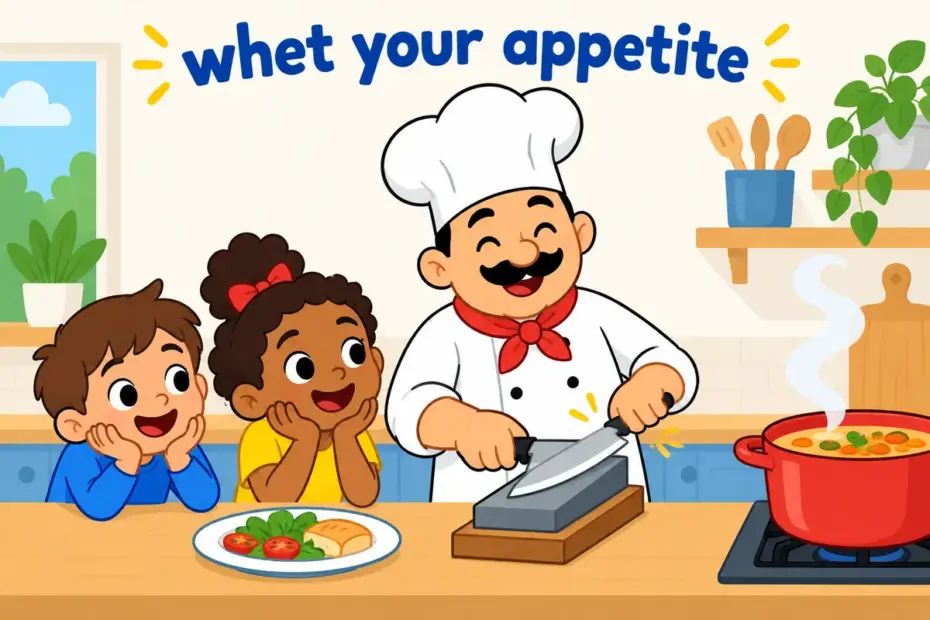
Whet means to sharpen a blade or tool on a stone, and by extension to sharpen a person’s appetite, curiosity or interest. To use whet in a sentence, name the thing being sharpened: “The smell of fresh bread whet our appetite.” The verb is transitive, so its object must always be stated.
Whet at a glance
- Whet is a transitive verb; its forms are whets, whetted and whetting.
- Its literal sense is sharpening a blade on a stone; its figurative sense is sharpening appetite or interest.
- The object is usually appetite, curiosity, interest or desire, and only rarely an actual knife.
- Whet belongs to written and semi-formal English, while casual speech prefers make you hungry or curious.
- The commonest error is the phrase wet your appetite, which swaps the sharpening verb for the damp one.
What does whet mean?
Whet is a transitive verb meaning to sharpen a blade or tool, and, more often today, to sharpen a feeling such as appetite or curiosity. The Cambridge entry for whet records both the literal and the figurative sense. The figurative sense does most of the work in modern writing: a first chapter, a trailer or a cooking smell can whet interest without any blade in sight.
| Sense | Plain meaning | Example sentence |
|---|---|---|
| Sharpen a blade | Put a fine edge on a tool | The smith whetted the chisel before the final cut. |
| Sharpen appetite | Make hunger stronger | The kitchen smells whetted everyone’s appetite. |
| Sharpen interest | Increase eagerness to know more | The opening chapter whetted my curiosity about the case. |
Two limits are worth stating plainly. Whet never means to satisfy, so a whetted appetite is a hungrier one, not a fed one. The word also sits a little above conversation, so a guest at the table would more likely say the smell made me hungry than reach for the verb.
How do you use whet in a sentence?
Whet follows one shape: something whets something else. Put the stimulus first and the appetite, curiosity or blade second, and keep the object stated because the verb is transitive. Five patterns cover almost every real sentence.
| Pattern | Example | What it signals |
|---|---|---|
| stimulus + whet + appetite | The harbour tour whetted my appetite for sailing. | An experience increases hunger for more. |
| whet + possessive + appetite | The sample menu whetted the guests’ appetite. | The possessive names whose desire is sharpened. |
| whet + curiosity or interest | The rumour whetted interest across the office. | Abstract nouns work as well as appetite. |
| be whetted | Her competitive streak was whetted by the close match. | Passive voice foregrounds the sharpened feeling. |
| whet + blade or tool | She whetted the kitchen knife on a steel. | The older, literal sense, still current in kitchens. |
The verb deepens a feeling that already exists; where a feeling is created from nothing, excite a crowd and stimulate demand are the broader choices.
Whet in a sentence: examples across contexts
Whet changes register more than it changes meaning. The nine sentences below keep the same verb as the scene moves from a kitchen to a news feature, and each one names the appetite or interest being sharpened.
| Context | Example sentence | Why this works |
|---|---|---|
| Kitchen | The scent of roasting garlic whetted our appetite long before dinner. | A sensory cause makes the figurative sense easy to picture. |
| Workshop | He whetted the plane iron on a worn stone. | The literal sense survives in trades, and the tool is the object. |
| Classroom | The first experiment whetted the class’s curiosity about magnetism. | Pairs the verb with curiosity rather than hunger. |
| Marketing email | The short preview whets readers’ interest in the full report. | A document acts as the stimulus, the standard business pattern. |
| News feature | Leaked minutes whetted speculation about a leadership challenge. | The stimulus is evidence, and the feeling is public, not physical. |
| Travel writing | A single photograph whetted my appetite for the whole coast. | The concrete image stands for the larger experience. |
| Academic prose | The pilot study whetted interest in a larger trial. | Keeps the tone impersonal while naming the effect. |
| Sports report | The comeback win whetted the fans’ appetite for a title run. | A result sharpens a collective desire. |
| Conversation | The trailer whetted my appetite, so I booked tickets that night. | The first person is acceptable once the object is clear. |
Whet vs hone and wet
Whet and hone both come from the image of a stone, but they have drifted apart, and wet is a different word that sounds almost the same. The three-way table shows where each one belongs.
| Attribute | whet | hone | wet |
|---|---|---|---|
| Core meaning | Sharpen a blade or a desire | Sharpen and refine a skill over time | Make something damp with liquid |
| Usual object | Appetite, curiosity, a blade | A skill, technique or craft | Cloth, a surface, a whistle |
| What it implies | Increased eagerness | Deliberate practice | Moisture, with no sharpening at all |
| Register | Literary and semi-formal | Neutral and professional | Everyday |
| Common phrase | whet your appetite | hone your skills | wet your whistle |
Verdict: choose whet when a desire grows sharper, hone when a skill is refined through practice, and sharpen a pencil or a skill only when the blade image is literal.
Word forms and grammar of whet
Whet inflects regularly, and its related noun is the whetstone rather than a form of the verb. The table also lists the spelling learners most often reach for by mistake. For the extended image of making something keen, hone a technique is the closer verb once practice is involved.
| Form | Part of speech | Example |
|---|---|---|
| whet | verb, base form | A good trailer will whet interest. |
| whets | verb, third person singular | The scent whets the appetite at once. |
| whetted | verb, past and past participle | The prologue whetted my curiosity. |
| whetting | verb, present participle | The teaser is whetting demand for the sequel. |
| whetstone | noun, related | He kept a whetstone beside the workbench. |
| wet | verb – different meaning, a common error | Rain wetted the path, which has nothing to do with sharpening. |
Common mistakes with whet
- Incorrect:
The trailer wet my appetite for the film.Correct: The trailer whetted my appetite for the film. Rule: Whet means sharpen; wet means dampen, so the fixed phrase uses whet. - Incorrect:
The story whetted.Correct: The story whetted my curiosity. Rule: Whet is transitive, so the thing being sharpened cannot be left out. - Incorrect:
She whetted her skills for the interview.Correct: She honed her skills for the interview. Rule: Whet sharpens a blade or a desire; hone refines a skill. - Incorrect:
The meal whetted my hunger, so I felt completely full.Correct: The meal whetted my hunger, so I wanted more. Rule: Whet increases desire and can never mean satisfy.
Practice using whet
Work through the six items, then read the answers for the reason rather than only the key.
- Fill the gap: The first chapter ______ my appetite for the rest of the novel.
- Choose the better word: The chef (whetted / wetted) the blade before slicing.
- Correct the error: The documentary wet my curiosity about volcanoes.
- Build a sentence: use whet your appetite about a busy food market.
- Spot the register: which belongs in a book review – the prologue whets curiosity, or the prologue makes me want to know more?
- Rewrite in the passive: The delay whetted her impatience.
Answers
- whetted – the chapter is the stimulus and appetite is the object that receives the action.
- whetted – a blade is sharpened, while wetted would mean the chef made it damp.
- The documentary whetted my curiosity about volcanoes – whet, not wet, is the sharpening verb.
- Model answer: The stalls of fresh produce whetted our appetite for a long lunch.
- The prologue whets curiosity – a review keeps the concise verb and avoids the chatty phrasing.
- Her impatience was whetted by the delay – the passive keeps the focus on the sharpened feeling.
The bottom line
Use whet in a sentence when something sharpens a blade, an appetite or a curiosity, and name that object directly. The two nuances that decide most sentences are these: the verb is transitive, so the sharpened thing must be stated, and it intensifies a desire rather than satisfying it. Where a skill is being improved through practice, pique someone’s interest or hone is often the more precise choice.
Frequently asked questions about whet
Is whet only used about appetite?
No. Appetite is the commonest object, but curiosity, interest and desire all work in the same pattern. The literal sense of sharpening a blade still appears in kitchens, workshops and blacksmithing, where a whetstone is a specific tool rather than a figure of speech.
What is the past tense of whet?
The past tense and past participle are both whetted, and the present participle is whetting. The doubled t keeps the short vowel sound, so a sentence reads the review whetted interest, not whet interest. The same doubling appears in whetting, never wheting.
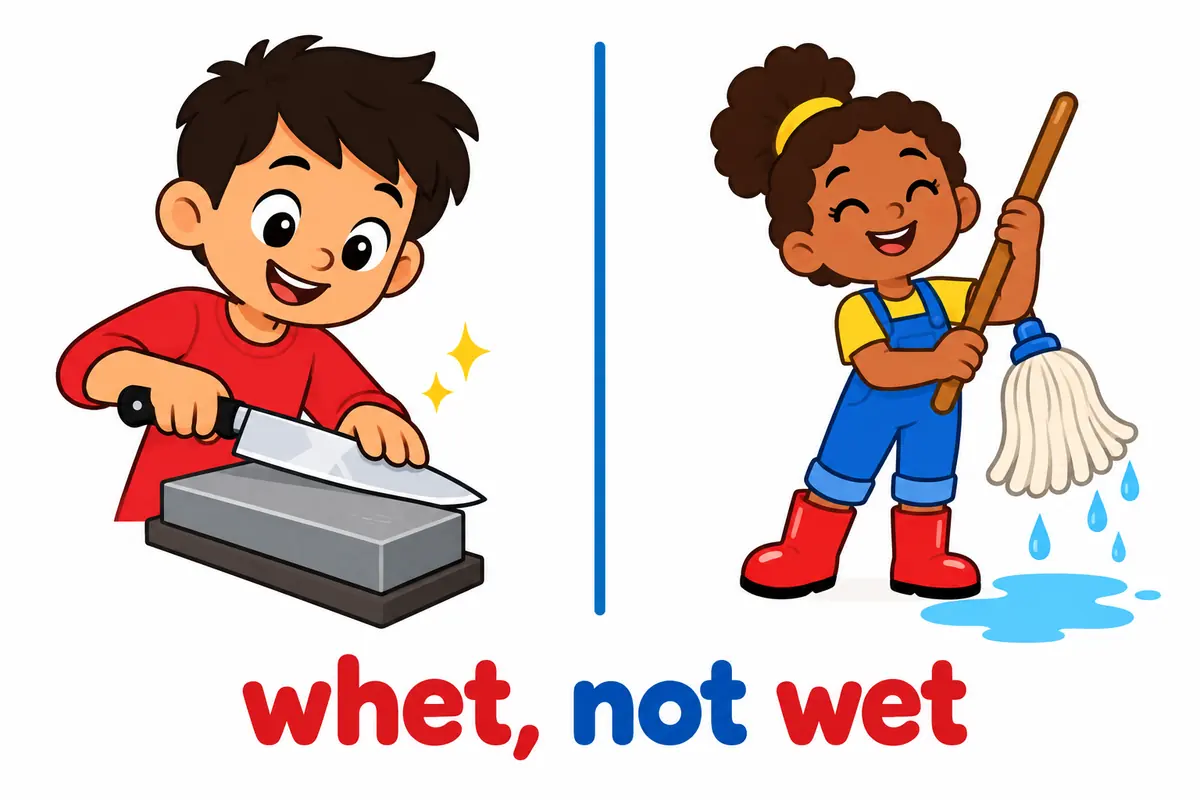
Is it wet your appetite or whet your appetite?
The correct phrase is whet your appetite, because the image is sharpening a hunger rather than dampening it. Wet your appetite is a common misspelling built on the identical sound. Remember the double t links the word to its meaning of making something keen.
Can whet mean to excite in general?
It leans that way but is narrower than excite. Whet means to make a specific appetite or interest stronger, so it implies a desire already present. Excite can create a feeling from nothing, while whet deepens one, which is why the two are not interchangeable.
Have you ever come across the word “whet” in your reading and wondered what it means? Essentially, “whet” is a verb that refers to sharpening something, typically a knife or one’s appetite. This action involves making something keener or more acute.
For example, when you read a well-written book or a compelling article, it can really whet your curiosity, leaving you eager to learn more. In cooking, the aroma of a delicious meal being prepared can whet your appetite, making you excited to dig in. So, keep an eye out for opportunities to use “whet” in your everyday conversations and writing to add a touch of flair and precision to your language.
7 Examples Of Whet Used In a Sentence For Kids
- Whet your pencil before starting to write.
- Use a sharpener to whet your crayons for coloring.
- Let’s whet our appetite with some tasty snacks.
- Whet your curiosity by asking lots of questions.
- Reading a book can whet your imagination.
- Let’s whet our skills by practicing drawing.
- Use a knife to whet the edges of the paper for crafts.
14 Sentences with Whet Examples
- Whet your appetite for knowledge by attending various seminars and guest lectures.
- Before starting your research paper, make sure to whet your research skills by going through relevant academic articles.
- Joining a study group can help whet your understanding of complex subjects.
- Attending career fairs can whet your interest in different job opportunities available in the market.
- Whet your creativity by participating in extracurricular activities like drama club or dance team.
- Going for internships during your college breaks can whet your practical skills and enhance your resume.
- Visiting libraries and exploring new books can whet your curiosity and broaden your knowledge base.
- Joining a debate club can help whet your critical thinking and argumentative skills.
- Regularly solving practice papers can help whet your problem-solving abilities before exams.
- Taking up a foreign language course can whet your linguistic skills and open doors to global opportunities.
- Participating in hackathons can whet your technical skills and provide hands-on experience in coding.
- Utilizing online platforms for learning like MOOCs can whet your appetite for continuous learning beyond the classroom.
- Volunteering for social causes can whet your sense of empathy and social responsibility.
- Enrolling in workshops on entrepreneurship can whet your business acumen and inspire you to start your own venture.
How To Use Whet in Sentences?
To use Whet in a sentence, start by identifying the context in which you want to use the word. Whet means to sharpen or stimulate, typically referring to one’s appetite or curiosity.
Next, think about what you want to convey in your sentence. For example, if you want to describe how something has increased your interest, you could say, “The intriguing book summary whet my curiosity, and now I can’t wait to read the whole book.”
Alternatively, if you want to talk about how something has made you eager for more, you could say, “The delicious appetizers whet my appetite for the main course.”
Remember that Whet is typically used in a figurative sense, so it’s important to consider how you can use it to add depth or emphasis to your sentence.
To practice using Whet in a sentence, try incorporating it into your everyday conversations or writing. This will help you become more comfortable with using the word and understanding its nuances.
Overall, using Whet in a sentence is a great way to add richness and detail to your communication. Just remember to consider the context and think about how the word can enhance your message before incorporating it into your sentence.
Conclusion
In conclusion, the examples of sentences with “whet” demonstrate how this word is used to describe sharpening or stimulating someone’s interest, appetite, or curiosity. By using “whet” in these contexts, writers are able to convey the idea of intensifying or increasing a particular feeling or desire. From stimulating curiosity with a mysterious book cover to sharpening the appetite with a delicious aroma, the versatility of “whet” allows for vivid and engaging descriptions that captivate the reader’s attention.
Overall, the varied examples of sentences featuring “whet” showcase its ability to evoke a sense of anticipation or eagerness. Whether it’s a captivating novel that whets the reader’s curiosity or a tantalizing aroma that whets the appetite, the use of “whet” effectively adds depth and interest to written descriptions, making them more compelling and engaging for the audience.


