
Whether introduces alternatives or uncertainty. Use it when you are considering which of two or more possibilities is true: I can’t remember whether I locked the back door. The sentence reports an indirect yes-or-no question; it does not state a condition. Whether can introduce a clause after verbs such as know, ask, decide, wonder, check, and confirm, and after nouns such as question or doubt.
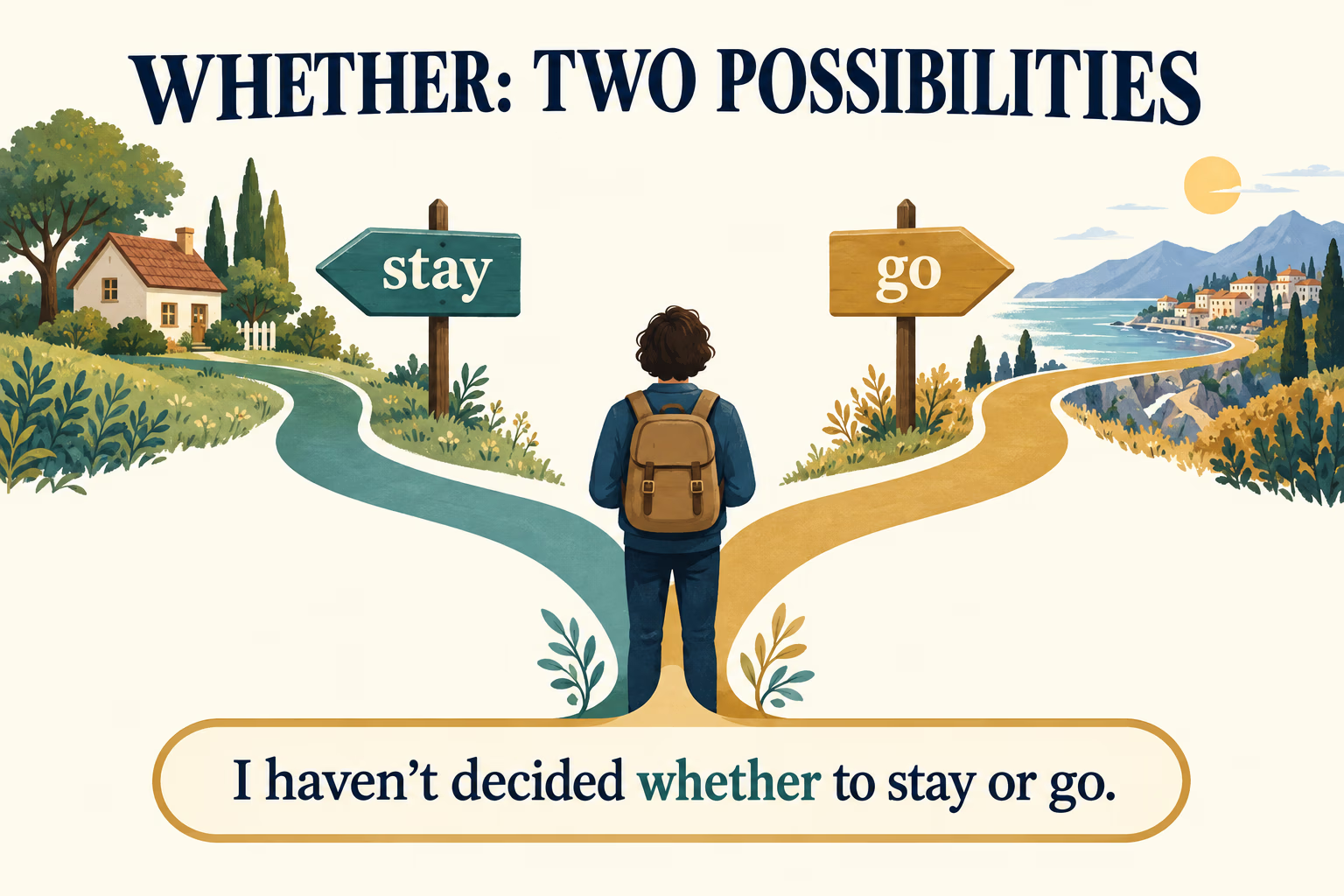
The most common pattern is whether + subject + verb: We’re checking whether the bus is on time. When the alternatives are named, use whether … or …: She hasn’t decided whether to walk or take the train. The two choices should be parallel, as in whether to call or to email or whether the room is quiet or noisy. The second to is optional when both infinitives share it: whether to call or email.
How to use “whether” in a sentence
Use these common patterns to make the relationship clear:
- Ask or find out whether: “Please ask whether the museum is open on Monday.”
- Decide or consider whether: “Mina is deciding whether she should take the earlier train.”
- Whether … or …: “We need to choose whether the meeting will be online or in person.”
- Whether to + verb: “The team discussed whether to postpone the launch.”
- Whether or not: “I’ll bring an umbrella whether or not the forecast changes.”
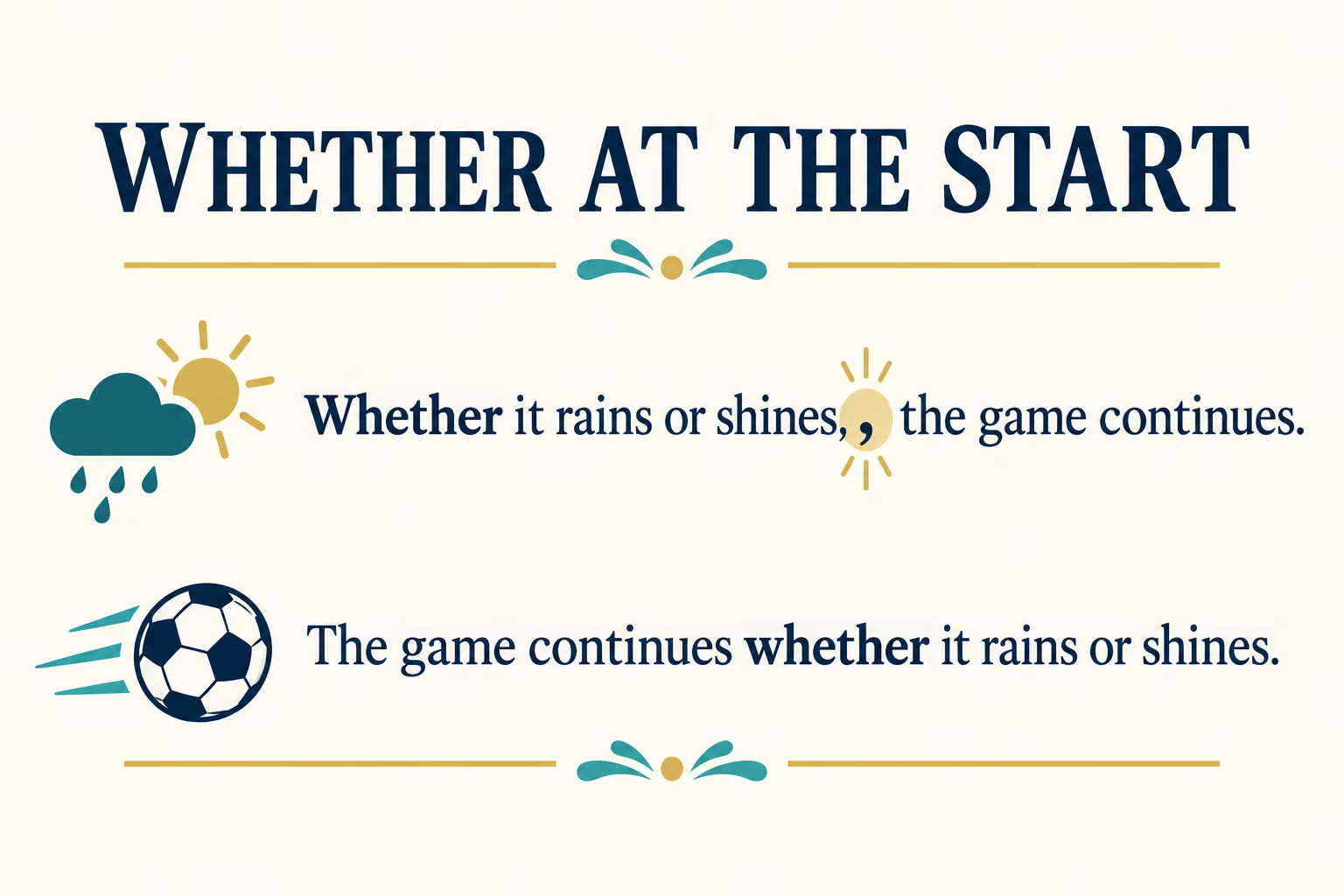
Whether can occur in the middle of a sentence, where the clause acts as the object of a verb or noun: They asked whether the tickets were refundable. It can also be the subject of a sentence: Whether we finish today depends on the weather. When a fronted whether-clause means “regardless of which possibility,” a comma commonly separates it from the main clause: Whether it rains or shines, the game continues. Do not add that comma when the whether-clause is the subject: Whether we go depends on the cost.
When the subject of the whether-clause is the same as the subject understood in the main clause, English often allows whether + to-infinitive: Jo couldn’t decide whether to stay. This means Jo couldn’t decide whether Jo should stay. Use a full clause when the subject changes or when it makes the meaning clearer: Jo couldn’t decide whether her guests should stay. Cambridge Grammar Today describes this infinitive pattern and the related use of whether … or not for alternatives.
“Whether” sentence examples
- Could you check whether the parcel has arrived?
- He asked whether the library would close early for the holiday.
- We have not decided whether to repair the old laptop or replace it.
- Whether the recipe needs more salt is a matter of taste.
- The coach will tell us whether practice is indoors or outside.
- Before booking, find out whether the ticket can be changed.
- Leah wondered whether her keys were still in the classroom.
- It is unclear whether the path is open after the storm.
- They debated whether the signs should use words or pictures.
- Whether you prefer tea or coffee, there is a warm drink in the kitchen.
- The report examines whether the new schedule reduced waiting times.
- I’m not sure whether I saved the latest version of the file.
Each example frames an open question: the speaker or writer is asking which possibility is correct, or whether a statement is true. In a direct question, the word order changes and the question mark stays with the main question: Is the store open? becomes I wonder whether the store is open. The indirect question uses statement word order (the store is), not question word order (is the store).
“Whether” vs. “if”
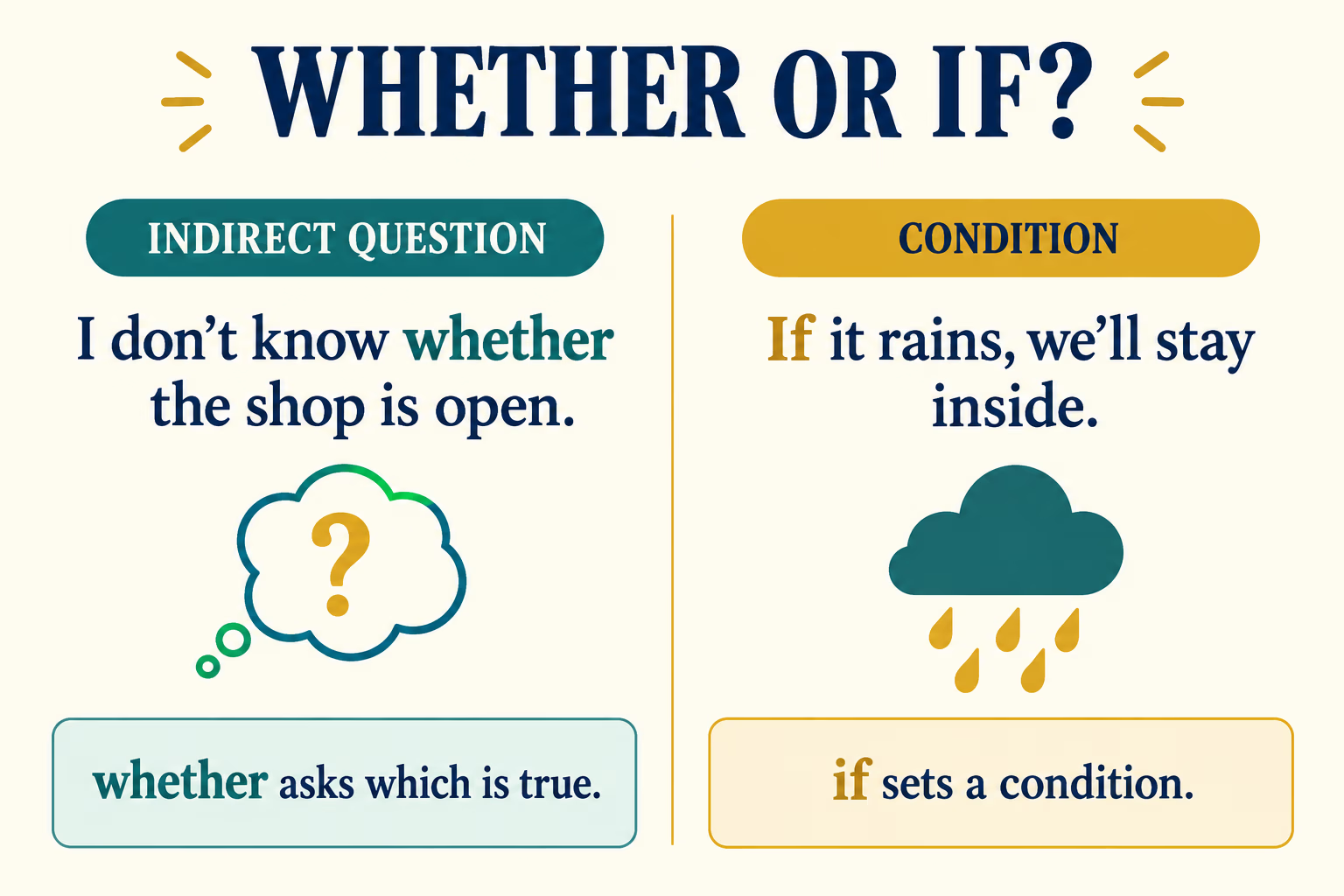
Whether and if can both introduce an indirect yes-or-no question after verbs such as know or wonder: I don’t know whether the shop is open and I don’t know if the shop is open are both standard. But if also introduces a condition: If the shop is open, I’ll stop there. Here it means “on the condition that”; whether cannot replace it with that meaning.
Choose whether when the clause is a subject, follows a preposition, or presents explicit alternatives. For example: Whether the train is delayed remains unclear; We talked about whether the plan was practical; Tell me whether you want soup or salad. In these constructions, if is usually not a suitable substitute. Cambridge’s grammar guide also notes that whether is preferred before a to-infinitive: They discussed whether to leave, not if to leave.
One useful check is to ask what the sentence means. If it means “on the condition that,” use if: If the alarm sounds, leave the building. If it asks which answer is true, whether is clear and often preferred: The guard asked whether the alarm had sounded.
When to use “whether or not”
Use whether or not when the meaning is “regardless of whether” or when you want to name both outcomes explicitly: Whether or not the forecast improves, the crew will check the trail. You can also place or not after the clause: Whether the forecast improves or not, the crew will check the trail. When the alternatives are already stated, a separate or not may be unnecessary: We’ll go whether it rains or shines. The Government of Canada Language Portal explains that an opening “whether” clause expressing a circumstance that does not change the main result should show both possibilities, either with a second alternative or with or not.
Compare the meanings: I don’t know whether the gate is locked reports uncertainty and does not need or not. We’ll use the garden whether the gate is locked or not means the plan stands in either case. Adding or not automatically to every sentence with whether can make the wording longer without adding meaning.
Common mistakes with “whether”
- Using question word order in an indirect question: Write She asked whether the room was available, not She asked whether was the room available. Keep the subject before the verb.
- Using whether for a condition: Write If the printer runs out of paper, add another sheet when you mean “on the condition that.” Use whether for the question We need to check whether the printer has paper.
- Writing “whether or not” when the other choice is already clear: Tell me whether you can attend is enough when the question is simply yes or no. Keep or not when the sense is “regardless of the answer.”
- Leaving alternatives unbalanced: Prefer whether to stay or to leave over whether to stay or leaving. Matching forms make the choices easier to read.
- Putting “or not” in the wrong place: Both whether or not the bus arrives and whether the bus arrives or not are possible. Choose the position that makes the sentence easiest to follow.
Whether vs. weather
Whether is a conjunction that introduces uncertainty or alternatives. Weather is the noun for conditions outdoors, such as rain, wind, or sunshine. The words sound alike, so check the sentence: We can’t decide whether to hike in this weather. Here, whether introduces the choice, and weather names the outdoor conditions.
Usage note for the examples below
Some older examples on this page describe whether as expressing a condition. For a precise distinction, if introduces a condition (If it rains, we’ll move indoors), while whether introduces an indirect question or alternatives (We don’t know whether it will rain). In a sentence such as Whether it rains or shines, the game continues, whether means the game continues in either case; it is not setting the condition for whether the game continues.
Sources and examples
Grammar patterns were checked against Cambridge Dictionary Grammar: “If or whether?”, its “Whether” guide, and the Government of Canada’s Language Portal guidance on “whether or not.” All new example sentences on this page are original.
Are you unsure about when to use the word “whether” in a sentence? Let’s break it down for you. “Whether” is a conjunction that introduces alternatives or possibilities, often used to express a choice between two options.
It is commonly used to present a conditional statement or to pose a question involving a decision or possibility. Understanding how to properly use “whether” can enhance the clarity and precision of your writing.
7 Examples Of Whether Used In a Sentence For Kids
- Whether it is raining or sunny, we can still have fun.
- We will see whether the sun shines tomorrow.
- I wonder whether we will see any birds in the sky.
- Let’s find out whether the flowers have bloomed today.
- I will find out whether my friends are coming to play.
- Tell me whether you would like some juice or water.
- We will see whether we can spot any butterflies in the garden.
14 Sentences with Whether Examples
- Whether you should opt for a double major or stick to a single major is a decision that requires careful consideration.
- As a college student, it’s important to know whether the upcoming exam is open book or closed book.
- Please confirm whether the workshop on entrepreneurship is scheduled for this weekend or the next.
- It is essential to determine whether the internship you are considering is paid or unpaid.
- Before signing up for that new club, think about whether you will be able to balance the commitment with your academic workload.
- Whether the library will be open during the holidays is something you need to inquire about in advance.
- Make sure to check whether the deadline for submitting your thesis has been extended.
- Figure out whether the guest lecturer scheduled for tomorrow will be covering a topic relevant to your course.
- Consider whether taking a semester off to pursue an internship aligns with your long-term career goals.
- Determine whether the college cafeteria offers a variety of healthy food options to cater to your dietary requirements.
- Research on whether the college has tie-ups with companies for campus placements.
- Confirm whether you meet the eligibility criteria to apply for the scholarship program.
- Discuss with your peers whether forming a study group for the upcoming semester would be beneficial.
- Evaluate whether joining a sports team will help you stay active and manage stress effectively.
How To Use Whether in Sentences?
Whether is a versatile word that is used to introduce a choice between two possibilities. When using whether in a sentence, it is important to consider the context and ensure that the sentence makes sense.
Here are some tips on how to use whether correctly:
-
Whether is often used to introduce a question in which there are two possible options. For example, “I’m not sure whether I should go to the party or stay home.”
-
Whether can also be used to introduce a clause that expresses doubt or uncertainty. For example, “I don’t know whether I will have time to finish my homework.”
-
Whether is typically followed by the word “or” when presenting two options. For example, “I need to decide whether to buy the red shirt or the blue shirt.”
-
Whether can be used to express a condition or hypothesis. For example, “We will have a picnic whether it rains or not.”
Remember, the key to using whether correctly is to consider the context of the sentence and ensure that it is clear what two options are being presented. With practice, you will become more comfortable using whether in your writing and conversations.
Conclusion
In conclusion, the examples provided illustrate the versatility and importance of crafting clear and effective sentences that include the word “whether.” Whether used to express doubt, present choices, or examine possibilities, this simple yet powerful word is a crucial component of effective communication. By carefully constructing sentences that incorporate “whether,” one can convey their ideas with clarity and precision, ensuring that their message is easily understood by others.
Therefore, whether you are writing an essay, having a conversation, or sending an email, remembering to consider the use of “whether” in your sentences can greatly enhance the effectiveness of your communication. Its ability to pose questions, offer alternatives, and express uncertainty makes it a valuable tool for engaging and informing your audience.


