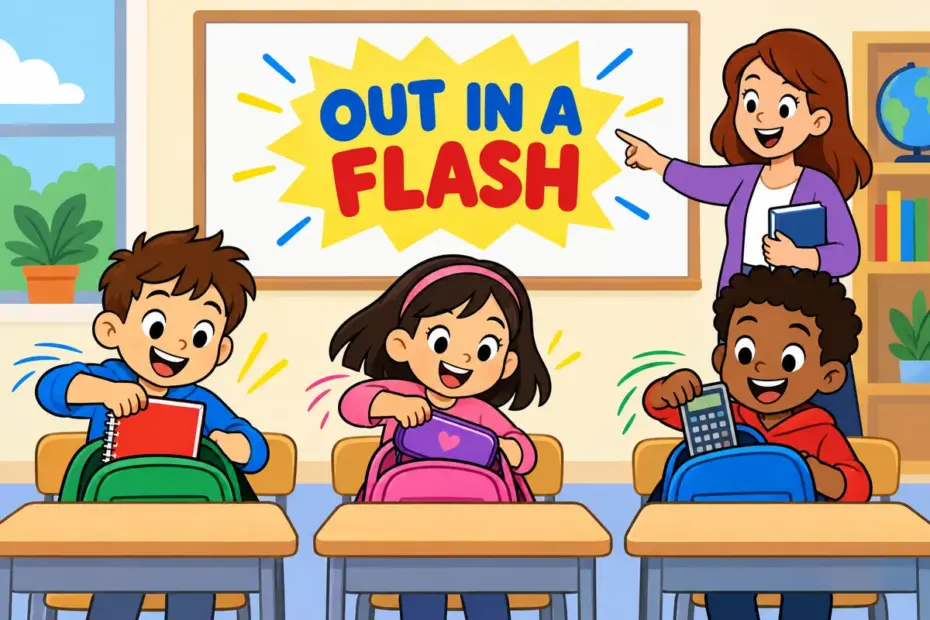
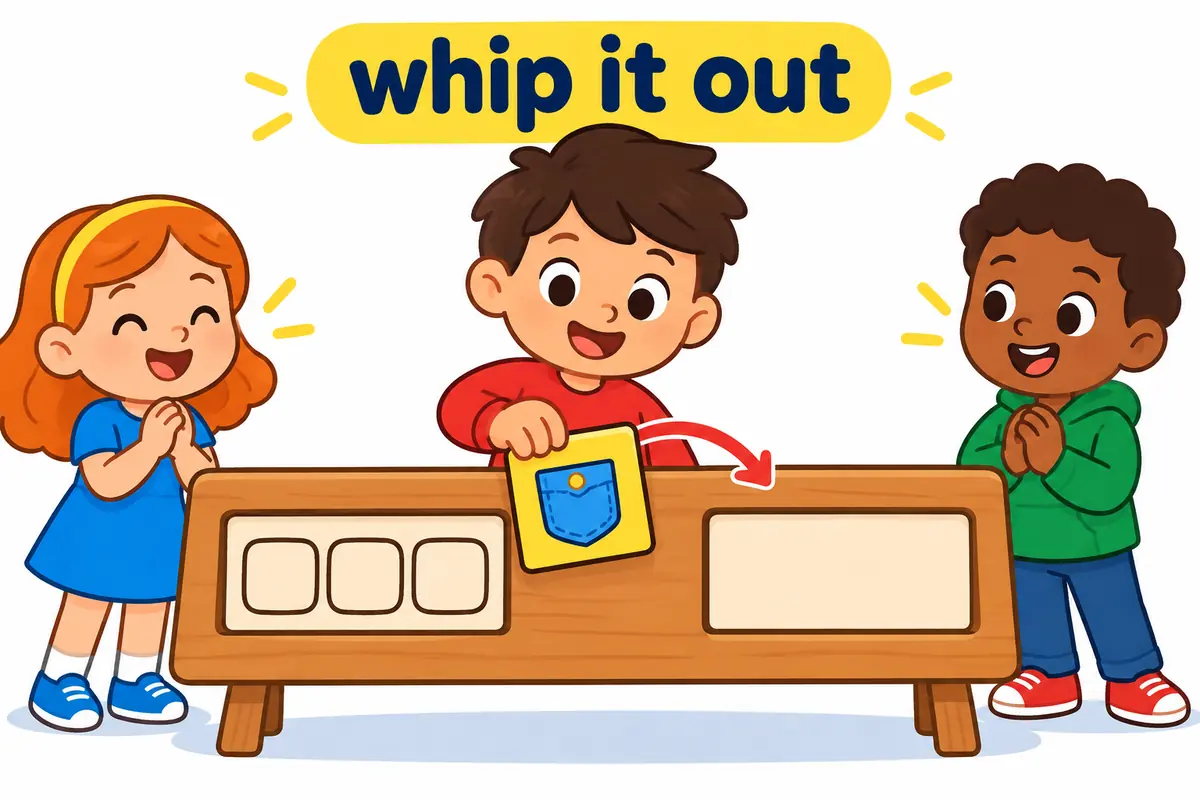
Whip out means to pull something out quickly and without ceremony, usually from a pocket, bag or drawer. To use whip out in a sentence, keep the tone informal and name the object: a phone, a wallet or a notebook. The verb is separable, so a pronoun goes between its parts: whip it out.
Whip out at a glance
- Whip out is a transitive phrasal verb; its forms are whips out, whipped out and whipping out.
- It is separable, so the object may follow the verb or sit between whip and out.
- The usual objects are small, handy things: a phone, a wallet, a pen or a tool.
- It belongs to informal speech and light journalism rather than formal writing.
- The commonest error is putting a pronoun after the particle, as in whip out it.
- A second sense is to produce something quickly, as in whipping out a clever answer.
What does whip out mean?
Whip out is a phrasal verb meaning to pull something out suddenly and quickly. The first sense is physical: a hand reaches into a pocket or bag and the object appears in one brisk movement. The second sense is figurative and means to produce words or a performance fast, as when a speaker whips out a statistic. The Cambridge entry for whip out treats the physical sense as the core one, and the speed is what separates it from the plainer pull something out, which anyone can do slowly.
| Sense | Plain meaning | Example sentence |
|---|---|---|
| Pull out quickly | Take something from a pocket or bag in one fast movement | She whipped out her bus pass at the barrier. |
| Produce fast | Give an answer, fact or performance with little preparation | The host whipped out a joke about the delay. |
| Reach for a tool | Bring out an object to use it immediately | The mechanic whipped out a wrench and knelt down. |
One limitation is worth stating plainly. Whip out says nothing about care or craft: it means quick and casual, so a slow, deliberate reveal needs reveal or present. It is also not a menacing word, and it never implies that the object is a threat.
How do you use whip out in a sentence?
Whip out is transitive, so it always needs something to bring out, and it is separable, so that object can follow the whole verb or sit between whip and out. A pronoun object must go in the middle. The particle never strands by itself at the end of a clause, so a sentence about who did it keeps the object close.
| Pattern | Example | What it signals |
|---|---|---|
| whip out + object | He whipped out his phone. | The object follows the full verb. |
| whip + object + out | He whipped his phone out. | The separable form, equally correct. |
| whip + pronoun + out | He whipped it out. | A pronoun must sit between the verb and the particle. |
| be whipped out | The tickets were whipped out before the queue moved. | Passive voice keeps attention on the object, not the person. |
| whip out + object + from + place | She whipped a coin out from behind his ear. | Names the source, common in tricks and games. |
When speed is not the point, a single verb works better. Writers who want a neutral tone choose produce an item for a formal setting, while whip out keeps the energy of a movement nobody had to plan.
Whip out in a sentence: examples across contexts
Whip out changes register more than meaning. The ten sentences below keep the same verb while moving from a classroom to a magic show, and each one makes the speed visible.
| Context | Example sentence | Why this works |
|---|---|---|
| Classroom | Each pupil whipped out a red pen for the marking exercise. | A small, familiar object shows the everyday sense. |
| Workplace email | The managers whipped out the old sales figures to defend the plan. | Uses the produce-fast sense for documents recalled without warning. |
| News report | The minister whipped out a prepared statement and refused questions. | Light journalism tolerates the informal verb in a serious setting. |
| Sports report | The keeper whipped out a yellow card before the players reached him. | The quick, decisive gesture suits match reporting. |
| Tech review | You whip out the earbuds and they connect in a second. | The second person puts the reader in the scene. |
| Fiction | He whipped out a knife, and the room went quiet. | Short, sudden action carries the scene forward. |
| Magic show | The magician whipped out a coin from behind a child’s ear. | Names the source, the classic trick frame. |
| Academic prose | The lecturer would not whip out a theory without citing a source. | The negative form shows an unusual, lightly ironic use. |
| Conversation | I whipped out my library card and the guard just laughed. | The first person is natural because the action is off duty. |
| Shared particle | After the match he worked up the nerve to ask out the scorer. | Same particle, but ask out means to invite on a date. |
The last row is the useful warning: out appears in dozens of phrasal verbs, and each one carries its own meaning. Whip out is about the speed of the movement, and nothing else.
Whip out vs pull out and brandish
Whip out overlaps with two verbs and is interchangeable with neither. pull out is neutral and can be slow; brandish is formal and menacing, and it applies to weapons or symbols meant to intimidate. Whip out keeps the element of surprise.
| Attribute | whip out | pull out | brandish |
|---|---|---|---|
| Core action | Draw out fast | Draw out, at any speed | Wave about in a threatening way |
| Register | Informal | Neutral | Formal and literary |
| Implies a threat | No | No | Usually yes |
| Typical object | Phone, wallet, pen, card | Any object | Weapon, banner, document |
| Can it split? | Yes: whip it out | Yes: pull it out | No fixed pattern |
| Common frame | A sudden movement | A steady motion | A public display |
Verdict: choose whip out for a quick, everyday grab, pull out when speed does not matter, and brandish only when the showing is meant to scare somebody.
Word forms and grammar of whip out
Whip out follows the regular pattern of whip, and the table also lists the invented forms learners sometimes write by mistake.
| Form | Part of speech | Example |
|---|---|---|
| whip out | phrasal verb, base form | I will whip out my notes if I forget. |
| whips out | third person singular | She whips out a camera whenever a dog appears. |
| whipped out | past and past participle | The guard whipped out a torch and looked inside. |
| whipping out | present participle | He kept whipping out his badge to skip the queue. |
| whip | verb, different meaning | Whisk the cream until it starts to whip. |
| whip outed | non-standard | Never write this; the past tense is whipped. |
Keep the bare verb remove in mind as a plain replacement when the sentence only needs the idea of taking something away.
Common mistakes with whip out
- Incorrect:
She whipped out it during the meeting.Correct: She whipped it out during the meeting. Rule: A pronoun object must sit between whip and out. - Incorrect:
The goalkeeper whipped out.Correct: The goalkeeper whipped out a card. Rule: The verb is transitive, so something must always be brought out. - Incorrect:
He whipe out a pen.Correct: He whipped out a pen. Rule: The past tense doubles the final consonant: whipped. - Incorrect:
The knight whipped out his sword to warn them.Correct: The knight brandished his sword to warn them. Rule: Whip out is neutral; brandish is the word for a threatening display. - Incorrect:
She whipped out that the price had changed.Correct: She whipped out a note showing the new price. Rule: The verb takes a noun phrase, never a that-clause.
Practice using whip out
Work through the six items, then compare your wording with the reasoning in the answers.
- Fill the gap: The usher ______ a torch when the lights failed.
- Choose the better word: The guard (whipped out / brandished) his badge to check the pass.
- Correct the error: He whipped out it to show the referee.
- Build a sentence: use whip out about a chef reaching for a knife.
- Spot the register: which belongs in a school report — the pupil produced her workbook, or the pupil whipped out her workbook?
- Rewrite with a pronoun: Tom whipped out his compass. Put the pronoun in the correct place.
Answers
- whipped out — the action is sudden and the torch is the object.
- whipped out — a badge is shown quickly and neutrally; brandished would suggest a threat.
- He whipped it out to show the referee — the pronoun belongs between whip and out.
- Model answer: The chef whipped out a knife and sliced the lemon.
- The pupil produced her workbook — a report keeps the neutral verb and avoids slang.
- Tom whipped it out — a pronoun must sit in the middle.
The bottom line
Use whip out in a sentence when something small appears in a quick, casual movement, and keep the tone informal. Two nuances decide most sentences: the verb is separable, but a pronoun must sit between whip and out, and the meaning is speed, not menace. When the movement is slow or the display is meant to threaten, reveal and brandish are the sharper choices.
Frequently asked questions about whip out
Is whip out a separable phrasal verb?
Yes. Whip out is separable, so the object may follow the whole verb or sit between whip and out: he whipped out his phone, or he whipped his phone out. Both are correct. The one fixed rule is that a pronoun must go in the middle, giving whip it out rather than whip out it.
What is the difference between whip out and pull out?
Whip out adds a strong sense of speed and suits informal speech, while pull out is neutral and can describe any speed. A magician whips out a coin in a flash, but a driver may pull out of a junction slowly. Only whip out carries the idea of surprise.
Can whip out be used in formal writing?
Rarely, and only with a light, journalistic tone. A news report may say the minister whipped out a statement, because the informality adds colour. In a legal or academic paper the same act is better written as produced or presented, since whip out sounds too casual for that register.
Where does a pronoun go with whip out?
A pronoun object always goes between whip and out, so the correct form is whip it out and never whip out it. The same rule applies to other separable phrasal verbs. When the object is a full noun phrase, both orders are acceptable and equally natural.