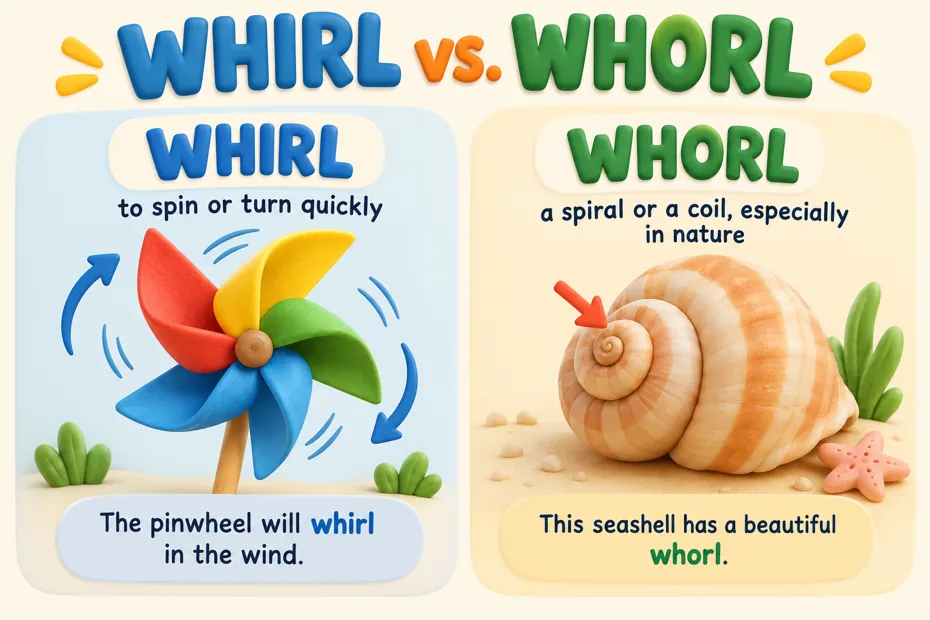
Whirl vs. whorl: movement or a spiral arrangement?
Whirl commonly means spin or move rapidly and can also name a spinning movement, bustle, or a brief attempt. Whorl names a coil, spiral, or circular arrangement, including a shell coil or a ring of plant parts. The title’s unexplained “whvsl” is not a spelling to learn from this article.
Correction and clarification: the original page compares whirl with “whvsl,” but the consulted sources do not establish a vocabulary meaning for that string. We cannot prove which word it was meant to represent. This guide explains the established word whorl as a useful comparison, without claiming certainty about the title’s intended correction. Also, whirl is both a noun and a verb, not just an action verb.
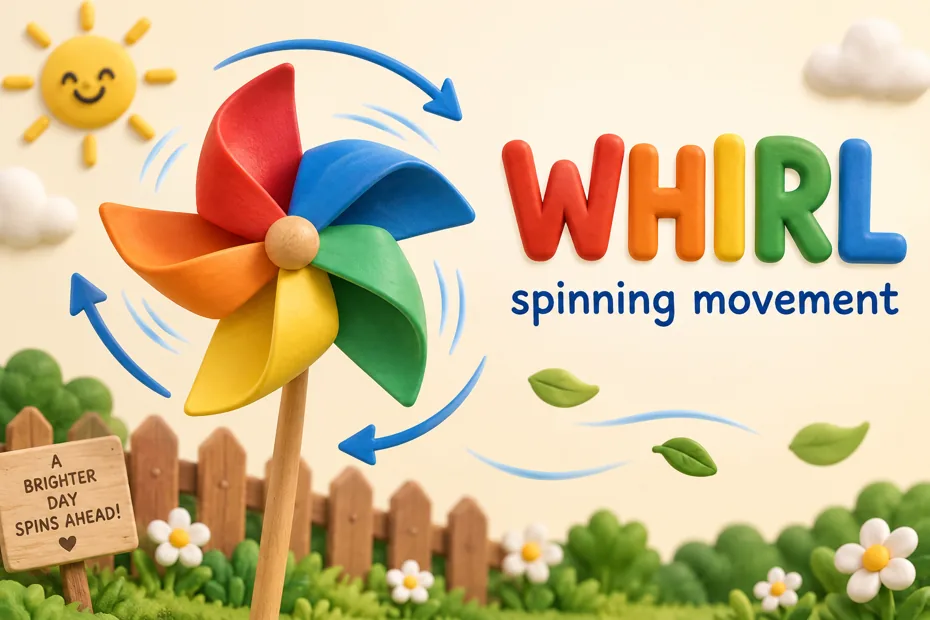
Key facts
| Word | Meaning | Example |
|---|---|---|
| whirl, verb | Spin or move quickly | The pinwheel whirls in the breeze. |
| whirl, noun | Spinning movement or bustle | The preparations became a whirl of activity. |
| give it a whirl | Try something | I have never painted, but I will give it a whirl. |
| whorl, noun | Coil, spiral, or circular arrangement | The shell has a visible whorl. |
Whirl as a verb
Merriam-Webster’s whirl entry records rotating movement, quick movement, and related senses. A pinwheel can whirl, leaves can whirl in a gust, and a dancer can whirl across a stage. These examples involve movement rather than simply the shape of an object.
The regular verb forms are whirls, whirled, and whirling. “The toy whirls” describes present action; “The toy whirled” places it in the past. “The toy is whirling” describes an action in progress. Keep the spelling whirl throughout those changes rather than replacing its vowel because the movement is circular.
It can work without an object: “The leaves whirled.” It can also describe causing something to turn: “The dancer whirled the ribbon.” Read the full sentence to identify who or what is moving. A circular object that is stationary does not need the verb whirl merely because it has a round shape.
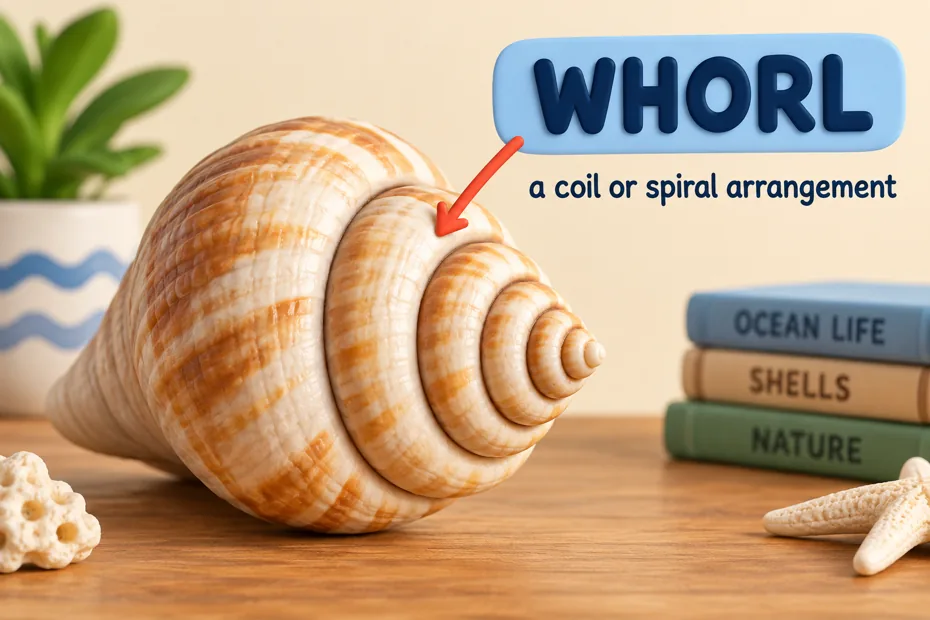
Whorl as a noun
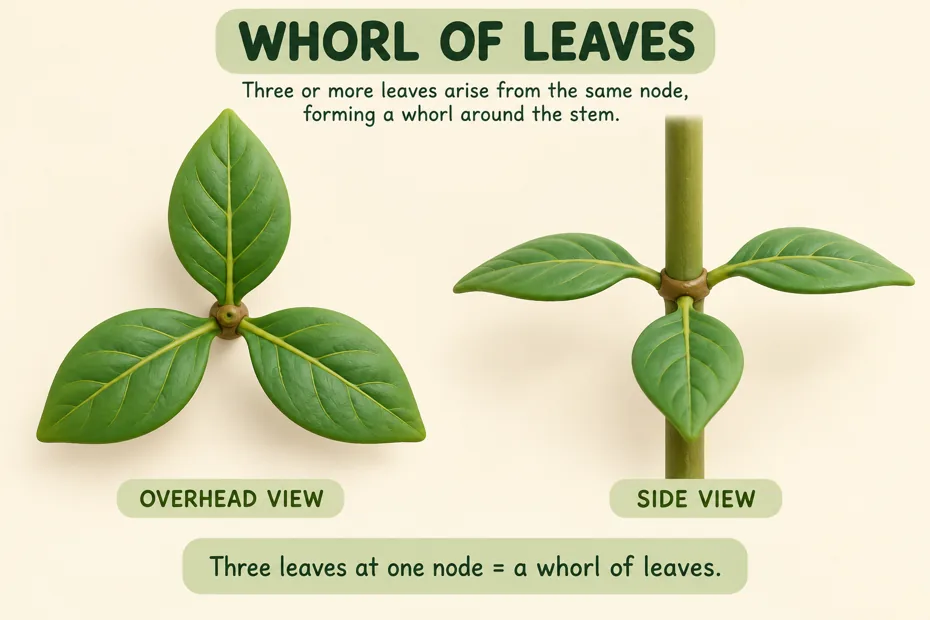
Merriam-Webster’s whorl entry records a coil or spiral and specialized circular arrangements. A shell whorl is part of its coiled structure. A whorl of leaves involves leaves arranged around the same level of a stem. The noun describes structure or arrangement, so the parts need not be moving.
For example, “The illustration shows one whorl of the shell” names a structural feature. “Three leaves form a whorl around the stem” names an arrangement. Compare those with “The loose leaves whirl in the wind.” The botanical sentence concerns how leaves are attached; the wind sentence concerns their motion.
Collins’s whorl entry also records spiral and circular-arrangement meanings. If you are using the term in a technical description, identify which feature you mean instead of assuming every round shape is a whorl. A useful description can mention the shell, plant parts, or other relevant structure.
Whirl as a noun and an expression
Collins’s whirl entry includes noun uses as well as the verb. “A whirl of dust crossed the path” names a moving swirl. “The morning was a whirl of appointments” describes a busy succession of events. The second example is figurative: appointments are not literally rotating around a central point.
In give it a whirl, the noun concerns trying something. “I will give pottery a whirl” means the speaker plans to try pottery. It does not mean the speaker has already made a spiral object. This expression is a useful reminder that the word’s meanings extend beyond literal spinning.
The difference is therefore not simply verb versus noun. Both whirl and whorl can be nouns. Ask whether the sentence names movement, bustle, or an attempt, or instead names a coil or arrangement. Meaning gives a more reliable spelling clue than the article a alone.
Practice choosing the spelling
Use spin as a test for many verb examples: “The ribbons spin” supports “The ribbons whirl.” Use coil or circular arrangement as a test for the structural noun: “The shell’s coil” supports “The shell’s whorl.” These substitutions are aids, not exhaustive definitions, because figurative expressions require their own context.
Try these blanks: “The pinwheel began to ___”; “The shell has another ___”; “The office became a ___ of activity”; “I might give the new hobby a ___.” The answers are whirl, whorl, whirl, and whirl. The shell example names a structure; the others concern movement, bustle, or trying.
Frequently asked questions
Is whorl a real word?
Yes. It is an established noun for a coil, spiral, or circular arrangement, with specialized uses in descriptions of shells and plant structures. Do not confuse it with the title’s unexplained “whvsl.” This guide teaches whorl as a relevant dictionary word rather than assuming it recovers the original intended spelling.
Is whirl always a verb?
No. It can name a spinning movement, a busy sequence of events, or an attempt in the expression give it a whirl. “A whirl of activity” uses a noun. Because whorl is also a noun, check the meaning instead of relying on a noun-versus-verb rule to choose the spelling.
What is a whorl of leaves?
It is an arrangement of leaves around a stem at the same level or node. The term concerns their arrangement, not their movement. If loose leaves are spinning in the wind, use whirl as the movement verb. The contrast between attached structure and motion helps clarify these botanical examples.
Should I write give it a whorl?
The usual expression is give it a whirl, meaning try it. “I will give the puzzle a whirl” describes making an attempt. Whorl would instead suggest a coil or arrangement and would not express the ordinary idiom. Learn the phrase with its intended meaning and complete spelling.
Are you confused about when to use “whirl” and “whvsl” in your writing? Well, you’re not alone. As a language expert, I’ve noticed that many people struggle with these two words and often use them interchangeably. In this text, I’ll shed some light on the appropriate usage of “whirl” and “whvsl” to help you avoid common mistakes and enhance your writing skills. We’ll explore the subtle differences between these words and provide practical examples to illustrate their correct usage. By the end of this article, you’ll have a clear understanding of when to use “whirl” and “whvsl” in your writing, ensuring that your message is conveyed accurately and effectively. So, let’s immerse and unravel the mystery behind these two words.
Key Takeaways
- “Whirl” is a verb that describes a rapid or spinning movement, while “whvsl” is a nonsensical word that has no meaning.
- It is crucial to use “whirl” correctly to ensure effective communication and avoid confusion.
- “Whirl” can be used to describe spinning objects, fluid movements of dancers, swirling winds, or even the rapid movement of thoughts.
- “Whvsl” does not exist in the English language and should not be used in any context.
- Understanding the subtle differences between “whirl” and similar words like “spin” and “twirl” can help in choosing the most appropriate word for specific meanings.
- Examples of using “whirl” correctly include describing objects in a tornado, the movement of dancers, or even the spinning motion of a blender.
What is “whirl”?
As an expert language blogger, I am here to shed some light on the confusion surrounding the usage of “whirl” and “whvsl.” In this section, let’s start by exploring the meaning and definition of “whirl.”
When we talk about “whirl,” we refer to a verb that describes a rapid or spinning movement. It signifies something turning or rotating swiftly around a central axis. This word can also be used as a noun to define a quick and swirling movement.
It’s important to understand the difference between “whirl” and “whvsl.” While “whirl” implies a spinning motion, “whvsl” is a nonsensical word that does not hold any meaning. Hence, it’s crucial to use “whirl” correctly to ensure effective communication.
To help grasp the concept better, let’s jump into a few examples:
- The wind whirls the leaves around in the air.
- She watched the colorful dancers whirl across the stage.
- The dust whirled in the stormy wind.
What is “whvsl”?
To better understand the confusion between “whirl” and “whvsl,” let’s first address the question: what is “whvsl”?
The truth is, “whvsl” is not a valid word in the English language. It does not exist in any dictionary, and it has no recognized definition. It is nonsensical and has no discernible meaning.
While “whirl” refers to a rapid or spinning movement, “whvsl” is simply a combination of letters that do not form a coherent word. It is important to note that using “whvsl” in any context will only lead to confusion and miscommunication.
Understanding the difference between “whirl” and “whvsl” is crucial for effective communication. By using “whirl” correctly, you can accurately convey the concept of a spinning or rapid movement. On the other hand, using “whvsl” will only confuse your audience and undermine your message.
Next, let’s explore some examples to solidify our understanding of these words and how to use them appropriately.
Differences between “whirl” and “whvsl”
When it comes to the words “whirl” and “whvsl,” it’s important to understand the key differences between them. These two words may sound similar, but their meanings are vastly different. Let’s investigate into the distinctions:
1. Definition of “Whirl”:
“Whirl” is a verb that refers to a rapid or spinning movement. It signifies a circular or rotating motion, often occurring with speed and force. For example, you might “whirl” around in a spinning chair or watch leaves “whirl” in the wind. It can also be used to describe a busy, rapid activity or a chaotic situation.
2. “Whvsl”: A Nonexistent Word:
On the other hand, “whvsl” is not a real word in the English language. It is a nonsensical combination of letters that does not hold any meaning or function. Using the word “whvsl” will only lead to confusion and miscommunication, as it lacks any valid definition or purpose. Hence, it’s crucial to disregard and avoid the use of “whvsl” in any form of communication.
3. The Importance of Using “Whirl” Correctly:
Using “whirl” accurately is essential for effective communication. By understanding its definition and utilizing it correctly, you can convey specific actions, movements, or situations more precisely. This clarity allows your audience to fully grasp your intent and message. By avoiding the nonexistent word “whvsl” and opting for “whirl,” you can ensure that your communication is clear and free of confusion.
4. Differentiating Between “Whirl” and Similar Words:
It’s also important to differentiate “whirl” from other similar words that may have overlapping meanings. For instance:
- “Spin”: While both “spin” and “whirl” denote rotational movement, “spin” generally refers to a smoother, more controlled motion, whereas “whirl” implies a quicker, more forceful action.
- “Twirl”: Similar to “whirl,” “twirl” suggests a rapid circular motion. But, “twirl” often involves a deliberate or playful movement, such as twirling a baton or twirling a strand of hair.
Understanding these subtle differences can help you choose the most appropriate word for your intended meaning and enhance the clarity of your writing or speech.
Examples of using “whirl” correctly
One key aspect of mastering the correct usage of words is by looking at examples. Here are some examples that will help you understand how to use “whirl” appropriately:
- The tornado caused cars and debris to whirl through the air. The strong winds swirled in a circular motion, creating a dangerous situation.
- She watched the dancers whirl across the stage, their bodies moving gracefully in synchronization. The fluid movements and spins added a dynamic element to the performance.
- I felt a sense of exhilaration as I let the amusement park ride whirl me around in circles. The spinning motion gave me a rush of adrenaline and made my head spin.
- The blender can quickly whirl ingredients into a smooth and creamy consistency. The blades move rapidly, creating a vortex that blends everything together.
- He felt his head start to whirl with confusion as he tried to process the complex instructions. The information overload made it difficult for him to think clearly.
These examples demonstrate the various contexts in which “whirl” can be used. From describing the movement of objects in a tornado to the spinning motion of dancers, the word “whirl” is versatile and can convey different meanings depending on the situation.
The key takeaway is to use “whirl” when describing a rapid or spinning movement. Whether it’s objects, people, or even thoughts, “whirl” is the appropriate word to convey that sense of swirling or circular motion.
Remember, proper usage of words is essential for effective communication. By using “whirl” correctly, you can avoid confusion and ensure that your message is conveyed clearly.
Let’s move on to understanding the definition and importance of using “whirl” correctly for effective communication.
Examples of using “whvsl” correctly
Now that we have established the difference between “whirl” and the nonsensical word “whvsl,” let’s take a look at some examples of using “whirl” correctly in sentences. Remember, “whvsl” does not exist in the English language and should not be used in any context. Here are a few examples showcasing the appropriate usage of “whirl”:
- The tornado caused debris to whirl through the air. In this sentence, “whirl” accurately describes the rapid and spinning movement of the debris as it is carried by the force of the tornado.
- The figure skater performed a graceful whirl on the ice. Here, “whirl” is used to convey the elegant spinning motion of the figure skater as they twirl and move across the ice.
- She watched as the leaves began to whirl and dance in the gusty wind. This sentence illustrates the swirling and spiraling movement of the leaves as they are carried by the wind.
- The dervishes whirled in a mesmerizing display of spinning and twirling. In this example, “whirl” captures the dynamic and rapid spinning motion of the dervishes during their traditional dance.
Remember, using “whirl” correctly is essential for effective communication, as it accurately conveys the sense of rapid or spinning movement. On the other hand, “whvsl” has no meaning and should not be used in any context. By understanding and utilizing the correct word, we can ensure clear and unambiguous conveyance of our messages.
It’s essential to differentiate between similar words such as “spin” and “twirl” and use “whirl” when describing a specific kind of circular or swirling movement. Proper usage of words is a crucial aspect of effective communication, and by grasping the nuances and distinctions between words, we can avoid confusion and enhance our ability to convey our thoughts accurately.
Next Section: The Importance of Using “whirl” Correctly
Conclusion
To conclude, it is crucial to use the word “whirl” correctly for effective communication. As discussed throughout this article, “whirl” refers to a rapid or spinning movement, while “whvsl” is a nonsensical word that does not exist in the English language. Using “whvsl” will only lead to confusion and miscommunication.
By understanding the definition of “whirl” and differentiating it from similar words such as “spin” and “twirl,” we can accurately convey the sense of swirling or circular motion. The examples provided in this text demonstrate the various contexts in which “whirl” can be used, from describing the movement of objects in a tornado to the spinning motion of dancers.
Proper usage of words is essential for clear communication, and using “whirl” correctly can help avoid confusion and ensure the clear conveyance of messages. So remember, when describing a rapid or spinning movement, use “whirl” as the appropriate word to convey that sense of swirling or circular motion.
By following these guidelines, we can effectively communicate and avoid any unnecessary confusion when using the word “whirl.”
Frequently Asked Questions
What is the difference between “whirl” and “whvsl”?
- “Whirl” refers to a rapid or spinning movement.
- “Whvsl” is a nonsensical word that does not exist in the English language.
Why is it important to use “whirl” correctly?
- Using “whirl” correctly is important for effective communication.
- Choosing the appropriate word helps avoid confusion and miscommunication.
Can you give examples of when to use “whirl”?
- “Whirl” can be used to describe the movement of objects in a tornado.
- It can also describe the spinning motion of dancers.
How is “whirl” different from words like “spin” and “twirl”?
- “Whirl” specifically refers to a swirling or circular motion.
- “Spin” and “twirl” have broader meanings and can describe various types of rotational movements.


