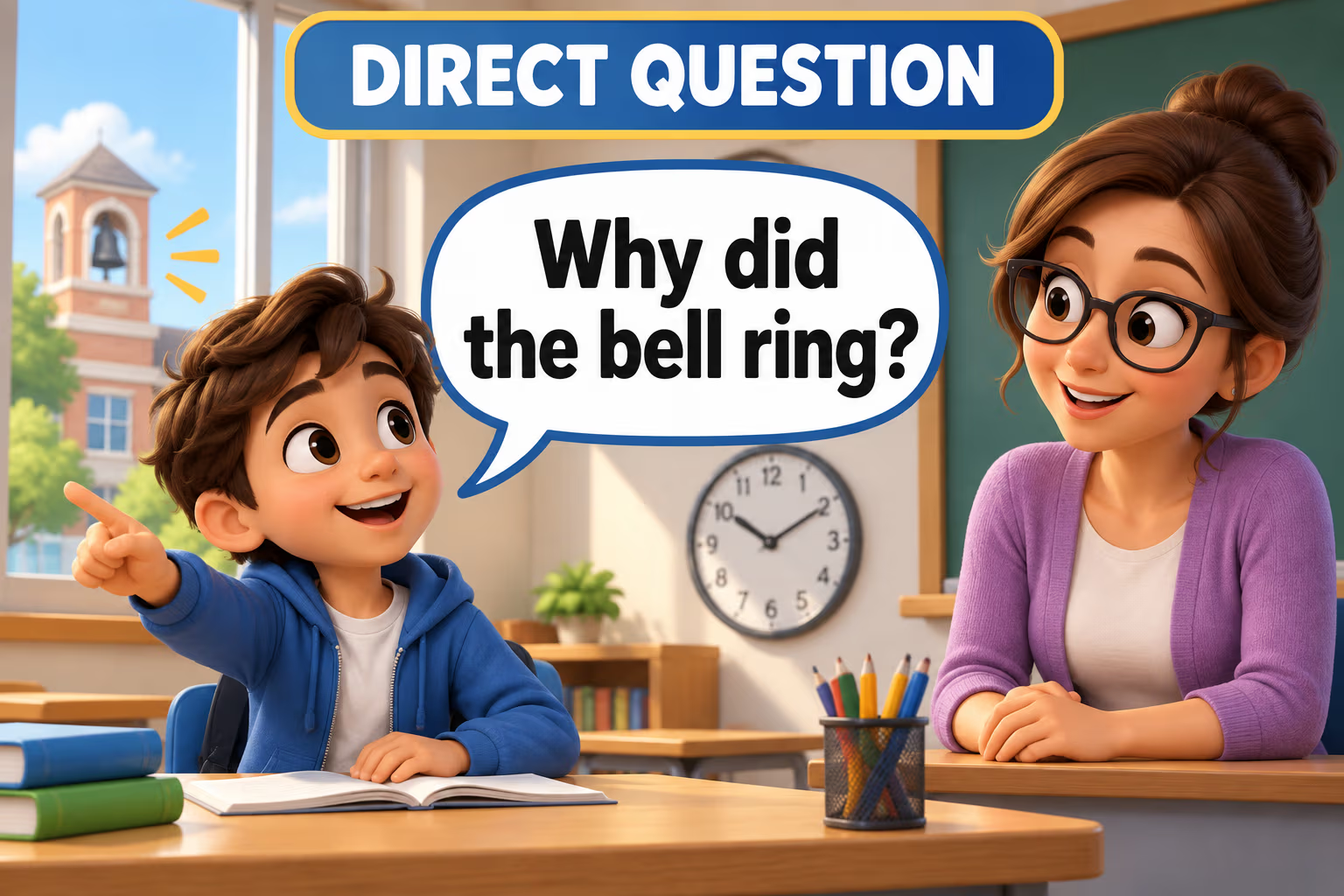
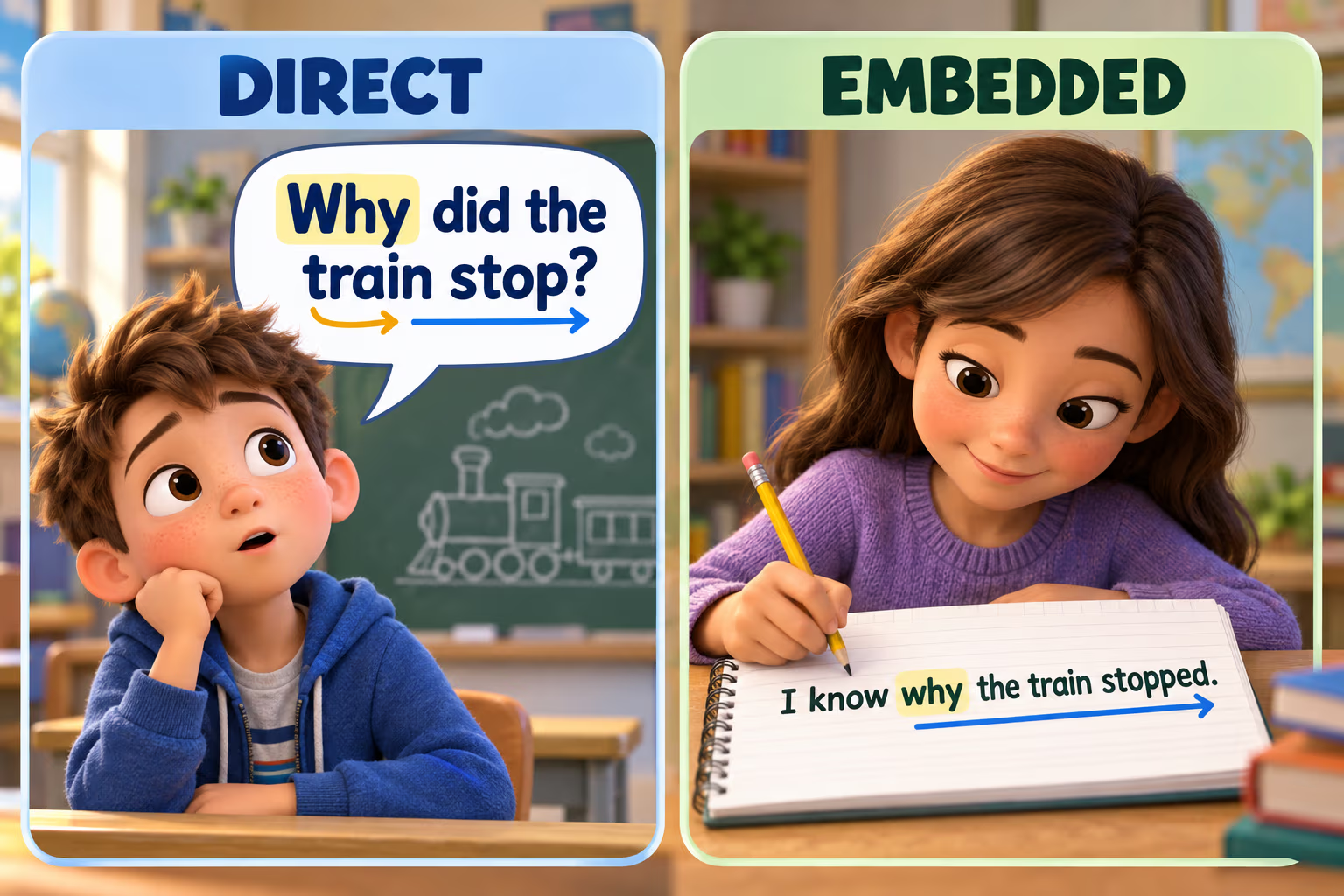
“Why” is an interrogative adverb used to ask for a reason or explanation, as in “Why did the train stop?” In a direct question, it usually comes before an auxiliary or a form of “be”; inside an embedded question, it keeps statement word order: “I know why the train stopped.”
Why in a Sentence at a Glance
- Meaning: “Why” asks for a cause, purpose, or explanation.
- Direct question: Put “why” before the verb or helping verb: “Why is the door open?”
- Embedded question: Keep subject–verb order: “She asked why the door was open.”
- Answer: A reason often starts with “because”: “Because the cat pushed it.”
- Punctuation: Use a question mark only when the whole sentence asks a question.
7 Examples Of Why Used In a Sentence For Kids
- Why do we need to drink water every day?
- Can you tell me why the sun rises in the morning?
- Why is it important to brush our teeth before bed?
- Why do we need to eat our fruits and vegetables?
- Why should we listen to our teachers in school?
- Why do we need to wear clean clothes every day?
- Why is it important to be kind to others?
14 Sentences with Why Examples
- Why is it important to manage your time effectively in college?
- Can you explain why attendance is mandatory in some classes?
- Why should you prioritize sleep and self-care during exam season?
- Have you considered why networking with alumni can be beneficial for your career?
- Do you understand why it’s important to seek help from professors when you’re struggling with a subject?
- Why do you think it’s necessary to participate in extracurricular activities in college?
- Could you explain why setting academic goals is crucial for your success?
- Why do you believe developing good study habits is essential for college students?
- Have you thought about why internships are helpful for gaining real-world experience?
- Can you clarify why it’s important to build a strong professional network while in college?
- Why do you think time management skills are especially important for college students in India?
- Have you considered why volunteering can have a positive impact on your educational experience?
- Why is it important to stay updated with current events and trends while in college?
- Can you justify why seeking mentorship from seniors can be advantageous for first-year students?
How To Use Why in Sentences?
Why is used to ask for the reason or purpose of something. It helps to initiate a conversation or to gain more information about a certain topic. When using why in a sentence, it is important to follow these guidelines:
Placement: Why is typically used at the beginning of a question. For example, “Why are you late?” or “Why did you choose that color?”
Punctuation: A question mark is placed at the end of a sentence that begins with why. This indicates that it is a question that requires an answer.
Usage: Why can be used in various contexts such as to understand someone’s actions, to seek clarification, or to express curiosity about a situation.
Tone: Depending on the tone in which why is used, it can come across as curious, accusatory, or simply inquisitive. Pay attention to the tone in which you ask the question to ensure effective communication.
Response: When someone responds to a question starting with why, they are expected to provide a reason or explanation for their actions or decisions.
Overall, why is a powerful word that can help you to gather information, understand situations better, and communicate effectively with others. Practice using why in sentences to improve your communication skills and to engage in meaningful conversations with others.
What does “why” ask about?
“Why” asks for a reason, cause, purpose, or explanation. The exact answer depends on the situation: “Why did the glass crack?” asks for a cause, while “Why did you save the file?” may ask for a purpose or motive. Cambridge English Grammar Today likewise treats “why” as a question word for reasons and explanations.
Use a cause when one event produced another (“The match was delayed because the field was wet”), and use a purpose when someone intended an outcome (“She set an alarm so she would not miss the bus”). “Why” can invite either kind of answer, so the surrounding verb and context matter.
How does “why” work in a direct question?
In a direct question, place “why” first and use the usual question order. With be, a modal, or another helping verb, the verb normally comes before the subject; with an ordinary present- or past-simple verb, add do, does, or did. The British Council describes this as inversion and shows question words before the verb.
| Sentence pattern | Example with “why” | What to notice |
|---|---|---|
| Be + subject | Why is the library closed? | “Is” comes before “the library.” |
| Modal + subject + base verb | Why should we leave early? | “Should” comes before “we.” |
| Do/does + subject + base verb | Why does this button flash? | Use “does” with a singular third-person subject. |
| Did + subject + base verb | Why did the team cancel practice? | After “did,” keep the main verb in its base form. |
The question word does not replace the subject: write “Why did she leave?” rather than “Why she left?” as a standalone question. An embedded clause can itself act as a sentence’s subject while keeping statement order: “Why the device failed remains unclear.” See the British Council’s question-form guide for the standard patterns.
How do embedded “why” questions work?
An embedded or indirect “why” question uses statement order after the question word: subject first, then verb. Write “I wonder why the shop closed,” not “I wonder why did the shop close.” The opening clause—“I wonder”—is the question or statement frame; “why the shop closed” is a clause inside it.
| Direct question | Embedded version |
|---|---|
| Why did the meeting end? | We know why the meeting ended. |
| Why is Maya smiling? | Can you tell me why Maya is smiling? |
| Why has the price changed? | He asked why the price had changed. |
Punctuation follows the whole sentence, not the embedded clause by itself. “I wonder why the train stopped.” ends with a period because it is a statement; “Do you know why the train stopped?” ends with a question mark because the complete sentence asks something. In reported speech, keep the question word but change to statement structure, as the British Council explains in its guide to reported questions.
What does “why not” mean?
“Why not?” can ask for a reason something should not happen, but “Why don’t we…?” and “Why not…?” also commonly make suggestions. “Why not take the earlier train?” usually proposes an option; it is not necessarily a request for the listener to defend a refusal. Tone and context distinguish a genuine challenge from a friendly suggestion.
- Suggestion: “Why not bring a jacket?” means “I suggest bringing a jacket.”
- Suggestion with “don’t”: “Why don’t we review the notes?” invites a shared action.
- Request for a reason: “Why not use the side entrance?” can ask what prevents that choice.
- Short reply: “Why not?” can mean “That sounds reasonable” or ask “What is the objection?” depending on intonation.
What is the difference between “why” and “because”?
“Why” usually introduces a question about a reason; “because” commonly introduces the reason in the answer. For example, “Why is the floor wet?” asks for an explanation, and “Because someone spilled water” supplies one. Do not use “why” as a conjunction in place of “because”: write “She left because she was tired,” not “She left why she was tired.” For more examples of the answer word, see our guide to because in a sentence.
| Purpose | Example |
|---|---|
| Ask for a cause | Why did the seedlings wilt? |
| Give a cause | The seedlings wilted because the soil dried out. |
| Ask for a method instead | How do I keep the soil moist? |
Choose “how” when you need a method or manner rather than a reason: “Why did the screen turn black?” asks for its cause, whereas “How do I make the screen brighter?” asks for a procedure. Our examples of how in a sentence show that different question words request different information.
More “why” sentence examples by pattern
These original examples show “why” in direct questions, embedded clauses, polite requests, and suggestions. The pattern—not simply the first word—determines the word order and punctuation.
- Cause: Why did the streetlights switch on before sunset?
- Purpose: Why are you saving a copy of the receipt?
- Polite request: Could you explain why the schedule changed?
- Embedded question: I cannot remember why the gate was locked.
- Reported question: The coach asked why we had arrived early.
- Curiosity: Why does the moon look larger near the horizon?
- Workplace: Why did the team move the deadline to Friday?
- School: The student asked why the fraction needed a common denominator.
- Everyday life: Do you know why the grocery store is closing early?
- Suggestion: Why not label the folders by project?
- Shared suggestion: Why don’t we compare both drafts before choosing?
- Reason in a narrative: No one knew why the dog kept waiting by the door.
- Formal inquiry: The report explains why the sample size was increased.
- Rhetorical question: Why rush when the train leaves in an hour?
- Negative question: Why didn’t the warning appear on the first screen?
- Modal verb: Why might a seed fail to sprout?
How can you fix common “why” errors?
Check whether the sentence is a direct question or an embedded one, then choose inversion and punctuation accordingly. In a direct past-simple question, “did” carries the tense, so the following main verb uses its base form; an embedded clause keeps subject–verb order.
| Common error | Better sentence | Reason |
|---|---|---|
| Why you are late? | Why are you late? | A direct question places “are” before the subject. |
| I wonder why did she leave. | I wonder why she left. | An embedded question uses statement order. |
| Why did the show ended? | Why did the show end? | Use the base verb after “did.” |
| Tell me why are you upset. | Tell me why you are upset. | The embedded clause keeps “you” before “are.” |
| Do you know why the door is open? | Correct as written. | The complete sentence is a question, so it takes a question mark. |
A useful editing test is to remove the opening frame. If the remaining words form a direct question by themselves, inversion may be needed; if they follow “I know,” “she asked,” “tell me,” or “we wonder,” they usually keep statement order. Compare the related question words in our guides to when in a sentence and where in a sentence.
Frequently Asked Questions About “Why” in a Sentence
Can you start a sentence with “why”?
Yes. A direct question commonly begins with “why,” as in “Why did the lights go out?” A sentence can also begin with an embedded clause, such as “Why the lights went out remains unclear,” where the clause acts as the subject and keeps statement word order. Capitalize “Why” at the start and punctuate the whole sentence.
Why does a direct question use “did”?
In a past-simple question with an ordinary verb, “did” carries the past tense and comes before the subject: “Why did the lights go out?” The main verb then stays in its base form, “go.” With the verb “be,” use inversion instead: “Why were the lights off?”
Do embedded “why” questions need a question mark?
Only when the whole sentence is a question. Write “I asked why the room was empty.” with a period because the sentence reports a question; write “Can you tell me why the room was empty?” with a question mark because the full sentence asks the reader something. The embedded clause itself does not determine the final punctuation.
Can “why” be used for a suggestion?
Yes. “Why not call ahead?” and “Why don’t we check the map?” commonly suggest an action rather than ask for a cause. A listener can usually recognize the suggestion from the proposed action and friendly context. If the speaker stresses “why,” the same structure may challenge someone to explain an objection.
What is a simple way to answer a “why” question?
Give the cause or purpose directly, then add a short explanation if needed. For “Why is the printer offline?” a useful answer is “Because its network cable is disconnected.” For “Why did you choose this route?” explain the goal, such as “It avoids the roadworks.” Match the answer to the reason the speaker requested.
The Bottom Line
“Why” asks for a reason or purpose, and its word order depends on where the question appears. Direct questions usually invert the auxiliary and subject; embedded questions keep statement order. Use “because” to supply a cause, and let the whole sentence determine whether the final mark is a period or question mark.
Conclusion In conclusion, it is important to understand the purpose and rationale behind each statement by asking “why.” By questioning the reasons behind sentences, one can gain a deeper insight into the meanings and intentions conveyed. Through analyzing the context and motivations behind sentences with “why,” individuals can enhance their understanding, critically evaluate information, and engage in more meaningful conversations. By actively seeking the reasons behind statements, one can uncover valuable insights, challenge assumptions, and foster a more intellectually stimulating environment.