Work around is a phrasal verb meaning to deal with a problem or obstacle indirectly instead of removing it. To use work around in a sentence, put the obstacle straight after the verb: “We worked around the broken lift.” The particle cannot be separated from its object.
Work around at a glance
- Work around is a prepositional phrasal verb; its forms are works around, worked around and working around.
- The dominant pattern is work around + obstacle, with the obstacle as the object.
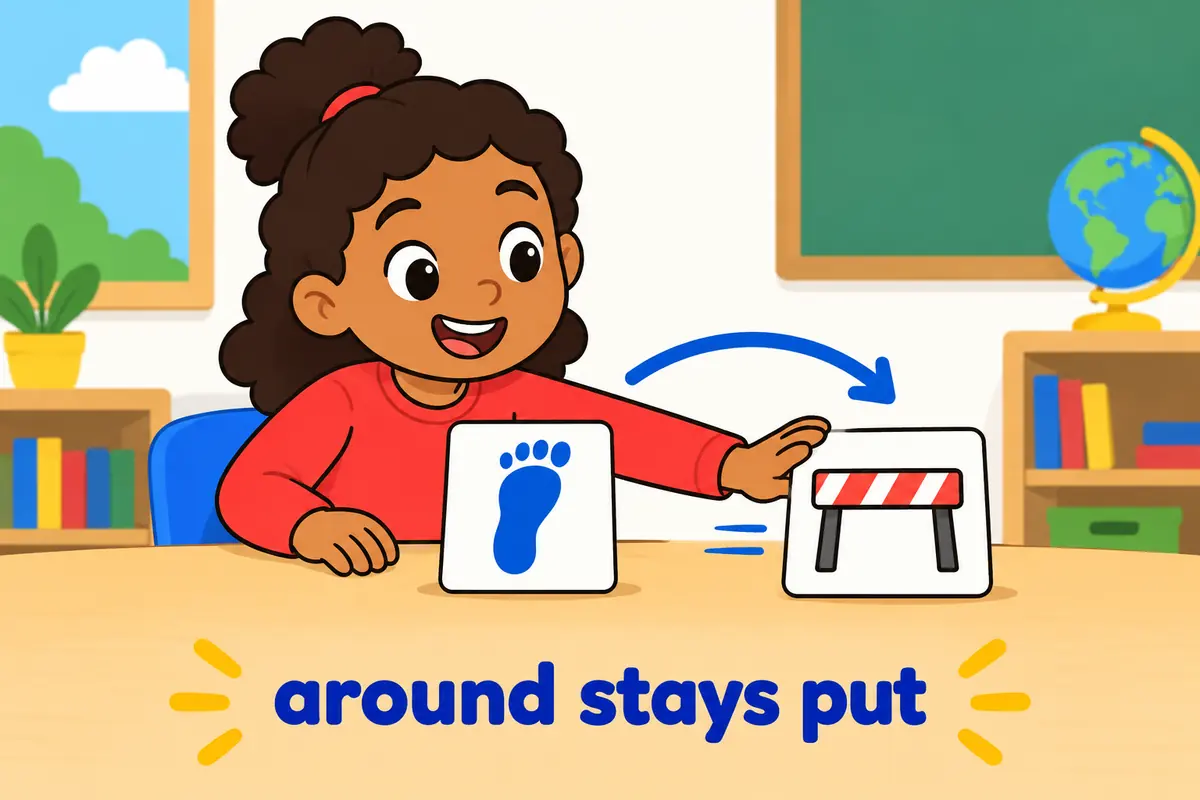
- The particle around stays with the verb and is never moved after the object.
- It suits everyday and workplace talk about delays, rules, faults and limits.
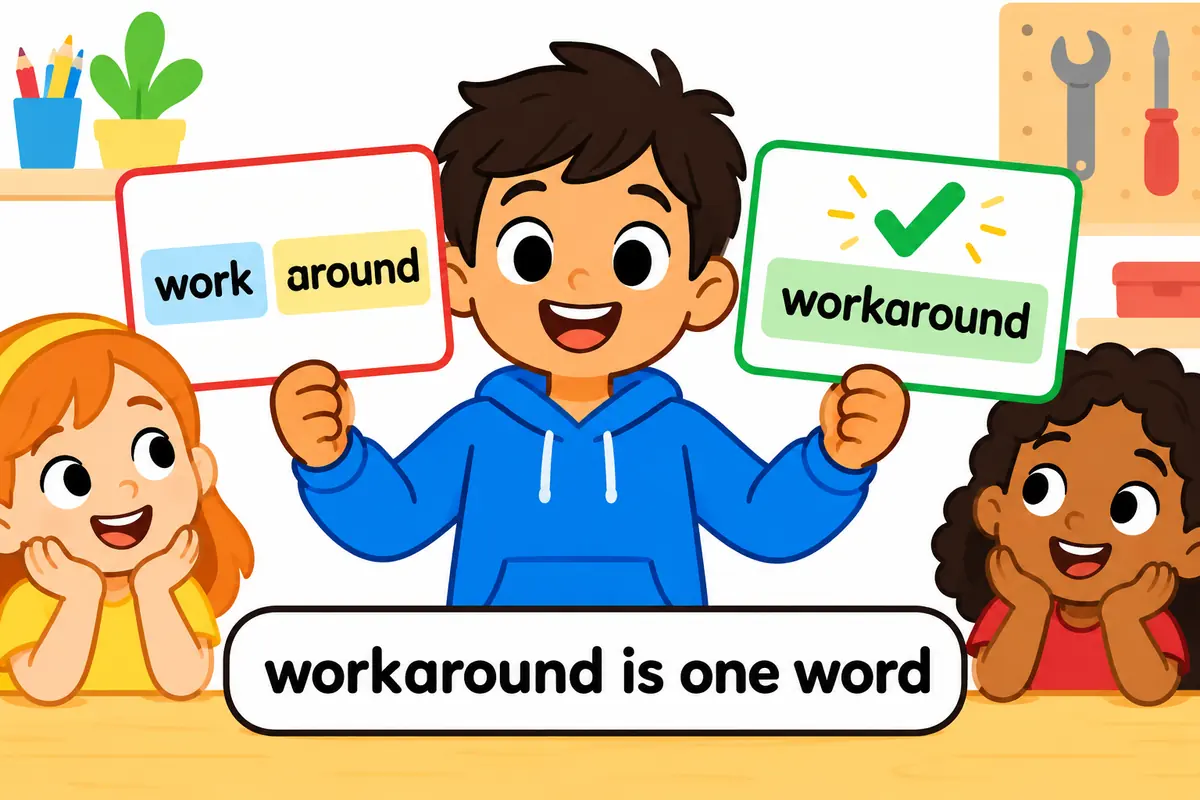
- The commonest error is writing the noun as two words; the noun is the single word workaround.
What does work around mean?
Work around is a phrasal verb meaning to find a practical path past an obstacle without removing it. The Cambridge entry for work around records this sense of dealing with a problem indirectly, and the meaning nearly always involves something inconvenient that stays in place. A team that works around a missing file finds another route; it does not fix the missing file.
| Sense | Plain meaning | Example sentence |
|---|---|---|
| Avoid an obstacle | Find a way past something inconvenient | Drivers worked around the flooded road. |
| Operate within a limit | Keep going despite a constraint | The team worked around the tight budget. |
| Reach a point gradually | Move slowly toward a topic or place | She worked around to the real question. |
Work around is not the same as solve. When you solve a problem you remove its cause, but when you work around one you leave the cause alone and change your own route. That is why the word is common in offices and software teams, where some obstacles cannot be removed today. A related noun, workaround, names the alternative route itself.
How do you use work around in a sentence?
Three grammar points matter more than any other for this verb: it is transitive, the particle does not split from its object, and the obstacle follows directly after around.
| Pattern | Example | What it signals |
|---|---|---|
| work around + obstacle | We worked around the closed bridge. | The obstacle is the direct object. |
| work around + abstract limit | They worked around the staff shortage. | The limit is a condition, not a thing. |
| work around + it/that | The rule is strict, but we can work around it. | A pronoun object is standard here. |
| work around + by/with + method | We worked around the delay by rerouting mail. | Names the method used to get past it. |
| stranded in a relative clause | the obstacle that we had to work around | Around may end the clause. |
| work around + the fact that | We worked around the fact that the office had no lift. | Names a situation rather than a thing. |
Around cannot be pushed after the object. The wording work the problem around is not English in this sense, because around is a preposition here rather than a movable particle. It may, however, be stranded at the end of a relative clause, as in the rule that everyone worked around, where the object has moved to the front.
Work around in a sentence: examples across contexts
| Context | Example sentence | Why this works |
|---|---|---|
| Classroom | We worked around the missing textbook by sharing two copies. | Daily obstacle handled without complaint. |
| Workplace email | We can work around the server outage until the engineers arrive. | Neutral, practical tone. |
| News report | Commuters worked around the closed station by taking replacement buses. | Names the obstacle and the detour. |
| Software writing | The app works around older browsers by serving a simpler page. | Technical sense, transitive. |
| Academic writing | Researchers worked around the small sample by pooling two datasets. | Careful response to a limitation. |
| Customer service | We worked around the billing glitch and refunded the fee manually. | Shows an improvised fix. |
| Sports writing | The striker worked around a tight defence with quick passes. | Physical sense of going past players. |
| Conversation | We will just work around it for now. | Pronoun object, informal and natural. |
| Project planning | The schedule worked around two public holidays. | Constraint as object. |
| Everyday travel | Cyclists worked around the roadworks along the riverside. | Literal physical route past a blockage. |
| Retail | Staff worked around the till failure by writing receipts by hand. | Improvised response under pressure. |
| Healthcare | Nurses worked around the shortage of beds by opening a side ward. | Practical adaptation to a limit. |
Notice how often the object is a condition rather than a thing you can touch. Teams work around staff shortages, public holidays and slow systems as readily as they work around a closed bridge. The verb therefore belongs to planning and problem-solving talk, where the difficulty is accepted and the effort goes into the route rather than the cause.
Work around vs get around
The nearest confusable is get around, because both can describe overcoming a difficulty.
| Attribute | Work around | Get around |
|---|---|---|
| Core meaning | Find a practical route past an obstacle | Avoid or overcome a rule or problem |
| Other senses | Rarely more than one clear sense | Also travel and become known |
| Register | Neutral to informal, common at work | Informal in every sense |
| Typical object | Delay, fault, shortage, roadworks | Rule, restriction, problem, crowd |
| What it implies | The obstacle stays and you adapt | You evade or outwit something |
| Tone | Practical and constructive | Often slightly evasive |
Choose work around when the difficulty remains and you simply find another way, and choose get around a rule when someone avoids or sidesteps an authority. A team works around a broken printer; a driver gets around a parking rule.
Word forms and grammar of work around
| Form | Part of speech | Example |
|---|---|---|
| work around | base verb, two words | We will work around the fault. |
| works around | third-person singular | The system works around slow links. |
| worked around | past tense and past participle | They worked around the closure. |
| working around | present participle | She is working around the missing data. |
| workaround | noun, one word | We found a workaround for the bug. |
| work-around | noun, hyphenated variant | Use workaround; the hyphen is old-fashioned. |
The particle around appears in many other phrasal verbs, each with its own sense: turn around a struggling business, look around a new office, hang around after class, or push around someone weaker. Work around is the one you reach for when the sense is finding a practical path past a problem.
The noun takes a plural, workarounds, and appears in compounds such as a workaround plan. The hyphenated form work-around was once standard for the noun and still turns up in older technical writing, but modern dictionaries list the closed form workaround first. Keeping the verb open and the noun closed settles nearly every spelling question about this pair.
Common mistakes with work around
- Incorrect:
We need a work around for this bug.Correct: We need a workaround for this bug. Rule: the noun is a single word. - Incorrect:
They worked the problem around.Correct: They worked around the problem. Rule: around stays with the verb and precedes its object. - Incorrect:
We will work around of the delay.Correct: We will work around the delay. Rule: around already carries the relation, so do not add of. - Incorrect:
The software works around flexible.Correct: The software works around rigid formats. Rule: the verb is transitive and needs an object. - Incorrect:
We worked it around by hiring more staff.Correct: We worked around it by hiring more staff. Rule: do not split the preposition from its object. - Incorrect:
He is good at work around problems.Correct: He is good at working around problems. Rule: after a preposition, use the gerund.
Practice using work around
- Fill in the blank: The crew ______ around the damaged cables to restore power.
- Choose the better word: The driver tried to (work around / get around) the parking fine.
- Correct the error: We worked the shortage around by borrowing stock.
- Build a sentence: use work around about a team facing a broken printer (pattern: work around + obstacle).
- Spot the register: which fits a workplace update, work around or circumvent?
- Fill in the blank: There was no way to fix the rule, so we simply worked ______ it.
- Correct the error: We need a work around quickly.
Answers
- worked. The obstacle follows directly and the past tense matches the completed repair.
- get around. Avoiding a fine by evasion suits get around, while work around keeps the obstacle in place.
- We worked around the shortage by borrowing stock. The particle stays before its object.
- Model: The team worked around the broken printer by emailing the file. The obstacle follows the verb and the method follows by.
- work around. It is plain and neutral, while circumvent is formal and legal in tone.
- around. It is the fixed particle of this verb and links to the pronoun object.
- We need a workaround quickly. The noun is one word, unlike the two-word verb.
The bottom line
The safest pattern for work around in a sentence is to keep the particle next to the verb and put the obstacle straight after it. The verb is transitive and its particle never splits, though around may end a relative clause. Keep the two-word verb apart from the one-word noun workaround, and reach for get around or solve when the sense shifts to evading a rule or removing a cause.
Frequently asked questions about work around
Is workaround one word or two?
It depends on the job the word is doing. As a verb, it is always two words: we work around a problem. As a noun, it is one word: we found a workaround. The hyphenated form work-around is an older variant of the noun that most style guides now drop, so write the noun as a single word.
Can you separate work and around?
No. In this sense around is a preposition, not a movable particle, so the obstacle must follow it directly. You say work around the delay, never work the delay around. The one exception is a relative clause, where the object moves to the front and around is stranded at the end, as in the rule that everyone worked around.
What is the difference between work around and get around?
Work around means finding a practical path past an obstacle that stays in place, as in working around a broken lift. Get around leans toward evading or outwitting something, and it has extra senses such as travelling or becoming known. Use work around for adaptation at work and get around for sidestepping a rule.
Is work around formal or informal?
Work around is neutral to informal and very common in offices, support desks and software teams. In a formal report, writers often prefer circumvent, avoid or adapt to. For a workplace update, a quick message or everyday speech, work around sounds natural and clear, which is why it spreads so easily.