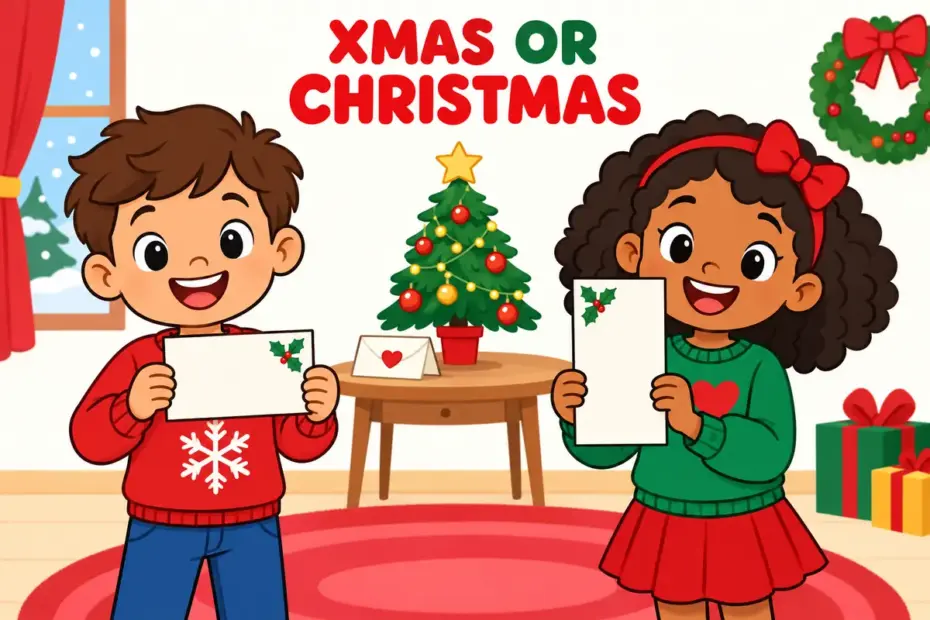
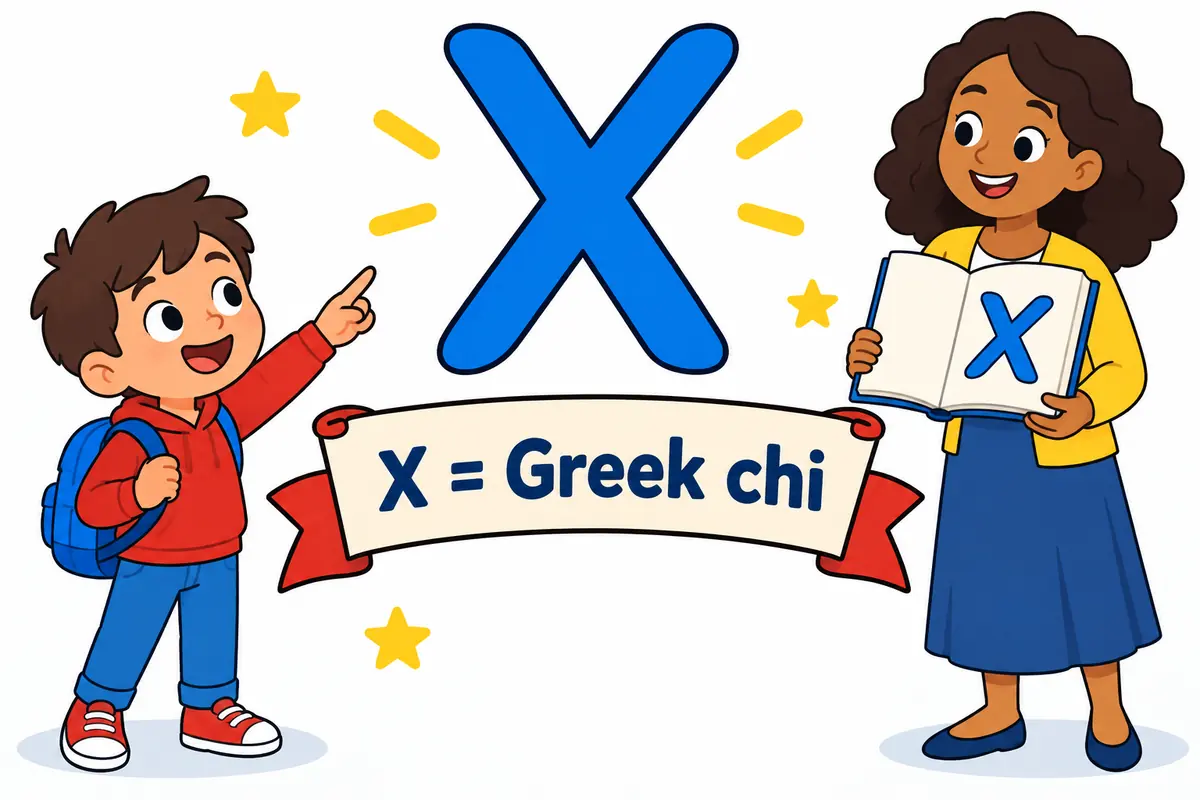
Xmas vs Christmas comes down to register: use Christmas in formal, religious and professional writing, and reserve Xmas for casual greetings, signs and cramped layouts. Xmas is not a slur or a plot to remove Christ; the X stands for the Greek letter chi, the first letter of Christos. Both are correct, but one suits a formal letter.
Xmas vs Christmas at a glance
- Christmas is the full name of the festival; Xmas is a shortened written form of the same word.
- Neither spelling is wrong, but they belong to different registers.
- Christmas is neutral to formal and safe almost everywhere.
- Xmas is informal and best kept for cards, adverts and tight spaces.
- The X is not an erasure of Christ but an old abbreviation built on a Greek letter.
Xmas vs Christmas: the master comparison
The master table sets the two forms against the criteria that decide most real sentences. Read down the rows to find the situation you are writing in. Each row isolates one decision, so a writer can settle the spelling by matching the occasion rather than by guessing.
| Criterion | Xmas | Christmas |
|---|---|---|
| Register | Informal and light | Neutral to formal |
| Length | Four characters, compact | Nine characters |
| Origin | An abbreviation built on the Greek letter chi | The full English name of the festival |
| Religious clarity | Omits the name Christ | Names Christ directly |
| Best uses | Cards, adverts, posters, tight layouts | Letters, worship, news, contracts |
| Risk | Can read as casual or flippant to some readers | Safe in almost every context |
| Greeting example | Merry Xmas! | Merry Christmas! |
Which should you use?
Match the form to the reader and the space, and the choice stops being difficult.
| Situation | Use | Why |
|---|---|---|
| Greeting card to a close friend | Xmas | Casual and warm, and the format is relaxed. |
| Email or letter to a client | Christmas | Formal writing keeps the full name. |
| Church notice or service sheet | Christmas | The full name matches the occasion. |
| Shop window or poster with tight space | Xmas | The compact form fits and suits advertising. |
| News headline with a neutral tone | Christmas | Avoids the flippant edge some readers hear in Xmas. |
When two options are both correct, the reader is the tie-breaker. A client, a congregation and a court expect the full name, while a friend opening a card expects warmth rather than ceremony. If you are unsure, choose Christmas, because the formal form rarely offends and the informal one occasionally does.
What do Xmas and Christmas mean?
The word Christmas is the full name of the annual Christian festival celebrated on 25 December, and Xmas is a shortened written form of that same name. The Cambridge entry for Christmas and the Cambridge entry for Xmas describe one holiday with two spellings. Christmas names Christ directly, while Xmas keeps only the first letter of the Greek word Christos. A greeting written either way refers to the same day.
Both forms are correct English, and dictionaries treat Xmas as a variant rather than a mistake. The difference a reader notices is tone, not accuracy: one form sounds like a letter, the other like a card. That is why a style choice, rather than a spelling rule, separates them.
This is also why the choice rarely matters in speech, where both words sound the same and the tone comes from elsewhere. In writing the form is visible, so a reader judges it before hearing a single word. Editors therefore treat the two spellings as a register decision rather than a spelling test, and they apply it much as they treat contractions.
How do you use Xmas and Christmas in a sentence?
Both words are nouns, and both can also sit before another noun as modifiers. Five patterns cover almost every real sentence.
| Pattern | Example | What it signals |
|---|---|---|
| Merry Christmas! | Merry Christmas to you and your family. | The standard festive wish. |
| Merry Xmas! | Merry Xmas from all the team. | Casual and common on cards and signs. |
| a Christmas / Xmas tree | They decorated the Christmas tree early. | An attributive modifier labels an object. |
| at Christmas | We stay with relatives at Christmas. | Names the season rather than one day. |
| Christmas Day | Christmas Day falls on a Friday. | A fixed compound names a date. |
The festive register is the whole point: swap one form for the other and the facts do not change, but the voice does. That is the test to apply before you publish.
Xmas and Christmas in sentences: examples across contexts
The twelve sentences below move from a formal letter to a billboard, and each one shows the form the setting calls for. Several use the abbreviation deliberately, while others show a formal setting where it would look out of place.
| Context | Example sentence | Why this works |
|---|---|---|
| Formal letter | We wish you a peaceful Christmas and a restful new year. | The full name suits a formal salutation. |
| Greeting card | Merry Xmas, and see you in the spring! | Casual tone and limited space. |
| Church notice | Christmas services begin on the first Sunday of Advent. | Worship uses the full name. |
| Shop window | Xmas gifts, half price this week. | Advertising favours the compact form. |
| News report | Christmas travel is expected to peak on Friday. | Neutral journalism keeps the full name. |
| Social post | Counting down to Xmas with the family. | Informal voice matches the platform. |
| School newsletter | The Christmas fair raised money for the library. | Formal but warm, so the full name fits. |
| Invitation | Join us for Christmas dinner at seven. | A fixed compound names the meal. |
| Text message | Merry Xmas, hope the drive is easy. | Quick and friendly, typical of chat. |
| Contract | The office closes for the Christmas holiday. | Legal text always uses the full name. |
| Radio script | The presenter wished listeners a happy Christmas on air. | Broadcast copy keeps the formal name. |
| Billboard | Xmas sale, three days only. | Very tight space forces the short form. |
Word forms and grammar of Xmas and Christmas
Christmas behaves like a proper noun, and Xmas copies it. One plural and one hyphen cause most of the trouble.
| Form | Part of speech | Example |
|---|---|---|
| Christmas | noun, proper | Christmas comes but once a year. |
| Christmases | noun, plural | The family spent three Christmases abroad. |
| Christmas | attributive modifier | They wrapped the Christmas presents. |
| Xmas | noun, informal abbreviation | Merry Xmas to all our readers. |
| Xmas | attributive modifier | The Xmas lights went up in November. |
| X-mas | variant, non-standard | Incorrect: Merry X-mas. Correct: Merry Xmas. |
Pluralising Xmas is rare, so the holiday counted over several years is almost always Christmases. Keep the abbreviation hyphen-free as well, because the standard written form is Xmas, not X-mas.
The modifier use is the one that trips people up in editing. Christmas tree, Christmas dinner and Christmas carol all take the full form without an apostrophe, while Xmas lights and Xmas cards take the abbreviation. Neither modifier changes the noun after it, so a plural noun still carries its own s.
Common mistakes with Xmas and Christmas
- Incorrect:
Merry X-mas!Correct: Merry Xmas! Rule: the standard abbreviation has no hyphen. - Incorrect:
We had three Xmas together.Correct: We had three Christmases together. Rule: the plural of the holiday is Christmases, not Xmas. - Incorrect:
I bought a Christmas’ tree.Correct: I bought a Christmas tree. Rule: an attributive noun takes no apostrophe. - Incorrect:
Xmas removes Christ from the holiday.Correct: Xmas uses the Greek letter chi, an old abbreviation for Christ. Rule: describe the history accurately rather than repeating the myth. - Incorrect:
The contract covers the Xmas period.Correct: The contract covers the Christmas period. Rule: formal documents use the full name.
Practice choosing between Xmas and Christmas
Work through the eight items, then read the reason beside each answer, because the setting, not the spelling, decides.
- Choose the better form: A letter to a bank should say (Xmas / Christmas).
- Choose the better form: A chalkboard outside a cafe with little room reads (Merry Xmas / Merry Christmas).
- Correct the error: We spent two Xmas in the mountains.
- Correct the error: The poster said Happy X-mas to everyone.
- Build a sentence: write a neutral news line about travel using the full name.
- Spot the register: which belongs in a service sheet, Christmas carols at six, or Xmas carols at six?
- Correct the error: The Xmases we spent abroad were the best.
- Choose the better form: A billboard with tiny space reads (Xmas / Christmas) treats.
Answers
- Christmas: a bank letter is formal, so the full name is right.
- Merry Xmas: the compact form suits a small, casual sign.
- We spent two Christmases in the mountains: the plural is Christmases.
- The poster said Happy Xmas to everyone: the standard abbreviation has no hyphen.
- Model answer: Christmas travel is expected to be busy on Friday.
- Christmas carols at six: a service sheet uses the full name.
- The Christmases we spent abroad were the best: Xmas is rarely pluralised.
- Xmas: a billboard has the least space, so the compact form earns its place.
The bottom line
Xmas vs Christmas is a question of register rather than correctness, and the answer is usually straightforward. Use Christmas in formal, religious and professional writing, where the full name is safe, and use Xmas in casual greetings, adverts and tight layouts. The X is an old abbreviation for Christ, so neither form insults the holiday; only the tone changes. The compact spelling saves space but costs formality, and that trade is the whole choice.
Frequently asked questions about Xmas and Christmas
Is Xmas offensive or disrespectful?
Most dictionaries treat Xmas as a standard informal variant, not an insult, and the X is a Greek letter rather than a crossed-out name. Some readers still find the short form flippant in a solemn or formal setting, so keeping Christmas for those contexts avoids causing unintended offence.
Where does the X in Xmas come from?
The X stands for chi, the first letter of the Greek word Christos, and that letter has long served as a shorthand for Christ. Scribes used it in religious abbreviations centuries ago, so Xmas grew from a conventional writing shortcut rather than from any attempt to remove Christ from the festival.
Is Xmas a real English word?
Yes. Xmas appears in standard dictionaries as an informal written form of Christmas, and it is common on cards, signs and adverts. It is a variant rather than a mistake, although careful writers keep it out of formal letters, contracts, worship and neutral news reporting.
Should Xmas be written with a hyphen?
No. The standard spelling is Xmas without a hyphen. The hyphenated X-mas appears occasionally but is not the accepted form, and it is best avoided in edited writing. If you want the informal tone, write Xmas; if you want formality, write Christmas.