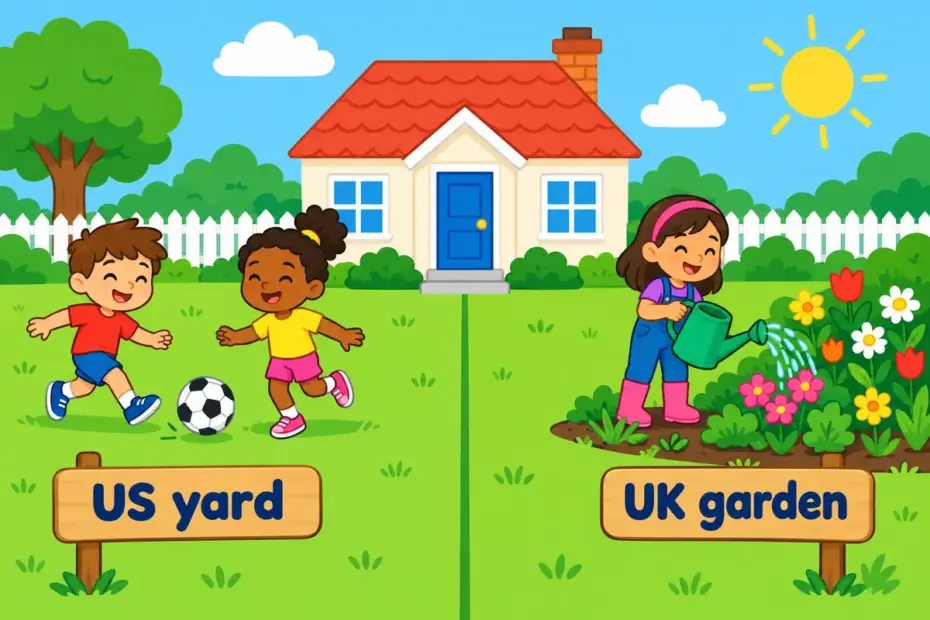
Yard vs garden is a choice that depends on which variety of English your reader uses: American English calls the ground around a house a yard and the planted part a garden, while British English calls the whole residential plot a garden and reserves yard for a paved or enclosed area.
Yard vs garden at a glance
- In American English, yard is the open ground around a house and garden is the planted part within it.
- In British English, garden is the whole outdoor space at home and yard is a paved or enclosed area.
- Both are countable nouns that take an article or a possessive: the yard, their garden.
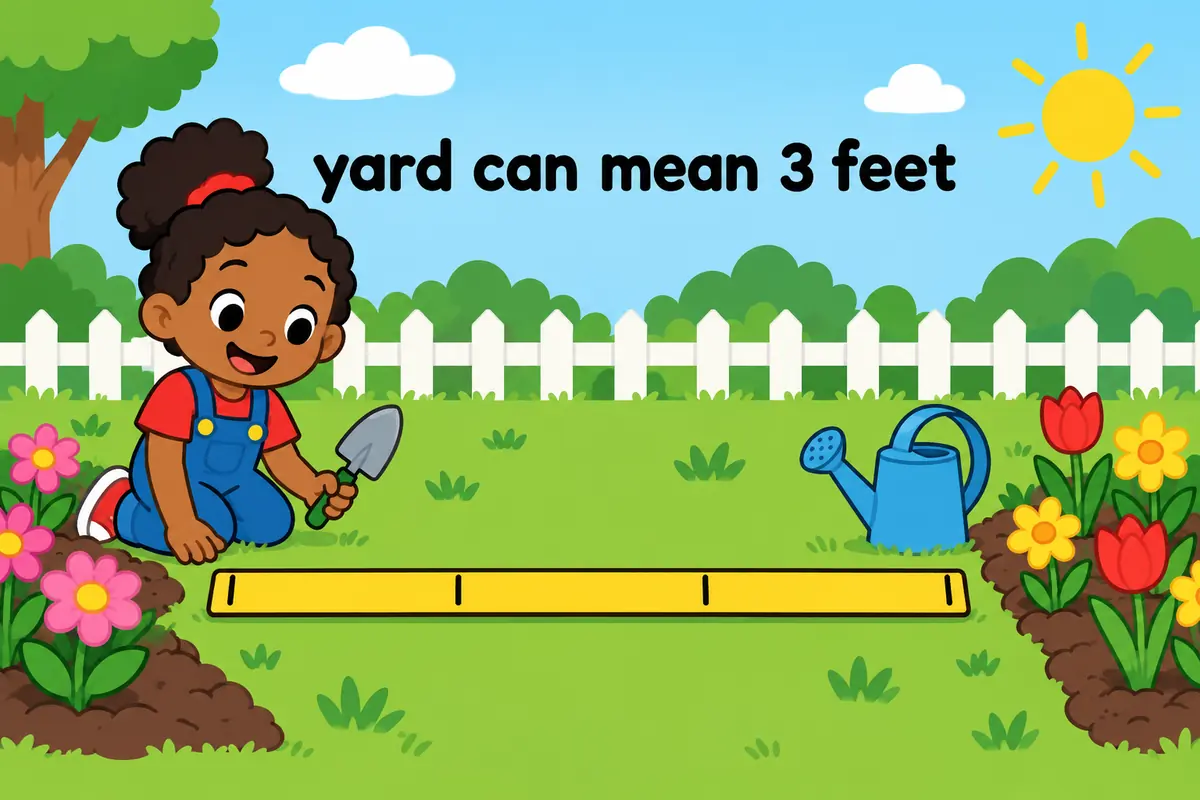
- Yard is also a unit of length equal to three feet; garden is never a measure.
- The commonest error is using one variety’s word in writing aimed at the other.
What do yard and garden mean?
Yard and garden overlap on the map but not in the dictionary. In American English, yard is the open ground around a building, and garden is the plot where flowers or vegetables grow inside it. In British English, garden covers the whole residential outdoor space, while yard is a paved or enclosed area such as a farmyard. The Cambridge entry for yard lists both the residential sense and the unit of length, and the Cambridge entry for garden records the cultivated sense first.
| Word | Variety | Sense | Example sentence |
|---|---|---|---|
| yard | American | Open ground around a house | The children played in the yard. |
| yard | British | A paved or enclosed area | The bikes are in the back yard. |
| garden | British | The ground around a house | We sat in the garden after lunch. |
| garden | American | A plot for growing plants | She planted tomatoes in the garden. |
| backyard | Both | The space at the back of a house | The party was in the backyard. |
One honest limitation applies to both words. Neither means a public park: a shared green space is a park or grounds, and a paved city space is a square or plaza. Calling a park a yard or a garden sounds wrong in every variety, because both words describe private space attached to a building.
Yard vs garden: the master comparison
The quickest way to keep the two words apart is to compare them on the features that actually decide a sentence. The table below pairs them criterion by criterion, and every cell gives a specific value rather than a preference.
| Criterion | yard | garden |
|---|---|---|
| Main sense in American English | The open ground around a house | The planted plot within that ground |
| Main sense in British English | A paved or enclosed working area | The whole outdoor space at home |
| What it usually contains | Lawn, trees, a patio, often a garden | Flower beds, borders, a lawn and paths |
| Typical phrase | mow the yard; the front yard | work in the garden; the back garden |
| Second sense | A unit of length, three feet | No second sense |
| Common collocation | backyard, schoolyard, farmyard | flower garden, vegetable garden |
| Usual verb | mow, rake, fence | plant, weed, water |
| Register | Everyday and neutral | Everyday and neutral |
The pattern is simple once it is laid out: yard names a space defined by a building, and garden names a space defined by cultivation. Where the two ideas meet, which word fits depends entirely on the variety of English being written.
Which should you use?
Four situations cover almost every real decision, and each has a firm answer.
| Situation | Use | Why |
|---|---|---|
| Describing the grass at a house for American readers | yard | American English treats the whole outdoor space as the yard. |
| Describing the same space for British readers | garden | British English calls the residential outdoor space the garden. |
| Writing about growing vegetables anywhere | garden | The cultivated sense is garden in both varieties. |
| Writing about a paved service area or a measurement | yard | yard keeps the paved sense and the three-feet unit in both varieties. |
| Writing a house listing | yard in the US, garden in the UK | Buyers search with the local word for the same space. |
If a single text must serve both audiences, name the thing rather than the space: the lawn, the flower beds, the patio. That avoids the mismatch entirely and keeps the sentence correct on both sides of the Atlantic.

How do you use yard and garden in a sentence?
Both words are countable nouns, so they normally take an article or a possessive. Yard has an extra life as a unit of length, which garden never shares, and garden can also work as a verb meaning to tend plants. The patterns below cover the practical uses.
| Pattern | Example | What it signals |
|---|---|---|
| the + yard / garden | The yard needs cutting. | Definite article for the outdoor space at a known house. |
| possessive + yard / garden | Their garden backs onto the canal. | Names whose outdoor space is meant. |
| yard as a measure | The fence is two yards high. | yard counts length; garden cannot be a unit. |
| garden as attribute | a vegetable garden | garden names a kind of plot when placed before a noun. |
| in the yard / garden | The tools are in the yard. | Both spaces take in for location. |
| to garden | She gardens every weekend. | garden works as a verb meaning to tend plants. |
The unit sense is a common trap. A reader who meets the sentence the yard is ten yards wide will pause, because the two uses of the same spelling sit side by side. Where clarity matters, write the garden is ten yards wide, or name the measure more plainly.
Yard and garden in a sentence: examples across contexts
The words change owners as the setting changes, and each example below names the variety it fits. Ten sentences show how the choice plays out in real writing, from a house listing to a gardening book.
| Context | Example sentence | Why this works |
|---|---|---|
| American home | The kids built a snowman in the front yard. | yard names the open ground around a US house. |
| British home | We had tea in the back garden. | garden names the whole outdoor space at a UK house. |
| House listing, US | The yard is fenced and the garden is planted with roses. | Separates the open ground from the cultivated plot. |
| Gardening book | Plant the seedlings in the vegetable garden. | Uses the cultivated sense that both varieties share. |
| Measurement | Leave two yards between the rows. | Uses yard purely as a unit of length. |
| Farm writing | The tractor is parked in the farmyard. | Uses the British paved or working sense of yard. |
| School notice | Children play in the schoolyard at break. | Yard compounds with school to name a paved play area. |
| Property advert, UK | A bright flat with a private courtyard garden. | Combines the paved sense with the green residential one. |
| Travel writing | Each cottage opens onto a walled garden. | garden carries the enclosed, private sense of British usage. |
| Conversation, US | I will mow the yard before lunch. | The fixed verb collocation for a US lawn is mow the yard. |
Read the third and fourth rows together and the logic becomes clear. A single American house can have both a yard and a garden, because the yard is the ground and the garden is what is planted in it.
Word forms and related words
The two families are worth learning together, because the derived words keep the same American and British split. A gardener tends plants, and gardening names the activity, whatever variety of English is used.
| Form | Part of speech | Example |
|---|---|---|
| yard | noun | The yard is bigger than it looks. |
| yards | noun, plural | Two yards of fabric will be enough. |
| backyard | noun, one word in US English | We ate in the backyard. |
| courtyard | noun | Guests gather in the courtyard. |
| garden | noun | The garden is full of bees. |
| gardens | noun, plural | The gardens open to the public in May. |
| garden | verb | They garden together on Sundays. |
| gardener | noun | The gardener pruned the apple tree. |
| gardening | noun | Gardening is her favourite hobby. |
Two related spaces complete the picture. A backyard is the space at the back of a house, and a courtyard is a paved area enclosed by walls or buildings. A patio is the hard-surfaced area for sitting, and it sits inside a yard or garden rather than replacing it.
Common mistakes with yard and garden
Almost every mistake comes from carrying one variety’s word into writing aimed at the other, or from borrowing yard for a space it never names.
- Incorrect for American readers:
The kids are in the back garden.Correct: The kids are in the backyard. Rule: American English uses yard or backyard for the ground around a house. - Incorrect for British readers:
Please mow the yard.Correct: Please mow the lawn, or mow the garden. Rule: British English reserves yard for a paved area; the grass is the lawn. - Incorrect:
The park is a lovely yard.Correct: The park is a lovely green space. Rule: yard names private ground, never a public park. - Incorrect:
The room is three gardens long.Correct: The room is three yards long. Rule: yard, not garden, is the unit of length equal to three feet. - Incorrect:
He gardens the yard every week.Correct: He works in the garden every week. Rule: to garden is intransitive, so it names the activity without taking the space as an object.
Practice using yard and garden
Work through the six items, then check the reasoning rather than only the answer.
- Fill the gap: For an American reader, the children played in the ______.
- Choose the better word: A British estate agent would advertise the grass behind the house as the back (yard / garden).
- Correct the error: The fence is five gardens long.
- Build a sentence: describe growing carrots in a way that works for any reader.
- Spot the register: which fits a US house listing — a spacious front yard, or a spacious front garden.
- Rewrite for both audiences: The garden needs cutting. Replace the space word so the sentence works in American English.
Answers
- yard — American English calls the open ground around a house the yard.
- garden — British English calls the residential outdoor space the garden.
- The fence is five yards long — only yard is a unit of length.
- Model answer: Plant the carrots in the vegetable garden, which works in both varieties.
- A spacious front yard — the US listing uses the American word.
- The yard needs cutting — swapping to yard makes the sentence correct for US readers.
The bottom line
Use yard vs garden according to the variety of English your reader expects, not according to the size or beauty of the space. American English calls the ground around a house a yard and the planted part a garden, while British English calls the whole residential plot a garden and keeps yard for a paved area or a unit of length. When in doubt, describe the lawn or the flower beds directly, and the sentence stays correct everywhere.
Frequently asked questions about yard vs garden
Why do Americans say yard and British people say garden?
The two varieties settled on different words for the same ground. American English kept yard for the open space around a house and narrowed garden to the planted plot, while British English kept garden for the whole residential space and narrowed yard to paved or working areas. Neither usage is more correct.
Is a yard bigger than a garden?
Size is not the issue, because the words measure different things. In American English the yard is the whole ground and the garden is a smaller planted part within it, so the yard is larger. In British English the garden is the whole space, and a yard is simply a paved area that can be any size.
Is yard also a unit of measurement?
Yes. A yard is a unit of length equal to three feet, roughly ninety centimetres, and it appears in both American and British English. That sense is unrelated to the outdoor space, which is why the yard is ten yards wide can sound momentarily confusing. Garden never has a measurement sense.
What should I call the grass: a lawn, yard or garden?
A lawn is the mown grass itself in both varieties. The enclosed area around that grass is the yard in American English and the garden in British English. So an American mows the yard while a British gardener mows the lawn inside the garden, and both are saying the same thing.