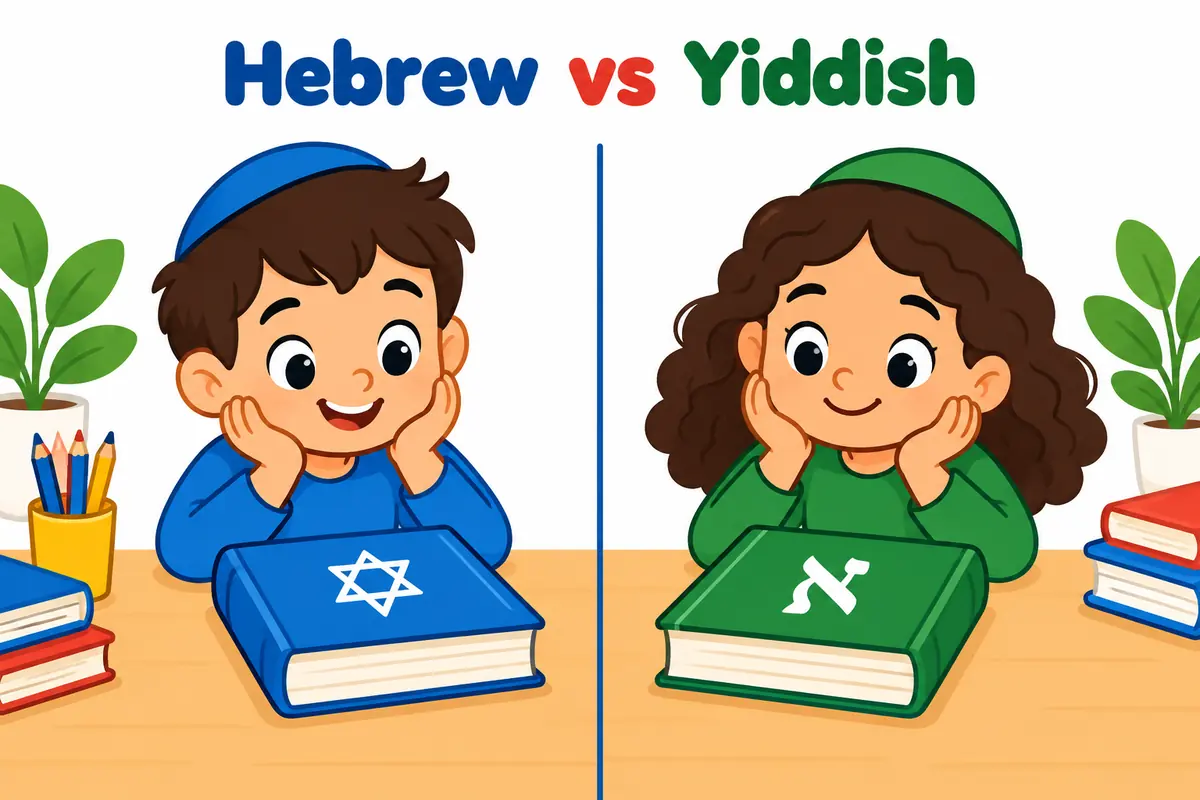
The yarmulke vs kippah question has a simple answer: kippah is the Hebrew word and yarmulke is the Yiddish word for the same small round head covering. Use kippah in most writing, and choose yarmulke when you are describing Ashkenazi Jewish communities that use the Yiddish term.
Yarmulke vs kippah at a glance
- Both words name the same brimless skullcap worn for prayer and daily life.
- Kippah is Hebrew; yarmulke entered English from Yiddish.
- The plural of kippah is kippot or kippahs, and the plural of yarmulke is yarmulkes.
- Kippah is the more widely used term in modern English writing.
- Neither word is more religious than the other, because both label one and the same garment.
Yarmulke vs kippah: the short answer
If you need one sentence, take this one: kippah is the Hebrew name for the skullcap and yarmulke is the Yiddish name for it, so the choice is about language, audience and community, not about two different objects. The table below weighs the features that decide which word fits a given piece of writing.
| Criterion | yarmulke | kippah |
|---|---|---|
| Source language | Yiddish | Hebrew |
| Usual communities | Ashkenazi, and older American usage | All Jewish communities and Israel |
| Frequency today | Familiar in older texts and American journalism | The default term in current writing |
| Plural | yarmulkes | kippot or kippahs |
| Register | Neutral, slightly traditional | Neutral and standard |
The short verdict: write kippah unless you have a specific reason to use yarmulke, such as quoting a Yiddish-speaking source, describing an Ashkenazi custom, or matching a publication that prefers the older term.
The choice is also reversible inside one piece. A writer may open with kippah for a general reader and switch to yarmulke for a quoted Yiddish source, as long as the shift is signalled. Consistency within a single community description matters more than a single fixed term, because a sudden unexplained switch looks like an error rather than a deliberate paraphrase.
What does kippah mean and what does yarmulke mean?
Kippah is a Hebrew noun for the small round cap that Jewish men and boys, and in many communities women as well, wear on the head; yarmulke is the Yiddish noun for the same cap. The Merriam-Webster entry for kippah and the Cambridge entry for yarmulke both define a skullcap, which confirms that the two labels describe one object.
| Word | Language of origin | Common plural | Example sentence |
|---|---|---|---|
| kippah | Hebrew | kippot, kippahs | He wore a blue kippah to the service. |
| yarmulke | Yiddish | yarmulkes | She kept a spare yarmulke in her bag. |
One limitation is worth stating plainly. Neither word explains why the cap is worn, and the two are not different garments, so writing that they are distinct religious items is inaccurate. A plain synonym such as skullcap is also available, and it is the safest choice when the audience is unlikely to know either term. For a general description of head wear, the broader word a soft cap keeps the sentence neutral.
How do you use yarmulke and kippah in a sentence?
Both words are countable nouns, so both need a determiner, and both appear in the same patterns. The noun names the object, so a sentence normally pairs it with a verb of wearing, placing, keeping or buying. Where the writer wants the plainest description, a plain hat and skullcap avoid the question of language entirely.
| Pattern | Example | What it signals |
|---|---|---|
| wear + a + kippah or yarmulke | He wears a kippah at synagogue. | The everyday act of having it on the head. |
| put on + a + kippah or yarmulke | She put on a yarmulke before the blessing. | The moment of beginning, not a habit. |
| a + colour + kippah or yarmulke | A white kippah rested on the shelf. | Describes the object in a neutral report. |
| hand out + kippot or yarmulkes | Volunteers handed out kippot at the door. | Plural form for several identical caps. |
| keep + a + yarmulke or kippah | He keeps a yarmulke in the glove box. | Possession rather than use. |

Yarmulke and kippah in a sentence: examples across contexts
The words carry the same meaning, so the examples below show how the choice of term changes only the flavour and the assumed audience. Each sentence names a setting where the word would naturally appear.
| Context | Example sentence | Why this works |
|---|---|---|
| News report | The mayor wore a kippah at the memorial. | Uses the standard term for a general readership. |
| History essay | Many nineteenth-century immigrants brought a yarmulke from Eastern Europe. | The Yiddish term matches the Ashkenazi setting. |
| Feature writing | A row of colourful kippot hung by the entrance. | The Hebrew plural suits a modern community portrait. |
| Religious studies | Worshippers put on a kippah before a quiet prayer. | Names the ritual moment without endorsing a practice. |
| Museum label | This velvet yarmulke belonged to a cantor from Vilnius. | The Yiddish term fits a documented Ashkenazi object. |
| Personal essay | My grandfather kept his yarmulke in a wooden box. | The family word is the natural one in memory writing. |
| Travel guide | Visitors are given a kippah before entering the site. | The Hebrew term is understood by local readers. |
| School report | Our class learned that a kippah and a yarmulke are the same cap. | Teaches the equivalence in one clear sentence. |
Which should you use?
The right word depends on who is reading and what you are describing, so the situation decides rather than a fixed rule. The table turns five common situations into a clear recommendation.
| Your situation | Use this word | Why |
|---|---|---|
| General audience, no religious detail | kippah, or skullcap | The Hebrew term is the standard one and skullcap avoids the choice. |
| Writing about Ashkenazi history or Yiddish sources | yarmulke | The term matches the community and the language of the records. |
| Quoting an Israeli or Hebrew-language source | kippah | The source uses the Hebrew word, so the translation follows it. |
| Describing the object with no community in view | skullcap | The neutral synonym sidesteps the language question. |
| Using both in one piece | state the equivalence once | The overlap should be explained exactly once, then stay consistent. |
Word forms and grammar of yarmulke and kippah
Both nouns are countable and both follow regular English grammar, although the Hebrew plural kippot is common in Jewish and academic writing. The table lists the forms and flags the one that learners often build wrongly.
| Form | Part of speech | Example |
|---|---|---|
| kippah | noun, singular | A kippah lay on the table. |
| kippot | noun, Hebrew plural | Rows of kippot hung by the door. |
| kippahs | noun, English plural | They bought two kippahs for the boys. |
| yarmulke | noun, singular | He borrowed a yarmulke at the entrance. |
| yarmulkes | noun, English plural | Three yarmulkes sat in the drawer. |
| yarmulka | noun, variant spelling | Older texts sometimes print yarmulka. |
Both words are usually lowercase in English, and neither is capitalised unless it opens a sentence. The Hebrew plural kippot follows the source language, while kippahs and yarmulkes follow English rules, so both plurals are correct within their own convention. A run of religious head coverings often invites comparison, and the related words a wrapped turban and a light veil name different garments worn by other communities.
Common mistakes with yarmulke and kippah
- Incorrect:
A kippah and a yarmulke are two different hats.Correct: A kippah and a yarmulke are two names for the same cap. Rule: The words differ in language, not in the object they name. - Incorrect:
He wore kippah to the service.Correct: He wore a kippah to the service. Rule: Both nouns are countable, so a determiner is required. - Incorrect:
Kippot is the only correct plural.Correct: Kippot and kippahs are both accepted plurals. Rule: The Hebrew plural and the English plural each follow their own convention. - Incorrect:
The yarmulkes is on the shelf.Correct: The yarmulkes are on the shelf. Rule: A plural noun takes a plural verb, however unfamiliar the word looks.
Practice using yarmulke and kippah
Work through the six items, then check the reason beside each answer.
- Fill the gap: Before the ceremony, each visitor was handed a ______ at the door.
- Choose the better word: In a history of Yiddish theatre, the scholar writes (kippah / yarmulke).
- Correct the error: She put kippah on the table.
- Build a sentence: use kippot about a row of caps hung by an entrance.
- Spot the register: which fits a museum label, this velvet yarmulke belonged to a cantor, or this cap thing belonged to a cantor?
- Explain in one sentence: why are the two words not opposites?
Answers
- kippah, because the standard term suits an unknown visitor, though yarmulke would also be correct.
- yarmulke, because the Yiddish term matches the Ashkenazi subject of the book.
- She put a kippah on the table, because the countable noun needs a determiner.
- Model answer: A row of kippot hung beside the entrance, each one a different colour.
- The first, because a museum label uses the precise term, not an informal phrase.
- They are synonyms from different languages, so both name the same cap rather than two objects.
The bottom line
For the yarmulke vs kippah choice, reach for kippah in general writing and yarmulke when Yiddish or Ashkenazi context calls for it. The two words name one object, so they are never opposites, and the deciding factors are the audience and the source you are translating. If the readership is unfamiliar with either term, skullcap removes the question.
Frequently asked questions about yarmulke vs kippah
Are a yarmulke and a kippah the same thing?
Yes, they are the same garment. Yarmulke is the Yiddish name and kippah is the Hebrew name for the small round skullcap worn on the head. The difference is the language of the speaker or writer, not the object. A shop selling one would sell the other under a different label.
Which word is more common in English?
Kippah has become the more common term in current English writing, especially in news and general reporting. Yarmulke remains familiar, particularly in older American texts and in writing about Ashkenazi communities. For a general audience today, kippah is the safer default, with yarmulke reserved for a specific cultural setting.
How do you pluralise kippah and yarmulke?
The English plural of yarmulke is yarmulkes, and the English plural of kippah is kippahs. Hebrew plurals add kippot, which is standard in Jewish and academic writing. All three are correct within their own convention, so pick one and stay consistent rather than mixing kippot and kippahs in the same paragraph.
Is it respectful to use either word?
Both words are respectful when they are used accurately, because neither is slang and neither carries a negative sense. Problems arise only from factual errors, such as treating the two as different religious objects or claiming one is more devout. Match the term to the community you are describing and spell it correctly.