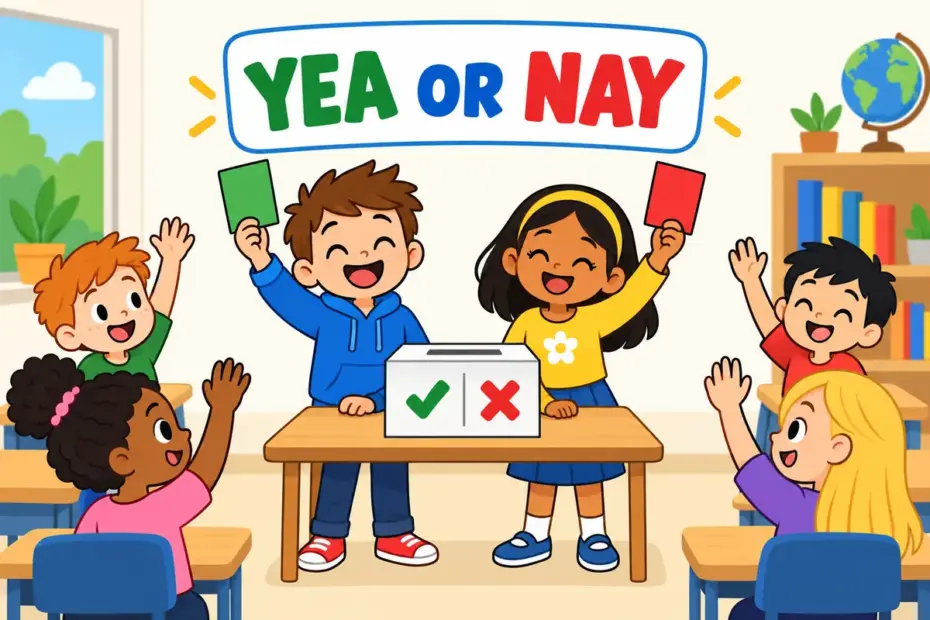
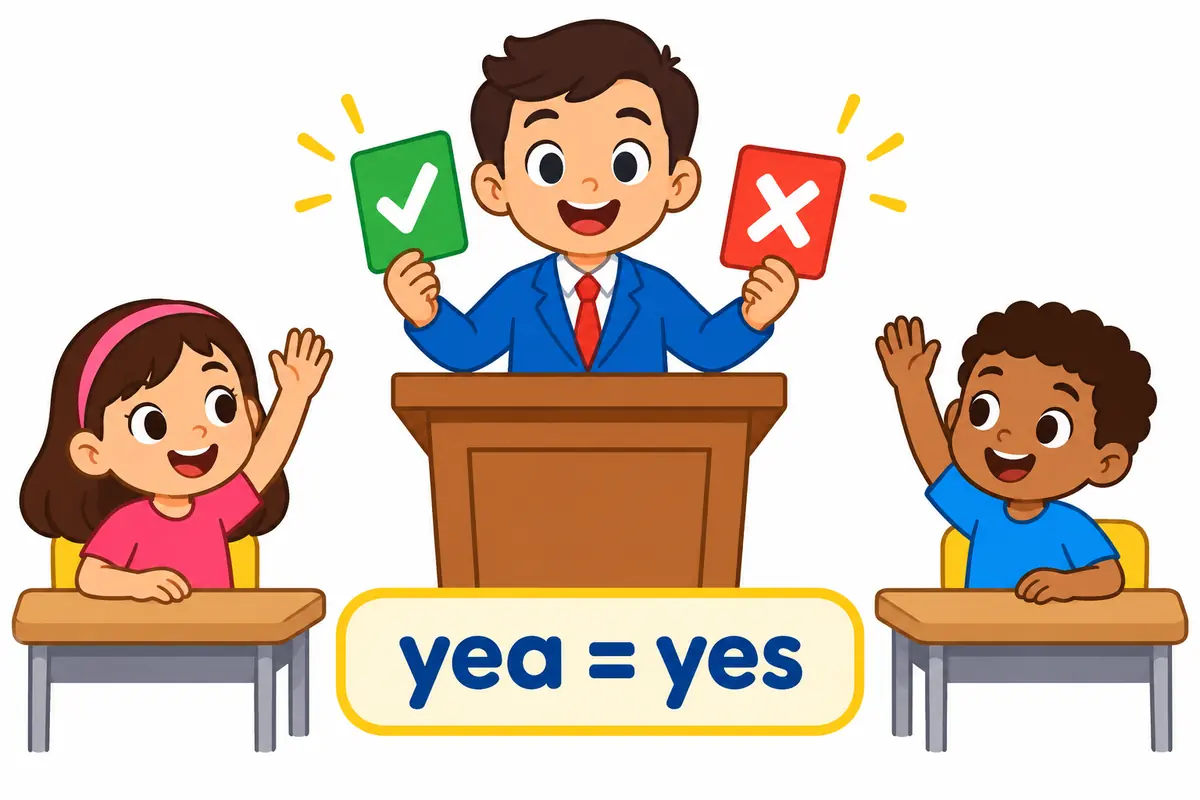
Yea vs nay is a single choice: yea records a vote in favour, nay records a vote against, and in ordinary speech plain yes and no are the natural words. The pair survives in formal recorded votes and in the phrase yea or nay. In a sentence, a chair asks for the yeas and nays and counts both.
Yea and nay at a glance
- Yea and nay are the affirmative and negative words used in a formal recorded vote.
- Yea is not the same as yeah: yea is formal, while yeah is casual speech for yes.
- Nay is the direct opposite of yea and also survives in the old construction nay, more.
- Both words work as adverbs and as countable nouns, so the yeas and the nays are both correct plurals.
- In everyday writing, replace them with yes and no unless you are reporting a vote.
What do yea and nay mean?
Yea is an adverb and noun meaning yes, an affirmative answer or vote, and nay is its opposite, meaning no or a negative vote. The Cambridge entry for yea and the Cambridge entry for nay both treat the words as old or formal, which explains why they cluster in legislative language. Where a writer needs only agreement, the plain word is yes.
| Term | Part of speech | Plain meaning | Example |
|---|---|---|---|
| yea | adverb | Yes, an affirmative answer | Yea, I agree with the motion. |
| yea | noun | An affirmative vote or voter | The bill passed with sixty yeas. |
| nay | adverb | No, a negative answer | Nay, I cannot support it. |
| nay | noun | A negative vote or voter | The nays were twelve. |
| nay | conjunction, old use | And more than that | A good plan, nay, an essential one. |
One limitation is worth stating. Yea and nay are not synonyms for the adjectives positive and negative, and they are not a general way to agree or refuse. They name a vote. Used for ordinary consent, they sound archaic, and a modern reader may read them as a joke rather than a decision.
Yea vs nay: the key differences
The two words are mirror images, so almost every attribute flips. The table below holds the features a writer actually weighs when choosing between them.
| Feature | yea | nay |
|---|---|---|
| Core meaning | Yes, in favour | No, against |
| Main use today | Recorded formal votes | Recorded formal votes |
| Everyday replacement | Yes | No |
| Sound trap | Close to the casual yeah | Sounds like neigh, the horse sound |
| Parts of speech | Adverb and noun | Adverb, noun and old conjunction |
| Fixed phrase | yea or nay | yea or nay |
The practical test is the word that follows. If a member is answering a roll call, yea and nay are the expected forms; if the same member is talking to a colleague afterwards, yes and no are the natural words. Register, not meaning, is what separates the two pairs.
Which should you use?
The setting decides the word, not personal preference. Four common situations map to a firm answer, and only the first two are genuinely formal.
| Situation | Use | Reason |
|---|---|---|
| Recording votes in a formal meeting | yea and nay | These are the spoken words a clerk writes down. |
| Reporting a vote in minutes or news | yea and nay | They name the two counts precisely. |
| Answering a friend in conversation | yes and no | Yea and nay sound archaic or jokey in speech. |
| Writing dialogue for a historical scene | yea and nay | The words place the speech in an older register. |
When in doubt, test the sentence in a committee room. If a clerk could write it down as a record of a vote, yea or nay fits; if it is an answer to a friend, use yes or no. Notice that only the first two settings produce a written record of the individual answers, while the last two borrow the words for colour.
How do you use yea and nay in a sentence?
Both words work as answers and as countable nouns, and the plural nouns are the usual form in minutes and reports. Place them after a verb such as vote, say or count, or use them on their own as a one-word reply.
| Pattern | Example | What it signals |
|---|---|---|
| vote yea / vote nay | Two members voted nay. | Records how a person cast a vote. |
| a yea / a nay | The motion failed by four nays. | Treats each vote as a countable noun. |
| the yeas and nays | The clerk read the yeas and nays. | Names both counts as a fixed pair. |
| say yea / say nay | When the chair asked, she said nay. | Reports the spoken answer. |
| yea or nay | Give me a yea or nay by Friday. | Asks for any decision, not only a legal one. |
As a quick check on tone, note that yea belongs to the same formal family as affirmative and assent, while nay sits with dissent. None of these five would appear in a text message.
Yea and nay in a sentence: examples across contexts
The examples below keep the vote sense while moving from a council chamber to a family meeting. The verb vote is the word that most often introduces them, and the plural nouns carry the counts.
| Context | Example sentence | Why this works |
|---|---|---|
| Legislature | The motion carried by fifty yeas to forty nays. | Names both counts, the standard reporting form. |
| Committee minutes | The chair recorded three nays and two yeas. | Treats each as a countable noun. |
| Meeting email | Please reply with a yea or nay before noon. | Uses the fixed phrase to ask for a decision. |
| Classroom debate | Every student had to say yea or nay in turn. | Shows the spoken answer in a structured vote. |
| News report | The amendment fell by a voice vote, with the nays prevailing. | Describes the outcome rather than counting. |
| Historical dialogue | Yea, my lord, the deed is done. | Places the word in an older, formal register. |
| Debate club | A single nay defeated the proposal. | Shows how one negative vote can defeat an idea. |
| Opinion column | The plan deserves a clear yea, not a shrug. | Uses yea figuratively for approval. |
| Casual chat | I expected a yes, not a formal yea. | Contrasts the everyday and formal words. |
| Local council | The minutes show how each member voted yea or nay. | Places the pair inside a single reported phrase. |
| Family meeting | We took a show of hands rather than a formal yea or nay. | Contrasts a casual decision with the formal pair. |
The counts matter more than the words in most of these sentences, which is why the plural nouns, the yeas and the nays, do most of the work in modern minutes and news reports.
Word forms and grammar of yea and nay
Neither word inflects. They gain plurals only as nouns, and the casual forms yeah and no belong to a different register. The table keeps the grammatical roles apart.
| Form | Part of speech | Example |
|---|---|---|
| yea | adverb | Yea, the minutes show agreement. |
| yea | noun | One yea was enough to carry it. |
| yeas | plural noun | Count the yeas before you announce. |
| nay | adverb | Nay, I do not accept that reading. |
| nay | noun | A single nay can stop a unanimous vote. |
| nays | plural noun | The nays were read aloud. |
Two small grammar points follow from this. The plural nouns take plural verbs, so the yeas were many and the nays were few. And because neither word is a verb, a sentence never says the committee yeaed the plan; it says the committee voted for the plan.
Common mistakes with yea and nay
- Incorrect:
Yea, I will see you tomorrow, mate.Correct: Yeah, I will see you tomorrow, mate. Rule: Yeah is the casual word for yes; yea is formal and belongs to votes. - Incorrect:
Two members voted neigh.Correct: Two members voted nay. Rule: Nay is the vote word; neigh is the sound a horse makes. - Incorrect:
The nays was seven.Correct: The nays were seven. Rule: Nays is a plural noun and needs a plural verb. - Incorrect:
He gave a yea of approval to the holiday plan.Correct: He gave his approval to the holiday plan. Rule: Outside a formal vote, yea sounds archaic; use approval or yes. - Incorrect:
Yea or no, we need a decision.Correct: Yea or nay, we need a decision. Rule: The fixed phrase pairs yea with nay, not no.
Practice using yea and nay
Work through the six items, then check the reasoning rather than only the answer.
- Fill the gap: The treaty passed by sixty yeas to thirty ______.
- Choose the better word: The clerk recorded four (yeas / yeahs) and one nay.
- Correct the error: The nays was louder than the yeas.
- Build a sentence: use the yeas and nays about a school council vote.
- Spot the register: which belongs in formal minutes — The motion fell by four nays, or Nah, it lost.
- Rewrite for speech: change the formal words in The committee said yea to the budget.
Answers
- nays — the negative votes are counted in the plural noun.
- yeas — yeahs is casual; the recorded votes are yeas.
- The nays were louder than the yeas — the plural noun takes were.
- Model answer: The secretary read the yeas and nays after the school council debate.
- The motion fell by four nays — minutes keep the formal vocabulary.
- The committee said yes to the budget — everyday speech replaces yea with yes.
The bottom line
Use yea to record a vote in favour and nay to record one against, and keep both for formal or ceremonial settings. The facts that decide most sentences are that the two words mirror each other exactly and that they belong to recorded votes rather than chat. In everyday writing, yes and no carry the same meaning without the ceremony.
Frequently asked questions about yea and nay
Is yea the same as yeah?
No. Yeah is the casual spoken form of yes and appears in relaxed writing, while yea is formal and almost always tied to a recorded vote. They sound similar, which is why they are confused, but swapping them changes the register completely. In a chat, use yeah; in minutes, use yea.
Is nay still used in English?
Nay survives mainly in formal votes and in the fixed phrase yea or nay. It also lives on in the old construction nay, more, where it means and even more than that. Outside those settings the everyday word is no, and using nay in conversation sounds deliberately old-fashioned or humorous.
How are yeas and nays used in a meeting?
A chair asks members to answer yea or nay and the clerk records both counts as the yeas and the nays. The two words then appear as plural nouns, as in the yeas were forty and the nays were twelve. This paired form is the clearest way to report a vote.
Can yea and nay be used outside voting?
They can, but the effect is formal or playful. A writer might ask for a yea or nay on any decision, and an opinion column may call for a clear yea rather than a shrug. Used about an ordinary yes or no in conversation, however, both words sound dated.