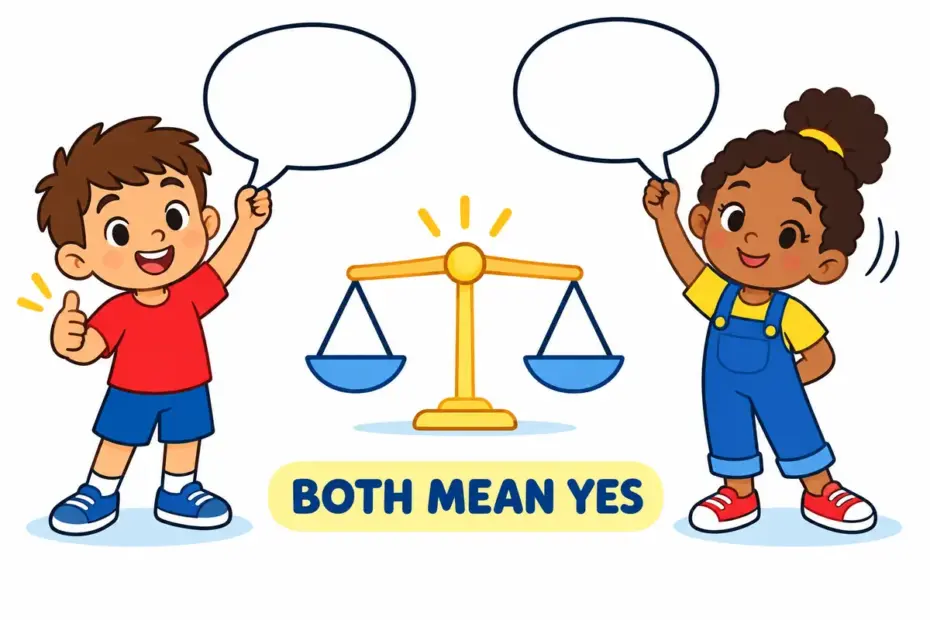
Yeah vs yep are both informal ways to say yes, but yeah is the safer choice for most writing and speech. Use yeah when the tone is casual yet still broadly standard, and keep yep for relaxed, familiar exchanges among friends. Neither belongs in a formal document, where yes remains the standard answer.
Yeah vs Yep at a glance
- Both yeah and yep are informal response words meaning yes.
- Yeah is more widely used and slightly more acceptable in everyday settings.
- Yep sounds warmer and more familiar, so it suits friends and family.
- Both work as a complete answer or as an opener before a clause.
- Neither fits a job application, a contract or an academic essay.
- The commonest error is using either word where yes is required.
Yeah vs Yep: the master comparison
The two words differ on one axis only, formality, and everything else follows from it. The table below sets the criteria side by side so the choice is visible at a glance.
| Criterion | yeah | yep |
|---|---|---|
| Formality | Informal but broadly standard | Strongly informal and familiar |
| Frequency of use | Very common across ages | Common but more casual |
| Usual placement | Standalone or sentence opener | Standalone or sentence opener |
| Tone | Neutral to friendly | Warm, breezy, companionable |
| Best fit | Everyday talk and casual email | Texts, chat and close friends |
| Where it fails | Formal writing and interviews | Any professional writing |
| Closest formal word | Yes | Yes |
The verdict is narrow: yeah is the more versatile casual choice, and yep is a deliberate step closer to the reader or listener. When in doubt, yeah travels further without sounding careless.
What does yeah mean?
Yeah is an informal response word meaning yes, used to agree, confirm or acknowledge. Yeah is only slightly more relaxed than yes and stays acceptable across most everyday speech, including much workplace conversation. The Cambridge entry for yeah records it as the informal form of yes, which is exactly the register it keeps.
It also does work that a plain yes cannot. As a one-word answer it carries a friendly edge, and in the fixed phrase yeah, right it signals doubt rather than agreement. That second use is the one learners misread most, because the words look like assent. Listeners rely on tone as much as words here, so a rising voice turns the same two syllables into a polite refusal to believe what was just said.
What does yep mean?
Yep is a casual variant of yes used to agree or confirm, and it is more relaxed than yeah. The Cambridge entry for yep records it as an informal response word, and its tone is quick and companionable rather than merely neutral. Yep suits a message to a friend far better than a note to a manager.
The word is mainly a spoken and texted form. In writing it signals intimacy or a breezy mood, so a writer who uses it in a report invites the reader to hear a shrug. That is a real effect, and it is why the choice is about tone before it is about grammar.
How do you use yeah and yep in a sentence?
Both words behave the same way: they open the reply and often stand alone. Six patterns cover the everyday uses, and only the register changes between them.
| Pattern | Example | What it signals |
|---|---|---|
| standalone yeah | “Ready?” “Yeah.” | Agrees without repeating the verb. |
| sentence opener | Yeah, I finished it last night. | Softens the start of a full answer. |
| fixed phrase | Yeah, right, as if that happened. | Signals doubt, not agreement. |
| oh yeah | Oh yeah, I forgot about that. | Recalls something suddenly. |
| standalone yep | “Coming?” “Yep.” | Gives a brief, friendly confirmation. |
| sentence opener | Yep, that works for me. | Warm agreement in casual talk. |
A related word worth knowing is sure, which agrees with a helpful rather than an emphatic tone. A similar register switch appears with indeed, which confirms in a more formal voice.
Yeah vs yep in a sentence: examples across contexts
The same two words move from a text thread to a courtroom, and the context decides which one survives and which one has to become yes.
| Context | Example sentence | Why this works |
|---|---|---|
| Text to a friend | Yeah, I will be there by eight. | Casual but clear in a short message. |
| Text to a friend | Yep, bring the snacks. | Quick and familiar between close friends. |
| Spoken reply at home | Yep, dinner is nearly ready. | Warm and brief across the kitchen. |
| Casual workplace chat | Yeah, the report is on your desk. | Relaxed speech that still reads as standard. |
| Group chat | Yeah, count me in for Saturday. | Friendly agreement in a low-stakes plan. |
| Phone call with family | Yep, Mum, I got the parcel. | Familiar tone signals closeness. |
| Dialogue in a novel | “You knew?” “Yeah.” | Captures natural, clipped speech. |
| Song lyric | Yep, we are going home. | The breezy register suits a light melody. |
| Interview answer | Yes, I managed that project. | Formal setting forces the standard word. |
| Customer email | Yes, I would like to confirm the booking. | Neither informal word belongs in business writing. |
| Classroom pair work | Yeah, I think the answer is right. | Quiet, natural speech between pupils. |
| Podcast conversation | Yep, that is how I remember it too. | Loose, unscripted talk rewards a light word. |
Notice that the two informal words disappear exactly where someone might be judged on their language, which is the practical boundary to remember. The classroom and podcast rows show the same words surviving comfortably when the setting is private rather than public.
Which should you use?
Match the word to the relationship and the medium, not to how you feel in the moment. Four common situations give a firm answer.
| Situation | Use | Why |
|---|---|---|
| Email to a colleague | yeah | Relaxed yet still broadly acceptable at work. |
| Text to a close friend | yep | Brief and warm between people who know each other. |
| Job interview or formal letter | yes | Neither informal word survives the formality check. |
| Dialogue you are writing | yeah | Reproduces natural speech without sounding too casual. |
Where agreement needs to sound precise rather than friendly, certainly and affirmative push the register upwards, and agreed does the same in a meeting. The rule of thumb is to read the message aloud before sending it: if the reply would sound odd spoken to a head teacher or a hiring manager, it does not belong on the page either.
Word forms and grammar of yeah and yep
Neither word inflects, and both sit outside standard written grammar. The variants below are the ones readers actually meet.
| Form | Part of speech | Example |
|---|---|---|
| yeah | response word, informal | Yeah, I can make it. |
| yep | response word, informal | Yep, see you at six. |
| yup | variant of yep | Yup, all done. |
| yea | formal vote word, different meaning | The members voted yea. |
| nope | informal negative counterpart | Nope, not today. |
One spelling trap is worth flagging. Yea is a formal word used in voting, not a casual spelling of yeah, and the two are not interchangeable. A second trap is yup, which is simply a variant of yep with the same informal register, so swapping one for the other changes nothing except the sound. Nope works the same way on the negative side, pairing with yeah and yep while staying just as casual, so a formal sentence needs not rather than nope. None of these forms takes an apostrophe or a capital letter in the middle of a sentence.
Common mistakes with yeah and yep
- Incorrect:
Yeah, I would like to confirm my attendance at the interview.Correct: Yes, I would like to confirm my attendance at the interview. Rule: Formal settings take yes. - Incorrect:
Yep, the defendant admits the charge.Correct: Yes, the defendant admits the charge. Rule: Yep is strictly informal and never appears in formal speech. - Incorrect:
Yeah right, I agree completely.Correct: Yeah, I agree completely. Rule: Yeah right signals doubt, so it contradicts agree. - Incorrect:
Yes yeah, that is correct.Correct: Yeah, that is correct. Rule: Use one agreement word, not two stacked together. - Incorrect:
She wrote yep in her cover letter.Correct: She wrote yes in her cover letter. Rule: Cover letters are formal writing.
Practice using yeah and yep
Choose the form by the setting, then read the reasoning rather than only the answer.
- Fill the gap: ______, I finished the assignment last night.
- Choose the better word: (Yep / Yes), I would like to apply for the advertised post.
- Correct the error: Yeah right, I completely agree with your plan.
- Build a sentence: use yep in a text to a close friend about meeting at the park.
- Spot the register: which belongs in a cover letter — yes, I have the required licence, or yep, I have the licence?
- Rewrite formally: Yeah, we can deliver on Friday. Replace the informal opener.
Answers
- Yeah — a relaxed but standard sentence opener before the clause.
- Yes — a job application is formal, so the standard word is required.
- Yeah, I completely agree with your plan — yeah right means doubt.
- Model answer: Yep, see you at the park at ten.
- yes, I have the required licence — a cover letter never takes yep.
- Yes, we can deliver on Friday — the formal word replaces the informal opener.
The bottom line
Choose yeah vs yep by formality: yeah is the broadly acceptable casual form, and yep is a warmer step for friends and family. The two details that settle most choices are the medium, since yep belongs in texts and chat, and the audience, because either word fails the moment a reader expects yes. Keep yes for anything formal and let the informal forms stay relaxed.
Frequently asked questions about yeah vs yep
Is yep more polite than yeah?
Neither is polite or impolite on its own; the tone depends on the listener. Yep sounds warmer and more familiar, which is friendly among equals but can seem flippant to a stranger or a senior colleague. Yeah is slightly more neutral, so it carries less risk when the relationship is unclear.
Can I start a sentence with yeah?
Yes, and it is one of the most natural uses. Starting with yeah softens the reply and connects it to the question, as in Yeah, I can help with that. Keep it out of formal writing, but in speech and casual messages an opening yeah is entirely standard.
Why does yeah right mean the opposite?
The phrase yeah right became fixed as a marker of doubt, so a rising tone turns agreement into disbelief. It means something closer to I do not believe you than to yes. For genuine agreement, drop right and say yeah on its own, ideally with a falling tone.
Are yeah and yep used in other languages?
They are English words, but similar shortened yes forms appear in many languages, which is why learners recognise them quickly. That familiarity can mislead, because each language sets its own line between casual and rude. Treat yeah and yep as English informal forms and check the setting before using either.