Yiddish vs Hebrew is a choice between a Germanic everyday language and the Semitic language of Jewish prayer and modern Israel. Use Hebrew for religious texts and Israeli speech; use Yiddish for the everyday language of Central and Eastern European Jews. “He speaks Hebrew” and “She reads Yiddish” are correct.
Yiddish vs Hebrew at a glance
- Yiddish is a Germanic language; Hebrew is a Semitic language.
- Both are written in the Hebrew alphabet, from right to left.
- Hebrew is the official language of Israel and the language of Jewish prayer.
- Yiddish was the everyday language of Ashkenazi Jews in Central and Eastern Europe.
- The two languages are not mutually intelligible, despite the shared script.
What is the difference between Yiddish and Hebrew?
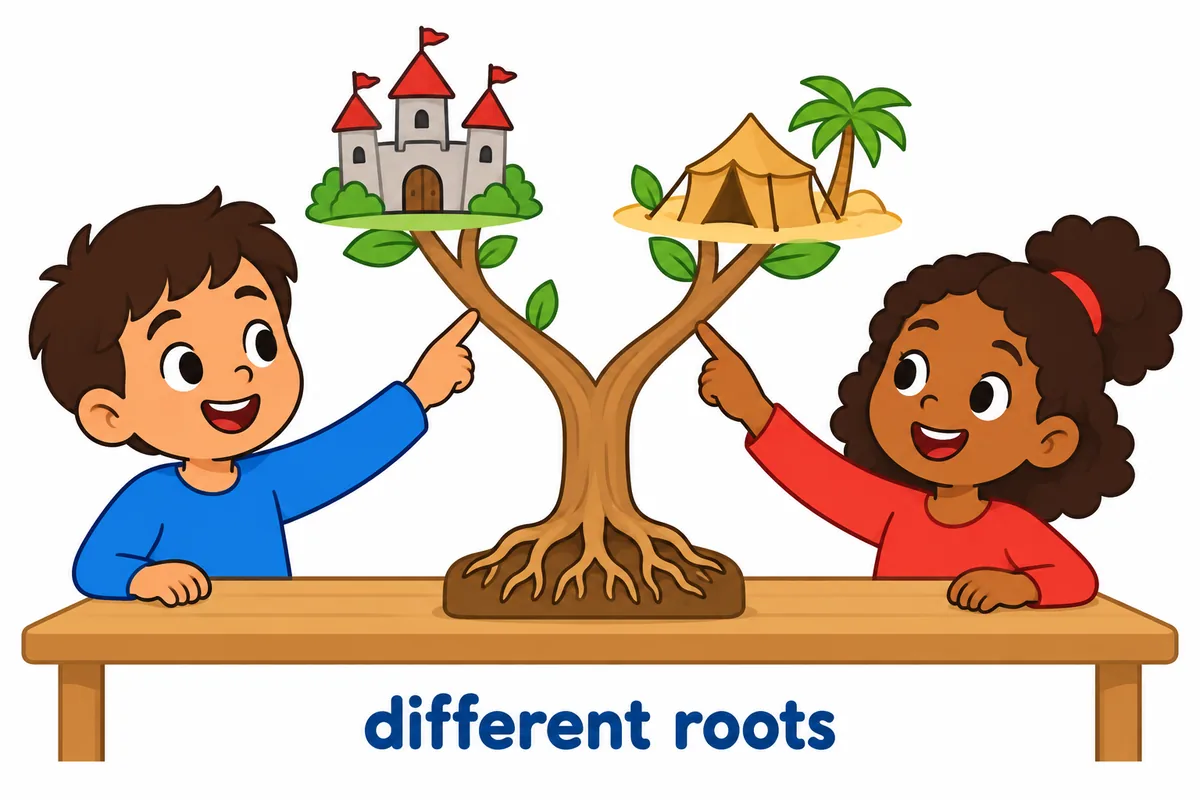
Yiddish is a Germanic language that grew among Ashkenazi Jews in Central and Eastern Europe, while Hebrew is a Semitic language used in Jewish liturgy and revived as the everyday speech of modern Israel. The Cambridge entry for Yiddish and the Cambridge entry for Hebrew treat them as separate languages, and that is the first point to hold: they are neighbours in culture, not branches of one tree.
| Feature | Yiddish | Hebrew |
|---|---|---|
| Language family | Indo-European, Germanic | Afro-Asiatic, Semitic |
| Closest relative | German, with Hebrew and Slavic words mixed in | Arabic and Aramaic |
| Main use today | Home and community life in some Haredi and diaspora groups | Daily life in Israel and prayer worldwide |
| Written form | Hebrew alphabet, right to left | Hebrew alphabet, right to left |
| Best known for | Proverbs, humour and theatre | Scripture, prayer and modern statehood |
Neither language is a dialect of the other, and neither is a version of German. Yiddish borrows Hebrew words for religious life, and Israeli Hebrew borrows an English jargon for technology, but the core grammars remain far apart.
The shared script explains most of the confusion. A reader who sees Hebrew letters on a page may assume the text is Hebrew, yet the same letters spell Yiddish words, and the giveaway is the language of the surrounding sentence rather than the look of the letters.
Yiddish vs Hebrew: master comparison
The decision table below weighs the two languages on the criteria that matter most to a writer, with a firm value in every cell.
| Criterion | Yiddish | Hebrew |
|---|---|---|
| Origin | Medieval Rhineland, spread across Eastern Europe | Ancient Canaan, continuously used in writing |
| Script | Hebrew alphabet, adapted to German sounds | Hebrew alphabet, the original square script |
| Direction | Right to left | Right to left |
| Speech community | Ashkenazi and some Haredi communities | About nine million speakers in Israel and abroad |
| Official status | No official state status | Official language of the State of Israel |
| Register range | Everyday, folk and literary | Everyday, liturgical and academic |
| Mutual understanding | Not mutually intelligible; a speaker of one does not automatically understand the other | |
Both languages share the Hebrew script, and the shared alphabet is the single feature that makes them look alike to a reader who knows neither. Everything below the surface, from vocabulary to word order, is different. A writer who needs one line about a Jewish language should name the community or the setting, because that detail decides the term.
Which should you use?
Match the language to the situation, and the choice is usually clear.
| Situation | Use | Reason |
|---|---|---|
| Writing a prayer or a blessing | Hebrew | The liturgy is in Hebrew. |
| Quoting a proverb or a joke from Eastern Europe | Yiddish | That tradition is Yiddish. |
| Everyday conversation in Tel Aviv | Hebrew | It is the language of the street. |
| Describing home life in a Haredi community | Yiddish | Many families use it at home. |
| Studying scripture or a classic text | Hebrew | The source text is Hebrew. |
When a sentence names both, keep them as separate nouns rather than blending them into one idea. If two situations appear together, name the setting first and the language second.
How do you use Yiddish and Hebrew in a sentence?
Both words work as nouns for the language and as adjectives before another noun. Neither takes a plural when it names the language itself.
| Pattern | Example | What it signals |
|---|---|---|
| Yiddish / Hebrew as a noun | Hebrew is the language of Israel. | Names the language itself. |
| Yiddish / Hebrew as an adjective | She hummed a Yiddish song. | Describes something belonging to the language. |
| in + Yiddish / Hebrew | He answered in Hebrew. | Names the language of an act. |
| speak, read or write + language | They read Yiddish every evening. | Common verbs for language skill. |
| translate into + language | The poem was translated into Yiddish. | Names the target language. |
The words never take an article before them when they name a language, so you write Hebrew is ancient, not the Hebrew is ancient.
Yiddish and Hebrew in context: examples
The examples below move from a family table to a news page, and each one keeps the two languages apart rather than treating them as one tradition.
| Context | Example sentence | Why this works |
|---|---|---|
| Classroom | Our teacher explained that Hebrew is Semitic and Yiddish is Germanic. | States the core contrast plainly. |
| Family history | My grandmother wrote letters in Yiddish to relatives in Warsaw. | Places Yiddish in its everyday setting. |
| Travel | In Jerusalem you hear Hebrew on the bus and English in the market. | Uses Hebrew as the local speech. |
| Religion | The congregation prayed in Hebrew while the sermon was in Yiddish. | Shows the two registers side by side. |
| Literature | Yiddish writers shaped a modern literature in the nineteenth century. | Names a literary tradition accurately. |
| News report | Hebrew is the official language of Israel and Arabic has special status. | Gives a formal, factual statement. |
| Technology | Israeli teams mix Hebrew with an English jargon of their own. | Shows borrowing in modern Hebrew. |
| Language study | Learners of Yiddish must first master the Hebrew alphabet. | Links the script to the study of both. |
| Food and culture | A Yiddish proverb often lands better than a translation. | Keeps the folk register intact. |
| Academic writing | The study compared Hebrew and Yiddish newspapers from the same decade. | Treats both as objects of research. |
The examples also show that Yiddish tends to appear in the past or in folk settings, while Hebrew covers both ancient texts and present-day street life.
Word forms and grammar of Yiddish and Hebrew
Both names behave as uncountable nouns for the language and as adjectives before another noun.
| Form | Part of speech | Example |
|---|---|---|
| Yiddish | noun, the language | Yiddish is still spoken in some homes. |
| Yiddish | adjective | They staged a Yiddish play. |
| Hebrew | noun, the language | Hebrew is the language of Israel. |
| Hebrew | adjective | She studied the Hebrew alphabet. |
| Hebrews | noun, the ancient people | The Hebrews left Egypt in the biblical account. |
| Hebrew, Yiddish | capitalisation rule | Language names are always capitalised in English. |
The plural Hebrews names a people and never the language, so Hebrew has no plural when it means the language. Yiddish has no plural form at all, and the adjective does not change to match a noun. Neither name changes when it follows a preposition, so in Yiddish and in Hebrew keep the same form.
Common mistakes with Yiddish and Hebrew
- Incorrect:
Yiddish is written in the Latin alphabet.Correct: Yiddish is written in the Hebrew alphabet. Rule: both languages use the Hebrew script. - Incorrect:
Hebrew is a dialect of Yiddish.Correct: Hebrew is a Semitic language, while Yiddish is Germanic. Rule: the two belong to unrelated families. - Incorrect:
She speaks yiddish at home.Correct: She speaks Yiddish at home. Rule: language names are capitalised. - Incorrect:
Yiddish came from Arabic.Correct: Yiddish developed from German with Hebrew and Slavic borrowings. Rule: the base of Yiddish is Germanic. - Incorrect:
The Hebrew is an easy language to learn.Correct: Hebrew is an easy language to learn. Rule: a language name as a noun takes no article. - Incorrect:
He translated the letter to Hebrew.Correct: He translated the letter into Hebrew. Rule: translate takes into, not to.
Practice using Yiddish and Hebrew
Complete the six items, then check the reason beside each answer.
- Fill the gap: The prayer was recited in ______, the language of the liturgy.
- Choose the better word: My great-grandparents spoke (Yiddish / Hebrew) at home in Poland.
- Correct the error: Yiddish uses the Latin alphabet.
- Build a sentence: use in Hebrew about a blessing said at a family meal.
- Spot the register: which belongs in an academic article — the study compares Hebrew and Yiddish newspapers, or Hebrew and Yiddish are kind of the same thing?
- Explain the shared feature: name the one thing the two languages have in common.
Answers
- Hebrew — the liturgy is in Hebrew, not Yiddish.
- Yiddish — it was the everyday language of Ashkenazi homes.
- Yiddish uses the Hebrew alphabet — the script is shared with Hebrew.
- Model answer: Grandpa said the blessing in Hebrew before the meal.
- The study compares Hebrew and Yiddish newspapers — an academic article avoids kind of and the false claim of sameness.
- They share the Hebrew alphabet and write from right to left.
The bottom line
Choose Hebrew for prayer, scripture and the everyday life of modern Israel, and choose Yiddish for the folk language of Ashkenazi Europe and its living communities. The two points that decide most sentences about yiddish vs hebrew are that they belong to different language families, and that the shared Hebrew alphabet hides how little they have in common below the surface. Where a community used both, Hebrew served prayer and Yiddish served the kitchen table.
Frequently asked questions about Yiddish vs Hebrew
Are Yiddish and Hebrew mutually intelligible?
No. A speaker of one cannot understand the other without study, because the two languages come from unrelated families. Yiddish is Germanic, so its grammar and common words sit close to German, while Hebrew is Semitic and shares its structure with Arabic. Only the shared script gives a false impression of closeness.
Which language is older, Yiddish or Hebrew?
Hebrew is far older. It has been written for more than two thousand years and was revived as a spoken language in the modern era. Yiddish emerged in the medieval period from German and other local languages. Hebrew is therefore the older written tradition by a wide margin.
Is Yiddish a dialect of German?
No. Yiddish began with German dialects but added Hebrew, Aramaic and Slavic elements and developed its own literature and grammar. German speakers catch some words but cannot follow a conversation. Calling it a dialect understates a language with centuries of writing and its own script.
Do Yiddish and Hebrew use the same alphabet?
Yes, both are written in the Hebrew alphabet, from right to left. Yiddish adapts some letters to spell vowels that Hebrew does not mark the same way, but the base letters are shared. That common script is the main reason the two languages look alike on the page.