Yike vs yikes comes down to one fact: yikes is the established interjection for surprise, alarm or dismay, while yike is a rare singular form that most editors avoid. Use yikes in speech and writing alike, and treat yike as a clipped or deliberate variant. The plural wins in almost every sentence.
Yike vs yikes at a glance
- Yikes is the standard interjection; yike is a rare singular that dictionaries list but everyday writers avoid.
- Both express surprise, alarm or dismay, and both sit outside formal writing.
- Yikes works as a whole exclamation, so it never takes a plural or an article.
- The only safe place for yike is deliberate dialect, a joke, or a character’s voice.
- The commonest error is using yike where yikes is expected, which readers read as a typo.
Yike vs yikes: the master comparison
The two forms differ in almost nothing except standardness. Both mark the same flash of alarm, but yikes is the form readers expect and yike is the marked variant that draws attention to itself. The table weighs the criteria that decide real sentences.
| Criterion | yike | yikes |
|---|---|---|
| Standardness | Rare; listed but uncommon | The established, expected form |
| Number | Singular | Plural, used as one fixed exclamation |
| Part of speech | Interjection, rarely | Interjection |
| Typical context | Dialect, deliberate singular, or a slip | Speech, chat and informal writing |
| Register | Marked and very informal | Informal but fully natural |
| Effect on the reader | Notices the odd form, not the alarm | Reads the alarm without a pause |
The decision rule is simple: if the form should be invisible, choose yikes. A writer reaches for yike only when the unexpected singular is the point. Where the feeling is closer to plain fright, fear and dread are the words for it, and neither is an interjection.
A useful check is to read the sentence aloud: if the word sounds like a stumble, the reader has met the singular where the plural belonged. In edited prose the plural form has effectively replaced the singular everywhere except in writing that deliberately quotes a dialect or a private joke, so the safe default stays yikes in every ordinary sentence.
What do yike and yikes mean?
Yikes is an interjection expressing surprise, alarm or dismay, and yike is a rare singular variant of the same exclamation. The Cambridge entry for yikes records the standard form, and the entry for yike records the much rarer one beside it. Both name a sudden reaction rather than an object or an action.
| Form | Plain meaning | Example sentence |
|---|---|---|
| yikes | Alarm or dismay at something sudden | Yikes, the ladder is wobbling. |
| yikes | Surprise at an unexpected sight | Yikes, you cut your hair. |
| yikes | A sympathetic wince | Yikes, that graze looks painful. |
| yike | The same alarm in a rare singular form | Yike, that price is steep. |
One limitation is worth stating. Yikes is an exclamation, so it cannot be used as a countable noun: a writer cannot have a yikes or count yikeses. Where a sentence needs a noun, an exclamation of shock or a cry of surprise does the work, and the interjection stays in the quotation marks.
How do you use yikes in a sentence?
Yikes is an interjection, so it stands apart from the grammar of the sentence that follows. It usually opens the sentence and takes a comma, and it never changes form. The table shows the shapes that occur most often in real writing.
| Pattern | Example | What it signals |
|---|---|---|
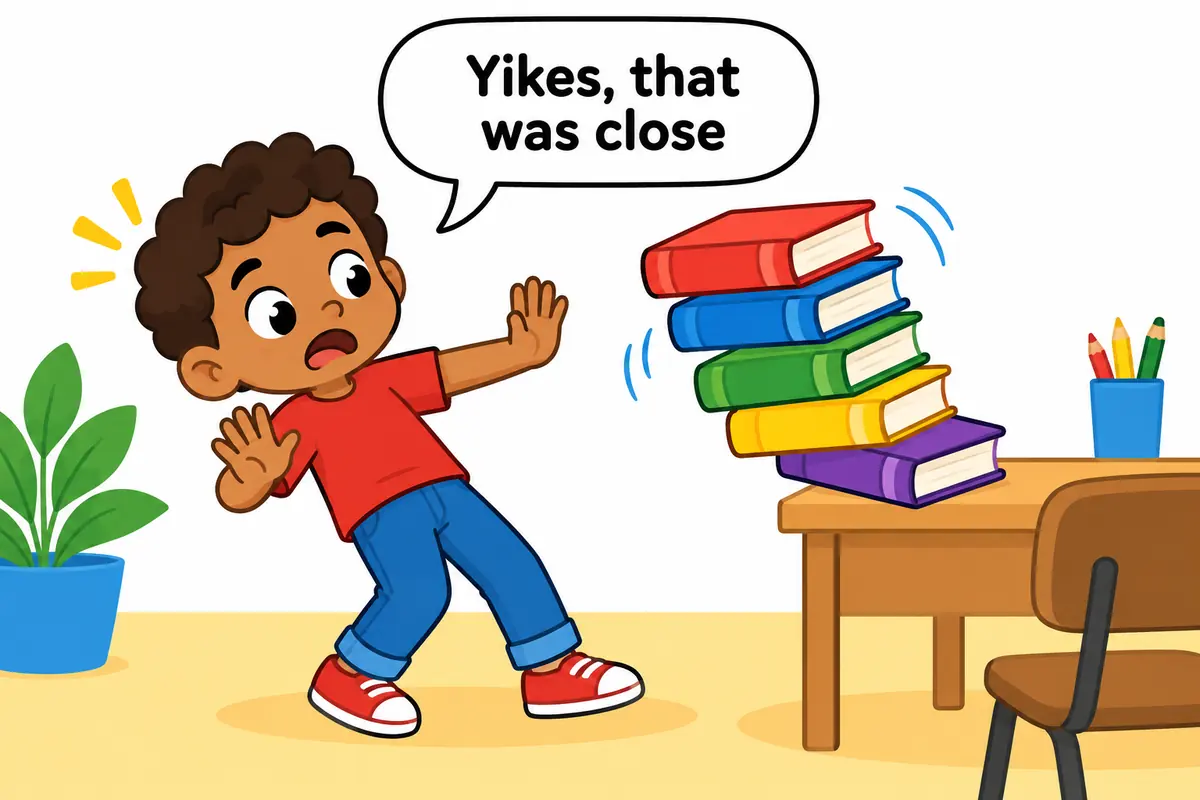
| yikes + comma + comment | Yikes, that was close. | The standard shape; the reaction comes first. |
| yikes on its own | Yikes. | A complete reaction with nothing added. |
| yikes + exclamation mark | Yikes! Look at that queue. | Adds force; keep it rare in careful writing. |
| say or think + yikes | She said yikes and stepped back. | Reports the reaction rather than performing it. |
| yike + comma + comment | Yike, that is a lot of work. | Deliberate singular; marked and unusual. |
Because yikes is a reaction word, it sits beside the other short exclamations rather than replacing them. Surprise and wonder cover the neutral end, while yikes leans toward alarm and a wince.
Yikes in a sentence: examples across contexts
Yikes moves between speech and informal writing, but it stays outside formal prose. The nine sentences below keep the same interjection while the setting changes from a group chat to a quoted line of dialogue.
| Context | Example sentence | Why this works |
|---|---|---|
| Classroom | Yikes, the model volcano is smoking already. | A sudden sight suits a spoken reaction. |
| Group chat | Yikes, that bill is much higher than last month. | Informal writing keeps the reaction natural. |
| Quoted dialogue | “Yikes,” she whispered, “that was close.” | Quotation marks let a formal text carry the interjection. |
| Sports report | Yikes, the keeper let a simple shot slip through. | Commentary tolerates the informal reaction. |
| Personal email | Yikes, I nearly missed the deadline. | A friendly note can use it freely. |
| Book review | The plot turns on one yikes moment after another. | The word can modify a noun in informal criticism. |
| Safety poster | Yikes, that cable is live. | A short alarm grabs attention fast. |
| Podcast script | Yikes, we are already out of time. | Spoken media mirrors conversation. |
| Diary entry | Yikes, the exam is tomorrow. | Private writing needs no formality. |
Notice that every row keeps the reaction short. A sentence that explains the alarm tends to use alarm and concern instead, because the interjection performs the feeling rather than describing it.
Which should you use?
Match the form to the job. Most readers want the invisible, standard option, and only a few situations call for the marked singular.
| Situation | Use | Why |
|---|---|---|
| A surprise in a text or chat | yikes | It is the form readers expect and read without a pause. |
| A quoted line in an essay | yikes | Dialogue uses the standard interjection. |
| A joke built on an odd singular | yike | The unexpected form is the point of the joke. |
| A dialect character in fiction | yike | The marked form signals the character’s voice. |
| Everything else | yikes | The plural is the safe default in every informal setting. |
The recommendation is firm: choose yikes unless you can name a reason for the singular. Where another exclamation fits better, wow for surprise is warmer and less alarmed than yikes, and gasp for a sharp intake of breath is more physical.
Word forms and grammar of yike and yikes
Neither form inflects, and neither becomes a noun. The table lists what each form is, and the invented shapes learners sometimes try.
| Form | Part of speech | Example |
|---|---|---|
| yikes | interjection | Yikes, the train is late again. |
| yike | interjection, rare singular | Yike, that is a long queue. |
| yikes | attributive in informal prose | It was a yikes moment for the team. |
| yikeses | non-standard plural | Marked wrong: the exclamation has no plural. |
| yikes’s | non-standard possessive | Marked wrong: an interjection takes no possessive. |
The attributive use is the one exception, and it stays informal: a yikes moment, a yikes price. Keep the standard form for reactions and the rare singular for deliberate effect. A close cousin, oh as a mild reaction, shows how many small exclamations behave the same way.
Common mistakes with yike and yikes
- Incorrect:
Yike, that was a huge spider.Correct: Yikes, that was a huge spider. Rule: The standard interjection is the plural form yikes. - Incorrect:
She said yikes that the train was late.Correct: She said yikes when the train was late. Rule: Yikes is an exclamation, not a subordinator; use when to join the clause. - Incorrect:
He gave a yike of surprise.Correct: He gave a cry of surprise. Rule: The interjection does not become a countable noun. - Incorrect:
The yikeses grew louder.Correct: The cries of alarm grew louder. Rule: An interjection has no plural form. - Incorrect:
Yikes’s meaning is alarm.Correct: The meaning of yikes is alarm. Rule: Interjections do not take a possessive apostrophe.
Practice choosing yike or yikes
Work through the seven items, then check the reasoning rather than only the answer.
- Fill the gap: ______, the ladder is wobbling.
- Choose the better word: (Yike / Yikes), that soup is far too hot.
- Correct the error: Yike, we are going to be late.
- Build a sentence: use yikes about an unexpected bill.
- Spot the register: which fits a chat message — Yikes, that is steep, or Yike, that is steep?
- Rewrite formally: replace the interjection in “Yikes, the costs doubled.”
- Explain the choice: why might a novelist write yike for one character only?
Answers
- Yikes — the standard plural form opens the reaction.
- Yikes — the everyday interjection is plural, so the singular would read as a slip.
- Yikes, we are going to be late — editors expect the standard form.
- Model answer: Yikes, the repair bill is three times what I expected.
- Yikes, that is steep — a chat message uses the natural plural form.
- The costs doubled, which is alarming — formal prose describes the feeling instead.
- The marked singular signals that one character’s voice differs from the rest — a deliberate choice.
The bottom line
The choice in yike vs yikes is settled by standardness, not meaning: both mark a flash of alarm, but yikes is the form readers expect and yike is the marked singular that draws attention to the word itself. Use yikes in speech, chat and quoted dialogue, and save yike for dialect, jokes or a character’s voice. The two details that decide most sentences are that yikes never inflects and that it cannot become a countable noun, so a cry of alarm is the formal alternative when a noun is needed.
Frequently asked questions about yike and yikes
Is yike a real word?
Dictionaries list yike, so it is a real word, but it is rare and not the everyday form. In practice most uses are either a deliberate singular or a slip for yikes. A careful writer treats yike as marked, because readers notice the unusual spelling before they register the alarm.
Is yikes slang?
Yikes is informal rather than slang in the narrow sense, because it appears in edited newspapers, magazines and fiction. It belongs to spoken and conversational registers, so a formal report would avoid it. In quoted dialogue or commentary, however, it is entirely acceptable.
Can yikes appear in formal writing?
Only inside quotation marks or in reported speech. A formal report would describe the feeling instead, as in the figures were alarming. Outside quotation, yikes breaks the tone of a report, a legal document or an academic paper, even though the word itself is well established.
What feelings does yikes express?
Yikes expresses surprise, alarm or dismay, and it often adds a sympathetic wince. The exact feeling depends on the sentence that follows: a wobbling ladder signals alarm, a painful graze signals sympathy, and an unexpected bill signals dismay. The interjection performs the reaction rather than naming it.