Yore vs olden days is a choice between a fixed literary noun and a warm nostalgic phrase: use of yore in deliberate, formal or playful writing, and the olden days in ordinary reminiscing. Yore cannot stand alone, while olden days needs its noun days.
Yore vs olden days at a glance
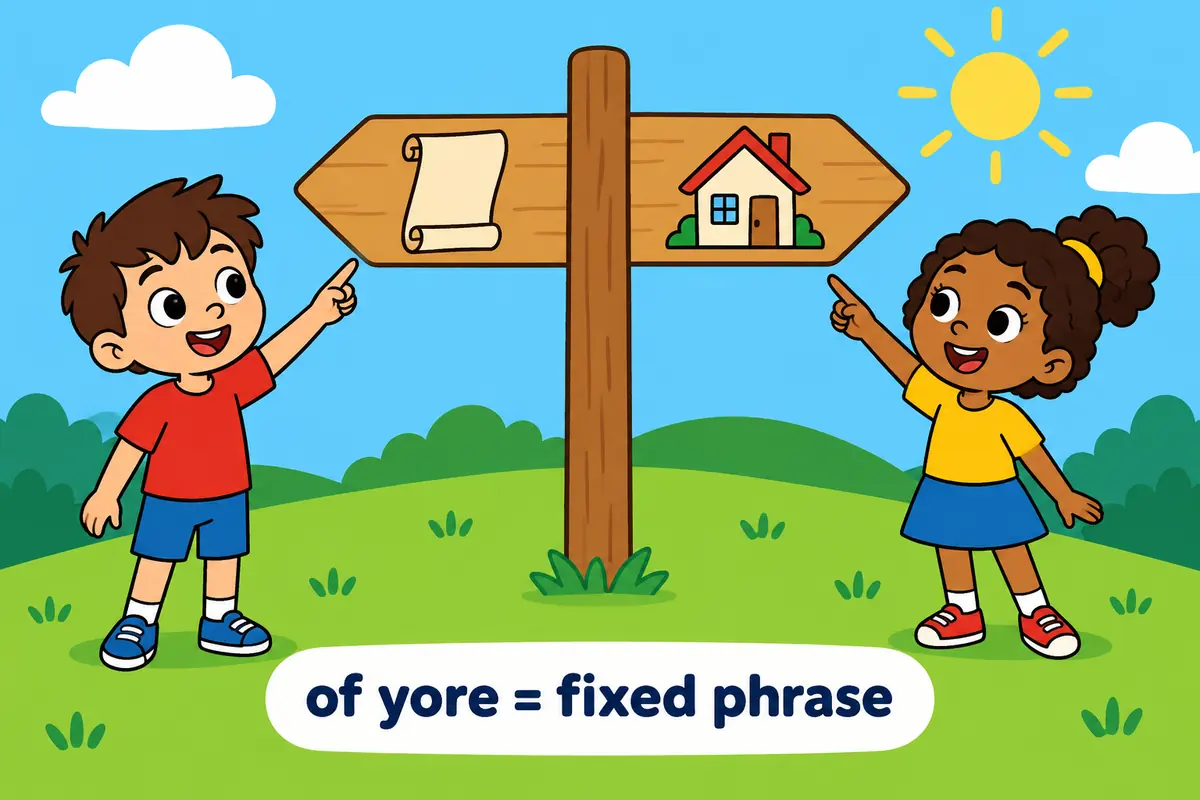
- Yore is a noun for time long past, and it lives almost only in the phrase of yore.
- Olden days is a noun phrase built on the adjective olden, meaning days long ago.
- Yore is literary and archaic in tone; olden days is conversational and nostalgic.
- Neither term gives a date or a century; both point to a vague, fondly remembered past.
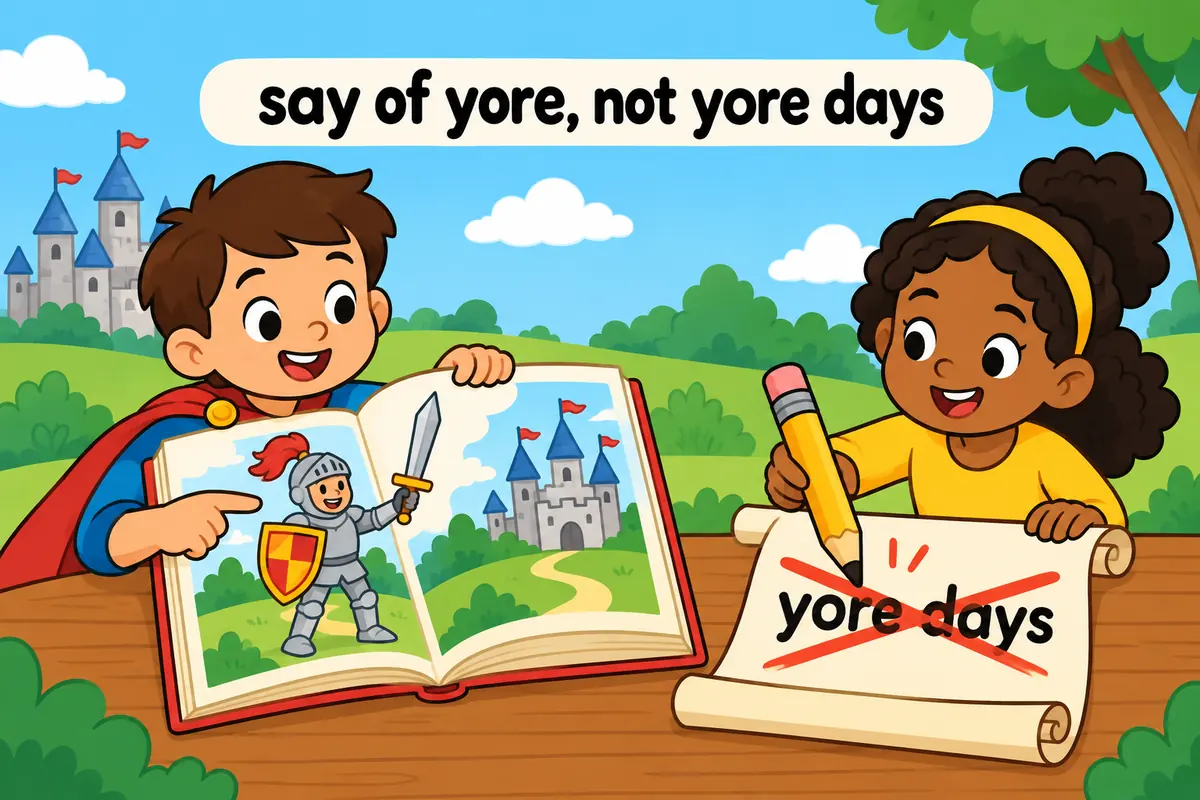
- The commonest error is treating yore as an adjective, as in yore days, which is not standard English.
Yore vs olden days: the master comparison
The table sets the two terms against the criteria that decide which one a sentence can carry.
| Criterion | Yore | Olden days |
|---|---|---|
| Part of speech | Noun, used after of | Noun phrase with the adjective olden |
| Core meaning | Time long past, told in story and verse | A past era remembered with fondness |
| Fixed form | Almost always of yore | Usually the olden days |
| Register | Literary, archaic, sometimes humorous | Conversational, warm, gently nostalgic |
| Typical setting | Historical fiction, poetry, ceremonial speech | Family talk, memoirs, light features |
| Connotation | Romantic and legendary | Simple, safe and personal |
| Sentence slot | After of: days of yore | After the: in the olden days |
| What it cannot do | Modify a noun before it: yore days | Stand alone: the olden is not English |
What does yore mean?
Yore is a noun meaning time long past, the era of legend and story. The Cambridge entry for yore notes that it survives in the phrase of yore, and that phrase is where nearly every modern use belongs. The dedicated page on yore shows the same narrow range, because the word is a fossil: it keeps its place only in that set expression. It names the distant past, which antiquity names more soberly and yesteryear names in a softer, single-word literary way.
One honest limit: yore carries no information. It does not say which century or which country, and it never appears as an adjective before a noun. Days of yore is correct; yore days is not, and a learner who bends the phrase shows at once that the word has been misread as a modifier.
What does olden days mean?
Olden days is a noun phrase meaning a time long ago, especially one remembered with affection. Its adjective is olden, which the Cambridge entry for olden days records only in set phrases such as olden days and olden times. The adjective olden cannot stand alone as a predicate: a speaker says in the olden days, never the olden was simple. The warmth is the point, so olden days often pairs with the feeling of nostalgia, a fond looking back rather than a historical claim.
One honest limit: olden days idealises. It rarely describes hardship and usually frames the past as gentler, which is why historians avoid it in serious work. For a neutral past, the noun past or the adverb formerly is safer, and for a single clear time reference a date is better than either phrase.
Yore vs olden days in a sentence: examples across contexts
The rows below show where each term sits comfortably, and what happens when a writer reaches for the wrong one.
| Context | Example sentence | Why this works |
|---|---|---|
| Historical fiction | Knights of yore rode out at dawn. | The literary register suits the romance of the scene. |
| Poetry | She sang of the heroes of yore. | The fixed phrase gives the line a formal, old-fashioned ring. |
| Ceremonial speech | We honour the customs of yore. | Public formality licenses the archaic noun. |
| Family talk | In the olden days we walked to school barefoot. | Conversational nostalgia is the phrase’s home. |
| Memoir | The olden days looked simpler from a kitchen window. | The soft, personal register fits a recollection. |
| Light feature | Readers shared photos of the olden days. | Journalistic nostalgia for a general audience. |
| Humour | Back in the days of yore, we had one channel and no remote. | The grand phrase played against a mundane detail. |
| School essay | Grandparents describe the olden days without screens. | Plain, warm language for a simple comparison. |
| Contrast | A bygone era is remembered as the olden days, while legend turns it into yore. | The sentence shows how memory and myth differ. |
| Wrong use | In yore days, people wrote letters. | Marked as incorrect because yore cannot modify days. |
The last row is the trap. To talk about the past in general terms, bygone works as an adjective before a noun, and long ago works as a plain time phrase. Yore and olden stay inside their fixed shapes.
Which should you use?
The decision is quick once the setting is clear. Match the situation to the row below and take the recommendation as firm.
| Situation | Use | Why |
|---|---|---|
| A novel, poem or speech with a deliberately old tone | of yore | The archaic noun creates the atmosphere you want. |
| A light joke about a grand, distant past | of yore | The overblown phrase is funny beside a small modern detail. |
| Reminiscing with family or friends | the olden days | The phrase is warm, plain and widely understood. |
| A neutral, factual account of the past | Neither | Use a date, the past or formerly to avoid romantic colour. |
| Describing a past era as an adjective | bygone | Bygone modifies a noun, which yore can never do. |
The main verdict bears repeating: for a literary or playful past, choose yore inside of yore; for ordinary nostalgic talk, choose the olden days. When accuracy matters more than mood, set both aside.
Word forms and grammar of yore and olden days
| Form | Part of speech | Example |
|---|---|---|
| yore | noun | The tales of yore were retold each winter. |
| of yore | fixed prepositional phrase | Travellers of yore crossed on foot. |
| olden | adjective, attributive only | Olden customs survive in the village. |
| olden days | noun phrase | The olden days seem far away now. |
| olden times | noun phrase | In olden times the road was a track. |
| yore days | non-standard | Incorrect: yore cannot modify a noun. |
Both terms are fixed, so the grammar is a matter of slots: yore follows of, and olden precedes days or times. Neither one inflects.
Common mistakes with yore and olden days
- Incorrect:
In yore days, letters took a week.Correct: In bygone days, letters took a week. Yore is a noun and cannot modify days; bygone is the adjective that can. - Incorrect:
The olden was peaceful.Correct: The olden days were peaceful. Olden is attributive, so it needs days or times after it. - Incorrect:
He recalled the yore with fondness.Correct: He recalled the past with fondness. Yore does not take the definite article alone; keep it in of yore or switch to the past. - Incorrect:
Days of olden were slower.Correct: Days of old were slower. The phrase is of old, not of olden, when no noun follows. - Incorrect:
The olden days were better, historically speaking.Correct: The olden days are remembered fondly, though the claim is hard to test. The phrase signals nostalgia, not evidence.
Practice using yore and olden days
Decide first whether the sentence needs the fixed noun of yore or the warm phrase the olden days, then check your choice.
- Fill in the blank: The storyteller spoke of dragons and kings of ______.
- Choose the better phrase: In (the olden days / yore days), families mended clothes instead of replacing them.
- Correct the error: The olden was full of songs.
- Build a sentence: describe villagers long ago telling stories in winter, using of yore.
- Spot the register: Which sentence suits a poem, and which a coffee-shop chat? (a) The banners of yore still flew in memory. (b) In the olden days we had no phones.
- Fill in the blank: The adjective that can modify days to mean long ago is ______.
- Choose the better phrase: For a neutral history essay, write about (the olden days / the nineteenth century).
Answers
- Yore. The fixed phrase of yore follows the preposition and names the legendary past.
- The olden days. Yore cannot modify days, and the sentence is everyday nostalgia.
- The olden was full of songs is wrong; write The olden days were full of songs. Olden needs a noun such as days.
- A model answer: The villagers of yore told stories through the long winter nights.
- (a) suits a poem, where the literary phrase sets the tone; (b) suits a coffee-shop chat, where plain, warm language fits.
- Olden. It is attributive and appears in olden days or olden times.
- The nineteenth century. A date keeps the essay factual, while the olden days adds nostalgic colour.
The bottom line
Yore vs olden days comes down to tone: of yore is literary, archaic and often playful, while the olden days is warm, plain and nostalgic. Keep yore inside its fixed phrase and remember that olden needs a noun such as days or times beside it. Neither phrase gives a date, so for factual writing a century or the plain noun past is the honest choice. Match the mood, then let the fixed form of each expression guide the sentence.
Frequently asked questions about yore and olden days
Is yore still used today?
Yore survives chiefly in the phrase of yore, where it appears in poetry, historical fiction and ceremonial speech, and sometimes in humour. It is not part of everyday conversation and is never used as an adjective. A writer who keeps it inside that fixed phrase will sound deliberate rather than mistaken.
Can olden be used without days?
Olden can appear with times as well as days, so olden times is fine. It cannot stand alone, so the olden and the olden was are both errors. The adjective is attributive, which means it must sit before a noun. For the distant past as a standalone phrase, use the past or days gone by instead.
What is a synonym for olden days?
Yesteryear is the closest single-word literary synonym, and bygone era is the closest phrase. Days gone by and the past are plainer options that keep the meaning without the nostalgic colour. Choose yesteryear for a formal, slightly wistful tone and the past when you want no emotional shading at all.
Why does yore only appear in of yore?
Yore is a fossil word: outside the set phrase of yore, modern English has dropped it, so it no longer builds new combinations. That is why yore days and the yore sound wrong, while days of yore sounds natural. Fixed expressions like this keep a single pattern long after the rest of the word’s uses have disappeared.