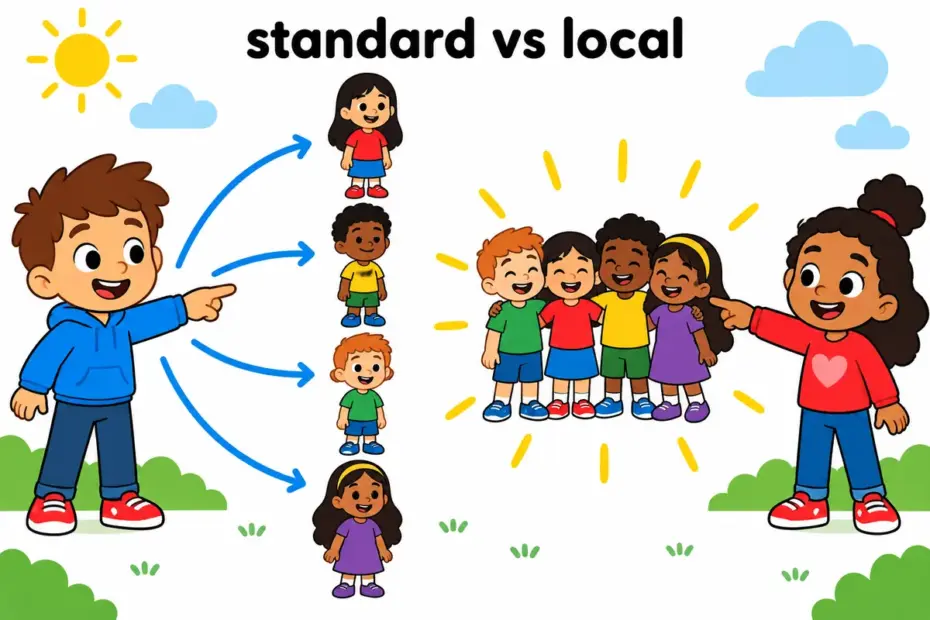
You vs youse comes down to one rule: use you in all standard English and reserve youse for informal speech in certain regional dialects. You is the neutral pronoun every reader accepts, while youse is a non-standard plural you marked local. Write you in essays, emails and exams, and keep youse for friendly dialogue.
You vs youse at a glance
- You is the standard second-person pronoun, and it serves both one person and a group.
- Youse is a non-standard, informal plural form of you found in some regional dialects.
- Standard writing uses you for every number and never marks the plural.
- Youse appears mostly in speech, in dialogue and in messages meant to sound local.
- The commonest error is writing youse in formal prose because the plural feels missing.
You vs youse: the core difference
The contrast is not one of meaning but of status. Both words address the people in front of you; they differ in whether the form belongs to standard English or to a local, informal variety.
| Feature | you | youse |
|---|---|---|
| Status | Standard English | Non-standard and regional |
| Number | Singular and plural | Plural only |
| Register | Neutral in every context | Informal speech and dialogue |
| Reach | Understood everywhere | Local; may puzzle outsiders |
| Best writing | Essays, emails, exams, contracts | Reported speech and casual notes |
| Grammar | Same form for subject and object | Mainly subject; possessive is rare |
| Safe default | Yes, in all formal work | No, unless the local voice is intended |
The practical test is simple. If the sentence must be accepted by every reader, choose you; if it must sound like a particular place and moment, youse can do that job in dialogue.
Which should you use?
Five common situations cover almost every decision, and each one has a firm answer rather than a compromise.
| Situation | Choose | Why |
|---|---|---|
| Academic essay or exam answer | you | Youse is non-standard and marked wrong in assessment. |
| Business email or report | you | The neutral form keeps a professional tone for every reader. |
| Dialogue for a regional character | youse | Signals place and social setting through speech. |
| Message to a local friend group | youse, if the group uses it | Matches the community casual voice. |
| Instructions, signs and manuals | you | The wording must be understood by everyone. |
Notice that no situation calls for youse in a document that speaks to a general audience. The form carries a local identity, and identity is exactly what formal writing tries to keep out of the way.
One further test settles borderline cases. Ask who will read the sentence and what they will do with it. A report, a contract, a rubric or a form is read by strangers who must not stumble, so it needs the standard form. A novel, a play or a personal message is read for voice, and a local form can carry information that plain you cannot. When both goals are present, keep the formal text in standard English and confine the dialect to quoted speech.
What does you mean?
You is the second-person pronoun in English, and a single form covers both one listener and several. The Cambridge entry for you and the Merriam-Webster entry for you both treat it as one pronoun with several roles, depending on where it sits in the sentence.
| Role | Form | Example |
|---|---|---|
| Subject | you | You are all welcome. |
| Object | you | The invitation is for you. |
| Possessive determiner | your | Bring your notes. |
| Possessive pronoun | yours | The choice is yours. |
| Reflexive | yourself, yourselves | Help yourselves to tea. |
One historical fact explains the whole debate. English once had a separate singular thou and a plural ye, and over time you replaced both, leaving one form for every number. Because that leaves no way to mark a group, several regions built a new plural, and youse is one of those repairs.
Two consequences follow for learners. Because you is numberless, a sentence such as you are all welcome is already unambiguous to a standard reader, so adding a plural form is never required. The missing plural also gets filled differently from place to place, so youse competes not with one rival but with several, among them y’all in the American South, you lot in much of Britain and you guys in many cities. Standard English leaves the pronoun untouched and lets context, or an added word such as all, carry the number.
What does youse mean?
Youse is a non-standard plural form of you used in informal speech in several regions, including parts of Ireland and Britain, Australia and New Zealand, and a few older city dialects in the United States. The Cambridge entry for youse labels it as informal, and the Merriam-Webster entry for youse treats it as a dialect form meaning you, especially as a plural.
Within those communities youse is not a mistake; it marks the speaker as belonging to the place, so it works as a regional dialect feature. It also carries a strong informal speech charge, and the regional form signals closeness rather than distance. Some writers treat it as local slang, though it is better described as a dialect pronoun. Letter variants such as yous and yiz appear in different areas, and the phrase youse guys is common in some cities, but none of these forms belongs in standard written English.

You and youse in a sentence: examples across contexts
The two forms separate cleanly by setting. Each row shows when the standard pronoun is required and when the local plural earns its place.
| Context | Example sentence | Why this works |
|---|---|---|
| Academic essay | You can see the pattern in every provincial record. | The neutral pronoun addresses the reader without marking region. |
| Business email | You will receive the revised schedule by Friday. | A single form covers one recipient or a whole team. |
| Novel dialogue | “Youse can wait outside,” the doorman said. | Marks the speaker place and class through speech. |
| Friendly message | Youse should come round for dinner on Sunday. | Matches the warm, local voice of a close group. |
| Classroom instructions | You all need a ruler for this task. | Standard forms carry the plural meaning cleanly. |
| News report | The council told residents that you must book a slot. | Formal reporting keeps the standard pronoun. |
| Play script | Youse two can take the back entrance. | A staged local accent needs the regional plural. |
| Public notice | You are asked to keep the gate closed. | Signs must be understood by every visitor. |
| Text to friends | See youse at the match on Saturday. | Casual spelling follows the spoken local form. |
| Exam answer | You should compare the two accounts carefully. | Assessment rewards the standard pronoun. |
A related choice is the plural form itself. Where American Southern English uses y’all and some other regions use you lot or you folks, youse is simply one more solution to the same missing plural, and every one of them is informal.
Common mistakes with you and youse
- Incorrect:
Youse is all invited to the formal dinner.Correct: You are all invited to the formal dinner. Rule: formal invitations take the standard pronoun, not a regional form. - Incorrect:
Youse is late again.Correct: Youse are late again, or You are late again. Rule: youse is plural, so it takes a plural verb. - Incorrect:
I will speak to youse about the report.Correct: I will speak to you about the report. Rule: workplace writing keeps the neutral object pronoun. - Incorrect:
Youse, please sign here for one person.Correct: You, please sign here, for a single person. Rule: youse is plural and cannot address one listener. - Incorrect:
Youse should be seated, ladies and gentlemen.Correct: You should be seated, ladies and gentlemen. Rule: public announcements stay in standard English.
Word forms and grammar of you and youse
The standard pronoun has a full set of forms, while the regional plural has almost none. That asymmetry is the heart of the comparison.
| Form | Part of speech | Example |
|---|---|---|
| you | pronoun, subject and object | You called, and I heard you. |
| your | possessive determiner | Your seats are near the front. |
| yours | possessive pronoun | The tickets are yours. |
| yourselves | reflexive pronoun | Help yourselves to the fruit. |
| youse | non-standard plural pronoun | Youse are welcome to stay. |
| youse, yous, yiz | non-standard spelling variants | The three spellings appear in different regions. |
Youse has no standard possessive and no standard reflexive, so a phrase such as youse own is not established in any variety. The standard pronoun you supplies all of those forms, which is one reason it remains the default in writing.
Practice choosing between you and youse
- Fill in the blank: ______ are all welcome to join the study session. (standard, whole group)
- Choose the better word: In a job application, write (you / youse) will find my references attached.
- Correct the error: Youse is the new members of the club.
- Build a sentence: write one line of dialogue in which a local speaker addresses a group using youse.
- Spot the register: which suits a school newsletter – youse should bring a packed lunch, or you should bring a packed lunch?
- Fill in the blank: In the regional dialect the plural of you is often written ______.
Answers
- You — standard English needs no separate plural form.
- you — a job application keeps the neutral, formal pronoun.
- Youse are the new members of the club — youse is plural and takes a plural verb.
- Model answer: “Youse can leave your bags by the door,” she said.
- You should bring a packed lunch — a newsletter addresses every family in standard English.
- youse — it is the common regional spelling, with yous and yiz as local variants.
The bottom line
Use you in all standard English, whether you address one person or a hundred, and treat youse as an informal regional plural that belongs in speech, dialogue and casual notes. The two facts that decide most sentences are that you needs no separate plural and that youse is plural only and takes a plural verb. Where you want local colour, youse is effective; where you need to be understood by everyone, the answer to you vs youse is always you.
Frequently asked questions about you and youse
Is youse a real word?
Youse is a real word in the sense that it is recorded and widely used in several regional dialects, and dictionaries list it as informal or dialectal. It is not standard English, so it does not belong in formal writing. Real and standard are simply two different questions.
Should you write youse in an essay?
No. Academic writing expects standard English, and youse is marked as non-standard, so an examiner will treat it as an error even though it is correct in its home dialect. Keep youse for quoted dialogue, creative writing or a casual message, and use you everywhere else.
What is the standard plural of you?
The standard plural of you is you. English uses one form for singular and plural, so you are addresses one person or a whole room. If a sentence needs to make the group explicit, standard English adds a word such as all, everyone or both rather than changing the pronoun.
Is youse singular or plural?
Youse is plural. It was created to fill the gap left when you took over both numbers, so it addresses two or more people and takes a plural verb, as in youse are. Using it for a single listener sounds wrong even in the dialects that use the form every day.