Youd vs you would is a choice of register: write you’d in casual prose and ordinary speech, and use you would in formal writing or when the sentence needs emphasis. The form youd without an apostrophe is simply a misspelling. You’d is a contraction that can also stand for you had, so context must decide.
Youd vs you would at a glance
- You’d is the contraction of you would, and also of you had.
- You would is the full form, always meaning the modal would and never had.
- Youd, with no apostrophe, is a spelling error rather than an accepted variant.
- The contraction belongs to speech, texts and fiction; the full form suits essays and reports.
- The two forms take exactly the same verb, so only register and emphasis differ.
- The commonest error is dropping the apostrophe that makes the contraction correct.
You’d vs you would: the master comparison
The verdict is simple. Use you’d when the tone is relaxed and the rhythm should be quick, and use you would when the tone is formal or you want the modal to land hard. Every other difference follows from those two pressures.
| Criterion | you’d | you would |
|---|---|---|
| Register | Casual, spoken, diary and dialogue | Formal, academic and deliberate |
| Length | One syllable, quick and light | Two words, slower and weightier |
| Emphasis | Low; the modal slips by | High; the modal is stressed |
| Possible meanings | you would or you had | you would only |
| Typical home | Texts, chat, novels, scripts | Essays, reports, letters, speeches |
| Contractions allowed | Yes, that is the whole point | Often avoided as a matter of style |
| Verb that follows | The base verb: you’d go | The base verb: you would go |
What does you’d mean?
You’d is a contraction, a single written form standing for two spoken words, and would is the modal verb it usually hides. The same clipped form can also cover you had, which is why the surrounding verb matters so much. The Cambridge entry for youd shows the contraction written with an apostrophe, and the apostrophe is the mark that replaces the missing letters.
| Written form | Expands to | Example sentence |
|---|---|---|
| you’d | you would | You’d enjoy the walk if the rain stopped. |
| you’d | you had | You’d finished before the bell rang. |
| you would | you would only | You would enjoy the walk if the rain stopped. |
| youd | nothing; it is a misspelling | Incorrect: |
One limitation is worth stating plainly. You’d is not wrong, but it is out of place in formal writing, and it is genuinely ambiguous where the next verb is the past participle. After a sentence such as you’d gone, a careful reader cannot tell whether you had gone or you would go is meant without more context.
How do you use you’d and you would in a sentence?
Both forms take the same base verb, so the grammar is identical and only the written shape changes. Four patterns cover almost every real use, and the third is the one that exposes the contraction’s ambiguity.
| Pattern | Example | What it signals |
|---|---|---|
| you’d + base verb | You’d think it was winter. | Casual you would, quick and unstressed. |
| you would + base verb | You would think it was winter. | The same meaning, fully stressed. |
| you’d + past participle | You’d seen it coming. | Here you’d means you had, not you would. |
| you’d better / rather / like | You’d better hurry. | Fixed polite formulas, always contracted. |
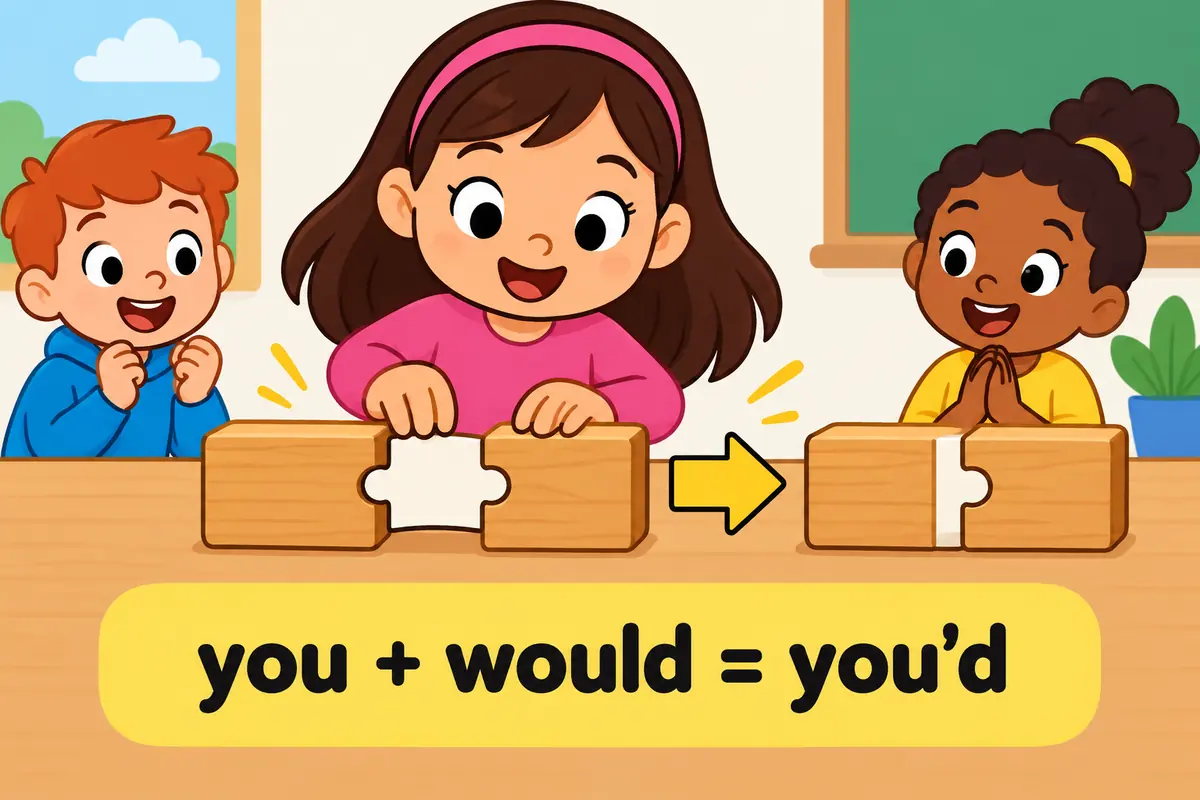
Two habits keep the forms straight in practice. First, read the sentence aloud: if you would sounds natural when the words are stretched, the contraction is safe. Second, check the verb after the contraction, because a past participle quietly changes the meaning to you had.
You’d and you would in a sentence: examples across contexts
The two forms carry identical meaning, so the examples below are grouped by how formal the setting is. Notice how often the full form appears where the writer wants the modal to be heard.
| Context | Example sentence | Why this works |
|---|---|---|
| Text message | You’d love the new bakery on the corner. | Relaxed and quick, which is what the contraction is for. |
| Fiction dialogue | You’d never guess who called. | Contractions keep speech natural on the page. |
| Friendly email | You’d be very welcome to join us on Friday. | Warm but still professional in a light register. |
| Essay | You would expect the two curves to cross here. | The full form suits a measured academic voice. |
| Formal letter | You would be entitled to a refund under clause four. | Precise and emphatic in a legal or official setting. |
| Persuasive speech | You would do the same in my position. | The stressed modal appeals directly to the listener. |
| Grammar lesson | You’d is short for you would or you had. | Names the contraction as the subject of discussion. |
| Diary entry | You’d have laughed if you had seen it. | Informal, reflective and personal. |
| Instruction sheet | You would then press the green button. | A procedural tone avoids the contraction. |
The same pattern appears with other modals, so a learner who masters one contraction can carry it across. Could becomes could’ve, and the pronoun you behaves the same way in each.
Which should you use?
Map the sentence to its reader before you choose. Formal readers forgive a contraction less easily than friends notice a stiff full form.
| Reader or situation | Write this | Why |
|---|---|---|
| Friend in a message | you’d | Matching the spoken tone reads as natural, not sloppy. |
| Academic essay | you would | Formal prose usually avoids contractions. |
| Emphatic claim | you would | The two words give the modal room to be stressed. |
| Ambiguous past perfect | you had | Spelling out had removes the you had or you would confusion. |
| Job application | you would | Signals care and formality to a stranger. |
Verdict: default to you’d in speech-like writing and you would in formal writing, and when the contraction could be misread as you had, spell the sentence out in full.
Word forms and grammar of you’d and you would
The two forms belong to one small set, and the third entry in the table is the one that causes errors. Keeping them side by side shows how little separates them.
| Form | Part of speech | Example |
|---|---|---|
| you’d | contraction of you would | You’d like the ending. |
| you’d | contraction of you had | You’d left before the storm. |
| you would | pronoun plus modal | You would like the ending. |
| you had | pronoun plus auxiliary | You had left before the storm. |
| youd | non-standard misspelling | Incorrect: |
Never move or drop the apostrophe. It sits between the u and the d, replacing the missing w and o of would, and it stays in place whatever verb follows.
Common mistakes with you’d and you would
- Incorrect:
youd better hurry.Correct: You’d better hurry. Rule: The contraction needs its apostrophe, so youd is a misspelling. - Incorrect:
you’ d rather stay.Correct: You’d rather stay. Rule: The apostrophe joins the letters; it is never a separate word. - Incorrect:
You’d have saw it coming.Correct: You’d have seen it coming. Rule: The contraction governs the verb form, which stays the past participle. - Incorrect:
In my formal report, you’d find the figures on page two.Correct: In my formal report, you would find the figures on page two. Rule: Formal writing usually avoids the contraction. - Incorrect:
You’d gone, so I waited.Correct: You had gone, so I waited. Rule: When you’d means you had, spelling it out removes the ambiguity.
Practice using you’d and you would
Work through the six items, then read the reasoning rather than only the answer.
- Fill the gap: If you asked nicely, ______ probably help.
- Choose the better form: In a formal letter, (you’d / you would) be entitled to a refund.
- Correct the error: youd better take an umbrella.
- Build a sentence: use you’d in a text message about a film.
- Spot the register: which belongs in an academic essay, you would expect the line to rise, or you’d expect it to go up?
- Remove the ambiguity: You’d left before I arrived. Rewrite it so only one meaning is possible.
Answers
- you’d — a casual conditional, so the contraction fits the spoken rhythm.
- you would — a formal letter avoids the contraction.
- You’d better take an umbrella — the apostrophe replaces the missing letters in would.
- Model answer: You’d absolutely love this film.
- You would expect the line to rise — formal prose keeps the two full words.
- You had left before I arrived — spelling out had removes the you would reading.
The bottom line
Youd vs you would comes down to one decision: use you’d for a relaxed, speech-like tone and you would for formal writing or emphasis, and never write youd without the apostrophe. The two nuances that decide most sentences are these: the contraction can also mean you had, so ambiguity sometimes demands the full form, and the modal that follows is the same base verb either way.
Frequently asked questions about youd vs you would
Is youd a real word?
No. Youd without an apostrophe is a misspelling of the contraction you’d. The only correct written forms are you’d, with the apostrophe standing in for the missing letters of would, and the full phrase you would. Spellcheckers flag youd for that reason.
Can you’d mean you had?
Yes, and that is the contraction’s hidden trap. You’d is short for both you would and you had, so the verb that follows tells you which is meant. A past participle signals had, as in you’d gone, while a base verb signals would.
Is you’d acceptable in formal writing?
It is grammatical but usually out of style. Formal essays, reports and legal letters tend to avoid contractions and write you would in full, which also lets the modal carry emphasis. Where house style permits contractions, you’d is not an error, only a more casual choice.
Where does the apostrophe go in you’d?
It goes between the u and the d, and it replaces the dropped letters of would. So you plus would becomes you’d, with one apostrophe and no space. Adding a space, as in you’ d, or leaving the mark out altogether both count as mistakes.