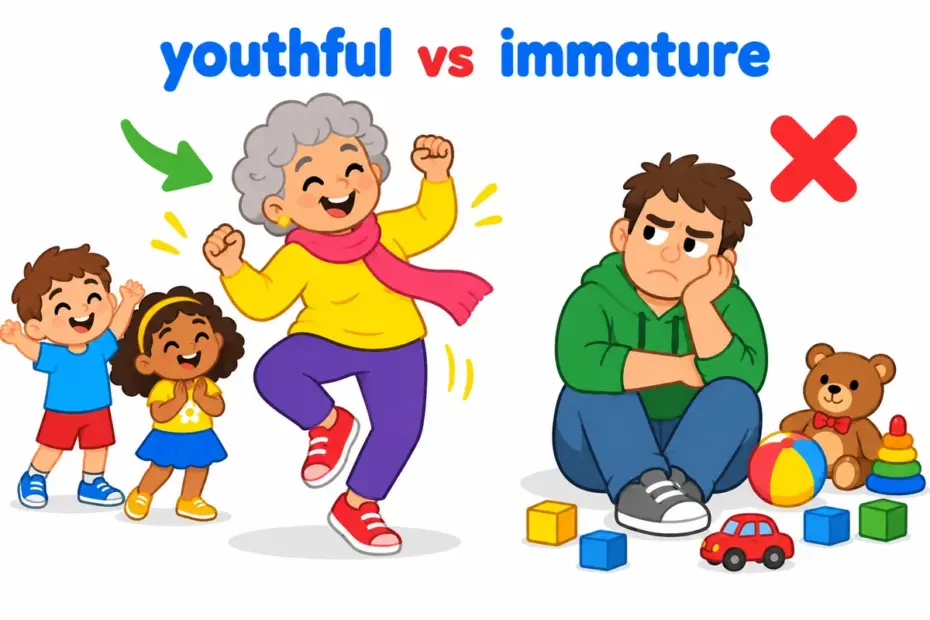
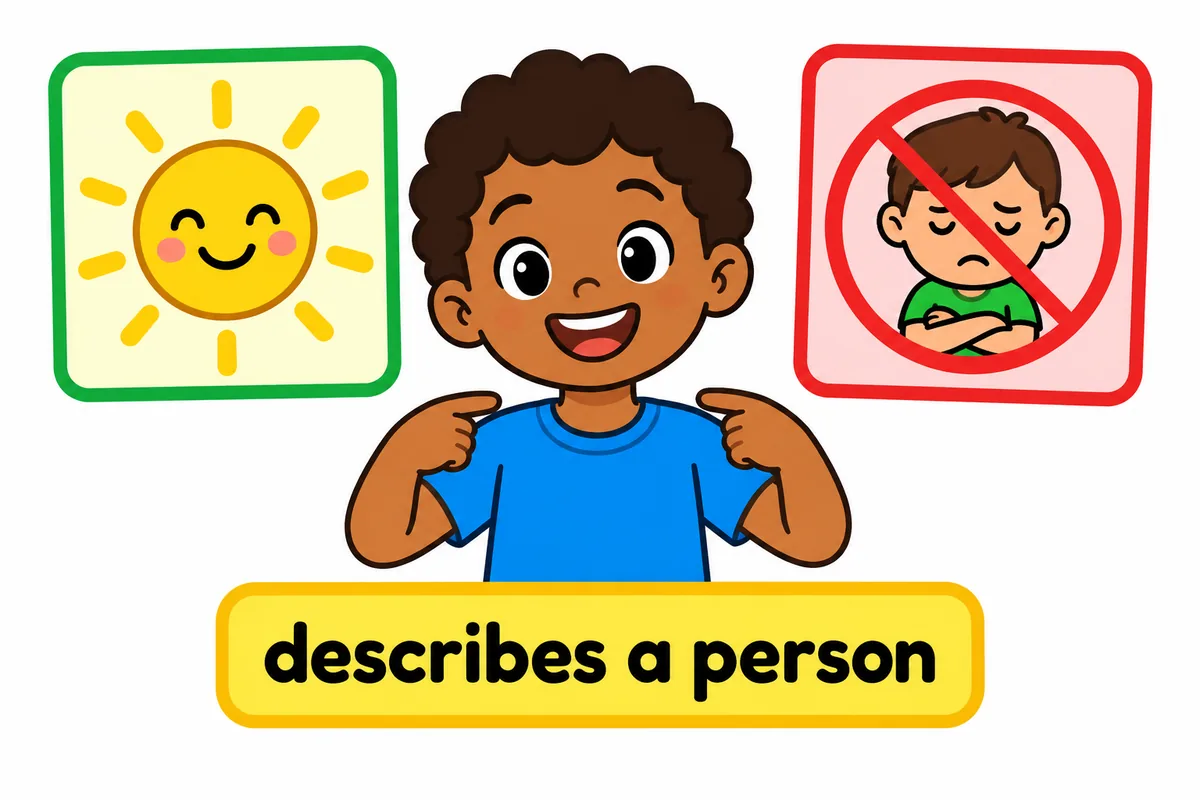
Youthful vs immature separates praise for energy from criticism of conduct: choose youthful to describe freshness and vitality, and immature to describe behaviour that has not grown up. The pair marks judgement rather than age, because a person of any age can look youthful while acting immature. Use youthful for appearance and vigour, and immature for decisions and manners.
Youthful vs immature at a glance
- Both words are adjectives, and both can describe a person of any age.
- Youthful is almost always positive: it praises freshness, vigour or a young-looking appearance.
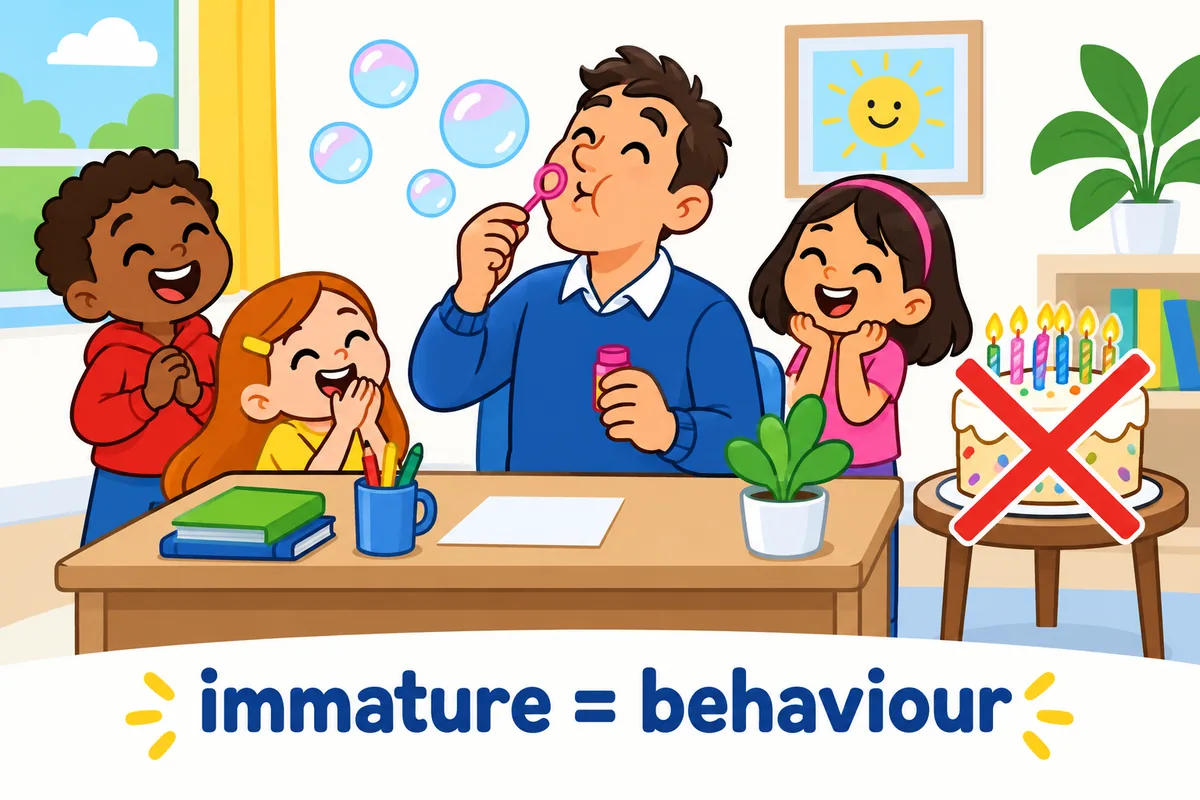
- Immature is almost always negative: it criticises behaviour as not yet grown up.
- Youthful points at the outside and at energy; immature points at conduct and judgement.
- The commonest error is using immature for physical youth, which is a different idea.
Youthful vs immature: the key difference
Youthful describes a quality people admire, while immature names a shortfall in behaviour. The master table below sets the two words against the criteria that decide real sentences, so you can pick the right one without hesitating.
| Criterion | youthful | immature |
|---|---|---|
| What it praises or faults | Freshness, vigour and a young appearance | Conduct that has not grown up |
| Tone | Warm praise, occasionally nostalgic | Criticism, occasionally teasing |
| Typical nouns | youthful energy, looks, enthusiasm, face | immature behaviour, reaction, joke, decision |
| What it judges | Vitality and appearance | Judgement and self-control |
| Age implication | None required; older people can look youthful | None required; adults can act immature |
| Usual opposite | Aged, tired or worn | Mature, grown-up or sensible |
| Register | Neutral and friendly in speech and writing | Neutral but blunt, common in feedback |
The verdict is quick to state: youthful flatters a person’s energy or looks, while immature questions their conduct. A single sentence can carry both without contradiction, as in her youthful energy made the older volunteers smile, but her immature reply to criticism did not.
What do youthful and immature mean?
Youthful is an adjective meaning having the qualities of youth, especially freshness, energy and a young-looking face. The Cambridge entry for youthful keeps appearance and vigour together. Immature is an adjective meaning not yet fully developed, and when it describes a person it means their behaviour lags behind their age. The Cambridge entry for immature covers the physical and the behavioural senses, and only the second is a criticism.
Youthful
| Sense | Plain meaning | Example sentence |
|---|---|---|
| Young-looking | Having a fresh appearance for one’s age | Her youthful face surprised the new colleagues. |
| Full of vigour | Energetic and lively in manner | He brought youthful enthusiasm to a tired committee. |
| Characteristic of youth | Typical of young people, often fondly | The garden kept a youthful wildness in spring. |
Immature
| Sense | Plain meaning | Example sentence |
|---|---|---|
| Not fully grown | Physically undeveloped, used of plants and animals | The immature fruit stayed hard on the branch. |
| Not yet ripe in judgement | Behaving below one’s age | An immature remark spoiled the meeting. |
| Premature or unready | Arriving before it is fully formed | It was an immature plan, rushed into print. |
One limitation is worth stating plainly. Neither word is a synonym for young. A young person is simply of few years, so a youthful grandfather and an immature colleague show that age and judgement travel separately.
How do you use youthful and immature in a sentence?
Both adjectives go before a noun or after a linking verb, so the grammar is the same for each. The choice rests on what you are judging, not on the structure of the sentence. Put youthful before words such as energy, looks, face or enthusiasm, and put immature before behaviour, reaction, joke, decision or remark. After be, look, seem or act, choose the word that names the quality you mean.
| Pattern | Example | What it signals |
|---|---|---|
| youthful + noun | Her youthful enthusiasm lifted the team. | Praise attached to a named quality. |
| look or seem + youthful | The actor looks youthful at sixty. | Appearance, honestly admired. |
| immature + noun | An immature comment ended the discussion. | Criticism aimed at a piece of conduct. |
| act + immature | He acted immature when the vote went against him. | The behaviour sense, kept to the person’s actions. |
| immature for + age | She is immature for her age. | Compares conduct with an expected standard. |
Where the contrast is with a mature, settled manner, mature supplies the clean opposite of immature without touching the idea of age.
Youthful and immature in a sentence: examples across contexts
The examples below keep the same two adjectives while the register shifts from a school report to a restaurant review. Each sentence shows which quality is being judged, so the contrast stays clear.
| Context | Example sentence | Why this works |
|---|---|---|
| Classroom | The tutor’s youthful energy kept the whole class awake. | Youthful praises vigour rather than years. |
| School report | Ben’s youthful curiosity about rocks is a real strength. | A warm quality attached to a positive noun. |
| Job reference | She is young in years but never immature with clients. | One sentence keeps age apart from conduct. |
| Workplace feedback | Refusing to share credit was an immature response. | Criticism aimed at an action, not a person. |
| Sports report | The seasoned keeper showed youthful reflexes at the end. | Youthful can flatter someone long past youth. |
| Family conversation | Grandad has a sprightly step and a youthful laugh. | Pairs a close synonym with the target for clarity. |
| Restaurant review | An immature wine left the sauce sharper than intended. | The physical sense, used without criticism of people. |
| News report | Voters responded to the candidate’s youthful optimism. | A public subject keeps the praise impersonal. |
| Academic writing | The study links youthful curiosity with lifelong learning. | Abstract nouns keep the tone measured. |
| Customer service | An immature joke on the help desk upset a caller. | Shows where the criticism belongs: the remark. |
| Storytelling | The wizard kept a youthful spark even at ninety. | Contrasts great age with lasting vitality. |
| Online discussion | Calling people names is immature, and the thread soon went quiet. | A blunt judgement about behaviour in public. |
Notice that no sentence calls a person immature for being young, which is the mistake the next section helps you avoid.
Which should you use?
Match the word to the judgement you want to make, and let the person’s age stay out of it. The table maps the situations readers meet most often to a firm recommendation.
| Situation | Choose | Why |
|---|---|---|
| Praising a fit, energetic seventy-year-old | youthful | It admires vigour without claiming they are young. |
| Giving feedback on a colleague who sulks | immature | It names the conduct, not the person’s years. |
| Describing a small, silly prank | childish | It is stronger than immature and points at silliness. |
| Describing a fresh, unlined appearance | youthful | Youthful looks is the standard collocation. |
| Describing a grown body that stayed undeveloped | immature | The physical sense, with no criticism of character. |
| Describing a legal case involving a person under eighteen | juvenile | The formal term for young offenders, where immature would be wrong. |
If you can swap in the phrase full of life and the sentence still works, choose youthful; if you can swap in not grown up and it still works, choose immature.
Word forms and grammar of youthful and immature
Youthful builds on the noun youth, while immature builds on mature with the negative prefix im-. The table lists the forms learners actually need, together with the comparatives that are more common than the -er endings.
| Form | Part of speech | Example |
|---|---|---|
| youthful | adjective | He has a youthful way of laughing. |
| youthfully | adverb | She dressed youthfully for the reunion. |
| youthfulness | noun | His youthfulness surprised the interviewers. |
| immature | adjective | An immature reply costs more than silence. |
| immaturity | noun | The report blamed immaturity, not malice. |
| more immature | comparative phrase | His second email was more immature than the first. |
| immaturely | adverb, rare | He behaved immaturely, though writers prefer the adjective. |
Keep the pair apart from mature, which is the direct opposite of immature, and from youth, which is simply the period of being young.
Common mistakes with youthful and immature
- Incorrect:
The immature child started school early.Correct: The young child started school early. Rule: Immature means not fully developed, so it cannot simply replace young. - Incorrect:
He was very immature for a cheerful man.Correct: He was very youthful for a man of sixty. Rule: Immature criticises conduct; youthful praises vitality or looks. - Incorrect:
She acted youthful at the party.Correct: She behaved youthfully at the party or she looked youthful at the party. Rule: An adverb modifies acted, so use youthfully. - Incorrect:
An immature face smiled from the poster.Correct: A youthful face smiled from the poster. Rule: Faces are praised as youthful; immature would imply they had not finished growing. - Incorrect:
Youthful behaviour in an adult is rude.Correct: Immature behaviour in an adult is rude. Rule: Behaviour is judged with immature, while youthful suits energy, looks and enthusiasm.
Practice using youthful and immature
Work through the six items, then check the reasons in the answers rather than only the keys.
- Fill the gap: Despite his grey hair, Uncle Ray kept a ______ laugh.
- Choose the better word: Snatching the last slice was an (youthful / immature) thing to do.
- Correct the error: The immature puppy chewed the whole shoe.
- Build a sentence: use immature for her age about a twelve-year-old who sulks when losing a game.
- Spot the register: which belongs in a job reference — a youthful enthusiasm for detail, or a pretty immature sense of humour?
- Rewrite with the adverb: She looks youthful in bright colours. Rewrite using youthfully.
Answers
- youthful — the sentence praises energy and good humour, not behaviour.
- immature — grabbing food is a criticism of conduct, so youthful would be wrong.
- The young puppy chewed the whole shoe — a puppy is simply young, and immature would suggest it had not finished growing.
- Model answer: She is immature for her age, sulking whenever she loses a board game.
- A youthful enthusiasm for detail — a reference praises strengths and avoids the critical word.
- She dresses youthfully in bright colours — the adverb describes how she dresses, not her face.
The bottom line
Use youthful to praise energy, freshness or a young-looking appearance, and immature to criticise conduct that has not grown up; the pair judges qualities, not birthdays. The two nuances that decide most sentences are these: youthful attaches to looks and enthusiasm, while immature attaches to behaviour and decisions, and neither word means simply young. For the plainest criticism of silly conduct, puerile is even blunter than immature.
Frequently asked questions about youthful and immature
Is youthful always a compliment?
Youthful is nearly always warm and positive when it describes a person’s looks or energy. It can turn slightly wistful when it means characteristic of youth, as in a youthful folly, where the tone softens the fault. In everyday praise it is a safe and flattering word to choose.
Can immature describe physical growth?
Yes, immature has a physical sense for plants, animals and premature plans, meaning not yet fully developed. When it describes a person’s conduct, the same word becomes a criticism. Context decides which sense is active, and the non-human sense carries no judgement at all.
What is the noun of youthful?
The noun is youthfulness, meaning the quality of being fresh and full of life, as in his youthfulness surprised the interviewers. Do not confuse it with youth, which is the period of being young, or with the noun young, which names young animals. Youthfulness describes a quality that can last.
Is immaturity the opposite of maturity?
Yes, immaturity is the direct opposite of maturity, and immature is the opposite of mature when both describe conduct. A mature response is calm and considered, while an immature one is hasty or self-centred. The pair works for people of any age, because both words judge behaviour rather than years.