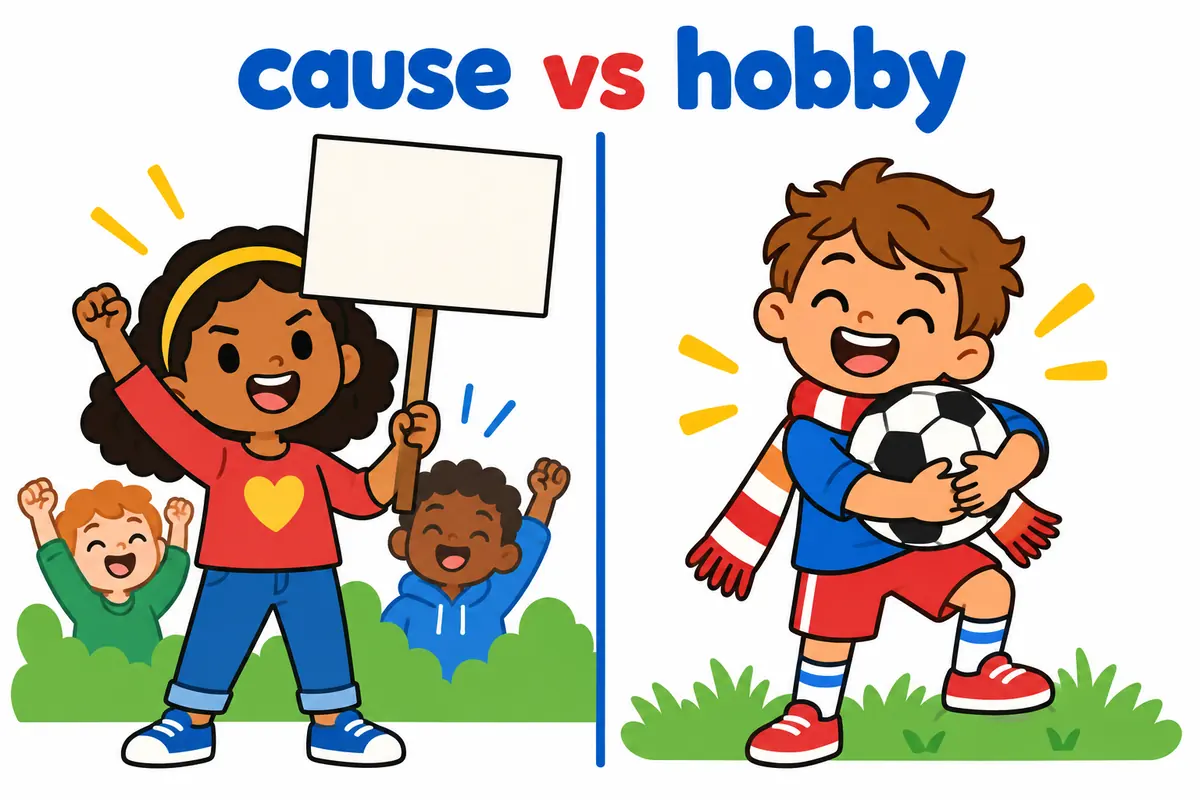
Choose zealot vs fanatic by the object of the person and the weight of the judgement. A zealot is devoted to a belief, faith or cause and can sound intolerant or dangerous; a fanatic is wildly keen on almost anything, from a football team to a diet, and usually sounds milder. Neither noun is neutral praise.
Zealot vs fanatic at a glance
- Both zealot and fanatic are countable nouns for a person, and both imply excess.
- A zealot is devoted to a belief, cause or faith; a fanatic is wildly keen on almost anything.
- Zealot keeps a religious and political flavour; fanatic stretches to sport, diets and hobbies.
- The adjectives are zealous and fanatical, and the abstract nouns are zealotry and fanaticism.
- The commonest error is treating the two as exact synonyms and ignoring the whiff of excess in both.
Zealot vs fanatic: the master comparison
The two nouns overlap in the idea of excess, so the useful test is what the person is excessive about. The table sets out the seven features that decide a sentence.
| Criterion | zealot | fanatic |
|---|---|---|
| Core meaning | A person carried away by devotion to a cause or faith | A person filled with wild, unreasonable enthusiasm |
| Object of devotion | A belief, religion or political cause | Anything, from a team to a diet |
| Setting it prefers | Religious and political writing | Sport, hobbies and everyday exaggeration |
| Intensity | Deep and sustained commitment | Frenzied and often temporary excitement |
| Connotation | Intolerant, sometimes dangerous | Obsessive, often slightly comic |
| Register | Formal and serious | Informal to journalistic |
| Typical sentence | The zealot refused to hear any other view. | My brother is a fanatic about clean cars. |
Which should you use?
Most real choices come down to a handful of situations. Match the need to the recommendation below and the sentence will read as though a native speaker wrote it.
- For a person defined by faith or ideology, choose zealot: the word carries the weight of belief.
- For a person whose enthusiasm is excessive but harmless, choose fanatic: it fits sport, food and hobbies.
- For a neutral word that judges no one, choose enthusiast or devotee and drop the edge.
- For someone intolerant of other people rather than merely keen, choose bigot, which names the prejudice itself.
What do zealot and fanatic mean?
Zealot is a noun for a person who is fanatical about a religion or a cause. The Cambridge entry for zealot stresses that devotion, while the entry for fanatic stresses extreme and uncritical enthusiasm. Note that a zealot is bound to a fixed belief, while a fanatic can be obsessive about something trivial. One honest limitation applies to both. These are not compliments: each word judges the person, so a neutral sentence about a keen supporter needs enthusiast or devotee instead.
| Word | Dictionary sense | Example sentence |
|---|---|---|
| zealot | A person who is fanatical about a religion or cause | The reformer was dismissed as a zealot by his rivals. |
| fanatic | A person with an extreme and uncritical enthusiasm | A crowd of fanatics queued all night for the tickets. |
| zealotry | The behaviour of a zealot | Their zealotry left no room for doubt. |
| fanaticism | The behaviour of a fanatic | The film charts the fanaticism of a losing campaign. |
How do you use zealot and fanatic in a sentence?
Both words behave as countable person nouns, and the preposition after them changes the flavour. The table shows the patterns that sound native.
| Pattern | Example | What it signals |
|---|---|---|
| a/the + zealot + of + cause | He was a zealot of the old faith. | Ties the person to one fixed belief. |
| zealot + for + cause | She became a zealot for reform. | Marks a cause taken up rather than inherited. |
| a/the + fanatic + about + thing | He is a fanatic about tidiness. | Names an everyday obsession, often lightly. |
| fanatic + for + team or hobby | They are fanatics for vintage cars. | Treats the enthusiasm as a shared hobby. |
| called or considered + a fanatic | Critics called him a fanatic. | Reports how others label the person. |
Zealot and fanatic in a sentence: examples across contexts
The words keep their meanings but shift in tone with the text. The sentences below move from religious history to a sports page, and each row shows which word and which neighbours fit.
| Context | Example sentence | Why this works |
|---|---|---|
| Religious history | The zealot would rather die than compromise. | Uses the word in its oldest, most serious setting. |
| Political column | Every party has its zealots who reject all compromise. | Names the unyielding wing of a movement. |
| Sports page | Fanatics camped outside the stadium for two nights. | Keeps the tone light and the enthusiasm harmless. |
| Food writing | A coffee fanatic owns three grinders. | Applies the word to a private passion, not a faith. |
| Psychology essay | The study treats fanaticism as a group phenomenon. | Uses the abstract noun for a measured analysis. |
| Everyday conversation | Do not be such a fanatic about the dishes. | Turns the word into gentle teasing. |
| News report | Police kept rival zealots apart at the rally. | Warns of danger without naming a religion. |
| Literary criticism | The novel turns its zealot into a tragic figure. | Uses the word to build character rather than judge. |
| Workplace email | We need enthusiasts, not fanatics, on this rollout. | Contrasts healthy interest with excess. |
Notice how the serious settings keep the conflict contained in language alone: no example needs violence to carry the warning that zealot implies. The lighter settings let fanatic become affectionate teasing. That range is the clearest signal of the difference between the two words, and it is why an enthusiast or a devotee is the safer choice when no judgement is intended.
Word forms and grammar of zealot and fanatic
Each noun has an adjective and an abstract noun behind it, and the table keeps the forms in parallel. Notice that fanatic can work as an adjective on its own, while zealot cannot.
| Form | Part of speech | Example |
|---|---|---|
| zealot | noun, person | The zealot would not listen. |
| zealots | noun, plural | A row of zealots blocked the entrance. |
| zealous | adjective | She was zealous in defence of the rule. |
| zealotry | noun, abstract | Zealotry thrives on certainty. |
| fanatic | noun or adjective | A fanatic crowd filled the square. |
| fanatical | adjective | He is fanatical about punctuality. |
| fanaticism | noun, abstract | Fanaticism fed on fear. |
The abstract nouns zealotry and fanaticism name the behaviour rather than the person, which is why an essay can analyse them without accusing anyone. When the real fault is prejudice rather than enthusiasm, a bigot is the precise word, because it names intolerance of other people instead of intensity of belief.
Common mistakes with zealot and fanatic
- Incorrect:
He is a zealot about football.Correct: He is a fanatic about football. Rule: Trivial hobbies take fanatic; zealot stays with beliefs and causes. - Incorrect:
Her fanaticism for the law was admired.Correct: Her zeal for the law was admired. Rule: Fanaticism implies unreasonable excess, so admiration needs the positive word zeal. - Incorrect:
They were zealots of the new phone.Correct: They were fanatics for the new phone. Rule: Objects take fanatic for, while zealot takes a cause or a faith. - Incorrect:
The zealot enjoyed a quiet hobby.Correct: The zealot pursued his cause with no tolerance for dissent. Rule: Zealot carries a hint of intolerance, so a harmless hobby misuses the word. - Incorrect:
A fanatic politician opposed all reform.Correct: A zealot politician opposed all reform. Rule: Political rigidity calls for zealot, while fanatic suits enthusiasm rather than doctrine.
Practice using zealot and fanatic
Work through the six items, then read the reasoning rather than only the key, because the object of the sentence decides the word.
- Fill the gap: A ______ of the old faith refused every compromise.
- Choose the better word: My cousin is a (zealot / fanatic) about vintage trains.
- Correct the error: She is a zealot about healthy eating.
- Build a sentence: use a fanatic about about a friend who cleans constantly.
- Spot the register: which belongs in a religious history? The zealot defended the doctrine, or the zealot loved the team.
- Change the noun to its adjective: Their fanaticism worried the neighbours.
Answers
- zealot, because a fixed faith is exactly the cause the word describes.
- fanatic, because a hobby takes fanatic rather than the belief-word zealot.
- She is a fanatic about healthy eating, because a daily habit is enthusiasm, not doctrine.
- Model answer: My flatmate is a fanatic about the kitchen and wipes every surface twice.
- The zealot defended the doctrine, because a history of religion keeps the serious register.
- Their fanatical devotion worried the neighbours, because fanatical is the matching adjective.
The bottom line
Choose zealot for a person bound to a faith or cause and fanatic for wild enthusiasm about anything else. The comparison turns on two points: zealot keeps a religious and political charge, while fanatic reaches into sport and hobbies, and fanatic wears its excess lightly enough to tease with, while zealot can still sound dangerous. When you want neither edge, enthusiast and devotee are the neutral options.
Frequently asked questions about zealot vs fanatic
Are zealot and fanatic exact synonyms?
No. They overlap in the idea of excess, but a zealot is defined by devotion to a belief or cause, while a fanatic is defined by unreasonable enthusiasm for almost anything. That difference in object is what guides the choice between them.
Which word is more negative?
Zealot usually carries the heavier charge. It suggests intolerance and sometimes danger, especially in political and religious writing. Fanatic is milder and often comic, which is why it fits sport, food and hobbies where nothing serious is at stake. The setting decides how hard the word lands, and a mild fixation rarely needs the stern noun.
What are the adjectives of these words?
The adjective for zealot is zealous, and the adjective for fanatic is fanatical. Zealous can even be positive, describing eager effort, while fanatical keeps the sense of excess. The matching abstract nouns are zealotry and fanaticism, so one family of words covers both the person and the behaviour.
Can I use fanatic for a serious belief?
You can, but the tone shifts. Fanatic about a religion sounds dismissive, as though the belief were a hobby. For a serious cause, zealot holds the register, and for a neutral description, devotee or adherent avoids the judgement altogether, which is often the safer choice in careful writing.