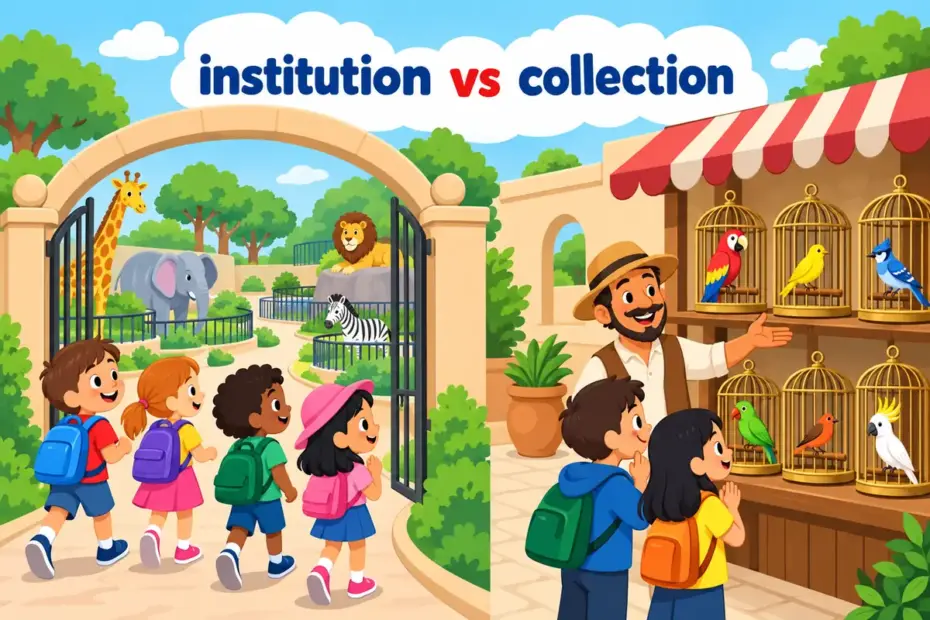
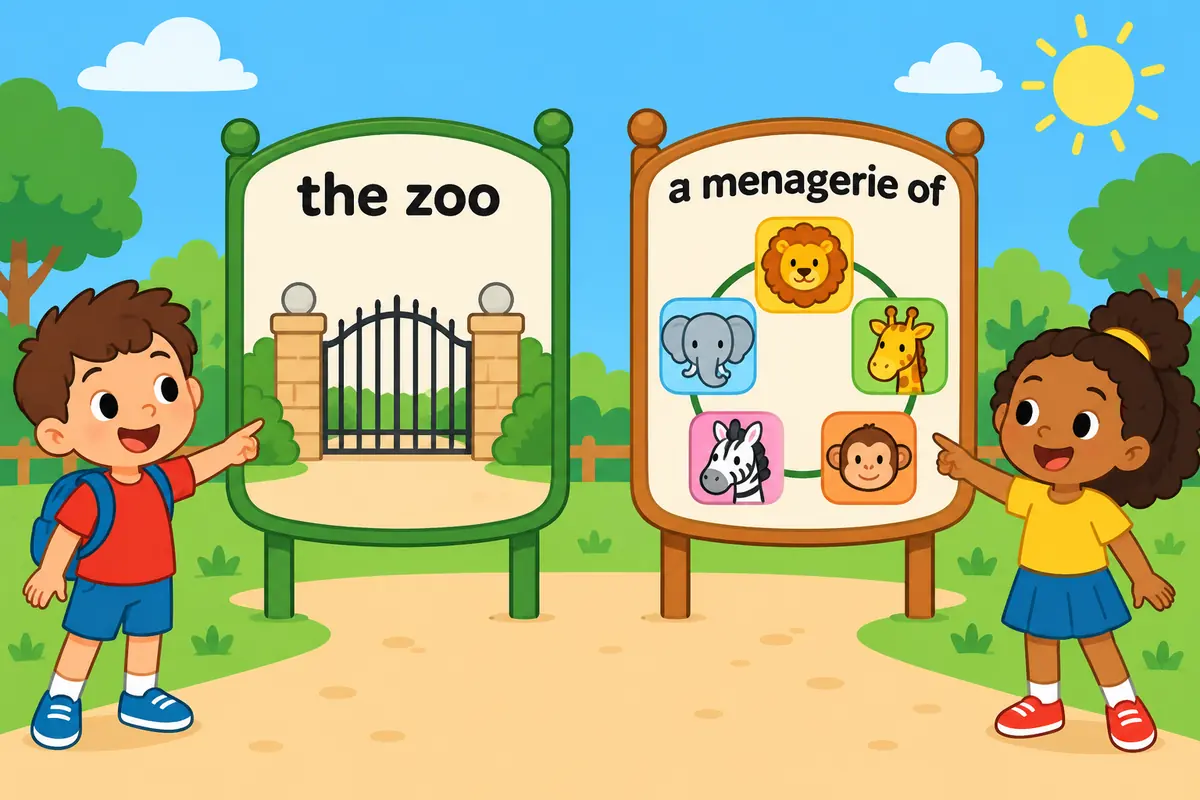
The zoo vs menagerie choice comes down to institution against collection. Use zoo for a public place that keeps wild animals in enclosures for visitors, education and conservation, and menagerie for a private or historic collection of exotic animals. Reach for menagerie when describing a strange assortment of characters.
Zoo vs menagerie at a glance
- Zoo is a countable noun for a public institution; its plural is zoos and the adjective is zoological.
- Menagerie is a countable noun for a collection of animals, and its plural is menageries.
- Zoo suggests organised enclosures, staff and a mission; menagerie suggests ownership and display.
- Only menagerie works figuratively for a mixed group of things, as in a menagerie of opinions.
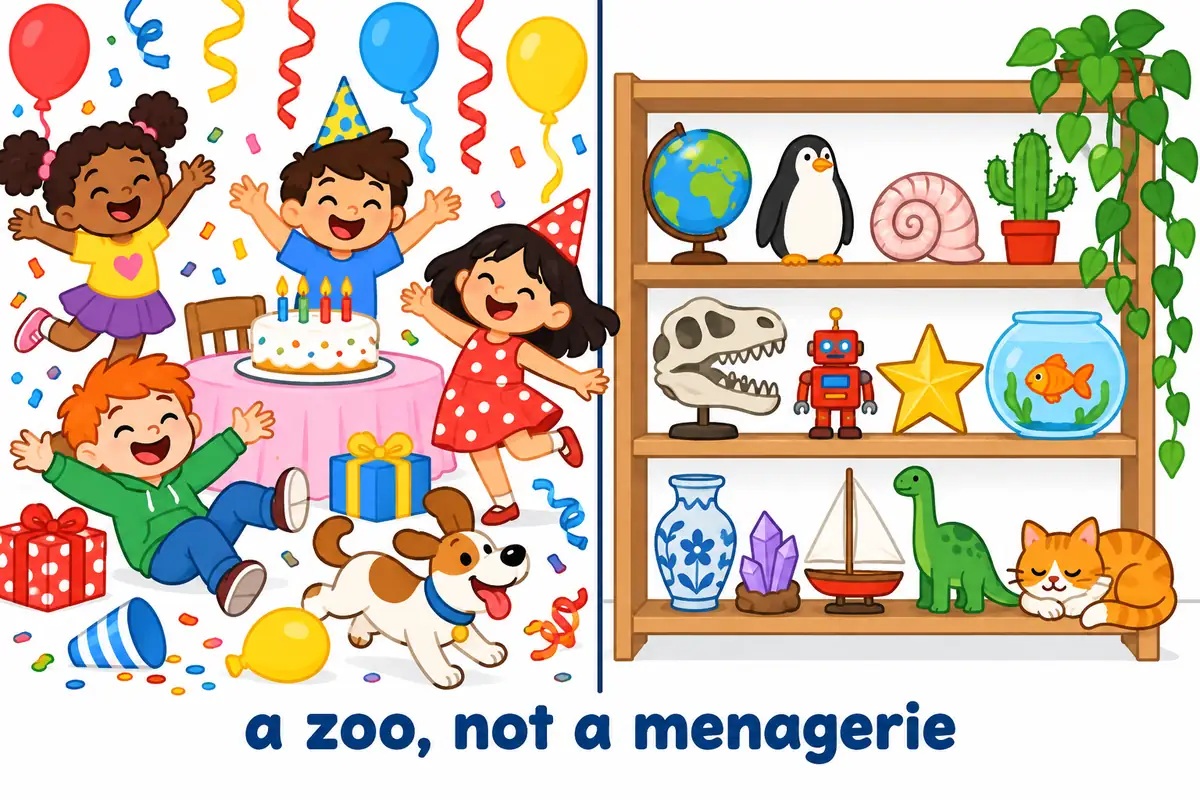
- Only zoo forms the idiom a zoo, meaning a chaotic place.
How do zoo and menagerie compare?
The two nouns sit at different points on one scale: zoo names an institution, while menagerie names a collection. That single difference decides scale, ownership, purpose and tone, and the master table below weighs both words against the criteria writers actually care about. The page devoted to zoo treats it as a place you visit, which is the everyday use.
| Criterion | zoo | menagerie |
|---|---|---|
| What it names | A public institution with enclosures | A collection of animals |
| Ownership | Often a city, charity or company | Often one wealthy owner |
| Access | Open to the paying public | Usually private or invited |
| Primary purpose | Education, conservation, display | Display, prestige or curiosity |
| Scale | Large, with many species and staff | Smaller and personally assembled |
| Historical setting | Modern, from the nineteenth century onward | Courtly and pre-modern collections |
| Register | Neutral and everyday | Formal, literary or historical |
| Figurative use | A zoo means a chaotic scene | A menagerie means a mixed group |
A second test settles most sentences quickly. If the place advertises opening hours, sells tickets and employs keepers, it is a zoo; if the sentence dwells on who owns the animals and how odd the group is, it is a menagerie. Only a modern facility with a rescue mission and no public display sits outside both, and that is a sanctuary.
What do zoo and menagerie mean?
Zoo is a noun meaning a place where wild animals are kept in enclosures so that people can see them, and it is a shortened form of zoological garden. The Cambridge entry for zoo covers this central sense, which always implies an organisation rather than an individual.
Menagerie is a noun meaning a collection of wild or unusual animals, especially a private one kept for display. The Cambridge entry for menagerie records both the animal sense and the figurative sense of a strange mixture, and the two share the idea of a gathered collection. The menagerie page treats that gathering as its central idea. The table below keeps the senses apart for each word.
| Word and sense | Plain meaning | Example sentence |
|---|---|---|
| zoo: the place | A public park of animal enclosures | We spent Sunday at the zoo. |
| zoo: the figurative chaos | A noisy, disordered place | The office was a zoo before the deadline. |
| menagerie: animal collection | A private or historic set of animals | The merchant kept a menagerie of parrots. |
| menagerie: mixed group | A strange assortment of things or people | Her bookshelf was a menagerie of odd titles. |
One limitation is worth stating plainly. Neither word is a synonym for habitat, because a habitat is where animals live in the wild, and neither word describes a farm. Zoo also does not mean a pet shop, however many animals are on show, and menagerie never implies the conservation work that a modern zoo claims as its purpose.
How do you use zoo and menagerie in a sentence?
Both words are countable nouns, so both take an article, but their habits differ. Zoo appears in fixed phrases about visiting a place, while menagerie appears in the pattern a menagerie of plus a plural noun. The table pairs the patterns so the contrast is easy to copy.
| Pattern | Example | What it signals |
|---|---|---|
| the zoo / a zoo | The children loved the zoo. | One named public institution. |
| at / to the zoo | We are going to the zoo. | A trip or visit, the commonest use. |
| a menagerie of + plural | He kept a menagerie of reptiles. | A personally gathered collection. |
| the king’s menagerie | The king’s menagerie held lions. | Ownership, usually historic. |
| be a zoo | The house is a zoo tonight. | Chaos, never a real animal collection. |
| an aviary full of birds | The aviary held owls and finches. | A single-species building inside a zoo or garden. |
Zoo vs menagerie: examples across contexts
The two words divide cleanly across registers: zoo suits news, travel and conversation, while menagerie suits history, literature and description. The nine sentences below move from a family outing to a museum label, and each one makes the contrast visible in its setting.
| Context | Example sentence | Why this works |
|---|---|---|
| Family outing | We took the children to the zoo to see the elephants. | A visit to a public place is the everyday sense. |
| Conservation news | The zoo bred three rare frogs this spring. | Breeding programmes belong to an institution. |
| Travel guide | The old zoo now runs a wildlife hospital. | Shows the institution evolving while keeping its name. |
| History essay | The palace menagerie housed lions and elephants. | A royal, owned collection fits the pre-modern period. |
| Museum label | The menagerie was assembled by a wealthy merchant. | Ownership is the point, so menagerie is exact. |
| Literary description | Her attic was a menagerie of broken clocks. | The figurative mix-of-things sense. |
| Conversation | The kitchen was a zoo before the guests arrived. | The idiom for chaos, never menagerie. |
| Feature article | The roadside menagerie kept its animals in cramped cages. | A private, criticised collection, often in reporting. |
| Nature writing | The reserve protects a natural habitat, not a menagerie. | Contrasts wild living space with a kept collection. |
Which should you use?
Five reader situations cover almost every decision, and each one has a firm answer rather than a hedge. Match your sentence to the situation, then write the matching noun.
| Your situation | Use this word | Why |
|---|---|---|
| A city park with enclosures, tickets and keepers | zoo | It is a public institution with staff and a mission. |
| A king’s private animals in the 1600s | menagerie | Ownership and history, not public access, define it. |
| A desk covered in tiny odd objects | menagerie | The figurative pattern a menagerie of treats them as a collection. |
| A frantic household on a school morning | zoo | The idiom a zoo means chaos, and menagerie never does. |
| A rescue centre that breeds endangered birds off display | sanctuary | No visitors and a rescue aim point away from both words. |
Word forms and grammar of zoo and menagerie
The two words build their families differently: zoo contributes an adjective and a scholar noun, while menagerie adds almost nothing beyond its plural. Neither word works as a verb, which is why sentences always place them as the thing being discussed or visited.
| Form | Part of speech | Example |
|---|---|---|
| zoo | noun, singular | The zoo opens at nine. |
| zoos | noun, plural | Many zoos now run breeding schemes. |
| zoological | adjective | She studied zoological records for a year. |
| zoologist | noun, a person | A zoologist checked the animals each morning. |
| menagerie | noun, singular | The menagerie filled two courtyards. |
| menageries | noun, plural | European menageries traded exotic birds. |
| enclosure | related noun | Each enclosure held one species. |
Common mistakes with zoo and menagerie
Incorrect: We visited the menagerie to see the new panda enclosure. Correct: We visited the zoo to see the new panda enclosure. Rule: A public place with new enclosures is a zoo, not a collection.
Incorrect: The menagerie runs a breeding programme for endangered frogs. Correct: The zoo runs a breeding programme for endangered frogs. Rule: Conservation is an institutional mission, which belongs to a zoo.
Incorrect: The birthday party turned the house into a menagerie. Correct: The birthday party turned the house into a zoo. Rule: The idiom for chaos is a zoo; menagerie never carries that sense.
Incorrect: She works at the zoological, caring for reptiles. Correct: She works at the zoo, caring for reptiles. Rule: Zoological is an adjective, so the noun in the sentence must be zoo.
Incorrect: The king kept a zoo of exotic birds in the tower. Correct: The king kept a menagerie of exotic birds in the tower. Rule: A private royal collection is historically a menagerie.
Incorrect: Her report was a zoo of conflicting figures. Correct: Her report was a menagerie of conflicting figures. Rule: A strange assortment takes menagerie, while a zoo describes a chaotic place.
Practice choosing zoo or menagerie
Work through the seven items, then read the reasons rather than only the answers.
- Fill the gap: The children begged to visit the ______ to see the giraffes.
- Choose the better word: The merchant’s private collection of parrots was a famous (zoo / menagerie).
- Correct the error: The charity runs a menagerie that breeds endangered frogs.
- Build a sentence: use a menagerie of about a desk covered in odd objects.
- Spot the register: which belongs in a history essay — The royal menagerie housed exotic animals, or The king’s animal place had, like, tons of stuff?
- Rewrite with the idiom: The office was chaotic on deadline day. Use zoo.
- Choose the better word: A public park with an education centre is a (zoo / menagerie).
Answers
- zoo — a visit to a public place with enclosures is a zoo.
- menagerie — a private collection assembled by an owner is a menagerie.
- The charity runs a zoo that breeds endangered frogs — a breeding programme is institutional.
- Model answer: The teacher’s desk was a menagerie of paper clips, shells and old keys.
- The royal menagerie housed exotic animals — a formal essay keeps precise, neutral vocabulary.
- The office was a zoo on deadline day — the idiom a zoo means chaos.
- zoo — public access and an education centre mark an institution.
The bottom line
Use zoo for a public institution that keeps wild animals in enclosures, and menagerie for a private or historic collection of exotic animals. The two nuances that decide most sentences are these: menagerie also works figuratively for a strange assortment, as in a menagerie of opinions, while only zoo forms the idiom a zoo for a chaotic place. When an owner and a collection are the point, menagerie is the exact word; when visitors and a mission are the point, zoo is.
Frequently asked questions about zoo vs menagerie
Is a menagerie just an old word for a zoo?
No. The words overlap in history, because early zoos grew from royal menageries, but they name different things. A menagerie is a collection of animals, often privately owned, while a zoo is a public institution with enclosures, staff and a mission. The difference is ownership and organisation, not age.
Can menagerie describe a group of people?
Yes. The figurative sense treats any strange assortment as a menagerie, so a cast of odd characters or a shelf of mismatched objects works naturally. The animals drop away and only the idea of a gathered, varied collection remains. Zoo has no equivalent figurative sense for people, because a zoo in that use means chaos.
Why is a chaotic place called a zoo and not a menagerie?
The idiom a zoo comes from the noise and bustle of a crowded animal park, so it describes disorder rather than a collection. Menagerie never developed that sense, because it stresses the carefully gathered animals rather than the crowd watching them. That is why a messy kitchen is a zoo, while a shelf of curiosities is a menagerie.
Which word is correct for a modern conservation centre?
Zoo fits when the centre is public, keeps animals in enclosures and runs education or breeding programmes. If the animals are off display and the aim is rescue rather than visitors, sanctuary is the better noun. Menagerie is wrong for either case, because it names a collection rather than an organisation with a mission.