100 action verbs for kids name the things children do every day, so run, jump, climb and share are the words that turn a sentence into a story. Each verb shows an action someone takes. The list below pairs forty common verbs with a simple meaning and an example a child can read.
100 action verbs for kids at a glance
- An action verb tells what a person or animal does.
- Most verbs for kids name everyday moves, such as run, jump and hop.
- A verb must agree with its subject, so the dog runs but the dogs run.
- Kids meet irregular past forms early, as go becomes went, not goed.
- Action verbs contrast with linking verbs such as is, which name no action.
What are action verbs for kids?
An action verb is a word that tells what someone or something does, so run, jump and swim are action verbs while is and seem are not. Young learners meet them first because each verb paints a movement a child can copy.
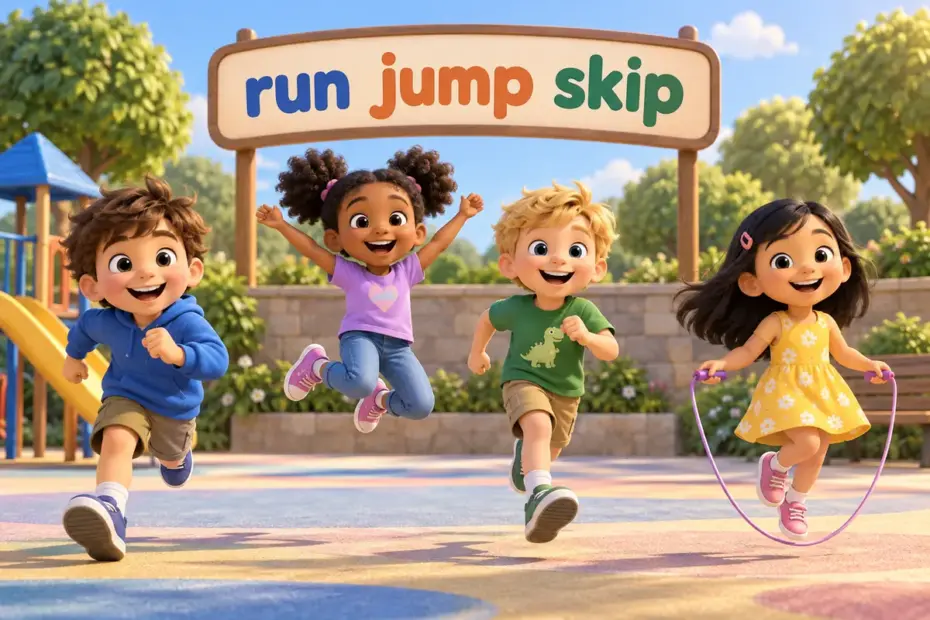
The words split into easy families: movement, such as hop and crawl; the senses, such as look and listen; and helping actions, such as share and help. Grouping the verbs this way gives a child a set to practise together.
| Action verb | Simple meaning | Example sentence |
|---|---|---|
| run | move fast on foot | The children run to the gate. |
| jump | push off the ground | Frogs jump over the log. |
| swim | move through water | We swim in the shallow end. |
| climb | go up something | They climb the rope ladder. |
| dance | move to music | The class dances on Fridays. |
| sing | make music with the voice | She sings a morning song. |
| read | look at words and understand | He reads a bedtime story. |
| write | make words with a pen | I write my name in the book. |
| draw | make a picture with lines | We draw a tall giraffe. |
| paint | make a picture with colour | They paint the paper blue. |
| build | make something from parts | The twins build a tall tower. |
| kick | hit with the foot | He kicks the red ball. |
| throw | send through the air | She throws the beanbag high. |
| catch | take hold of a moving thing | I catch the soft ball. |
| hop | jump on one foot | Bunnies hop along the path. |
| skip | move with light bouncing steps | They skip around the yard. |
| shout | speak very loudly | We shout across the field. |
| whisper | speak very softly | She whispers a secret. |
| laugh | make happy sounds | The joke makes us laugh. |
| smile | show a happy face | The baby smiles at the toy. |
| eat | take in food | We eat lunch at noon. |
| drink | take in a liquid | He drinks his milk. |
| sleep | rest with eyes closed | The kitten sleeps on the mat. |
| wake | stop sleeping | I wake at seven. |
| wash | clean with water | She washes her hands. |
| brush | clean with a brush | He brushes his teeth. |
| clap | hit the hands together | We clap for the winner. |
| stomp | walk with heavy steps | The giant stomps on the floor. |
| wiggle | move with small twists | The puppy wiggles its tail. |
| crawl | move on hands and knees | The baby crawls to the ball. |
| slide | move smoothly down | They slide down the chute. |
| swing | move back and forth | I swing on the rope. |
| ride | sit on and control | She rides her scooter. |
| dig | make a hole | We dig in the sandbox. |
| plant | put in the ground to grow | They plant sunflower seeds. |
| push | move away from you | He pushes the heavy box. |
| pull | move toward you | She pulls the little wagon. |
| lift | raise something up | I lift the light chair. |
| carry | hold and move | He carries the water jug. |
| share | let others have some | The boys share their crayons. |
The forty verbs above cover the actions of a normal school day, and the same pattern extends to the full set of one hundred. Practise a few at a time by acting them out, because a child remembers a movement far longer than a definition.
Once a child knows a verb, the next step is sentences built around an action, which show the verb at work. Verbs and descriptions pair up in describing words that go with each verb, adding colour to a simple sentence.
How do you use action verbs in a sentence?
A child only needs a subject and an action verb to make a complete sentence, and the pattern grows from there.
| Pattern | Example | What it signals |
|---|---|---|
| subject + verb | Birds fly. | The shortest complete sentence. |
| subject + verb + object | She kicks the ball. | Someone acts on something. |
| subject + verb + where | We play outside. | The action has a place. |
| subject + verb + when | They swim after lunch. | The action has a time. |
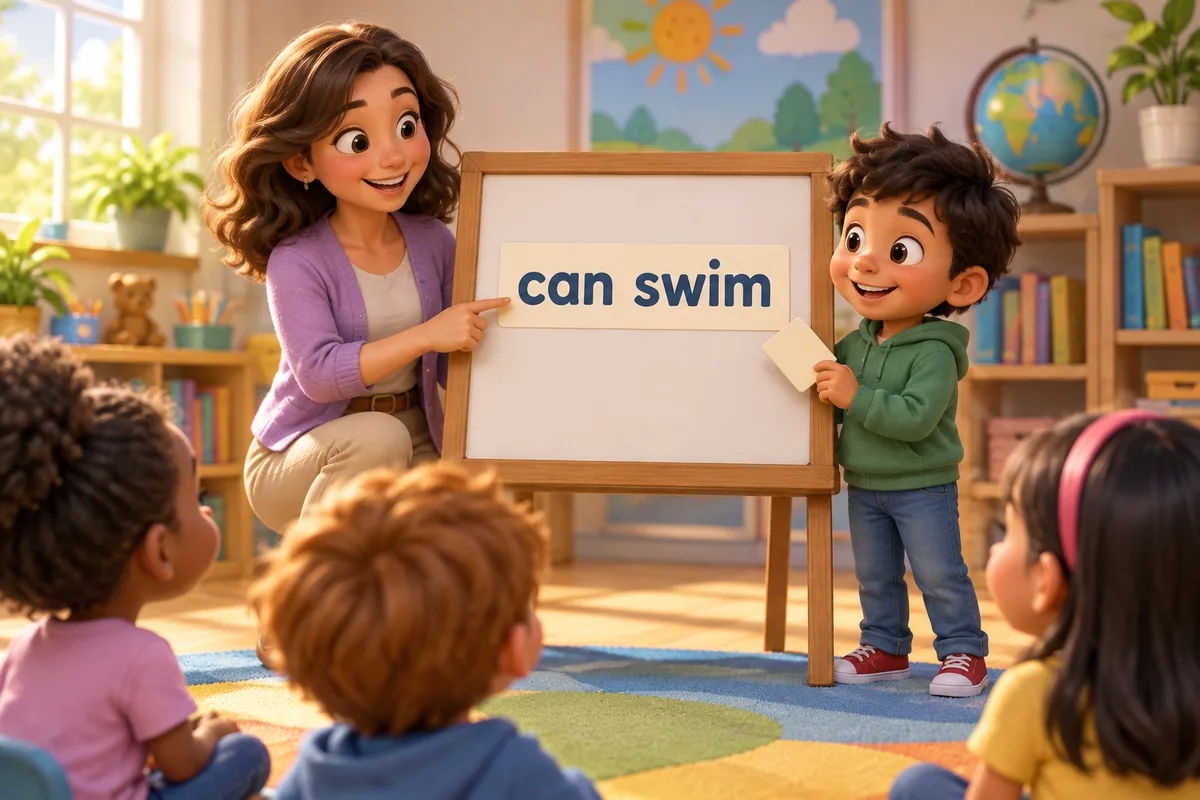
| verb + verb | He can jump. | A helper word comes before the action. |
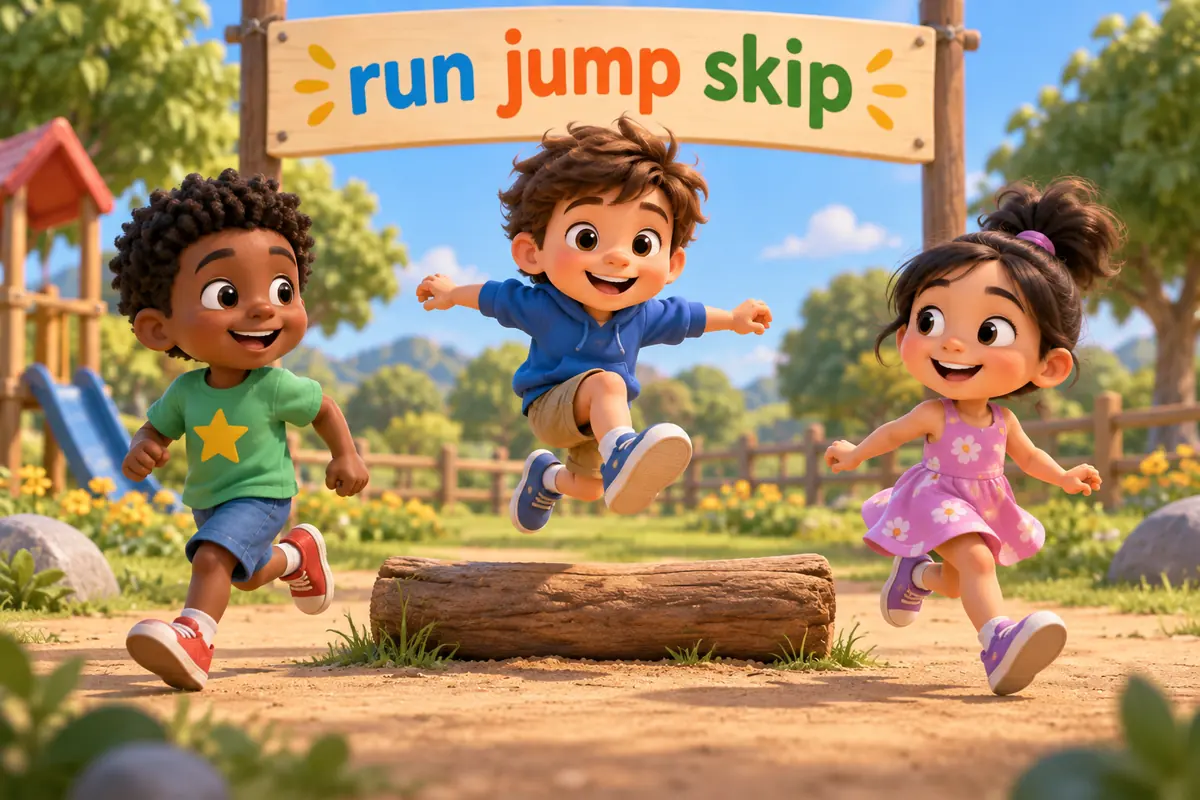
Action verbs in a sentence: examples across contexts
The same verbs appear in a classroom, a playground and a bedtime story, and each setting uses the action a child can picture.
| Context | Example sentence | Why this works |
|---|---|---|
| Classroom | We read a story together. | Reading is a quiet, everyday school action. |
| Playground | They climb the climbing frame. | Climbing names a clear physical move. |
| Kitchen | Mum stirs the soup. | Cooking verbs give a child a useful new word. |
| Bedtime | The baby sleeps in the cot. | Sleep completes a daily routine. |
| Bath time | He washes his hands. | A caring action a child does alone. |
| Garden | We plant tiny seeds. | Planting links a verb to a visible result. |
| Sports club | She kicks the ball to me. | A game gives the verb a clear object. |
| Music class | The children sing and clap. | Two verbs combine in one happy action. |
| Sharing time | The boys share their crayons. | A helping verb teaches a social skill. |
How do you teach action verbs to children?
Young learners pick up verbs fastest when the word arrives with the action, and the table below maps the method to the moment.
| Your goal | Method | Why it works |
|---|---|---|
| Teach a new verb | act it out together | The body links the sound to the movement. |
| Build a sentence | name a subject and a verb | Two parts show how a sentence starts. |
| Practise past tense | talk about yesterday | A real event calls for the past form. |
| Widen vocabulary | group verbs by family | Similar words are easy to recall together. |
| Check understanding | ask a child to do it | The action proves the meaning. |
A wider vocabulary builds from an alphabet list of words for young readers that starts with the letter A.
Word forms and grammar of action verbs
The verb changes with the subject and the time, and children meet the third-person -s first.
| Form | How it is used | Example |
|---|---|---|
| base form | with I, you, we, they | We run to the gate. |
| third-person -s | with he, she, it | She runs to the gate. |
| regular past -ed | for a finished action | They jumped over the log. |
| irregular past | a special past form | He went to the park. |
| helper + base | after can, will, must | I can swim. |
| -ing form | with is, are, was | The dog is running. |
Common mistakes with action verbs
The errors below appear in early writing, and each fix follows a rule a child can learn.
Incorrect: The dog run fast. Correct: The dog runs fast. Rule: A singular subject takes the -s form of the verb.
Incorrect: She goed to the park. Correct: She went to the park. Rule: Go has an irregular past form, went.
Incorrect: He can runs quickly. Correct: He can run quickly. Rule: After can, will or must, the verb keeps its base form.
Incorrect: The children plays together. Correct: The children play together. Rule: A plural subject takes the base form without -s.
Incorrect: She is jump on the bed. Correct: She jumps on the bed. Rule: An action needs its own verb, not the linking verb is.
Practice using action verbs
Try each item, then read the reason to check the answer.
- Fill in the blank: The rabbit ________ over the log. (jump)
- Fill in the blank: We ________ our hands before lunch. (wash)
- Choose the better verb: The bird ________ high in the sky. (flies / sits)
- Correct the error: He can swims very fast.
- Build a sentence: name a subject and an action for the playground.
- Spot the register: which fits a simple reader, The cat sleeps on the mat, or The cat is presently sleeping?
Answers
- jumps. A singular subject such as the rabbit takes the -s form.
- wash. The plural subject we takes the base form without -s.
- flies. Flying is the action that matches high in the sky.
- He can swim very fast. After can, the verb keeps its base form.
- Sample: The children climb the frame. A subject and an action make a complete sentence.
- The cat sleeps on the mat. A simple reader needs short words and a plain present verb.
The bottom line
100 action verbs for kids cover the everyday movements a child already makes, so the words are easy to teach by acting them out. Match the verb to the subject, keep the base form after can and will, and group similar verbs together. Then any action can become a sentence.
Frequently asked questions about action verbs for kids
Which action verbs should a young child learn first?
Start with the movements a child performs every day, such as run, jump, eat, sleep and wash. These verbs arrive with a clear action the child can do on request, which fixes the meaning fast. Add helping verbs such as share and help once the physical ones feel secure.
What is the difference between an action verb and a linking verb?
An action verb tells what the subject does, as in she jumps. A linking verb joins the subject to a description, as in she is happy, and names no action. Children can test the difference by asking whether the sentence shows something you could act out or copy.
Why is it we run but she runs?
English adds -s to the present-tense verb when the subject is a single person or thing, so she runs and the dog runs. With I, you, we or they, the verb keeps its base form and no -s appears. This is the subject-verb agreement rule a child meets first.
How can I help a child remember irregular past forms?
Use them in talk about real events, so a child says we went to the park and he ate his lunch. Repetition in everyday speech fixes forms such as went, ate and ran far better than a list. A short daily sentence about yesterday keeps the past tense alive.