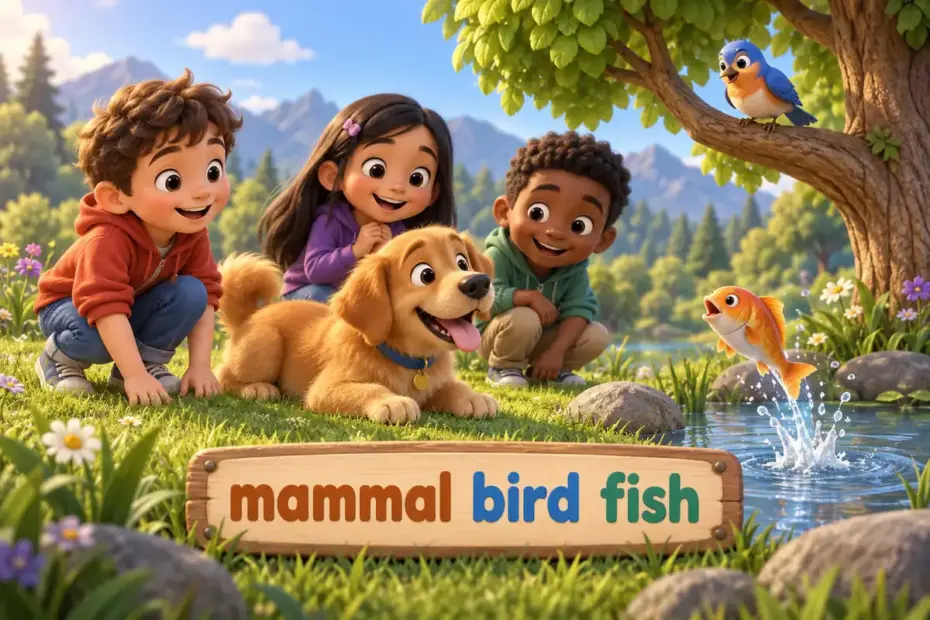
100 animal names with images turn a plain list into a picture dictionary, because each name is matched to a shape a learner recognises. Mammals, birds, fish, reptiles and insects each carry their own common names, and grouping them by kind aids recall. One example is simple: “The otter swims in rivers and sleeps on the bank.”
100 animal names at a glance
- Animal names group into mammals, birds, fish, reptiles, amphibians and insects.
- Each entry carries a common name, a group and one plain fact.
- Most animal plurals add -s, but a few stay the same, as sheep and deer.
- Learners mix up pairs such as alligator and crocodile or hare and rabbit.
- A picture fixes a name faster than a definition alone.
What are animal names?
An animal name is the common noun people use for a creature, such as dog, eagle or octopus. The name usually pairs with a group, so a dog is a mammal, an eagle is a bird and an octopus is a mollusc. Learners remember the name best when it is tied to a picture and one fact.
| Animal | Group | One plain fact |
|---|---|---|
| dog | mammal | It is one of the oldest domestic animals. |
| cat | mammal | It keeps its claws retracted when walking. |
| eagle | bird | It hunts with a hooked beak and sharp sight. |
| owl | bird | It hunts at night and turns its head far. |
| salmon | fish | It swims upstream to lay eggs. |
| octopus | mollusc | It has eight arms and changes colour. |
| frog | amphibian | It begins life as a tadpole in water. |
| cobra | reptile | It spreads a hood when threatened. |
| beetle | insect | It has hard wing cases over its back. |
| deer | mammal | It grows and sheds antlers each year. |
| penguin | bird | It swims well but cannot fly. |
| crab | crustacean | It walks sideways on jointed legs. |
How do you use animal names in a sentence?
An animal name is usually a countable noun, so it takes an article in the singular and a plural -s for more than one. A few names are irregular, and those forms are worth learning with the singular.
| Pattern | Example | What it signals |
|---|---|---|
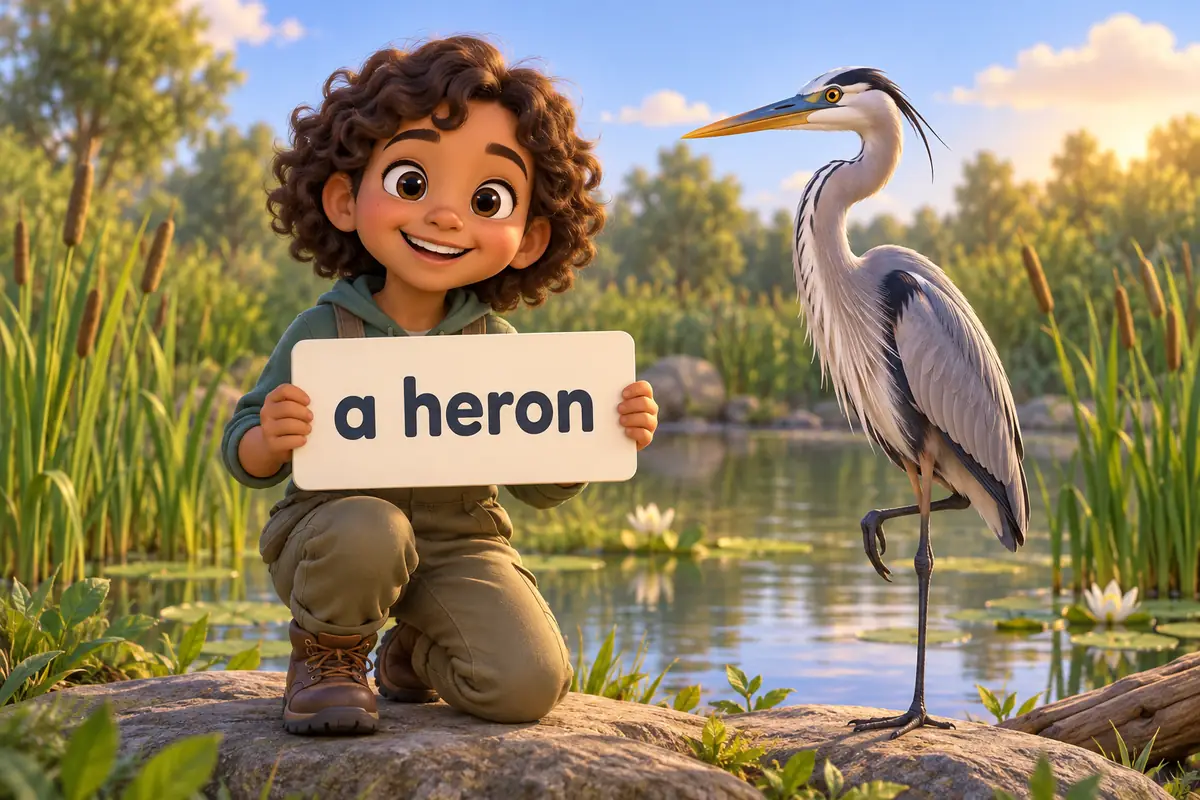
| a or an plus name | A heron stood by the water. | The singular countable noun needs an article. |
| name plus plural -s | Two foxes crossed the lane. | The plural marks more than one. |
| name as a modifier | The eagle nest sits high. | The first noun describes the second. |
| name in a fixed phrase | He is as busy as a bee. | The name appears inside an idiom. |
Several animal names also live inside fixed sayings, where the creature stands for a human quality rather than a literal animal.
| Idiom | Meaning | Example |
|---|---|---|
| as busy as a bee | very active | She is as busy as a bee before the show. |
| let the cat out of the bag | reveal a secret | He let the cat out of the bag by mistake. |
| the elephant in the room | an obvious problem no one mentions | Cost was the elephant in the room. |
| hold your horses | wait and be patient | Hold your horses until the results arrive. |
| a dark horse | a surprise winner | The young player was a dark horse in the race. |
Animal names across contexts
| Context | Example sentence | Why this works |
|---|---|---|
| Classroom | A mammal feeds its young with milk. | The group word frames the lesson. |
| Nature writing | The heron waited, still as a reed. | A precise name fixes the scene. |
| Farm report | The goats cleared the rocky pasture. | The name points to the working animal. |
| Zoo sign | The otter is active in the early morning. | The name and habit inform a visitor. |
| News story | Rangers moved the elephants to a wider reserve. | The plural name carries the subject. |
| Recipe note | The salmon bakes in twenty minutes. | The name works as a food noun. |
| Storytelling | The tortoise beat the hare to the line. | The two names carry the old fable. |
| Biology class | An amphibian spends part of its life in water. | The group term stays technical. |
| Travel blog | We saw a whale from the cliff path. | The name marks a memorable sighting. |
| Everyday chat | A stray cat lives behind the shed. | The name suits a casual line. |
Animal names and their nearest confusables
A few animal pairs share a look, so the name has to match the fact rather than the shape alone.
| Point | alligator | crocodile |
|---|---|---|
| Snout | wide and rounded | narrow and pointed |
| Teeth | the lower teeth stay hidden | the lower teeth show when the mouth closes |
| Habitat | mainly fresh water | fresh and salt water |
| Colour | darker, often grey-black | lighter, often olive-green |
| Common error | calling every crocodile an alligator | calling every alligator a crocodile |
For more frames, see the word animal in a sentence and farm animal in a sentence, for pets see domestic animal in a sentence, and for the ocean see marine animal in a sentence.
Word forms and grammar of animal names
| Form | Part of speech | Example |
|---|---|---|
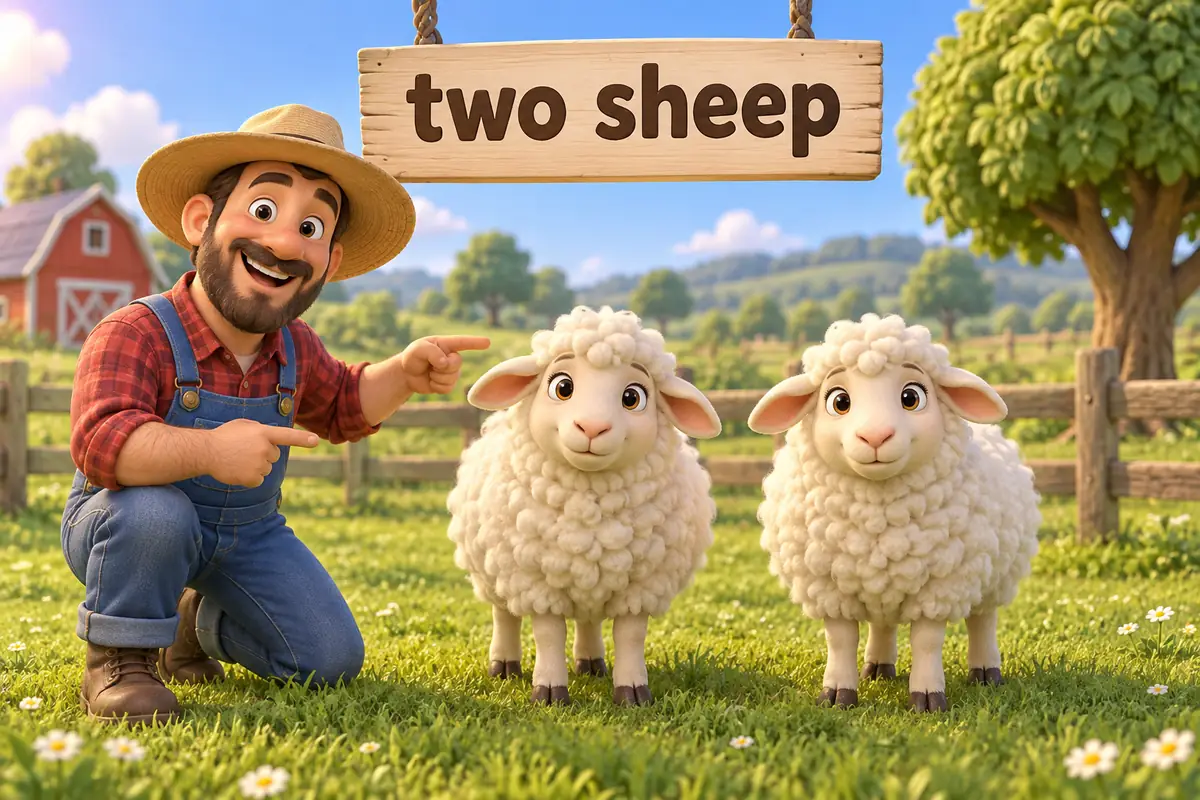
| sheep | noun, same singular and plural | One sheep grazed. Two sheep grazed. |
| deer | noun, same singular and plural | A deer crossed. Many deer crossed. |
| mouse | noun with irregular plural | One mouse. Several mice. |
| goose | noun with irregular plural | One goose. Several geese. |
| animal | noun | An animal needs food and water. |
| animal | modifier | Animal welfare rules apply here. |
| wildlife | uncountable noun | Wildlife thrives near the lake. |
Common mistakes with animal names
- Incorrect:
Two sheeps stood in the field.Correct: Two sheep stood in the field. Rule: sheep keeps the same form in the plural. - Incorrect:
I saw a elephants at the waterhole.Correct: I saw elephants at the waterhole. Rule: a plural countable noun takes no article. - Incorrect:
Several mouses ran under the floor.Correct: Several mice ran under the floor. Rule: mouse has the irregular plural mice. - Incorrect:
An octopus are a fish.Correct: An octopus is a mollusc. Rule: the verb agrees with the singular subject and the group must be right. - Incorrect:
The cattles grazed near the barn.Correct: The cattle grazed near the barn. Rule: cattle is already plural and takes no -s.
Practice using animal names
Try each item, then read the reason to check the answer.
- Fill in the blank: A ________ builds a dam across the stream.
- Fill in the blank: Three ________ swam past the boat.
- Choose the better name: the bird that hunts at night is an ________. (owl / eagle)
- Correct the error: Two deers crossed the road.
- Build a sentence: use a or an plus an animal name about a creature near water.
- Spot the register: which fits a zoo sign, “The otter is active in the early morning” or “Otter is busy”?
Answers
- Beaver: it builds dams, which no other common animal in the list does.
- Salmon: salmon is both singular and plural, so three salmon needs no -s.
- Owl: an owl hunts at night, while an eagle hunts by day.
- Two deer crossed the road: deer keeps the same form in the plural.
- Sample: A heron stood by the water. A singular countable noun needs a or an before it.
- The otter is active in the early morning: a sign gives a full, calm fact, while the other line is casual slang.
The bottom line
100 animal names with images work best as groups, because a mammal, a bird and a reptile each carry their own naming habits. Watch the plurals, since sheep, deer and cattle do not add an -s, and check a confusable pair against a fact rather than a silhouette. Learn one name with one picture and one fact, and the list stays in memory.
Frequently asked questions about animal names
How many animal names should a beginner learn first?
A beginner can start with about twenty common names that cover each group, such as dog and cat for mammals, eagle and owl for birds, salmon for fish and frog for amphibians. Adding one picture and one fact to each name fixes it faster than reading a long list.
Why are some animal plurals irregular?
A small set of animal nouns keeps an old plural form, so sheep and deer stay the same and mouse becomes mice. These forms survive because the words are very old and very common. The safe habit is to learn the plural with the singular as a pair.
What is the difference between an alligator and a crocodile?
An alligator has a wide, rounded snout and its lower teeth stay hidden when the mouth closes, while a crocodile has a narrow, pointed snout and shows its lower teeth. Alligators live mainly in fresh water, and crocodiles tolerate salt water as well.
Can animal names be used as describing words?
Yes. An animal name can sit before another noun as a modifier, as in eagle nest, farm animal or dog food. In that position it describes the second noun rather than naming a creature on its own, and it stays singular even when it means many.