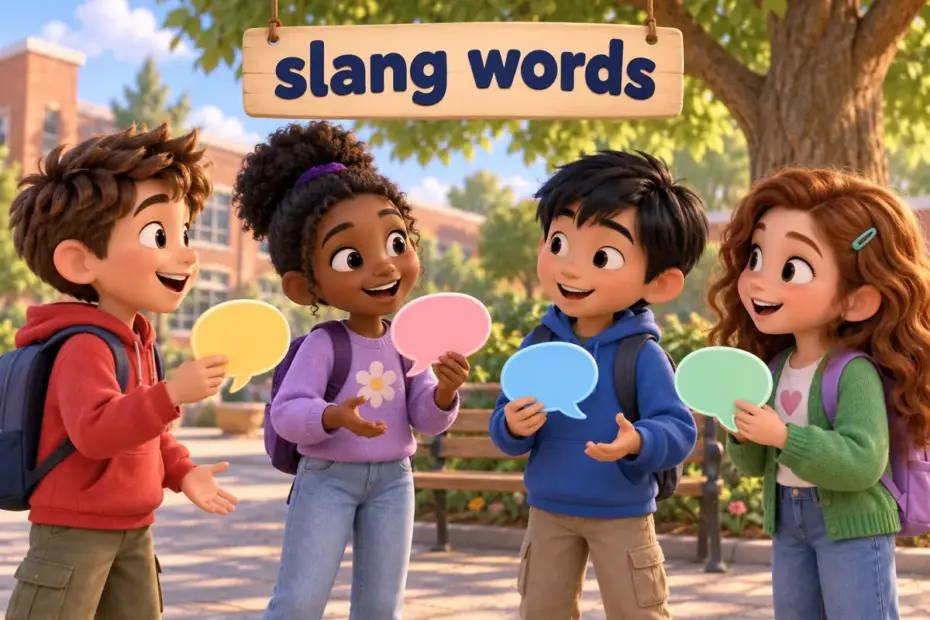
100 slang words with meanings give a fast route into the informal English people really speak. Slang is the casual vocabulary of friends, school and the internet, and it changes faster than formal words. A simple example is “I am stoked for the trip”, meaning very excited.
100 slang words with meanings at a glance
- Slang is informal language used with friends, not in formal writing.
- Most slang words are short, and many come from older dialects.
- A slang word often has a plain meaning and a casual twin.
- The same word can be warm in one group and rude in another.
- The commonest mistake is using slang in a school essay or a job letter.
What is slang?
Slang is the loose, playful vocabulary that groups invent and share, and it usually lives in speech and online messages rather than in dictionaries. A slang word can stand in for a plain word, add strong feeling, or mark someone as part of a group. The table below shows ten core terms and how each one behaves.
| Slang | Meaning | Example |
|---|---|---|
| cool | good or acceptable | That is cool with me. |
| hang out | spend time together | We hang out after class. |
| bail | leave or cancel | He bailed on the plan. |
| lit | exciting or excellent | The concert was lit. |
| fam | close friends or family | Thanks, fam. |
| no worries | it is fine | No worries, I will wait. |
| legit | genuine or good | That excuse is not legit. |
| hyped | excited | We are hyped for Friday. |
| ghost | stop replying suddenly | He ghosted me for a week. |
| flex | show off | That is a quiet flex. |
How do you use slang in a sentence?
Slang follows the same grammar as the plain word it replaces, so the sentence shape rarely changes. What changes is the tone: slang suits a message to a friend and looks out of place in a report or a letter to a teacher.
| Pattern | Example | What it signals |
|---|---|---|
| slang as a verb | We hang out on Fridays. | A casual action with friends. |
| slang as an adjective | That film was lit. | Strong praise or excitement. |
| slang as a noun | He is a real legend. | A friendly label for a person. |
| slang in a greeting | Sup, buddy? | An informal hello. |
| slang with a plain verb | I am stoked to start. | Everyday grammar with a slang adjective. |
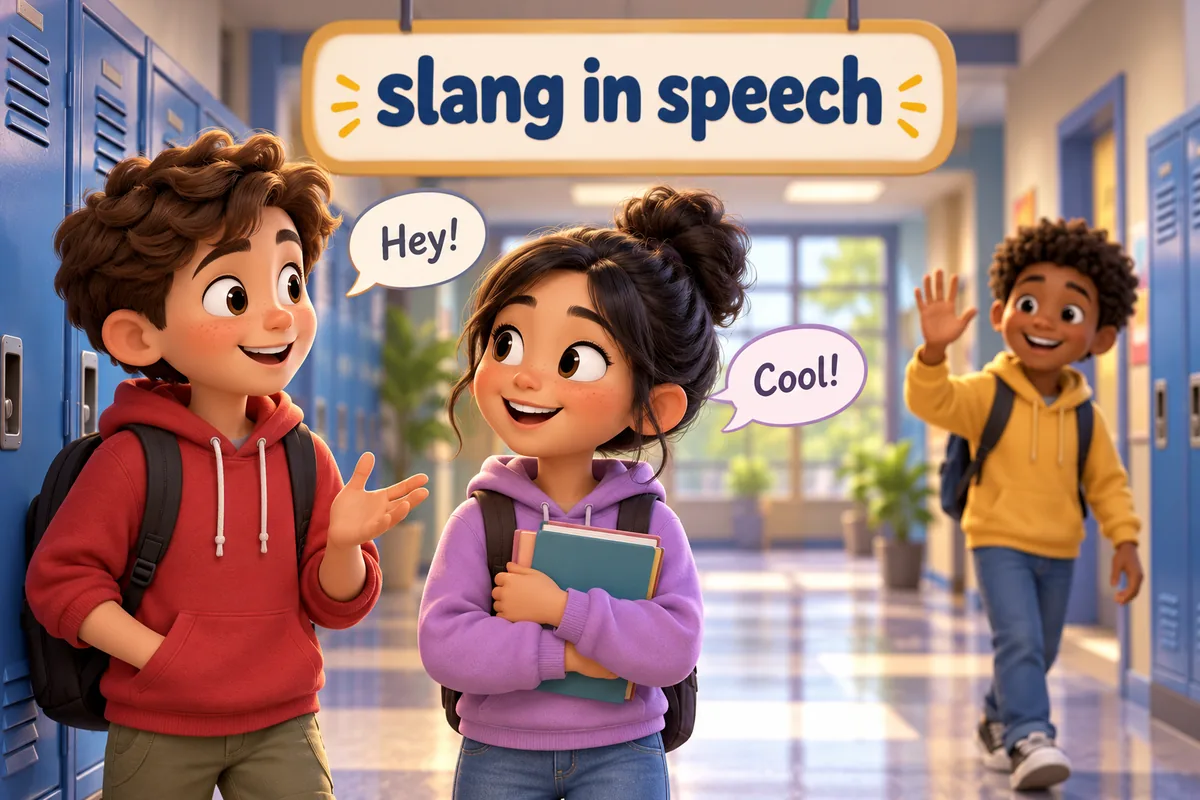
100 slang words with meanings across five groups
The list is grouped into five everyday areas so a learner can find the word they need. Every entry carries a short meaning and one example sentence, and the plain word sits beside it for comparison.
Greetings and goodbyes
| Slang | Meaning | Example |
|---|---|---|
| hey | hello | Hey, how are you? |
| yo | hello, casual | Yo, what is up? |
| sup | what is up | Sup, buddy? |
| hiya | hello | Hiya, everyone. |
| howdy | hello | Howdy, partner. |
| what’s up | how are you | What’s up with you? |
| later | goodbye for now | Later, everyone. |
| peace | goodbye | Peace, I am off. |
| catch you later | see you soon | Catch you later, Sam. |
| take care | goodbye | Take care, see you soon. |
| cheers | thanks | Cheers for the lift. |
| ta | thank you | Ta for the help. |
| ciao | hello or goodbye | Ciao, see you soon. |
| see ya | goodbye | See ya tomorrow. |
| adios | goodbye | Adios, my friend. |
| deuces | goodbye | Deuces, I am out. |
| holla | hello | Holla, is anyone there? |
| g’day | hello | G’day, mate. |
| aloha | hello or goodbye | Aloha, everyone. |
| peace out | goodbye | Peace out, team. |
Friends and people
| Slang | Meaning | Example |
|---|---|---|
| dude | a person, often male | Dude, that was funny. |
| mate | a friend | Thanks, mate. |
| pal | a friend | You are a good pal. |
| buddy | a friend | Come on, buddy. |
| homie | a close friend | That is my homie. |
| bro | a brother or friend | Nice one, bro. |
| sis | a sister or friend | Go for it, sis. |
| fam | close friends or family | I have got you, fam. |
| squad | a close group | The whole squad came. |
| crew | a group of friends | Meet the crew. |
| bestie | a best friend | My bestie called me. |
| bae | a sweetheart | Bae, look at this. |
| folks | people or parents | The folks are here. |
| guys | a group of people | Hey, guys. |
| lad | a boy or young man | He is a good lad. |
| bloke | a man | That bloke is kind. |
| chick | a young woman, informal | She is a cool chick. |
| newbie | a beginner | A newbie joined today. |
| pro | an expert | She is a real pro. |
| legend | a great person | You are a legend. |
Approval and reactions
| Slang | Meaning | Example |
|---|---|---|
| cool | good | That is cool. |
| sweet | good | Sweet, let us go. |
| awesome | excellent | Awesome work. |
| epic | very impressive | That goal was epic. |
| lit | exciting | The party was lit. |
| fire | excellent | That song is fire. |
| sick | very good | Sick trick, man. |
| dope | very good | Dope shoes. |
| wicked | great | Wicked idea. |
| rad | great | Rad skateboard. |
| ace | excellent | Ace job, team. |
| neat | tidy or good | Neat trick. |
| sharp | smart or stylish | Sharp outfit. |
| solid | reliable or good | Solid plan. |
| clean | neat or smooth | Clean catch. |
| clutch | decisive at the right time | That shot was clutch. |
| killer | excellent | Killer move. |
| gnarly | impressive or tough | Gnarly wave. |
| mean | impressive | Mean guitar solo. |
| boss | excellent | Boss move. |
Feelings and states
| Slang | Meaning | Example |
|---|---|---|
| stoked | excited | I am stoked for the trip. |
| psyched | excited | She is psyched to play. |
| hyped | excited | We are hyped for the match. |
| pumped | excited | He is pumped to start. |
| bummed | disappointed | I am bummed about the rain. |
| gutted | very disappointed | She was gutted to lose. |
| salty | annoyed | He is still salty about it. |
| chuffed | pleased | I am chuffed with my mark. |
| knackered | very tired | I am knackered tonight. |
| beat | tired | You look beat. |
| wiped | exhausted | We were wiped after the hike. |
| zonked | exhausted | He was zonked by noon. |
| starving | very hungry | I am starving. |
| hangry | angry from hunger | She gets hangry at lunch. |
| chill | calm | Just chill, it is fine. |
| mellow | relaxed | The mood was mellow. |
| wired | full of energy | I am wired after that coffee. |
| jittery | nervous | He felt jittery before the test. |
| spaced | distracted | Sorry, I spaced out. |
| mad | angry | He was mad about the delay. |
Everyday actions
| Slang | Meaning | Example |
|---|---|---|
| hang out | spend time together | We hang out on Fridays. |
| grab a bite | eat something quickly | Let us grab a bite. |
| crash | sleep | I need to crash early. |
| bail | leave or cancel | He bailed on us. |
| bounce | leave | Time to bounce. |
| chillax | relax fully | Just chillax tonight. |
| hit the road | set off | We hit the road at dawn. |
| kick back | relax | Kick back and rest. |
| pig out | eat a lot | We pigged out on pizza. |
| chow down | eat | Chow down, everyone. |
| nosh | have a snack | Let us nosh before the film. |
| veg out | relax lazily | We vegged out all day. |
| snooze | sleep briefly | Do not snooze the alarm. |
| score | get something wanted | I scored a free ticket. |
| snag | get something quickly | She snagged a bargain. |
| nab | take quickly | He nabbed the last seat. |
| cop | buy or get | I copped new shoes. |
| flake | cancel at the last minute | Do not flake on us. |
| dip | leave quietly | He dipped before the end. |
| rock up | arrive | They rocked up late. |
Slang across contexts
One slang word can fit a message to a friend and sound wrong in an essay, so the setting matters as much as the meaning. Each example below shows slang used well in one place.
| Context | Example sentence | Why this works |
|---|---|---|
| Text message | Catch you later, fam. | Slang suits a quick goodbye between friends. |
| School corridor | That test was rough, I am wiped. | Casual words match a tired chat. |
| Group chat | Who is down for pizza tonight? | Slang invites a fast reply. |
| Sports field | That save was clutch. | Praise sounds natural on the pitch. |
| Family dinner | The folks are hyped for the trip. | Warm slang can fit relaxed family talk. |
| Online game | Good game, you are a legend. | Friendly slang builds team spirit. |
| Music talk | This track is fire. | Slang carries strong feeling. |
| Birthday post | Happy birthday, bestie. | Slang keeps a message affectionate. |
| Camping trip | Let us chow down by the fire. | Slang fits an easy outdoor meal. |
| Class presentation | Avoid slang and use formal words. | A formal setting needs plain vocabulary. |
Slang and formal words compared
Every slang term has a plainer twin, and choosing the right one depends on who is reading. The table sets a few pairs side by side.
| Point | slang | formal twin |
|---|---|---|
| Tone | casual and warm | neutral and clear |
| Setting | friends and messages | school, work and reports |
| Example | That is sick. | That is excellent. |
| Lifespan | often short-lived | stable for years |
| Risk | can sound rude or dated | widely understood |
| Best for | building closeness | building trust and clarity |
Use slang to build closeness with people you know, and use the formal twin when the reader is a teacher, a boss or a stranger. The two styles can live in one person, but they rarely belong in one sentence.
Word forms and grammar of slang
Slang copies the grammar of ordinary English, so a slang verb still takes the usual endings and a slang adjective still sits before its noun.
| Form | Part of speech | Example |
|---|---|---|
| bail | verb | He bails whenever it rains. |
| bailed | past verb | She bailed before the film. |
| bailing | present participle | They are always bailing on plans. |
| lit | adjective | The show was lit. |
| legend | noun | She is a legend. |
| ghosted | verb | He ghosted the group chat. |
| fam | noun | Thanks, fam. |
Many slang terms also carry an idiom sense, so a learner who meets them in speech should check a slang sentence and a slangy sentence for balance. A fixed expression works the same way, as shown in an idiom sentence, and the plain side lives in a vocabulary sentence.
Common mistakes with slang
Slang is easy to get wrong because its tone shifts with the group and the moment. These five slips cover most of the trouble.
- Incorrect:
The report shows the plan is, like, a total flop.Correct: The report shows the plan failed. Rule: formal writing needs plain vocabulary. - Incorrect:
Good morning, sir, sup?Correct: Good morning, sir, how are you? Rule: greeting style must match the listener. - Incorrect:
She is a sick person.Correct: She is an excellent person. Rule: a slang sense can clash with the medical meaning. - Incorrect:
I am stoked, I am stoked, so stoked.Correct: I am stoked about the trip. Rule: repeat a slang word once, not three times. - Incorrect:
Yo, mister teacher, wassup.Correct: Hello, teacher, how are you? Rule: slang does not replace basic politeness with a stranger.
Practice using slang
Try each item, then read the reason beside the answer to check your thinking.
- Fill in the blank: We ________ out at the park every Saturday. (spend time together)
- Fill in the blank: I am ________ for the match. (excited)
- Choose the better word: after the long hike we felt wiped / lit. (wiped / lit)
- Correct the error: Good morning, professor, sup?
- Build a sentence: use hustle and chill in one friendly text.
- Spot the register: which fits a job letter, “I am stoked to join” or “I am delighted to join”?
Answers
- hang, because hang out means spend time together.
- hyped, because hyped means excited.
- wiped, because wiped means tired while lit means exciting.
- Good morning, professor, how are you? because a professor is a stranger who needs plain politeness.
- Sample: Just let me chill, then we can hustle to the bus. It pairs two casual verbs naturally.
- I am delighted to join, because a job letter needs formal, plain vocabulary.

The bottom line
100 slang words with meanings open the door to informal English, but the plain twin is what carries you into a classroom or an office. Learn each term with one example and note whether it sounds warm or rude. Keep slang for friends and messages, and reach for the formal word when the reader is a teacher, a boss or a stranger.
Frequently asked questions about slang
Is slang the same as a dialect?
No. A dialect is a full system of pronunciation, grammar and words shared by a region or group, while slang is a small set of casual terms that sits on top of any dialect. Slang can move between dialects quickly, and a dialect keeps its own grammar for far longer.
Can slang ever be used in school writing?
Slang can appear in school writing when the task is a story, a message from a character or a quote. In a report, an essay or a formal letter, the plain word is safer. A useful test is to ask whether the reader expects formal English or a natural voice.
Why does slang change so quickly?
Slang changes fast because it signals belonging, and each new group wants its own words. When a term spreads too widely, it stops marking a group and a fresh term replaces it. That is why a word can sound trendy one year and dated a few years later.
What should a learner do with a new slang word?
A learner should note the word, its plain meaning and the setting where it fits, then listen before using it. Copying slang too early can sound forced or rude. Once a learner hears a term used warmly by friends, it is safe to try in the same setting.