100 writing sentences for kids gives young learners model lines to copy, finish, and improve. The examples grow from a short caption such as The dog runs to a joined line such as The dog runs and the cat sleeps. Short prompts turn each model into writing practice a child can do alone.
100 Writing Sentences for Kids at a Glance
- A writing sentence is one a child builds, not only reads.
- Practice moves in three steps: label, add detail, join ideas.
- Models show the shape, and prompts make the child supply the words.
- Familiar topics keep attention on the writing.
- The commonest error is a run-on without a joining word.
What Are Writing Sentences for Kids?
A writing sentence for kids is a model line that a child uses to practise composing, rather than only reading. The task is active: copy the model, change a word, finish an open line, or build a new one on the same pattern. Because the grammar is already correct in the model, the child concentrates on choosing words and holding the sentence together.
| Step | What the child does | Example |
|---|---|---|
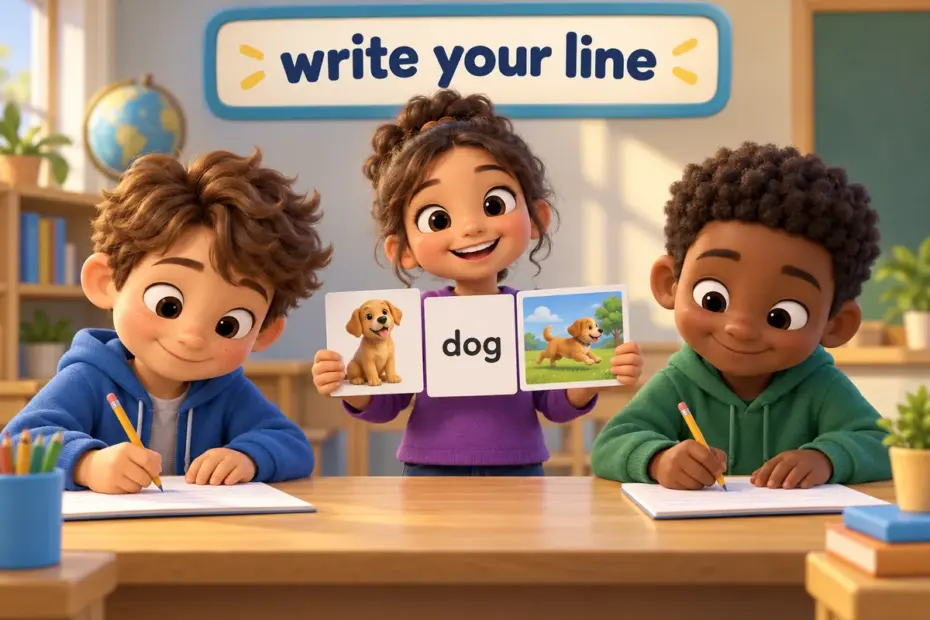
| Label | names the picture in one word | dog |
| Simple line | adds a verb to the label | The dog runs. |
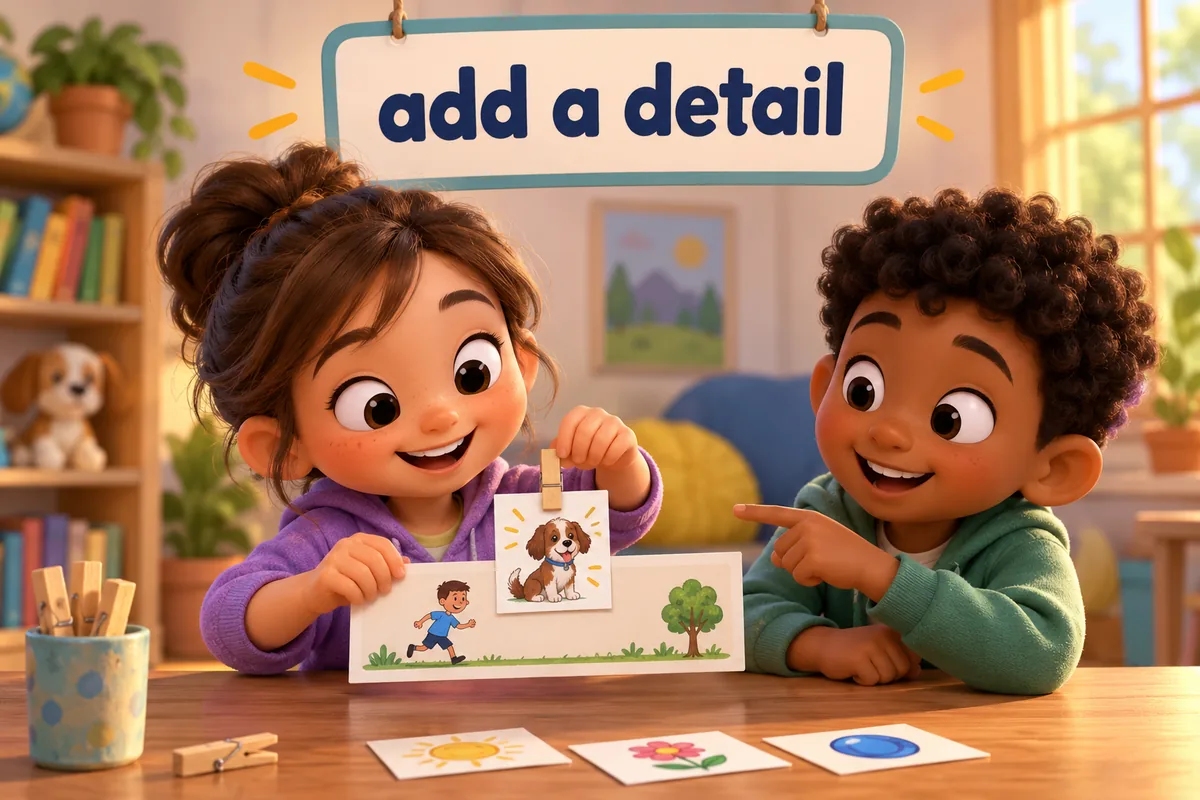
| Add detail | adds one describing word | The big dog runs. |
| Add phrase | adds where or when | The big dog runs in the park. |
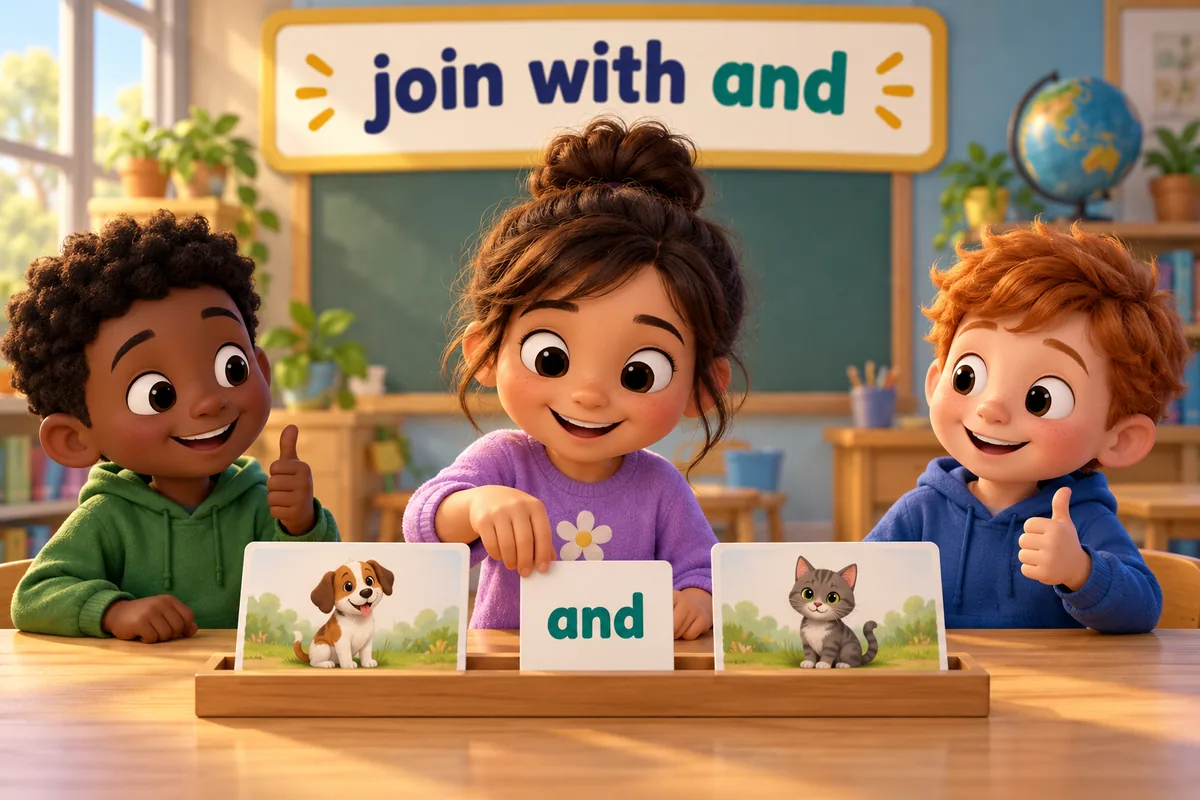
| Join | links two lines with a joining word | The big dog runs, and the cat sleeps. |
How Do You Practise Writing Sentences With Kids?
Give a model, then change one thing at a time. Start with a subject and verb, add a single detail, and only join two ideas when the child is ready. The patterns below show how each small addition keeps the sentence correct while making it richer.
| Pattern | Example | What the child practises |
|---|---|---|
| subject + verb | Birds fly. | the base frame |
| add an adjective | Little birds fly. | describing words |
| add a phrase | Little birds fly over the wall. | where or when |
| join with and | Birds fly, and bees buzz. | linking two ideas |
| join with because | We ran because it rained. | cause and effect |
Writing Sentences for Kids: Examples Across Contexts
These models use places a child knows, and the note beside each line shows the skill being practised.
| Context | Sentence | What it practises |
|---|---|---|
| Pets | My puppy sleeps on the rug. | a phrase telling where. |
| School | We painted a picture today. | a time word. |
| Playground | The swing goes up and down. | two postions in one line. |
| Food | I ate a warm bun for lunch. | one describing word. |
| Weather | Bright snow covered the garden. | a vivid past verb. |
| Family | My sister reads to me at night. | a habit in the present. |
| Toys | The red train chugs along the floor. | a colour and a sound verb. |
| Nature | A small bee visits the flowers. | a present action. |
| Trip | We saw three boats on the lake. | a number word. |
| Story | The brave mouse hid under the chair. | a character and a place. |
| Morning | I brush my teeth before breakfast. | a sequence word. |
| Evening | The stars shine in the dark sky. | a poem-like line. |
Which Sentence Starter Should a Child Use?
Pick the starter by the writing goal. A description wants an adjective, a report wants a plain subject-verb line, and a story wants a vivid verb. Matching the starter to the goal teaches a child to choose rather than guess.
| Writing goal | Starter to use | Example |
|---|---|---|
| Describe something | The … is | The sky is grey. |
| Tell an action | A … | A dog barked. |
| Report a fact | We … | We built a tower. |
| Show a feeling | I felt … | I felt proud. |
| Begin a story | Once … | Once a fox lived here. |
A child adds detail fastest with the describing words gathered in adjectives for writing. Story sentences come alive with the choices in adjectives for story writing. Older children benefit from avoiding adjective overuse once they can write longer lines. Vocabulary for the writing tasks grows from sets such as a words for kids.
Word Forms and Grammar of Writing Sentences
Three word types carry most children’s writing. The table shows how each one slots into a line.
| Word type | Job in the sentence | Example |
|---|---|---|
| noun | names the thing | the kite |
| verb | shows the action or state | the kite flies |
| adjective | describes the thing | the red kite |
| adverb | says how the action happens | the kite flies high |
| joining word | links two ideas | the kite flies, and we cheer |
| run-on (non-standard) | two lines without a join | The kite flies we cheer |
Common Mistakes in Writing Sentences for Kids
My dog is run in the park. Write My dog runs in the park. Rule: use one main verb, not a linking verb plus another verb.
The kite flies we cheer. Write The kite flies, and we cheer. Rule: two complete ideas need a joining word.
A very big. Write A very big dog barked. Rule: a sentence needs a noun and a verb, not just describing words.
I goed to the shop. Write I went to the shop. Rule: some common past forms are irregular.
The cat sleep. Write The cat sleeps. Rule: a singular subject takes the -s form of the verb.
Practice Writing Sentences
- Fill in the blank: The little dog ______ in the garden. (run)
- Choose the better line: (Big dog. / The big dog barks.)
- Correct the error: The kite flies we cheer.
- Build a sentence: describe the sky in one line with an adjective.
- Fill in the blank: We ran ______ it rained. (joining word)
- Spot the register: which suits a story, The brave mouse hid or The mouse was observed hiding?
Answers
- runs — a singular subject takes the -s verb form.
- The big dog barks. — it has a subject and a verb.
- The kite flies, and we cheer. — the two ideas need and.
- Sample: The sky is grey. — an adjective follows the linking verb.
- because — because gives the reason for running.
- The brave mouse hid — the vivid line suits a story.
The Bottom Line
100 writing sentences for kids works when each model is short, correct, and ready to change. Build every line in small steps: name the thing, add a verb, add one detail, then join two ideas with a joining word. Copying a good model and changing one word teaches more than a page of rules, and daily practice makes the pattern stick.
Frequently asked questions about writing sentences for kids
How do I teach a child to write a sentence?
Begin with the two parts every sentence needs: a thing and an action. Ask the child to name something and then say what it does, giving a line such as The dog runs. From there, add one describing word at a time. Model the line, change a single word together, and let the child try the next one alone.
How long should a child’s sentence be?
For young writers, six to ten words is a comfortable target, short enough to punctuate correctly and read aloud in one breath. A child can also join two such lines into a longer sentence. Length should grow slowly as control improves, because a long line written without control usually becomes a run-on.
Should children copy model sentences?
Yes, copying is a starting step, but it should not stop there. Copying fixes the shape of a correct sentence; changing one word in the model forces the child to make a real choice. Finish each copy with a small change or a fresh line on the same pattern, so the model becomes a tool rather than an answer.
How can I help a child who writes run-on sentences?
Ask the child to read the sentence aloud and stop where the sense ends. Reading aloud exposes the point where one idea finishes and the next begins, which is where a full stop or a joining word belongs. Then practise joining two short lines with and, but or so until the pattern feels natural.