
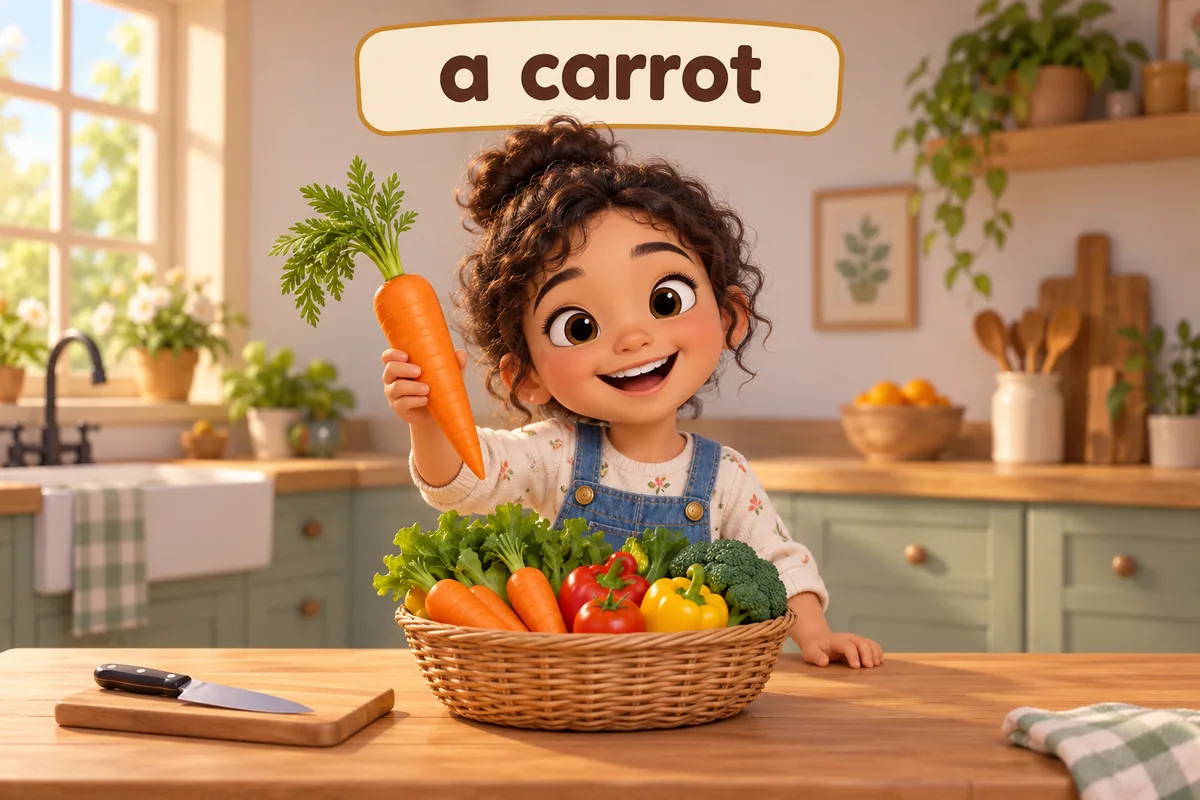
100 vegetable names in English cover the roots, leaves, stems and fruits that people cook and eat. Grouping them by the part of the plant we use, such as root vegetables and leafy greens, makes the list far easier to learn. A simple example is “The carrot grows under the soil.”
100 vegetable names at a glance
- A vegetable is a plant or plant part eaten as food.
- Vegetables group by the part eaten: root, leaf, stem, flower and fruit.
- Most vegetable names are countable, so a carrot means one and carrots means more.
- Some names are uncountable in cooking, as in add spinach to the pan.
- Learners often confuse vegetables with fruits, which carry seeds and grow from a flower.
What are vegetable names?
A vegetable name is the common word for a plant part eaten as food, such as carrot, cabbage or leek. Cooks divide them by the part used, so a carrot is a root, a cabbage is a leaf and a celery stalk is a stem. The name usually comes with the part it belongs to.
| Vegetable | Part we eat | One plain fact |
|---|---|---|
| carrot | root | It grows straight down into the soil. |
| potato | tuber | It stores starch in an underground stem. |
| cabbage | leaf | Its leaves wrap into a tight head. |
| spinach | leaf | Its soft leaves cook in seconds. |
| lettuce | leaf | It is eaten mostly raw in salads. |
| celery | stem | Its stalks are crisp and full of water. |
| broccoli | flower | We eat its green flower heads. |
| cauliflower | flower | Its white head is a mass of buds. |
| onion | bulb | Its layers store food for the plant. |
| garlic | bulb | Each clove can grow a new plant. |
| tomato | fruit | It carries seeds and grows from a flower. |
| cucumber | fruit | It is mostly water and eaten raw. |
How do you use vegetable names in a sentence?
Vegetable names are countable nouns, though a few work as uncountable mass nouns when they name food rather than plants.
| Pattern | Example | What it signals |
|---|---|---|
| a or an plus name | She peeled a carrot. | The singular countable noun needs an article. |
| plural plus verb | The tomatoes ripen fast. | The plural marks more than one. |
| name as uncountable food | Add spinach to the pan. | The mass noun names food, not a plant. |
| name as a modifier | A carrot cake needs spice. | The first noun describes the second. |
A handful of fixed phrases carry a vegetable name, and they appear in ordinary speech rather than on a menu.
| Phrase | Meaning | Example |
|---|---|---|
| couch potato | a lazy person | He became a couch potato over the holiday. |
| as cool as a cucumber | very calm | She stayed as cool as a cucumber. |
| small potatoes | unimportant | The late fee was small potatoes. |
| in a pickle | in a difficult situation | We were in a pickle without the recipe. |
| spill the beans | reveal a secret | Do not spill the beans before the party. |
Vegetable names across contexts
| Context | Example sentence | Why this works |
|---|---|---|
| Market | The carrots are fresh this morning. | The name points to a produce item. |
| Recipe | Dice the onion before frying. | The name leads a cooking step. |
| Garden | The lettuce grows in cool weather. | The name fits a growing note. |
| Classroom | A potato is a tuber, not a root. | The name supports a science point. |
| Nutrition note | Spinach adds iron to a meal. | The name carries a health fact. |
| Restaurant menu | Roasted cauliflower comes with herbs. | The name suits a dish title. |
| Farm report | The tomato harvest starts in July. | The plural name suits a report. |
| Shop talk | These cucumbers are cheaper today. | The name supports a comparison. |
| Travel blog | We bought garlic at the village stall. | The name marks a local buy. |
| Everyday chat | Peel the potato, please. | The name suits a quick request. |
Vegetable and fruit compared
The kitchen and the science lab disagree about a few foods, so the word choice depends on the setting rather than the food itself.
| Point | vegetable | fruit |
|---|---|---|
| Meaning | a plant part eaten in a savoury dish | the seed-bearing part that grows from a flower |
| Example | a carrot is a vegetable | an apple is a fruit |
| Botany | a loose kitchen term | a precise botanical term |
| Taste | often savoury or mild | often sweet |
| Common error | calling a tomato a vegetable in botany | calling a tomato a fruit on a menu |
The word also appears in natural lines at vegetable sentence examples, where the countable and uncountable uses sit side by side. For more frames, see sentences built around vegetables in a kitchen context, and a learner can check a vegetable in a full sentence against the patterns above.
Word forms and grammar of vegetable names
One base word gives a noun, a plural and a describing form, and the ending shows which job the word is doing in the sentence.
| Form | Part of speech | Example |
|---|---|---|
| vegetable | noun | A vegetable grows in the field. |
| vegetables | plural noun | The vegetables are on the stove. |
| vegetarian | noun or adjective | A vegetarian avoids meat. |
| veggie | informal noun | She packed a veggie lunch. |
| fresh | adjective | Fresh cabbage keeps for a week. |
| raw | adjective | Raw carrot is very crisp. |
| boil | verb | Boil the potatoes for ten minutes. |
Common mistakes with vegetable names
Most errors come from agreement and from the uncountable food use, and both are quick to check.
- Incorrect:
I bought a carrots at the market.Correct: I bought carrots at the market. Rule: a plural countable noun takes no article. - Incorrect:
The vegetables is ready.Correct: The vegetables are ready. Rule: a plural subject takes a plural verb. - Incorrect:
She peeled an onion bulb.Correct: She peeled an onion. Rule: the common name already names the object, so the extra label is wrong. - Incorrect:
A spinach are good for you.Correct: Spinach is good for you. Rule: spinach is uncountable and takes no article. - Incorrect:
These tomato are ripe.Correct: These tomatoes are ripe. Rule: the plural noun and the verb must both be plural.
Practice using vegetable names
Try each item, then read the reason to check the answer.
- Fill in the blank: A ________ grows straight down into the soil.
- Fill in the blank: These ________ are ripe and red.
- Choose the better word: a potato is a ________, not a root. (tuber / bulb)
- Correct the error: The vegetables is on the stove.
- Build a sentence: use a or an plus a vegetable name about something on a market stall.
- Spot the register: which fits a recipe, “Dice the onion before frying” or “Onion chop now”?
Answers
- Carrot: it grows downward as a root vegetable.
- Tomatoes: the plural noun matches the plural verb are and the red colour.
- Tuber: a potato is an underground stem, while a bulb such as onion has layers.
- The vegetables are on the stove: a plural subject takes the plural verb are.
- Sample: A cabbage sits on the stall. The article a marks one countable vegetable.
- Dice the onion before frying: a recipe uses a full, clear instruction.

The bottom line
100 vegetable names in English are easiest to learn by the part we eat, from roots and leaves to stems and flowers. Treat most names as countable, so a carrot is one and carrots are more, and note when a name turns uncountable as food, as in add spinach. Keep vegetable for the kitchen sense and fruit for the seed-bearing botanical sense.
Frequently asked questions about vegetable names
How do you group vegetables for learning?
Group them by the part of the plant we eat: root vegetables such as carrot and beetroot, leafy greens such as cabbage and spinach, stem vegetables such as celery, flower vegetables such as broccoli, and fruit vegetables such as tomato and cucumber. The group gives each name a hook.
Why is spinach uncountable in a sentence?
Spinach often names food rather than a single plant, so it behaves as an uncountable noun and takes no article, as in add spinach to the pan. When it names separate plants in a field, speakers may count it, but the food sense is far more common.
What is the difference between a vegetable and a fruit?
In everyday cooking, a vegetable is a savoury plant part used in main dishes, while a fruit is the sweet, seed-bearing part that grows from a flower. In botany, tomato and cucumber are fruits because they carry seeds, even though cooks treat them as vegetables.
How do you make a vegetable name plural?
Most vegetable names add -s, so carrot becomes carrots and onion becomes onions. A few change form, such as potato to potatoes and tomato to tomatoes, which add -es because they end in -o. Learn the plural with the singular as a pair.