Drop Off in a Sentence: Meanings, Grammar & Examples
Drop off is a phrasal verb with four everyday senses: to deliver someone or something, to fall asleep, to decline, and to become fewer. To use drop off in a sentence, decide which sense you need, then check whether an object is involved. In the delivery sense the particle can move: “drop the forms off.”
Drop off at a glance
- Drop off is a phrasal verb; its four main senses are deliver, fall asleep, decline and become fewer.
- Only the delivery sense is separable: drop the parcel off and drop off the parcel both work.
- A pronoun object must sit between the verb and the particle: drop it off, never drop off it.
- The decline and sleep senses are intransitive and inseparable, so no object follows them.
- The noun is hyphenated: a drop-off in sales, or a school drop-off point.
What does drop off mean?
Drop off is a phrasal verb, and its senses are best kept apart because they behave differently in grammar. The first and most concrete sense means to take a person or thing to a place and leave them there. The next three are intransitive: to fall asleep, to become less, and to thin out as people leave one by one.
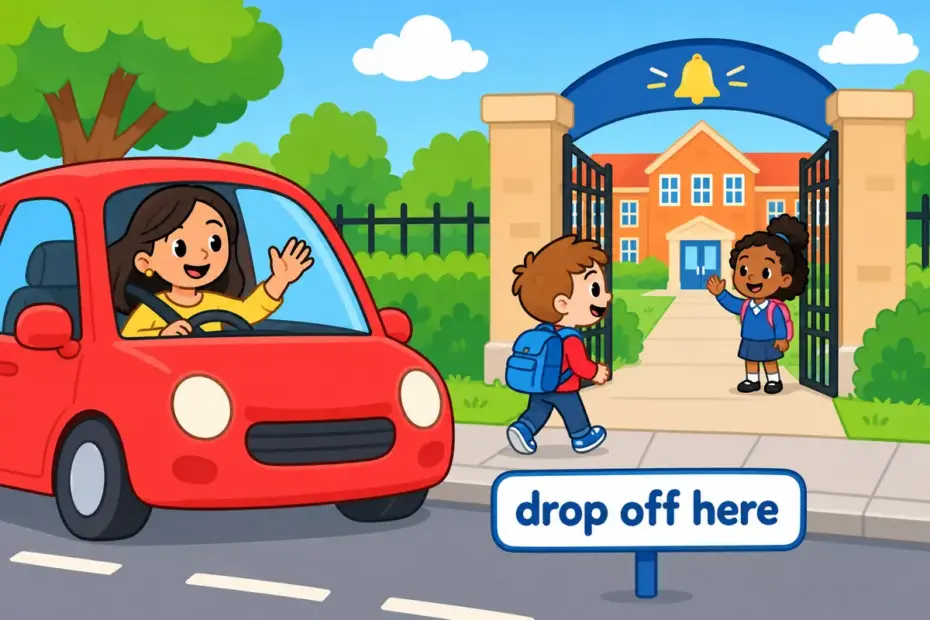
The delivery sense is the only one that can take a direct object, and it is the only one that separates. If you can replace the object with a pronoun, the pronoun belongs in the middle: drop her off, not drop off her. That single test explains most of the confusion the word causes.
| Sense | Plain meaning | Example sentence |
|---|---|---|
| Deliver | Take someone or something somewhere and leave it | I’ll drop off the keys this evening. |
| Fall asleep | Fall asleep, often without meaning to | The baby dropped off during the drive. |
| Decline | Become less in amount or strength | Sales dropped off after the holiday. |
| Become fewer | Thin out as people leave gradually | Members dropped off as the year went on. |
| Noun: drop-off | A decline, or a place for leaving people or goods | The drop-off in demand was sudden. |
For the sleep sense, speakers usually reach for doze when the sleep is light, and for fall asleep when they want the plain meaning without the idiom. For a fall in numbers, decline is the neutral verb, while deliver covers the same ground as the delivery sense, minus the idea of leaving something behind.
How do you use drop off in a sentence?
Two questions settle every sentence: is there an object, and is the sense physical delivery or an intransitive change? The table shows the working patterns and the trap in each one.
| Pattern | Example | What it signals |
|---|---|---|
| drop + object + off | She dropped the kids off at school. | Delivery, with the object split from the particle. |
| drop + off + object | She dropped off the kids at school. | Delivery, with the particle before the object. |
| drop + pronoun + off | She dropped them off. | The only order a pronoun allows. |
| drop off (no object) | Sales dropped off in winter. | Intransitive decline; nothing is delivered. |
| drop off (no object) | He dropped off on the sofa. | Intransitive sleep; no object is possible. |
Can you split drop off?
You can split drop off only in the delivery sense, and only when the object is a noun or a name. Both drop the parcel off and drop off the parcel are correct, and native speakers choose between them by rhythm and by how long the object is. A long object almost always goes after the particle, because a heavy noun stranded at the end of the clause sounds clumsy.
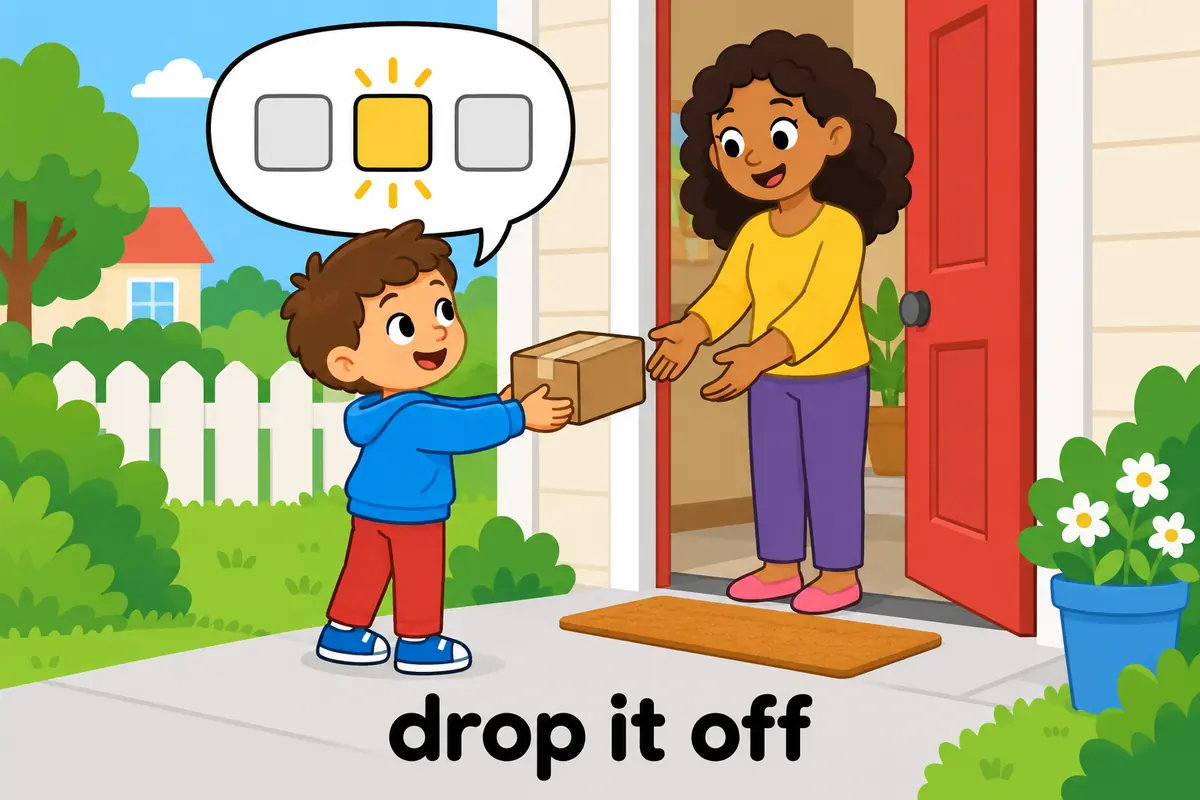
The one hard rule concerns pronouns. When the object is a pronoun such as it, them, him or her, it must sit between the verb and the particle: drop it off. The version drop off it is wrong in every variety of English. For the decline and sleep senses there is nothing to split, because these uses take no object at all.
| Object type | Correct | Incorrect |
|---|---|---|
| Short noun | drop the parcel off | drop off the parcel is also fine |
| Long noun | drop off the box of textbooks | drop the box of textbooks off |
| Pronoun | drop it off | drop off it |
This split behaviour places drop off in a large family of English phrasal verbs whose particle can strand after the object. The same flexibility shows up in verbs built on other base words, such as break off a conversation or break a conversation off.
Drop off in a sentence: examples across contexts
| Context | Example sentence | Why this works |
|---|---|---|
| Driving and parenting | I drop the children off at school before work. | The noun object sits between verb and particle. |
| Workplace email | Could you drop off the signed forms at reception? | Polite request, particle before the object. |
| Retail report | Foot traffic dropped off sharply after lunch. | The intransitive sense describes a decline. |
| News writing | Donations dropped off once the appeal ended. | Links the fall to a clear cause. |
| Conversation | He dropped off halfway through the film. | Everyday sense of falling asleep. |
| Academic prose | Participation dropped off in the final weeks of term. | Formal, measured, no object. |
| Logistics | Drivers drop off parcels at the depot each evening. | Concrete, habitual delivery. |
| Running club | Runners dropped off one by one on the long hill. | Shows the become-fewer sense. |
| Courier message | I can drop it off on my way home. | The pronoun correctly splits the verb. |
| Sleep talk | The puppy dropped off the moment the car started. | Warm, informal use of the sleep sense. |
Drop off vs drop out
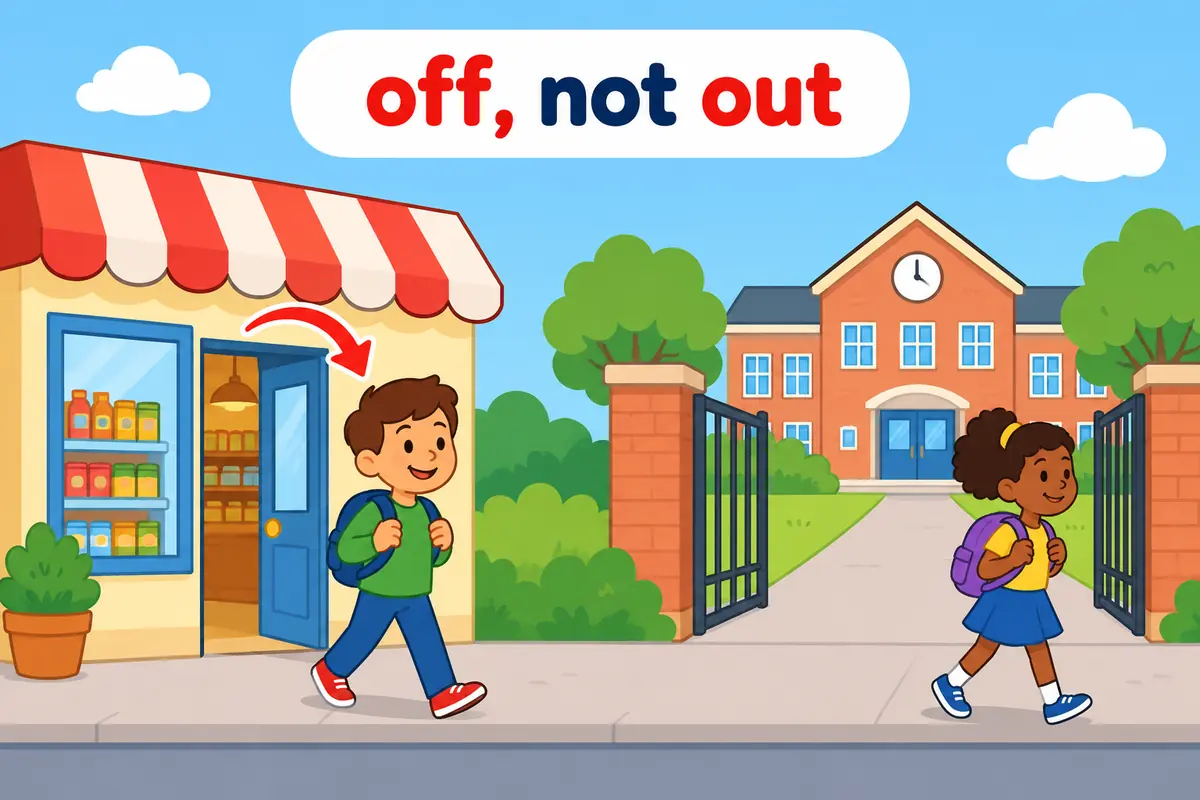
Drop out and drop off are built from the same verb, and learners often swap them. To drop out is to leave something permanently and often completely, such as a course, a race or the workforce. To drop off is to lessen, leave gradually, or deliver something.
| Attribute | Drop off | Drop out |
|---|---|---|
| Meaning | Deliver, sleep, decline or thin out | Leave permanently |
| Object | Only the delivery sense takes one | Can take of, as in drop out of college |
| Separability | Separable in the delivery sense | Not separable |
| Typical subject | Sales, a driver, a baby, a runner | A student, a candidate, a racer |
| Register | Neutral and very common | Neutral, often about institutions |
| What it implies | A gradual or physical lessening | A clean break or exit |
Verdict: use drop off for anything that softens or is left somewhere, and drop out for a person who quits for good. A courser who leaves for one evening has dropped off; a courser who never returns has dropped out. For the opposite of leaving, drop in describes a brief, friendly visit.
Word forms and grammar of drop off
| Form | Part of speech | Example |
|---|---|---|
| drop off | Base phrasal verb | I can drop off the tickets. |
| drops off | Third-person singular | The bus drops off passengers here. |
| dropped off | Past tense and participle | Demand dropped off last year. |
| dropping off | Present participle | She is dropping off the children now. |
| drop-off | Noun, hyphenated | a drop-off in attendance |
| dropout | Noun, different meaning | A dropout is a person who leaves school early. |
The noun keeps a hyphen, and it is worth remembering because dropout, written as one word, means a person rather than a decline. There is no passive form for the intransitive senses: saying sales were dropped off is not standard, because nothing does the dropping.
Common mistakes with drop off
- Incorrect: Please drop off me at the corner. Correct: Please drop me off at the corner. The rule: a pronoun object always goes between the verb and the particle.
- Incorrect: He dropped off the course in March. Correct: He dropped out of the course in March. The rule: drop out is a permanent exit; drop off is a gradual or physical lessening.
- Incorrect: He dropped off asleep at once. Correct: He dropped off at once. The rule: drop off already means fall asleep, so the extra word is redundant.
- Incorrect: The dropout in sales worried the managers. Correct: The drop-off in sales worried the managers. The rule: the noun for a decline is hyphenated drop-off; dropout names a person.
- Incorrect: Sales dropped off to a record low. Correct: Sales dropped to a record low. The rule: to mark a level reached, use the plain verb drop; drop off describes the fact of lessening, not the target.
- Incorrect: The lectures drop off at five o’clock. Correct: The lectures finish at five o’clock. The rule: drop off never means finish or end, which is a common learner guess from the particle.
Practice using drop off
- Fill in the blank: Could you ______ the package at number ten?
- Choose the better word: The crowd dwindled as people dropped off / dropped out through the afternoon.
- Correct the error: I will drop off you outside the station.
- Build a sentence: use drop off to say that a baby went to sleep in the car.
- Spot the register: which fits a workplace email, (a) I’ll drop the report off this morning, or (b) I’ll drop it off, yeah, no worries?
- Fill in the blank: Attendance ______ off after the first month.
- Choose the better word: She dropped off / dropped out of university and never went back.
Answers
- drop — the particle follows the object, so drop … off wraps around the package.
- dropped off — a crowd thinning gradually is the become-fewer sense, not a permanent exit.
- I will drop you off outside the station — the pronoun must sit between drop and off.
- The baby dropped off the moment the car started — the sleep sense takes no object.
- (a) I’ll drop the report off this morning — it suits the calm, professional tone of an email.
- dropped — the past tense shows a completed change over the first month.
- dropped out — leaving university for good is a clean break, so it needs out, not off.
The bottom line
Drop off carries four useful senses, and grammar is what separates them. Use drop off in a sentence with an object only for delivery, place a pronoun between the verb and the particle, and leave the decline and sleep senses bare. Keep drop out for a permanent exit, hyphenate the noun as drop-off, and the word will behave every time.
Frequently asked questions about drop off
Is drop off a phrasal verb?
Yes. Drop off is a phrasal verb formed from the verb drop and the particle off, and its meaning is not predictable from the two parts alone. Its four senses come from the whole phrase rather than from drop by itself. Phrasal verbs behave as a single unit in grammar.
What is the noun form of drop off?
The noun is drop-off, written with a hyphen, and it means either a decline or a place for leaving people and goods. You can talk about a drop-off in sales or a hotel drop-off point with the same spelling. The unhyphenated word dropout is different: it names a person who leaves school or a course early.
Can drop off mean fall asleep?
Yes, and this is one of its most common informal senses. To drop off is to fall asleep, often gently or without meaning to, as in the baby dropped off in the car. It is intransitive, so it never takes an object, and it appears more in speech and light writing than in formal reports.
Why do we say drop someone off?
In the delivery sense, drop off means to let someone leave the vehicle at a place, and the object naturally moves between the verb and the particle. English allows both drop someone off and drop off someone, but a pronoun is stricter: it must go in the middle, as in drop her off at the gate.