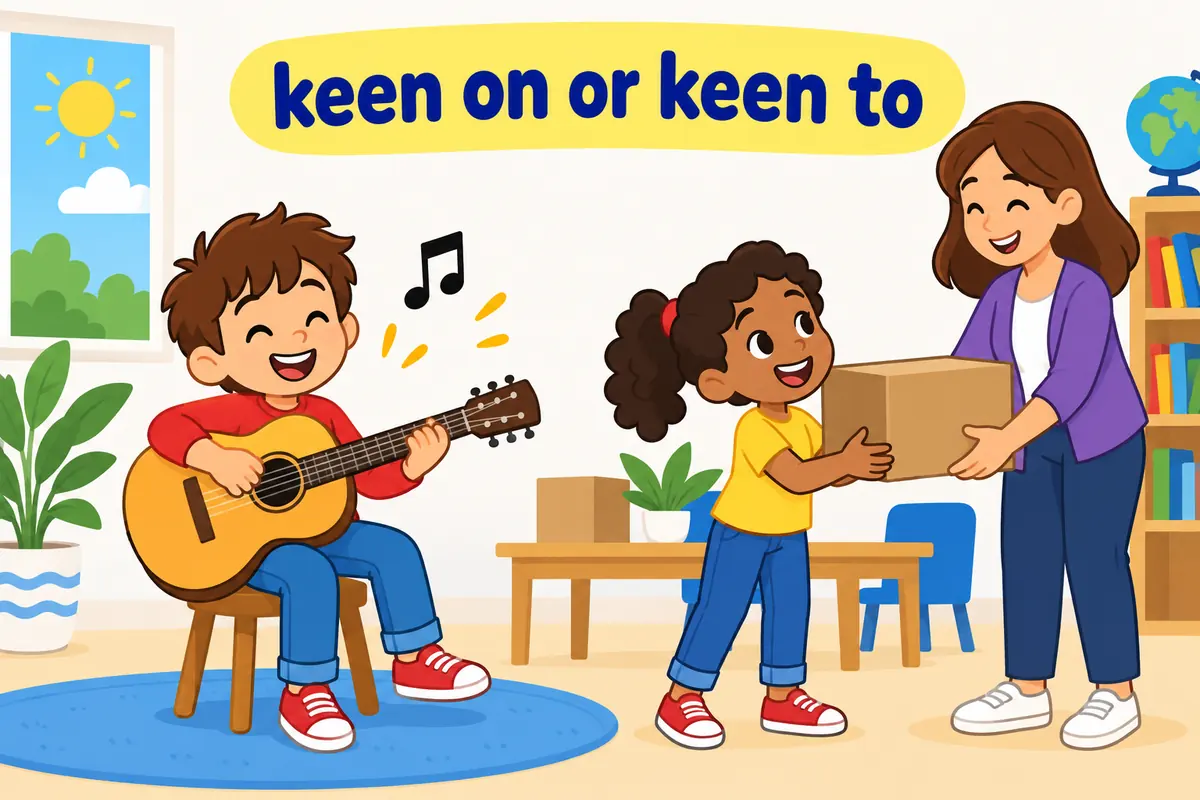
Keen on means very interested in or enthusiastic about something, and in British English it can also mean romantically attracted to someone. To use keen on in a sentence, put the person or thing right after on: “She is keen on classical music.”
Keen on at a glance
- Keen on is an adjective plus preposition meaning very interested in or enthusiastic about something.
- It is common in British English; American speakers usually say interested in or into.
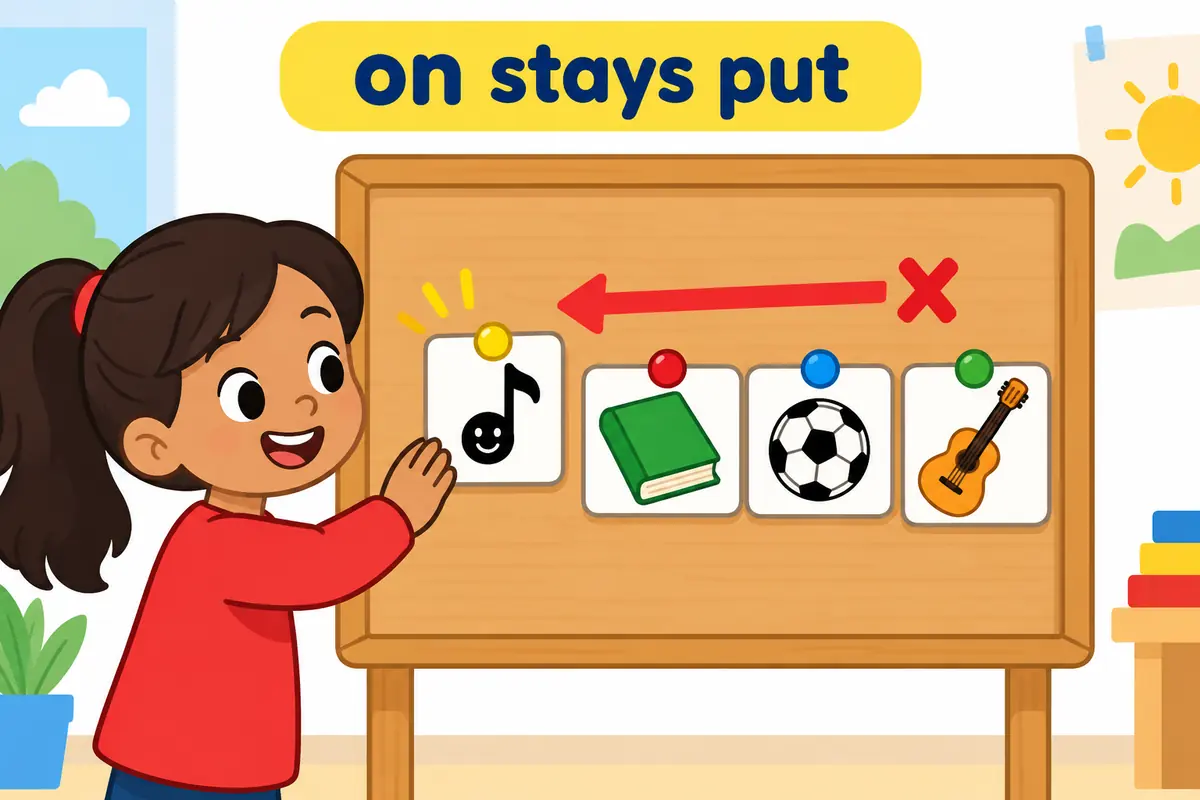
- The object follows on directly and cannot move: keen on music, never keen music on.
- It is graded with very or really, as in very keen on, not with much.
- With a person it can mean romantically attracted, so the context decides.
What does keen on mean?
Keen on is an adjectival phrase meaning very interested in or enthusiastic about something, or, applied to a person, romantically attracted to them. The Cambridge entry for keen on records the enthusiastic sense, and the romantic sense is common enough in British speech that a listener uses context to tell them apart. The phrase never means physically sharp, which is a different job for the adjective keen.
| Sense | Plain meaning | Example sentence |
|---|---|---|
| enthusiastic about an activity | Enjoys and welcomes it | My brother is keen on sailing. |
| interested in a plan or idea | Favours it and wants it to happen | The board is keen on the merger. |
| attracted to a person | Has a romantic interest | She is keen on a boy in her class. |
| not keen on | Politely against something | I am not keen on that colour. |
One limitation is worth setting down. Keen on sounds warm but not neutral, and it belongs mainly to British English. In an American office, saying I am keen on the proposal can sound slightly formal or imported; interested in or into does the same work without the accent. The phrase is also too vague for a formal recommendation, where support, approve or favour names the position more precisely.
How do you use keen on in a sentence?
Keen on is not a separable phrasal verb, so treat it as one unit. The preposition on stays glued to keen, the object always comes after it, and the particle never strands at the end; you say keen on jazz, never keen jazz on. This is unlike a separable phrasal verb such as bring on or call on, where the object can sometimes move between the verb and its particle. A separate verb, to keen someone on, does mean to urge them forward, but that is a different construction and a different meaning.
The phrase is followed by a noun or a gerund, and it is graded with very or really. Six patterns cover almost every real sentence.
| Pattern | Example | What it signals |
|---|---|---|
| be + keen on + noun | She is keen on chess. | Enthusiasm for a thing or activity. |
| be + keen on + verb-ing | He is keen on learning guitar. | Enthusiasm for doing something. |
| be + very / really + keen on | They are very keen on the idea. | The usual intensifier, not much. |
| be + not keen on | I am not keen on that plan. | Polite disagreement. |
| be + keen on + person | He is keen on her. | Romantic interest, read from context. |
| be + keen to + verb | She is keen to help. | The infinitive alternative, about an action. |
Keen on in a sentence: examples across contexts
Keen on stays the same while its object changes, and the ten sentences below move from a British kitchen table to a New York office. Each one shows what the speaker is drawn to, and how the phrase is graded.
| Context | Example sentence | Why this works |
|---|---|---|
| British conversation | I am quite keen on that little cafe by the bridge. | Native British use with the soft intensifier quite. |
| School | She is keen on the school orchestra this year. | A gerund-free noun keeps it simple. |
| Workplace email | We are very keen on the supplier you recommended. | Signals warmth without committing to a deal. |
| Hobbies | He is keen on restoring old bicycles. | Gerund after on names the activity. |
| Romance | Everyone could tell he was keen on her. | The person object triggers the romantic sense. |
| Parents | They are not keen on the idea of a late party. | Not keen on softens a refusal. |
| Travel writing | Visitors are keen on the coastal path in autumn. | Names a shared enthusiasm. |
| American contrast | My colleague in Chicago would say she is into chess, not keen on it. | Shows the regional preference directly. |
| Sports report | The manager is keen on a younger squad. | States a preference that shapes decisions. |
| Academic writing | Few researchers are keen on repeating the trial. | Measured understatement of reluctance. |
Notice how often the phrase carries a soft edge. In the workplace and parenting sentences, keen on and not keen on signal a preference without turning it into a firm decision, which is exactly why British speakers reach for it. The one place it hardens is the romance sense, where keen on her is understood as a statement of interest that everyone else has already noticed.
Keen on vs eager, interested and fond of
Keen on overlaps with three other expressions and is not interchangeable with any of them. Someone who is eager to help feels the same enthusiasm, but eager takes a to-infinitive rather than on. To be interested in the subject is the neutral, international way to say the same thing, and it carries no accent.
| Attribute | keen on | eager | interested in | fond of |
|---|---|---|---|---|
| What follows | a noun or verb-ing | a to-infinitive | a noun or verb-ing | a noun or verb-ing |
| Core feeling | Enthusiastic, willing | Impatient to act | Curious, attentive | Warm affection |
| Typical object | A hobby, a plan, a person | An action | A topic or field | A person, food, a place |
| Register | British, informal to neutral | Neutral | Neutral, global | Neutral, gentle |
| What it implies | Enjoys and favours it | Wants to start now | Pays attention to it | Likes it with affection |
Verdict: choose keen on for a British-flavoured enthusiasm, eager when the person cannot wait to act, interested in for a neutral international tone, and fond of when the feeling is warm affection rather than eagerness.
Word forms and grammar of keen on
The base word keen changes form, but the phrase keen on is fixed. The table sets out the adjective and its relatives, then the two constructions that trip up learners. The informal cousin hooked on a game suggests a habit rather than a choice, so it carries a different flavour.
| Form | Part of speech | Example |
|---|---|---|
| keen | adjective | She has a keen interest in astronomy. |
| keener | comparative adjective | He is keener on tennis than on golf. |
| keenest | superlative adjective | She is the keenest member of the club. |
| keenly | adverb | They were keenly waiting for the results. |
| keenness | noun | His keenness to learn impressed the tutor. |
| keen on | adjective + preposition | I am keen on the new schedule. |
| keen to | adjective + infinitive | I am keen to start the new schedule. |
| keen someone on | verb — different meaning | The captain keened the team on with a shout. |
Two constructions sit side by side and answer different questions. Keen on asks what the person likes, and its object is a noun or a verb-ing; keen to asks what the person wants to do, and its object is a bare verb. Do not mix them, because keen on to swim and keen to swimming are both wrong. Other on phrases behave differently, as in call on a neighbour, where on belongs to a true intransitive phrasal verb.
Common mistakes with keen on
- Incorrect:
She is keen on to learn Japanese.Correct: She is keen on learning Japanese or She is keen to learn Japanese. Rule: Keen on takes a noun or verb-ing; keen to takes a base verb, never both. - Incorrect:
I am not much keen on that idea.Correct: I am not very keen on that idea. Rule: Grade keen with very or really, not with much. - Incorrect:
He is keen music on.Correct: He is keen on music. Rule: The phrase is not separable, so on always comes before the object. - Incorrect:
They are keen of the new plan.Correct: They are keen on the new plan. Rule: The preposition is on, not of; of belongs to fond of. - Incorrect:
He keened on the team.Correct: He keened the team on. Rule: The verb keen someone on means to urge them forward, and its object comes before on.
Practice using keen on
Work through the seven items, then read the reasoning rather than only the answer.
- Fill the gap: My cousin is very ______ photography.
- Choose the better form: She is keen (on learning / on to learn) to drive.
- Correct the error: I am not much keen on maths this year.
- Build a sentence: use keen on about a neighbour who loves gardening.
- Spot the register: which belongs in an American office email — we are keen on the proposal, or we are interested in the proposal?
- Change the construction: He is keen on running. Rewrite it with keen to.
- Choose the better word: After the injury, she was still (keen on / eager to) return to the pitch.
Answers
- keen on — the adjective plus preposition precedes the noun photography.
- on learning — keen on is followed by a verb-ing, not by to.
- I am not very keen on maths this year — keen takes very, not much.
- Model answer: Our neighbour is keen on growing vegetables in the front garden.
- We are interested in the proposal — American workplace writing prefers interested in.
- He is keen to run — keen to takes the base verb run.
- eager to — eager takes a to-infinitive about the action of returning.
The bottom line
Use keen on in a sentence to say someone is enthusiastic about a thing, a plan or a person, and remember that on never separates from keen. Two nuances decide most cases: keen on takes a noun or a verb-ing while keen to takes a base verb, and the phrase is chiefly British, so enthusiastic about the plan or interested in travels more widely. When the feeling is quiet fondness rather than eagerness, attached to a place or fond of is the softer choice.
Frequently asked questions about keen on
Is keen on British or American?
Keen on is common in British English and understood everywhere, but American speakers usually reach for interested in or into the idea. In a casual American message, keen on can sound slightly formal or borrowed. Both forms are correct; the choice is largely a matter of which English you are writing in.
What is the difference between keen on and keen to?
Keen on comes before a noun or a verb-ing and asks what someone likes, as in keen on sailing. Keen to comes before a base verb and asks what someone wants to do, as in keen to sail. Mixing them, as in keen on to sail, is the commonest mistake with the phrase.
Can you be keen on a person?
Yes, and in British English it usually means romantically attracted, as in he is keen on her. The same structure can, less often, mean plain enthusiasm for someone’s company or work. Context and tone decide, so writers often add a clarifying phrase when the romantic reading is unintended.
Why can you not say keen music on?
Because keen on is not a separable phrasal verb. The on is a preposition tied to the adjective, so it must stay immediately before its object, giving keen on music. True phrasal verbs such as call on allow the object to move, but keen on keeps the two words together.