Cut up is a phrasal verb that mainly means to cut something into pieces, though it also describes being wounded, upset or playful. To use cut up in a sentence, keep both parts with the object: “She cut the paper up.” The verb is separable, so a pronoun must sit between the two words.
Cut up at a glance
- Cut up is a separable phrasal verb, so the particle up can move past a full noun object.
- The core sense is cutting something into smaller pieces.
- A pronoun object must go between the verb and the particle: cut it up, never cut up it.
- Other senses cover a wound, being deeply upset, and playful misbehaviour.
- Common collocations are cut up vegetables, a cut-up collage and badly cut up.
- The commonest error is stranding the particle after a pronoun, as in cut up them.
What does cut up mean?
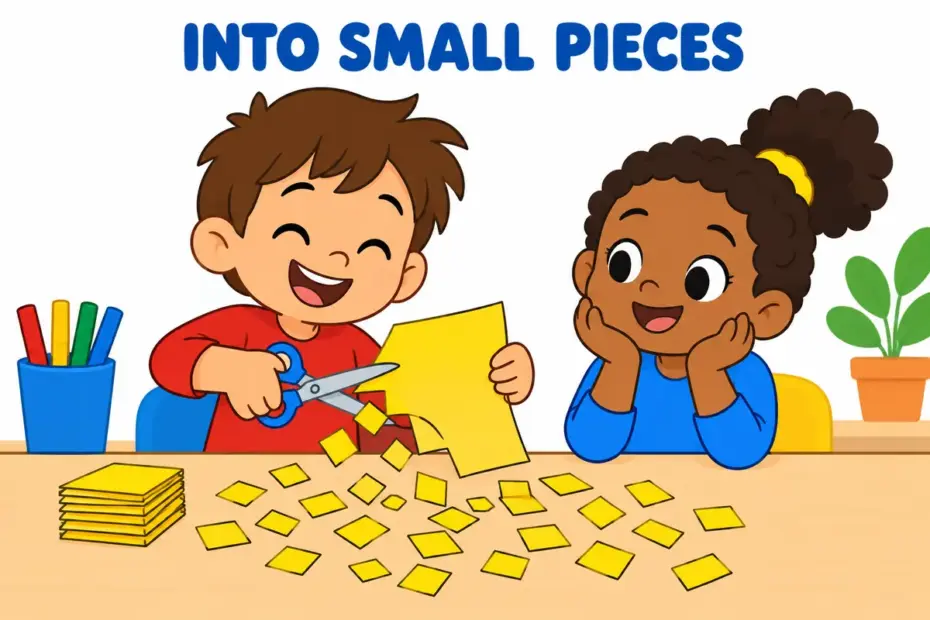
Cut up is a phrasal verb meaning to divide something into smaller pieces, and a set of informal senses grew from that physical core. The Cambridge entry for cut up records the cutting sense and the informal sense of being upset. In the kitchen you would chop vegetables, and at a desk you might shred paper, but both actions can be described as cutting something up when the result is many small pieces.
| Sense | Plain meaning | Example sentence |
|---|---|---|
| Cut into pieces | Divide something into many smaller parts | Cut up the apples for the pie. |
| Wound | Mark or injure with repeated cuts | His hands were badly cut up by the glass. |
| Deeply upset | Distressed, used as an adjective | She was cut up about the news. |
| Misbehave playfully | Fool around, intransitive and informal | The children were cutting up at the back. |
| Criticize harshly | Attack a performance or idea in review | The critics cut up the new play. |
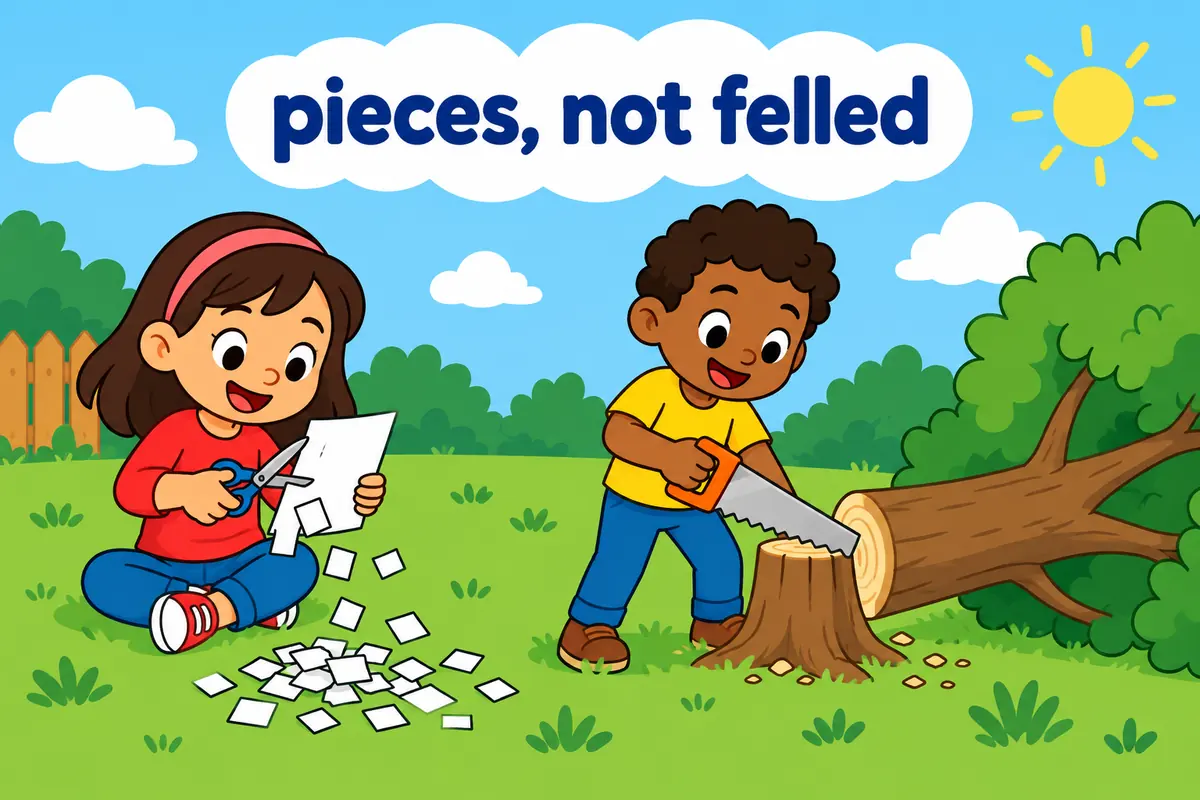
One limitation matters. Cut up is not the same as cut down, cut off or cut in half, even though all four use the verb cut. Cut up means many pieces; cut down means fell or reduce; cut off means separate by cutting or stop a supply; and cut in half means one division into two equal parts. When the particle changes, the meaning changes with it, which is why the intransitive misbehaving sense sounds so far removed from slicing vegetables.
How do you use cut up in a sentence?
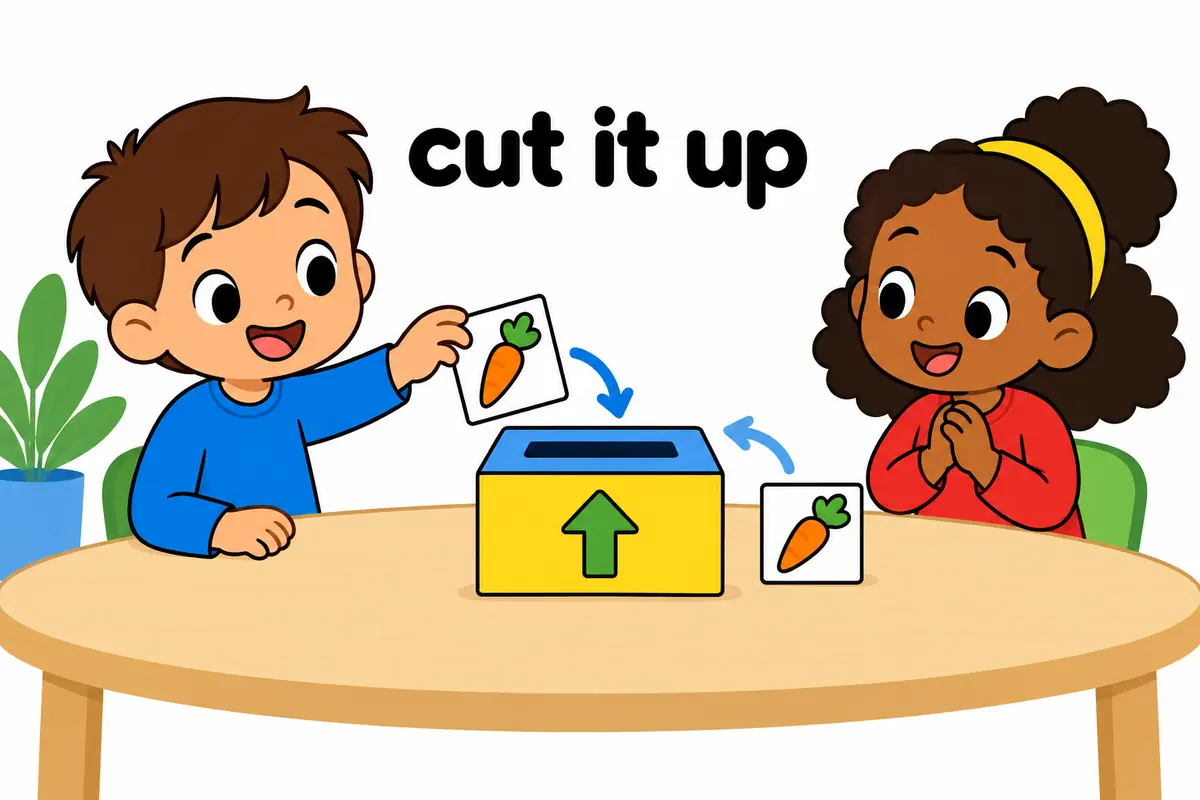
The physical sense follows one of three orders, and the choice between them depends only on what the object is. A full noun may sit before or after the particle, but a pronoun has only one legal position: between the verb and the particle. That rule is what separates a natural sentence from a translated one.
| Pattern | Example | What it signals |
|---|---|---|
| cut up + noun | Cut up the vegetables. | The default order, with the particle next to the verb. |
| cut + noun + up | Cut the vegetables up. | Same meaning; a full noun is free to follow the particle. |
| cut + pronoun + up | Cut them up. | The only correct order with a pronoun object. |
| get cut up (passive) | He got cut up by the broken glass. | The wound sense, informal in the passive. |
| be cut up about + noun | She was cut up about the result. | The adjective sense: deeply upset by something. |
| cut up (no object) | The class was cutting up all lesson. | Intransitive and informal: to act up or clown around. |
Two grammar points decide most sentences. First, the particle never strands on the wrong side of a pronoun: cut up it is impossible in every standard variety of English, while cut it up is the expected order. Second, only the cutting and wounding senses are transitive; the misbehaving sense takes no object at all, so you can say the boys were cutting up but never the boys cut up the room in that meaning.
Cut up in a sentence: examples across contexts
The phrasal verb changes register far more than it changes shape. The sentences below run from a classroom craft table to a restaurant kitchen, and each one names the object being cut or the person being upset.
| Context | Example sentence | Why this works |
|---|---|---|
| Classroom | The pupils cut up coloured paper for the display. | A concrete material makes the pieces sense visible. |
| Home kitchen | Cut up the fruit and put it in a bowl. | An imperative that reads as a genuine instruction. |
| Restaurant kitchen | The chef cut the meat up into neat portions. | Shows the particle moved after a full noun. |
| First aid | His knees were badly cut up when he fell off the bike. | Uses the wound sense in the passive. |
| Informal chat | She was quite cut up when her dog ran away. | The adjective sense reports emotion, not injury. |
| School report | A few boys were cutting up at the back of the hall. | Intransitive and playful, with no object. |
| Theatre review | The reviewers cut up the second act without mercy. | The harsh-criticism sense, common in arts writing. |
| Gardening | Cut up the prunings before they go in the bin. | Branches become many pieces, so up fits exactly. |
| Sewing | She cut up an old shirt to make patches. | Links a large item to the small pieces it becomes. |
| Art class | He made a cut-up collage from magazines. | Turns the phrasal verb into a hyphenated noun. |
| Conversation | Don’t cut it up too small or the pieces will burn. | Demonstrates the required order with a pronoun. |
The one constant across all eleven is the smallness of the result. If the thing is not reduced to pieces, cut up is the wrong choice.
Cut up vs cut down, cut off and cut out
Learners confuse cut up with its cousins because they share one verb and one short particle. Each particle carries its own meaning, and the contrast is easiest to see in cooking and gardening. To cut down means to fell a tree or reduce an amount; to cut off means to detach completely or stop a supply; to cut out means to remove by cutting or to stop doing something.
| Attribute | cut up | cut down | cut off |
|---|---|---|---|
| Core meaning | Divide into many pieces | Fell or reduce | Detach or stop a supply |
| Typical object | Vegetables, paper, cloth | Trees, costs, words | Cables, power, contact |
| Separable? | Yes: cut them up | Yes: cut it down | Yes: cut it off |
| Result | Many small parts | Something shorter or lower | Something no longer connected |
| Register | Neutral and everyday | Neutral to formal | Neutral to technical |
| Example | Cut the carrots up. | Cut down the old oak. | Cut off the water supply. |
Verdict: if the result is pieces, the particle is up; if the result is something shorter, lower or disconnected, choose down, off or out instead, and never swap them for variety.
Word forms and grammar of cut up
Cut is irregular, so its past form is cut rather than cutted, and the phrasal verb inherits that. The hyphen appears only in the noun and adjective compounds, which is the detail that trips up careful spellers. To carve the roast or to divide the dough are close actions, but cut up stays the plainest label when the pieces are small.
| Form | Part of speech | Example |
|---|---|---|
| cut up | phrasal verb, base and past | Cut up the onion; yesterday she cut up the onion. |
| cuts up | phrasal verb, third person singular | He cuts up the cardboard for recycling. |
| cutting up | phrasal verb, present participle | She is cutting up the fabric now. |
| cut-up | noun, hyphenated | Everyone laughed at the class cut-up. |
| cut-up | adjective, hyphenated | He framed a cut-up poster of old headlines. |
| cutup | noun, American variant | The host is a cheerful cutup. |
Keep the two-word spelling for the verb and the hyphen for the noun. Writing cutup the verb or cut up the noun both look wrong to an editor even when the meaning is clear.
Common mistakes with cut up
- Incorrect:
Please cut up it.Correct: Please cut it up. Rule: A pronoun object must sit between the verb and the particle. - Incorrect:
She was cut up the rude comment.Correct: She was cut up about the rude comment. Rule: The upset adjective takes about before the cause. - Incorrect:
They cut up the tree in the garden.Correct: They cut down the tree in the garden. Rule: Cut up makes pieces; cut down fells or reduces. - Incorrect:
The children were cutting up themselves in class.Correct: The children were cutting up in class. Rule: The misbehaving sense is intransitive and takes no object. - Incorrect:
Cut up the paper in half.Correct: Cut the paper in half, or cut up the paper into strips. Rule: Cut up implies many pieces; a single division uses cut in half.
Practice using cut up
Work through the seven items, then check the reasoning as well as the answer.
- Fill the gap: The recipe says to ______ the mushrooms before frying.
- Choose the better word: Storm winds (cut off / cut up) the village for two days.
- Correct the error: She cut up it into tiny squares.
- Build a sentence: use cut up with a pronoun object about an old pair of jeans.
- Spot the register: which belongs in a recipe — cut up the tomatoes, or the tomatoes got cut up?
- Rewrite with the particle after the noun: Cut up the cardboard.
- Explain the difference: The gardener cut up the branches and the gardener cut down the branches.
Answers
- cut up — the mushrooms become many pieces, so the pieces particle fits.
- cut off — the village was isolated and its supplies stopped, which is the detach sense.
- She cut it up into tiny squares — a pronoun must come before the particle.
- Model answer: She cut them up and made them into patches.
- cut up the tomatoes — a recipe keeps the imperative and names the object.
- Cut the cardboard up — a full noun may follow the particle.
- Cut up means the branches became many pieces; cut down means the branches were removed from the tree.
The bottom line
Use cut up in a sentence when something is reduced to many small pieces, and keep a pronoun between the verb and the particle. Two nuances decide most sentences: cut up is separable with a noun but fixed around a pronoun, and its informal senses of being upset or misbehaving are unrelated to cutting. When the result is a felled tree or a stopped supply, cut down and cut off are the accurate verbs.
Frequently asked questions about cut up
Is cut up one word or two?
As a verb, cut up is always two words, as in cut up the fruit. The noun meaning a joker, and the adjective describing a collage, are hyphenated: a cut-up and a cut-up poster. American writing sometimes spells the noun cutup without a hyphen, but the verb never joins into one word.
What does it mean to be cut up about something?
To be cut up about something means to be deeply upset by it, and the phrase is chiefly informal British usage. It works as an adjective rather than an active verb, so it usually follows be or seem. The cause takes about: she was cut up about the delay, not cut up the delay.
Can you separate the verb cut up?
Yes, cut up is separable, so a full noun object may go before or after the particle. Cut the paper up and cut up the paper are both correct. A pronoun, however, must always go in the middle: cut it up is right, and cut up it is never acceptable in standard English.
Is cut up formal or informal?
The physical sense is neutral and fits recipes, instructions and everyday speech. The other senses are informal: being cut up about something belongs in conversation, and cutting up in class describes playful behaviour. In formal writing, choose precise alternatives such as divide, shred, distressed or disrupt instead.