Exacting describes a demand that takes great effort, care or precision to meet. To use exacting in a sentence, place it before the noun it judges or after the verb be: “an exacting editor”, “the deadline was exacting”. The adjective rarely describes an object; it almost always describes a standard, a task or a person who sets one.
Exacting at a glance
- Exacting is an adjective; it describes a standard, a task or a person who sets one.
- The two senses are demanding high standards of people and requiring great effort or skill.
- Usual partners are exacting standards, an exacting teacher, an exacting schedule and exacting demands.
- Exacting belongs to formal and literary writing; in casual speech people say demanding instead.
- The commonest error is reaching for exacting where exact, meaning precise, is meant.
What does exacting mean?
Exacting is an adjective meaning demanding a great deal of effort, care or precision from someone. The Cambridge entry for exacting gives one sense, but writers use two, and the split explains most sentence choices: one sense points at a person who demands much, the other at a task that takes much. Where the point is effort rather than standards, taxing is the plainer word.
| Sense | Plain meaning | Example sentence |
|---|---|---|
| Demanding of people | Expects high standards and much of others | Her exacting editor read every draft twice. |
| Requiring effort | Takes great care, skill or endurance to complete | Restoring the fresco proved an exacting task. |
One limitation deserves stating plainly. Exacting says nothing about whether a person is fair or kind; it records only the size of the demand. An exacting teacher may be generous or cold. Nor does it mean precise or accurate, which is the job of exact: exactness measures correctness, while exacting measures how much is asked.
How do you use exacting in a sentence?
Put exacting beside the thing it judges and let the demand be visible: an exacting standard, an exacting reader, an exacting week. Five patterns cover almost every real sentence, and the attributive one, with the adjective before its noun, outweighs all the rest. A piece of writing that earns rigorous praise usually reaches that judgement through exacting standards.
| Pattern | Example | What it signals |
|---|---|---|
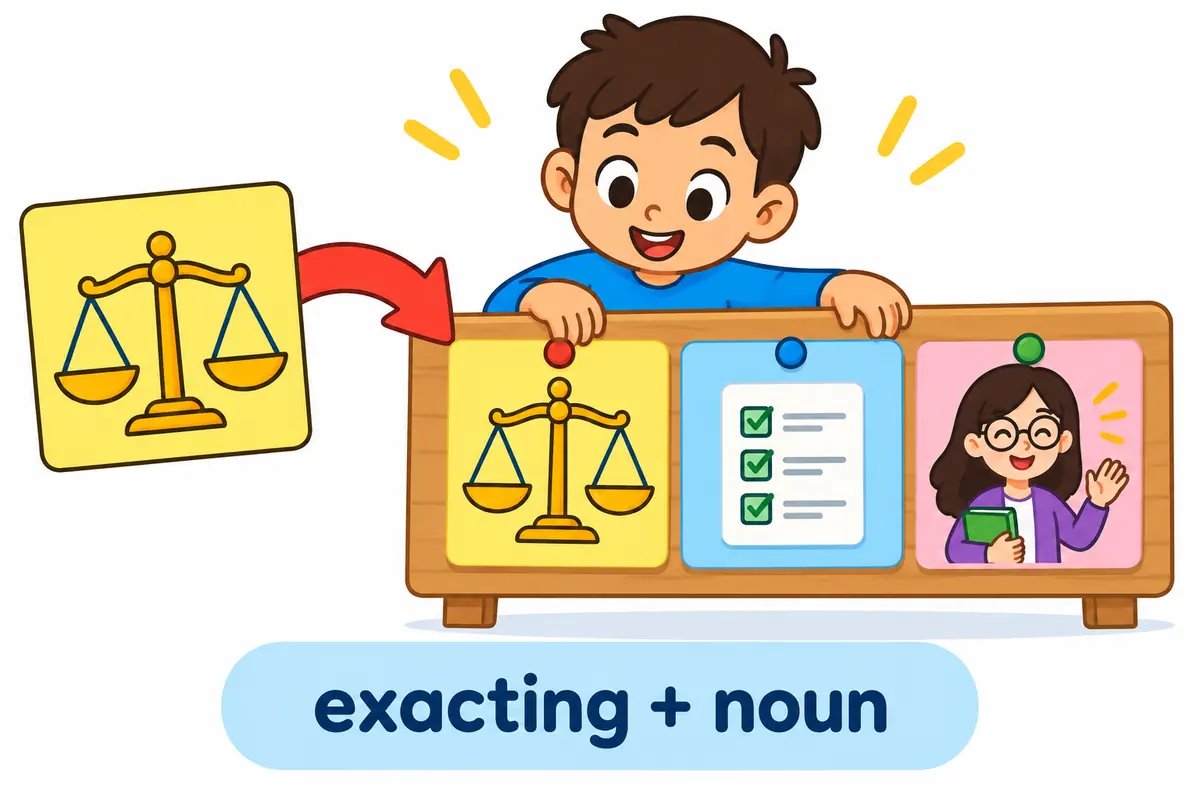
| exacting + noun | The choir faced an exacting rehearsal schedule. | Attributive use, the commonest; the noun names what is demanded of. |
| be + exacting | The final module is exacting. | Predicative use, stating that something demands much. |
| exacting about + noun | He is exacting about punctuation. | Names the narrow area where the demand falls. |
| exacting on/of + someone | The rules are exacting on new recruits. | Points at the people who carry the weight of the demand. |
| proved/turned out + exacting | The climb proved exacting above the ridge. | Reports difficulty discovered in practice rather than expected. |
Exacting in a sentence: examples across contexts
Exacting changes register more than meaning. The nine sentences below keep the same adjective while moving from a classroom to a contract, and each one makes the demand concrete enough to picture.
| Context | Example sentence | Why this works |
|---|---|---|
| Classroom | The new science unit is exacting for pupils who have never written a lab report. | Names the group and the skill the demand targets. |
| Workplace email | Please allow extra time, because the client expects an exacting brief with two review rounds. | Ties the adjective to a schedule consequence. |
| News report | The inquiry set exacting standards for future inspections. | Pairs exacting with a public, formal noun. |
| Job advertisement | We are looking for an exacting editor who will protect the house style. | Presents exacting as a desirable trait in hiring. |
| Academic writing | Exacting peer review is what keeps replication honest. | Treats the demand as a feature of a system, not a person. |
| Sports writing | The coach’s exacting training load left little room for error. | Joins the adjective to a measurable burden. |
| Review | The film is beautiful but exacting, asking viewers to hold three timelines at once. | Applies exacting to an experience rather than a person. |
| Conversation | My grandmother was exacting about table manners. | Uses the about pattern, the one that survives in speech. |
| History essay | The treaty imposed exacting terms on the smaller state. | Pushes exacting toward severity, close to stringent. |
Notice that only one sentence applies the adjective to a person’s character in speech. Everywhere else it attaches to standards, tasks or systems, which is the pattern this word prefers.
Exacting vs stringent
Exacting and stringent both point at high demands, but one belongs to people and the other to rules. An exacting coach pushes a squad; a stringent test tightens a requirement. Writers who are critical of a draft often describe the marking rather than the marker.
| Attribute | exacting | stringent |
|---|---|---|
| Core idea | Demands much effort or high standards | Imposes strict, tight conditions |
| Typical subject | A person, a task, a schedule, a critic | A rule, a test, a law, a condition |
| Who feels it | The person or team being pushed | Whoever must satisfy the rule |
| Usual noun partners | standards, demands, teacher, schedule | rules, controls, limits, requirements |
| Implied tone | Demanding but not necessarily cold | Impersonal and officially strict |
Verdict: choose stringent when rules and conditions are tight and impersonal, and exacting when a person or a task stretches somebody’s effort.
Word forms and grammar of exacting
Exacting is an adjective with no common comparative form; English writes more exacting rather than exactinger. Its relatives divide sharply, and two of them look similar while meaning something else entirely.
| Form | Part of speech | Example |
|---|---|---|
| exacting | adjective | an exacting mentor |
| exact | adjective or verb, different meaning | an exact measurement; to exact a penalty |
| exactly | adverb | The parts fit exactly. |
| exactness | noun | The exactness of the copy impressed the judge. |
| exaction | noun, rare and different meaning | The exaction of a fee caused loud complaint. |
| exactitude | noun, formal | She recorded each reading with exactitude. |
Keep exaction apart in meaning: it names a demand for money or a thing taken, not a standard. Exactitude, by contrast, is simply careful precision, the noun behind exact rather than exacting.
Common mistakes with exacting
- Incorrect:
The tutor was very exacting to her students.Correct: The tutor was very exacting with her students. Rule: use with or towards for the people who face the demand; to is not idiomatic here. - Incorrect:
an exacting measurement of the wallCorrect: an exact measurement of the wall. Rule: exacting means demanding, while exact means precise. - Incorrect:
The schedule exacts the whole team.Correct: The schedule is exacting for the whole team. Rule: exact is a verb meaning to demand and obtain; exacting is the adjective that describes difficulty. - Incorrect:
Exacting standards need to be meet.Correct: Exacting standards must be met. Rule: standards are met, and after must the past participle met is required. - Incorrect:
The course is exacting that students read two books a week.Correct: The course is exacting; students read two books a week. Rule: exacting is an adjective and cannot introduce a that-clause.
Practice using exacting
Work through the six items, then read the reasoning rather than only the answer.
- Fill the gap: The admissions panel was ______ about the personal statement.
- Choose the better word: For the violin solo she needed (exact / exacting) timing and endless patience.
- Correct the error: The schedule exacts us for six weeks.
- Build a sentence: use be exacting about for a swimming coach who counts every lap.
- Spot the register: which belongs in a job advertisement — an exacting standard of proof, or this job is, like, so exacting?
- Rewrite with a noun: The teacher demanded exactness from us. Use exacting instead.
Answers
- exacting — the panel sets the demand, so the adjective describes it.
- exact — timing is precise; exacting would describe the demand the piece makes on her.
- The schedule is exacting for us — exact is a verb meaning to demand and obtain, not to tire someone.
- Model answer: The swimming coach is exacting about turns, counting every lap aloud.
- An exacting standard of proof — an advertisement keeps its register formal and avoids like.
- The teacher was exacting about our written work — the adjective replaces the abstract noun.
The bottom line
Use exacting in a sentence when a person, task or standard demands a great deal of effort or care. Two nuances settle most choices: the adjective normally precedes its noun, as in exacting standards, and it measures the size of the demand rather than fairness or precision. When you mean accurate, choose exact; when you mean tight and impersonal rules, choose stringent. An exacting editor may also be meticulous, but the two adjectives answer different questions: exacting asks how much is demanded, meticulous asks how carefully it is done.
Frequently asked questions about exacting
Is exacting a positive or negative word?
Exacting is neutral, so its tone comes from context. An exacting standard of care sounds admirable, while an exacting workload sounds exhausting. The adjective records the size of a demand and nothing about fairness, so praise or complaint must come from the surrounding nouns and verbs rather than from exacting itself.
What is the difference between exacting and exact?
Exacting means demanding much effort or high standards, as in an exacting coach. Exact means precise and correct, as in an exact measurement. They sit on different ideas, demand and accuracy, so an exacting task is hard while an exact figure is right, and swapping them produces a sentence that is wrong or amusing.
Can exacting describe a task rather than a person?
Yes, and it often does. Exacting applies to any noun that can make a demand or carry one: an exacting schedule, an exacting climb, an exacting course. The person sense is only one branch, so a sentence such as the restoration proved exacting is fully standard, not a loose extension of the word.
Which preposition follows exacting?
About names the area of the demand, as in exacting about detail. With or towards names the people who feel it, as in exacting with her staff. On and of point at those who carry the weight, as in exacting on recruits. To is not idiomatic, which is why exacting to her students reads as an error.