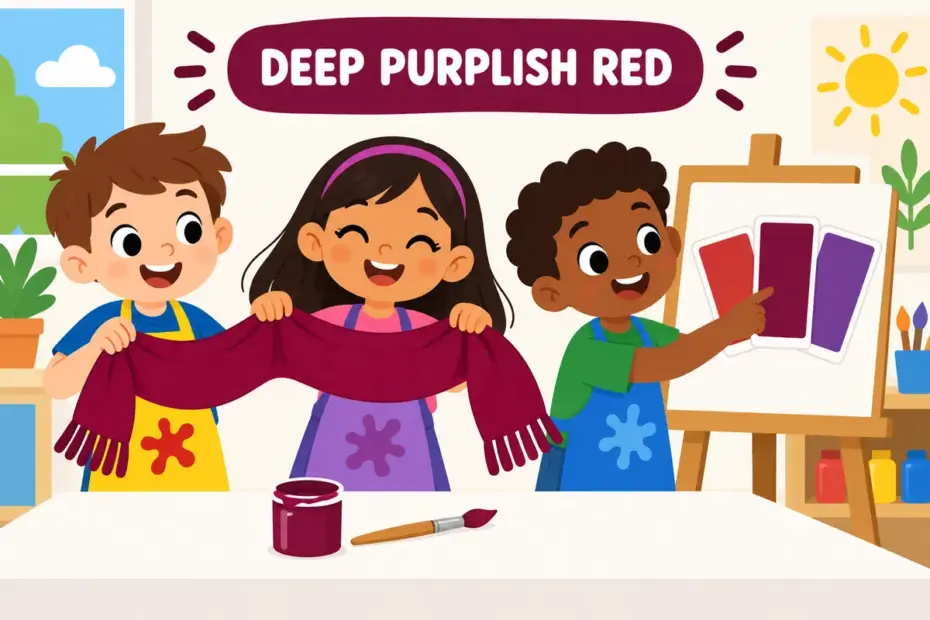
Carmine is a noun and adjective for a deep purplish red, and it also names the red dye behind the colour. To use carmine in a sentence, treat it as a colour word: “She wore a carmine scarf” names the shade, while “The artist mixed carmine” names the pigment.
Carmine at a glance
- Carmine is a noun and an attributive adjective naming a deep purplish red.
- The colour sense and the dye sense share one spelling and one hue.
- As a colour adjective it sits directly before the noun: a carmine ribbon.
- Common partners are carmine red, carmine lipstick, carmine dye and carmine lake.
- The commonest error is using carmine as a verb, as in she carmined the cloth.
- Carmine leans slightly blue, so it reads cooler than scarlet or tomato red.
What does carmine mean?
Carmine is a noun and adjective meaning a deep purplish red, and it also names the red colouring matter used to produce that shade. The Cambridge entry for carmine gives the colour sense, and the pigment sense explains why the word appears on paint and lipstick labels rather than in casual talk.
| Sense | Plain meaning | Example sentence |
|---|---|---|
| Colour | A deep purplish red shade | The door was painted a warm carmine. |
| Pigment | The red colouring matter itself, traditionally taken from the cochineal insect | The label lists carmine among the ingredients. |
One honest limitation: carmine is the wrong word for a bright orange-red, which is nearer vermilion, and it is far too strong for a pale pink. In everyday speech most people simply say deep red; carmine earns its place in art, cosmetics and design, where an exact swatch matters. It is also cooler than a rose pink and darker than scarlet.
The pigment sense carries a technical edge worth knowing. In artists’ materials carmine is usually sold as a lake, a dye fixed onto a transparent base, which is why carmine lake behaves differently from an opaque earth red when it is glazed over another colour. The label tells you whether a tube will layer or cover. A dye-based red also fades faster in strong light than a mineral pigment, which is one reason a conservator records its presence on an old canvas.
How do you use carmine in a sentence?
Carmine behaves like most colour words: it can sit before a noun, stand alone after an article, or name a substance being mixed. Five patterns cover almost every real sentence.
| Pattern | Example | What it signals |
|---|---|---|
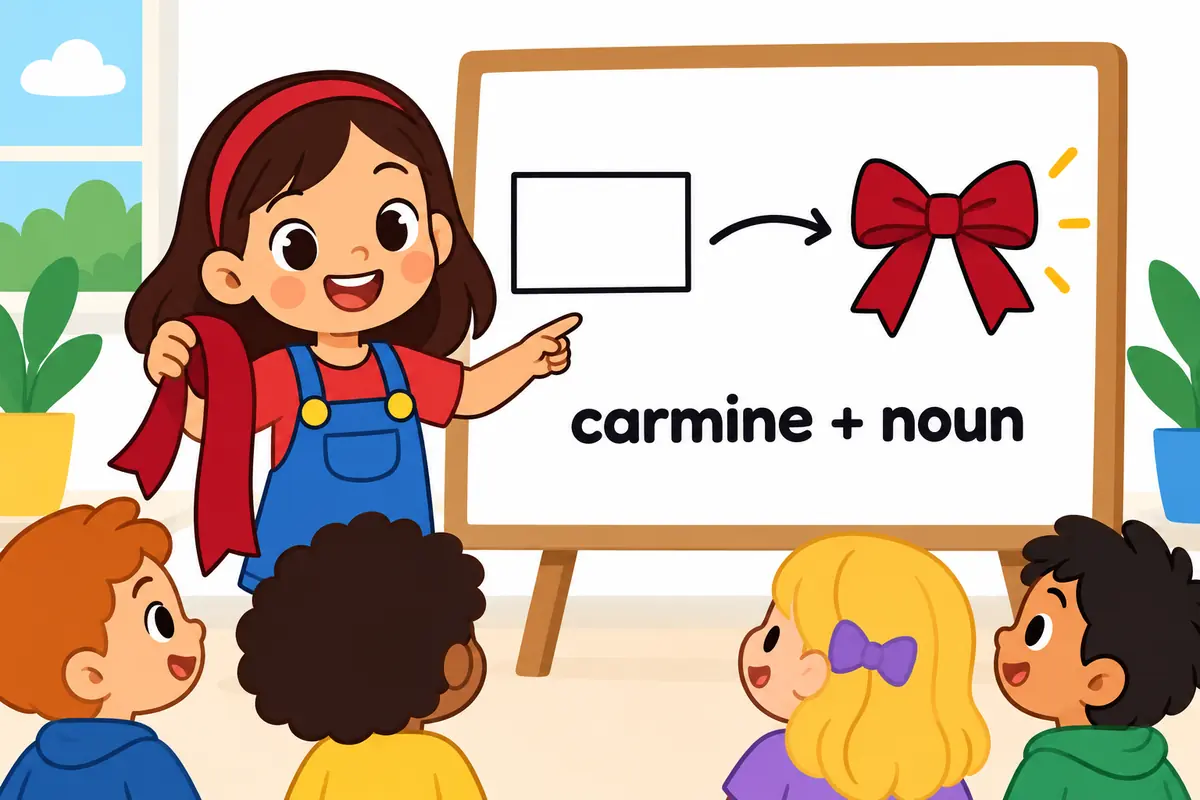
| carmine + noun | She chose a carmine ribbon for the parcel. | The colour adjective before a noun. |
| a / the + carmine | The later painting adds a darker carmine. | The colour used as a countable noun. |
| carmine red | The team plays in carmine red. | A fixed compound naming the exact shade. |
| mix / add + carmine | Mix carmine with white to lighten it. | The pigment sense, treated as a mass noun. |
| be / look + carmine | The sky looked carmine at sunset. | Predicative use for a colour impression. |
The register clue is the noun after it. Carmine lipstick and carmine dye belong in cosmetics and craft writing, while a carmine sky belongs in description.
A second restriction explains why learners over-extend the adjective. Carmine works attributively, as in a carmine scarf, and predicatively for an impression, as in the sky looked carmine, but it does not compare in the ordinary way. A writer who needs a graded comparison reaches for darker or lighter, producing a darker carmine rather than carmine-er or more carmine.
Carmine in a sentence: examples across contexts
Carmine keeps one meaning while changing register from a paint pot to a poem. The ten sentences below show which use is active and why it works.
| Context | Example sentence | Why this works |
|---|---|---|
| Fashion | The designer sent a carmine coat down the runway. | Names the exact shade a buyer can match. |
| Cosmetics | The ingredient list includes carmine for the red tint. | Uses the pigment sense on a real label. |
| Art class | Mix carmine with a little white to make the petals. | Instructions treat the pigment as a substance. |
| Painting review | A carmine glow gathers behind the portrait. | Attributive colour adjective in criticism. |
| Food packaging | Carmine gives the sweet its deep red colour. | Technical, mass-noun use on packaging. |
| Nature writing | The maple leaves turn carmine in late October. | Precise colour in a seasonal description. |
| Interior design | They painted the hallway a bold carmine. | Colour as a countable noun after a preposition. |
| Ceremony | Carmine powder marks the parting during the festival. | Names a red pigment in a cultural setting. |
| Product copy | Carmine red lipstick suits warm skin tones. | Fixed compound plus an everyday register. |
| Poetry | A carmine thread of light crossed the field. | Metaphorical yet colour-accurate. |
| Museum label | The glaze is a thin carmine over gold leaf. | A conservation note names the pigment exactly. |
| Theatre programme | The costume note calls for a carmine sash and cream gloves. | A design note fixes the exact colour a maker must match. |
Carmine vs vermilion
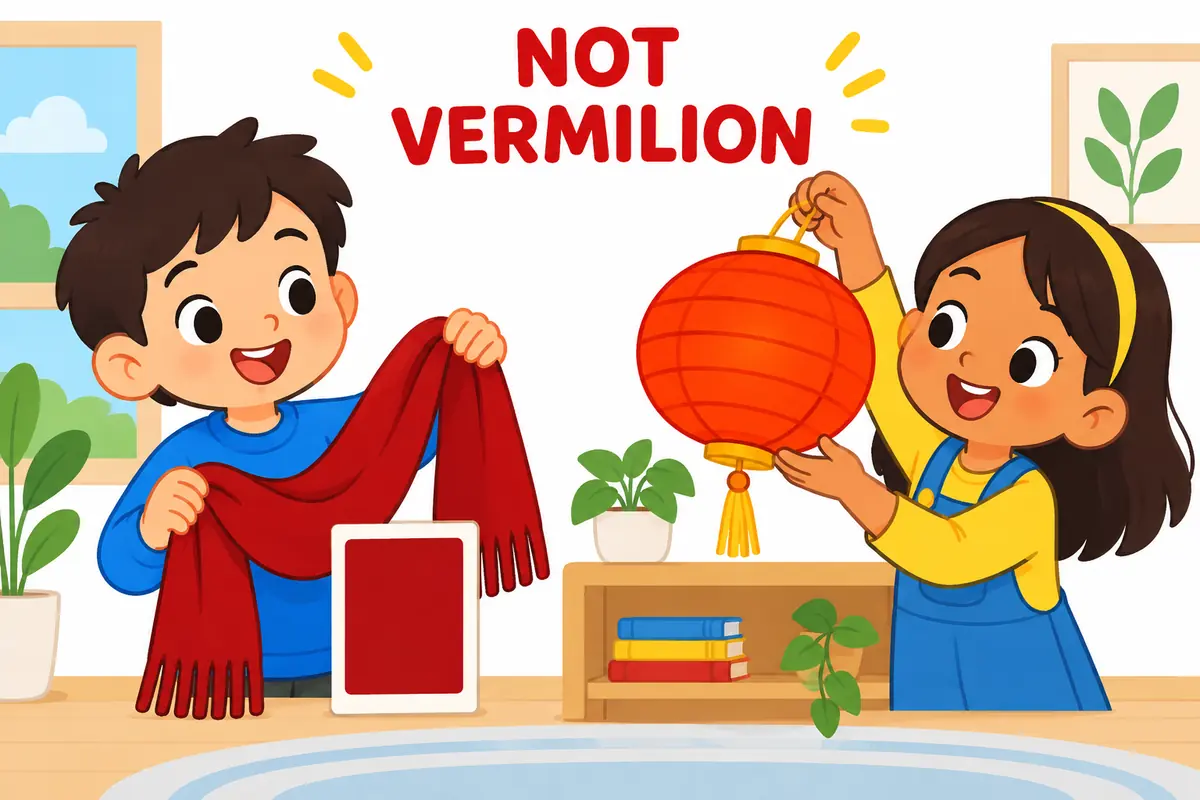
Carmine and vermilion are both reds, and writers reach for the wrong one when a description needs to be precise.
| Attribute | carmine | vermilion |
|---|---|---|
| Hue | A deep purplish red | A bright orange-red |
| Source of the shade | Often a dye once taken from the cochineal insect | Historically a mineral-based red |
| Feel | Rich, cool, slightly blue | Vivid, warm, close to scarlet |
| Typical uses | Cosmetics, textiles, fine art | Lacquer, signal reds, pottery |
| Register | Precise and slightly technical | Literary and historical |
Verdict: choose carmine for a deep, slightly cool red and vermilion for a hot orange-red near scarlet. Neither word is an exact substitute for the other.
The practical test is temperature. If the red you see could sit beside a blue without clashing, carmine is the safer word; if it glows beside an orange, vermilion is closer. Mixing the two in one description leaves a reader unable to picture the colour, which is the opposite of what a precise shade word is for.
Word forms and grammar of carmine
Carmine rarely changes shape, and the form learners invent most often is a verb that standard English does not use.
| Form | Part of speech | Example |
|---|---|---|
| carmine | noun and adjective | The carmine is too cool for this wall. |
| carmine red | noun phrase | The flag uses a true carmine red. |
| carmines | noun, rare plural | Two carmines were mixed for the final glaze. |
| carmined | verb, non-standard | Incorrect: She carmined the cloth. Correct: She dyed the cloth carmine. |
A brighter, more transparent red is a ruby, and the everyday umbrella word for all of them is simply red.
Note that the spelling never changes to mark a comparative or a plural in careful writing. Where a designer needs several versions, the usual phrasing adds a modifier instead: a light carmine, a deep carmine, a carmine tinted toward blue. The bare plural carmines survives only in technical talk about several pigments being mixed.
Common mistakes with carmine
- Incorrect:
The artist carmined the canvas.Correct: The artist painted the canvas in carmine. Rule: carmine is a noun or adjective, not a verb. - Incorrect:
She wore a vermilion carmine coat.Correct: She wore a carmine coat. Rule: two colour adjectives rarely stack; pick the one you mean. - Incorrect:
The sky turned carmines at dusk.Correct: The sky turned carmine at dusk. Rule: a colour adjective does not take a plural. - Incorrect:
Carmine is very red.Correct: Carmine is a deep purplish red. Rule: a colour name is defined by its hue, not graded with very. - Incorrect:
The painting is full of carmine colour colour.Correct: The painting is full of carmine. Rule: carmine already contains the idea of colour, so colour is redundant.
Practice using carmine
Work through the six items, then read the reason beside each answer.
- Fill the gap: The autumn hedge turned a glowing ______ red.
- Choose the better word: For a cool, purple-leaning red, use (carmine / vermilion).
- Correct the error: The label says the sweet is carmined with a natural dye.
- Build a sentence: use carmine as an adjective before a piece of clothing.
- Spot the register: which belongs in a cosmetics list, carmine 3% or the scarf looked carmine?
- Name the sense: in the artist mixed carmine, is carmine the colour or the pigment?
- Rewrite with the compound: make the flag red in a deep shade, using carmine red.
- Fill the gap: The conservator applied a thin ______ over the gold leaf.
Answers
- carmine: the fixed compound carmine red names the exact deep, purplish shade.
- carmine: it is the cooler, purple-leaning red; vermilion is a bright orange-red.
- The label says the sweet is coloured with carmine: carmine is a noun, so it cannot become a verb.
- Model answer: He bought a carmine tie for the winter concert.
- Carmine 3%: an ingredient list uses the pigment sense with a quantity, not a description.
- It is the pigment: mix signals a substance, so carmine works as a mass noun.
- The flag was carmine red: the compound names the exact shade and drops the vague phrase deep shade.
- carmine: glazing names the pigment sense, fixed as a lake and applied in a thin layer.
The bottom line
Use carmine in a sentence as a colour word, and decide whether you mean the shade or the substance. The shade is a deep purplish red that works as an adjective or a countable noun; the substance is the dye, treated as a mass noun and mixed like paint. For a brighter orange-red, choose vermilion instead.
Frequently asked questions about carmine
Is carmine the same as red?
No, carmine is a specific shade within red, not a synonym for the whole colour. A carmine sits deep and slightly purple, so a carmine scarf looks cooler and darker than a scarlet or a tomato-red one. Use carmine when the precise hue matters.
Is carmine a noun or an adjective?
Carmine works as both. As a noun it names the colour or the dye, as in the wall needs more carmine. As an adjective it sits before a noun, as in a carmine ribbon. The adjective use is attributive only, so you would not normally write the ribbon is very carmine.
Where does carmine colour come from?
Carmine is traditionally a red dye obtained from the cochineal insect, which is why the word appears on food and cosmetic labels. Today the term also names the deep red hue itself in art and design, whether or not that particular dye produced it.
What is the difference between carmine and crimson?
Crimson is the broader, more common word for a strong red that leans slightly blue, while carmine is a narrower shade, usually deeper and a touch more purple. Crimson appears in everyday writing, whereas carmine belongs to precise colour lists in art, fashion and cosmetics.